A is for Aden and Z is for Zanzabar


A is for Aden and Z is for Zanzibar... Now what is between? For the world wide classical era philatelist and stamp collector, a country specific philatelic survey is offered by the blog author, Jim Jackson, with two albums: Big Blue, aka Scott International Part 1 (checklists available), and Deep Blue, aka William Steiner's Stamp Album Web PDF pages. In addition, "Bud" offers commentary and a look at his completely filled Big Blue. Interested? So into the Blues...

Sunday, February 16, 2014

Mozambique

1877 Scott 6 25r rose "Portuguese crown"
Quick History
The Portuguese East Africa Colony, or Mozambique Colony, was located along the coast of southeast Africa.

The Capital City was Lourenco Marques ( now called Maputo), and the population was 5,000,000 in 1940.

( I've already discussed the situation within the Mozambique colony with my Lourenco Marques post, so I've "borrowed" the information from that post to present here.)

The reality was that, within the Mozambique Colony, settlements were scattered, and these outposts by necessity had their own stamps. Besides Mozambique (1877), one can find issues for Lourenco Marques (1895), Inhambane (1895), Zambezia (1894), Quelimane (1913), Tete (1913), Mozambique Company (1892), and Nyassa Company (1898), for the Portuguese East Africa lands. Eventually, the stamps of Mozambique were exclusively used.

Michael, author of the Dead Country Stamp website has a fine Mozambique Area Transition Chart which should help to clear confusion.  Thanks Michael!

Portuguese East Africa 1922 ( Mozambique)
One will find on this 1922 map "Lourenzo Marques" (now the Capital city Maputo) in the southern portion of Portuguese East Africa (Mozambique Colony). One can also find the geographical location of Inhambane, Mozambique Company, "Quilimane", Tete, "Nyasa Company", and the off shore island of Mozambique.

Mozambique

The modern map of Mozambique has Maputo (Name changed from Lourenco Marques in 1976 after independence from Portugal ), and the Inhambane, Zambezia, Tete, and Niassa regions.

The permanent town of Lourenco Marques dates from about 1850. Because of the growing importance and settlement of nearby Transvaal, the town flourished.  A railroad was built to Pretoria, Transvaal in 1895.

In fact, Lourenco Marques became the capital of Mozambique in 1898. Prior, the island of Mozambique (just offshore in northern Mozambique) had been the capital. (This explains why the Portuguese East Africa lands were referred to, early on, as "Mozambique".)

Let's now take a closer look at Mozambique and its stamp issues....

1903 Scott 65 130r brown/straw "King Carlos I"
Into the Deep Blue
The 2011 Scott Classic Specialized catalogue has, for Mozambique 1877-1939, 430 major stamp descriptions. Of those, 269 are CV <$1-$1+, or 62.5%  As is typical for many Portuguese colonies, the stamps are generally quite affordable.

A closer look at the stamps and issues
1000 Reis = 1 Milreis
100 Centavos = 1 Escudo (1913)
1881 Scott 10r green "Portuguese Crown"
Between 1877-85, a fourteen stamp issue with the "Portuguese Crown", as shown, was released. Ten of these stamps have a value of <$1-$2. Reprints were printed with Perforation 13 1/2, although the original issue also had Perforation 13 1/2, as well as 12 1/2. See the Scott catalogue for more specifics.

1886 Scott 21 100r yellow brown "King Luiz"
The "King Luiz" nine stamp set was issued in 1886. The value of of all the stamps in the set is $2 or less. The Perforation 12 1/2 are considered major numbers, while the perforation 13 1/2 stamps are given minor numbers by Scott.

1894 Scott 29 50r light blue "King Carlos I"
In 1894, a twelve stamp set with "King Carlos I" portrait was released. Nine of these stamps have a value <$1-$1+.

1903 Scott 59 65r dull blue "Carlos I"
The familiar- for Portuguese colonies- "King Carlos I" visage issue- some 23 stamps- was released between 1898-1903. Thirteen stamps are <$1-$1+ value.

1902 Scott 78 130r on 300r orange
On stamps of 1886
In 1902, nine of the 1886 "King Luiz" stamps were surcharged, as illustrated. Eight of the stamps range in value between <$1-$4.

1902 Scott 91 400r on 80r yellow green
On stamps of 1894
Also in 1902, twelve of the 1894 "King Carlos I" stamps were likewise surcharged. The stamps are valued between $1+-$5.

1902 Scott 95 25r sea green 
On stamps of 1898
Four of the 1898 "King Carlos I" stamps were overprinted, as shown, in 1902. 

1911 Scott 102 15r gray green
Stamps of 1898-1903 overprinted in carmine or green
With the 1910 revolution from a Monarchy to a Republic in Portugal, the stamps of the colonies were overprinted "Republica". Here, the "Carlos I" 1898-1903 stamps were overprinted in carmine or green.

1912 Scott 119 50r deep blue "King Manuel II"
Overprinted in carmine or green
The recently issued 1910 "King Manuel II" type design stamps were likewise overprinted in 1912. This issue - some 11 stamps-was never released in Mozambique without the overprint.

1913 Scott 140 15c on 150r bister  "Vasco da Gama"
On stamps of Portuguese Africa
In 1913, the eight stamp common design type Vasco Da Gama issues for Macao, Portuguese Africa, and Timor, were surcharged for use in Mozambique. The stamps range in value from $1+-$3.

1914 Scott 169 20c yellow green "Ceres"
Between 1914-26, the familiar "Ceres" stamps were produced for Mozambique. Some 43 stamps were eventually issued. One can see that this stamp was posted from the capital, Lourenco Marques.

1926 Scott 189 5e buff
The higher denomination "Ceres" stamps rarely are given a specific space in Big Blue. Perhaps it is because they (5e-20e) have a higher value ($2+-$10+)? I think there is another reason, also. If a stamp in a prolific multi-year issue is issued later- here 1926-, the BB editors tends to not give that stamp a space

1915 Scott 194 115r on 25r blue green
Overprinted locally (L)  or in Lisbon (R)
Stamps of 1902 and 1902-05 overprinted in carmine respectively
In 1915, the previously surcharged provisional stamps of 1902 were overprinted "Republica". But, they can be found with both a local overprint (9 stamps), and a Lisbon overprint (8 stamps). Note especially the difference in the "R" and "A". Both overprints are inexpensive (<$1), so both types can and will be found in a collection- and they are given different Scott numbers!

1919 Scott 225 1 1/2c on 5c red 
War Tax stamps of 1916-18 surcharged
The truth is, when one is dealing with a colony that has the same stamps as other colonies- except for the change in name- it is perhaps a trifle dull. Where the interest lies is in the surcharges! Here, a war tax stamp of 1918 is surcharged for regular mail use.

1920 Scott 229 6c on 5c red
War Tax stamp of 1918 surcharged in green
Another war tax stamp is surcharged in green. Nice!

1921 Scott 230 10c on 1/2c black, red surcharge
On Lourenco Marques stamp
This is interesting. Here, a Lourenco Marques stamps is surcharged in 1921, and the stamp could be used throughout Mozambique. (Recall that Lourenco Marques stamps were allowed until 1920, then the stamps of Mozambique were used.)

1921 Scott 233 30c on 1 1/2c brown, blue surcharge
A blue surcharge was applied to this 1 1/2c brown "Ceres" stamp in 1921.

1924 Scott 237 80c bright rose 
Overprinted in green
For the 4th centenary of the death of Vasco da Gama, a 80c bright rose "Ceres" stamp was overprinted. A commemorative on the cheap, wouldn't one say? ;-) 

1925 Scott 239 40c on 400r on 80r
Here we have a surcharge on a surcharge, with "Republica" overprinted for good measure.

1929 Scott 247 50c gray on 1917 postage due stamp
Overprinted in black with bars in red
A postage due design stamp was called to do regular postal duty in 1929. These are the kind of issues that can make Portuguese colony stamps a more interesting endeavor.

1931 Scott 250 1.40e on 2e dark violet
Finally, two "Ceres" stamps were surcharged in 1931.  All of these examples of surcharged specimens between 1918-31 are quite inexpensive.

1933 Scott 269 20e orange
"Portugal" holding volume of the "Lusiads"
Mozambique received their own definitive issue in 1933 with the 19 stamp "Lusiads"  set. This poem, written in a Homeric fashion in 1572, treats the Portuguese voyages of discovery during the 15th and 16th century in an epic style.

The entire issue is quite inexpensive @ <$1-$2. 

1938 Scott 285 5e olive green 
"Prince Henry the Navigator"
The "common design type" eighteen stamp issue of 1938, actually released for eight Portuguese colonies, is in large format, and is impressive, even if they have to be shared. ;-) Prince Henry the Navigator organized and financed the voyages of discovery that lead to the rounding of Africa, and establishing sea routes to the Indies.

1938 Scott 288 40c on 45c bright blue
Surcharged in black
Only one stamp of the "Lusiads" issue was surcharged, and the 1938 40c on 45c bright blue is shown here. Value is $1+.

1939 Scott 289 80c violet/pale rose
"Map of Africa"
With the Presidential visit of 1939, a four stamp set was released, as shown. The high denomination, the 20e brown/buff, has a value of $30- rather high certainly for the stamps of Mozambique.

Air Post 1938 Scott C9 10e magenta 
"Plane over Globe"
The 1938 Air Post issue ( nine stamps) likewise is a common design type in a large format. Quite inexpensive.

Postage due 1904 Scott J4 30r orange
Although Mozambique got by with the Air Post 1938 common design type stamps as their only (needed) issue, somehow Mozambique required a Postage Due set in 1904 (10 stamps), 1911 (10 stamps), 1916 (10 stamps), 1917 (10 stamps), 1918 (3 stamps), 1921 (5 stamps), and 1924 (2 stamps). There must have been a lot of letters with inadequate postage on them. ;-)

The 1904 issue- in Reis denomination- has 10 stamps, all inexpensive.

1911 Scott J19 200r carmine, green overprint
With the fall of the monarchy, the stamps were overprinted as shown in 1911. These are likewise very inexpensive.
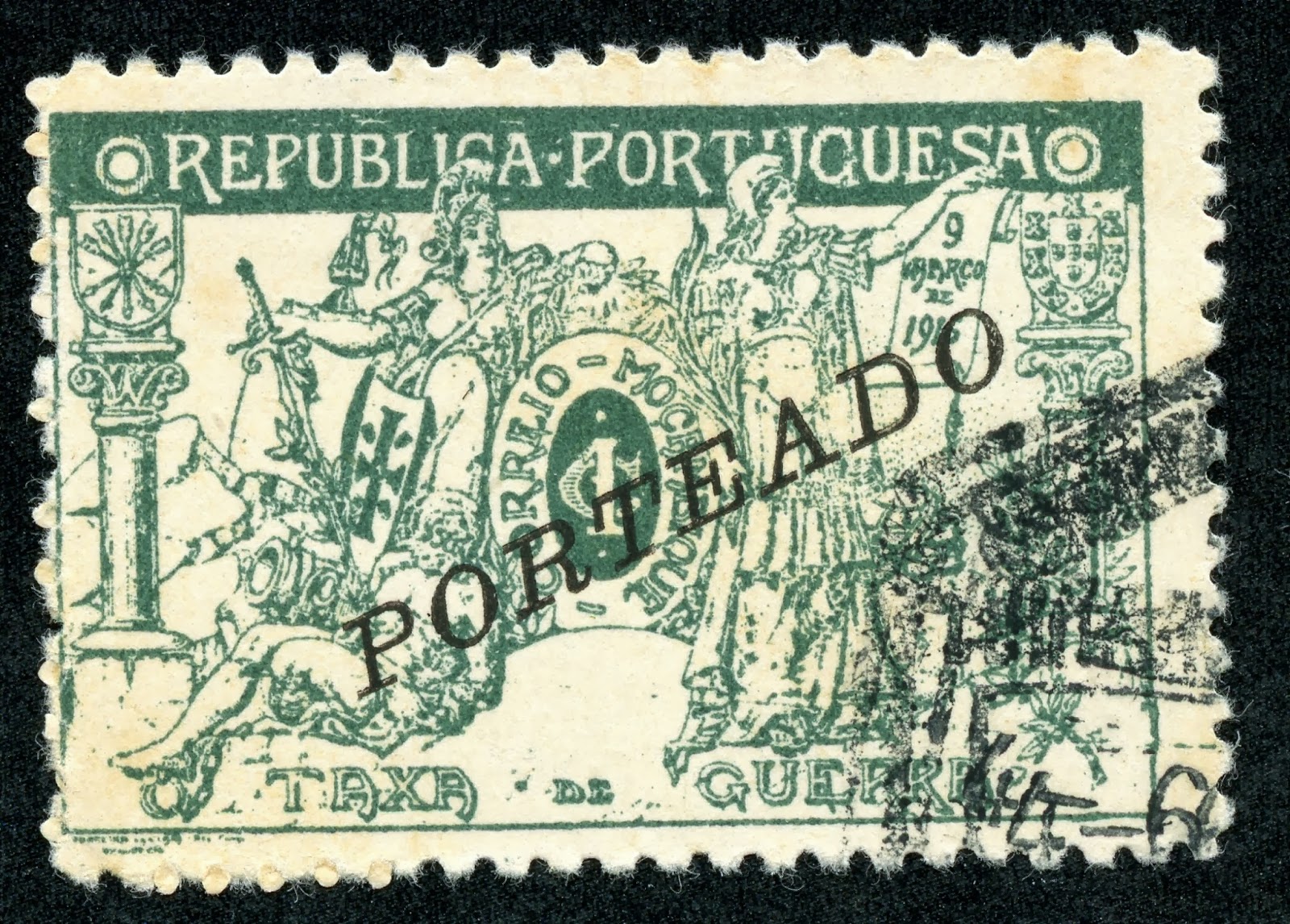
1918 Scott J33 1c gray green 
War Tax stamps of 1916 overprinted diagonally
Three war tax stamps (two rouletted and one perforated) were overprinted for postage due use in 1918.

1917 Scott J41 13c deep blue
Type of 1904 issue with value in Centavos
The Postage Due issue of 1917- 10 stamps- were this time in Centavos denominations.

1921 Scott J47 20c on 2 1/2c violet, red surcharge
Five of the "Ceres" stamps- two from Lourenco Marques, three from Mozambique- were surcharged for postage due use in 1921. Inexpensive and interesting.

1924 Scott J49 20c on 30c olive green, black surcharge
In 1924, two more "Ceres" stamps were surcharged to be used as postage dues. Value is <$1.

War Tax 1918 Scott MR3 1c gray green, perforated
The War Tax stamps were first issued as rouletted 7 in 1916 ( 1c gray green, 5c rose). They were then reissued as perforated 11,12 in 1918. A perforated example is shown here.

Newspaper 1893 Scott P6 2 1/2r brown
If one can find the 1886 Scott 19 "King Luiz" 40r chocolate stamp with a "Journaes" overprint with surcharge, one has the fairly rare P1-P5 1893 newspaper stamps @ $10+-$90.

Scott P6, though is the more common Newspaper stamp found.

Postal Tax 1925 Scott RA5 40c slate & yellow, black surcharge
"Seal of the Local Red Cross Society"
There are some 47 Postal tax stamps issued between 1925-1931. Often, these stamps were obligatory to be used on certain dates, in order to raise funds for charitable causes.

Here illustrated is an example of the six stamp 1926 "Cross of the Orient Society" issue.

1933 Scott RA41 40c bister brown & carmine
"Mother and children"
Type of 1929 issue
Beginning in 1929, and continuing yearly until 1940, the "Mother and Children" stamp was issued in different colors each year. The 1933 issue is shown here.

Deep Blue
1933 "Lusiads" issue in Deep Blue
Deep Blue ( Steiner) has 34 pages, and has a space for all the major Scott numbers.


1902  Scott 92 400r on 300r  blue/salmon 
On stamps of 1894, surcharged
Big Blue
Big Blue '69, on four pages, has 137 spaces. Coverage is 32%. Clearly, BB could have provided more spaces considering Mozambique's relatively inexpensive stamps.

Mozambique is located in the album between Montserrat and Mozambique Company.

Checklist

1877
1, 2 or 3, 6,12,

1886
15,16,20,

1894
24,25,26,27,(28),

1898
49,50,51,54,55,

1902
94,95,96,

1903
53,56,(61),

1905
98,

1911
99,100,101,102,103,104,105,

1912
114,115,116,117,118,119,

Next Page

1913*
125 or 133 or 141, 126 or 134 or 142, 127 or 135 or 143, 131 or 147, 132 or 148,

Update: The Ceres issue presented here below originally had the (now "old") numbers in the 2011 catalogue. By 2014, Scott had parsed the Ceres into 1914 Perf 15 X 14 chalky paper, 1919-26 Perf 15 X 14 ordinary paper, and 1919-26 Perf 12 X 11 1/2 ordinary paper issues, all with major numbers.
I will present both here: "old" and "current" numbers.

Old numbers...

(1913-actually 1914) Ceres Issue
149,150,151,152,153,155,159,
162,163,164,167,169,172,(175),

1921 Ceres Issue
156,157,158,160,161,165,173,

1922 Ceres Issue
166,168,176,180,183,188,

1923
236,

1926 Ceres Issue
154,170,171,178,181,186,(189),

Current numbers...

(1913-actually 1914) Ceres Issue
149,150,151,152,153,154,155,
156,157,158,159,160,161,(163),

1921 Ceres Issue
172 or 189, 173 or 190, 174 or 191, 191A*, 191B, 191F, 191M,
*Note 191A "6c lilac" apparently. Apparently, because my 2014 catalogue has a listing error.
Lists "4 1/2c gray" twice for 191 & 191A. (Note: the error was corrected in the 2017 catalogue.)

1922 Ceres Issue
191G,191I,191N,191P,191R,241,

1923
236,

1926 Ceres Issue
187,191K,191L,191O,191Q,240,(242),

Next Page

1933
251,252,253,254,255,256*,257,258,
259,260,261,262,263,264,265,266,

1938
270,271,272,273,274,275,
276,277,278,279,280,281,

Air Post
1938
C1,C2,C3,C4,C5,C6,

Next Page

Newspaper Stamp
1893
P6,

War Tax
1916
MR1 or MR3, MR2 or MR4,

Postage Due
1903 (actually 1904)
J1,J2,

1917
J34,J35,J36,J37,J38,J39,(J40),

Postal Tax
1925
RA1,RA2,RA3,

Postal Tax Due
1925
RAJ1,RAJ2,RAJ3,

Semi-Postal
1920
B1,B2,B3,B4,
B5,B6,B7,B8,

End

Comments
A) Expensive stamps ($10 threshold): None
B) (   ) around a number indicates a blank space choice
C) *1913-  Surcharged with choices on Macao, Portuguese Africa, Timor stamps
D) *256 is slate gray in BB, blue-green! in Scott.

1939 Scott 290 1.75e blue/pale blue "Map of Africa"
Out of the Blue
Considering how "exotic" Mozambique appears and appeals to me, it would be easy to lament the Portuguese designs- reflecting none of the land, animals, or people of the colony. ( A hint of what could have been done will be demonstrated by the next blog post - Mozambique Company.)

But with the many local surcharges, they are still interesting stamps to collect. ;-)

Links
Mozambique - Bud's Big Blue

Note: Maps appear to be in the public domain.

Comment?

Monday, February 10, 2014

Montserrat

1903 Scott 15 2 1/2p ultramarine & black "Symbol of the Colony"
Quick History
Montserrat, one of the five presidencies of the British Leeward Islands colony during the classical stamp era, is part of the West Indies archipelago. It is located  300 miles east-southeast of Puerto Rico and 30 miles southwest of Antigua.

Montserrat in the Caribbean Sea
Montserrat (10 miles by 7 miles) was named by Christopher Columbus in November, 1893, after the Monastery of Montserrat in (now) Spain.

The English, though, had control of the island by 1632, and Montserrat became known as "The Emerald Isle of the Caribbean": partially for its lush greenery, but more because the Irish were transported there as slaves, servants, and prisoners.

Symbol of the Colony and Coat of Arms (1909)
The Coat of Arms, formally adopted in 1909, but understood as a symbol of the colony before, shows a lady in green (Erin) with a golden harp (part of the coat of arms of Ireland) embracing a cross (Christianity). The Symbol of the Colony motif is found on Montserrat's stamps from 1903-1913.

After the initial influx of Irish labor, African slaves were imported for the plantations and production of sugar, rum, arrowroot and cotton. Later, lime trees were planted.

On March 17, 1768, an unsuccessful  slave uprising occurred.  Montserratians today celebrate Saint Patrick's Day, to commemorate that day of slave revolt, as an official public holiday.

Montserrat used their own stamps from 1876-1890; then the stamps of the Leeward islands were exclusively used. Montserrat stamps were resumed in 1903, along with the concurrent use of Leeward island stamps, until 1956.

I will say little about the other Leeward Islands and their stamp production here, because I covered that aspect in the Leeward Islands blog post.

Montserrat and the exclusion zone
The population of Montserrat was 12,000 (1942), and the Capital was Plymouth.

I say "was", because more recent climatic and geographical events have occurred.

• Hurricane Hugo struck in 1989, damaging more than 90% of the structures on the island.
• The previously dormant Soufrière Hills volcano became active in 1995, and destroyed the capital city of Plymouth. 8,000 people have left the island (primarily for the U.K.), and the population today is only 5,000. The southern half of the island is in an exclusion zone, and only the northern half is now inhabited.

Montserrat continues to be a British Overseas Territory.

1923 Scott 56 1p deep violet "King George V"
Into the Deep Blue
The 2011 Scott Classic Specialized catalogue has, for Montserrat 1876-1885, 1903-1951, 130 major stamps descriptions. Of those, 60 are CV <$1-$1+, or 46%. Most of these less expensive stamps tend to be from later issues, as one would expect for a British colony.

A closer look at the stamps and issues
12 Pence = 1 Shilling
20 Shillings = 1 Pound
100 Cents = 1 Dollar (1951)

1876 Scott 1 1p red "Queen Victoria"
Stamps of Antigua Overprinted in Black
The first stamp for Montserrat was borrowed from the 1873 Antigua 1p lake, which was then overprinted. An overprinted 6p green was also issued. Antigua, 30 miles from Montserrat, was the more populous.

Note that Scott labels the color "red" for Montserrat, but "lake" for Antigua, even though, by presumption, the same stamp. The WW classical collector needs to take the color labeling in the catalogues with a grain of salt.

1903 Scott 13 1p carmine & black
"Symbol of the Colony",wmk 2
There were some "Queen Victoria" stamps issued between 1880-84, but we will pick up the issue thread with the 1903 "Symbol of the Colony" designed stamps. This nine stamp issue introduces the colony motif, as discussed in the "Quick History" section. Lovely, no? These had the "Crown and C A" watermark.

 1904 Scott 22 1/2p green & gray green
"Symbol of the Colony", wmk 3
Between 1904-08, another "Symbol of the Colony" themed set, some nine stamps, was issued. Most are the same color as the 1903 issue, except with the "Multiple Crown and C A" watermark. Get out the watermarking tray. ;-)

By the way, there is also a high value- the 5sh carmine & black that is printed in large format with "King Edward VII", for the preceding two issues. With a CV north of $100, please send me one if you have duplicates. ;-)

1908 Scott 32 1p carmine
 "Symbol of the Colony", ordinary paper
Then, between 1908-13, some eleven stamps were printed as the preceding two issues, but in different colors. These can be found on ordinary (lower values) or chalky (higher values) paper. This issue is also wmk 3. Regarding paper, the only stamp one has to differentiate in the issue is the 3p violet/yellow, which is found in both chalky and surface-colored paper varieties.

1908 Scott 36 6p red violet & gray violet
"Symbol of the Colony", chalky paper
Above is an example of the 1908-13  issue on chalky paper.  One must admit that the typographed design is stunning when enlarged and viewed on a monitor.

1916 Scott 43 1/2p green 
"King George V", wmk 3
Between 1916-22, an eleven stamp set was released with "King George V" portrait embedded. Fortunately, Montserrat kept its individuality with the "Symbol of the Colony" image also found on the stamp. Think how more attractive the British colony stamps would be today for today's collectors if more of them did not have the generic "key plate" design!

1922 Scott 54 1/2p brown
"King George V", wmk 4
Between 1922-29, more stamps (21) were released with the dual image, this time with watermark 4 (Multiple Crown and Script C A). As some are the same colors as the wmk 3 stamps, keep the watermarking tray handy.

1932 Scott 76 1p red "New Plymouth and Harbor"
Tercentenary Issue
For the 300th anniversary of the colonization of Montserrat in 1632, a 10 stamp set with this design was released. As is typical for many British colonies, the lower denominations are affordable (<$1-$1+), while the higher denominations require wallet opening ($10+-$100+). If one is collecting classics WW, one may need to be resigned to more empty spaces in the British colonies if an eye is kept on the budget.

1942 Scott 93 1p carmine "Sea Island Cotton"
In 1938, a ten stamp "George VI" pictorial with three designs was released- all with perforation 13. Then, in 1942-43, the stamps were released again, but with perforation 14. My 1947 Scott catalogue notes the different perforations, but only assigns one major number for each denomination. But the 2011 Scott assigns the 1942-43 perforation 14 stamps, which have a lesser CV, with the major numbers, and gives minor numbers to the 1938 perforation 13 issue.

If one is collecting with BB, and want to be obsessive about specified dates, one will need to put the more expensive (($10+-$20+ for six stamps) minor numbers into the album. Me?- I'm not that obsessive. ;-)

1951 Scott 122 24c emerald & rose carmine
"Picking Tomatoes"
Deep Blue (Steiner) pages for the British Colonies cover through the George VI era, and happily have spaces for this interesting thirteen stamp 1951 pictorial set. The set has seven designs: here showing "picking tomatoes". 

War Stamp 1917 Scott MR1 1/2p green
Overprinted in Red
Montserrat had three stamps issued for war tax, and this one is the 1/2p green with the red overprint. There is also a black overprint stamp, and one that is orange & black in color- shown elsewhere in the post.

Deep Blue
1922-29 "King George V" wmk 4 issue in Deep Blue
Deep Blue (Steiner) has 11 pages for Montserrat, and follows the modern Scott catalogue for all major numbers.

1942 Scott 94 1 1/2p rose violet  "Sea Island Cotton"
Big Blue
Big Blue '69, on two pages, has 43 spaces for the issues of Montserrat. The country is located in the '69 between Montenegro and Mozambique.

Observations
• Only one stamp crosses the $10 threshold, and none the "Most Expensive" ($35) threshold.
• The "1938" pictorial series is interesting, because Scott now gives the perforation 14 stamps the major number. These were actually issued in 1942-43. The 1938 perforation 13 issue is given a minor number. The 1938 issue is also more expensive, with four stamps @ $10. One can, of course, put in either variety, because, if a minor number is eligible, the major number is eligible for the space also.
• One can complain a bit about the stamps not put into BB- the three 1918 War Tax stamps ( <$1) for instance. There is plenty of space to add more stamps on the second page. ;-) ( I note that a War Tax space was dropped by the '69 editors.)

Checklist

1879-85*
5, 3 or 7 or 8,

1903-10
12 or 22 or 31A, 13 or 23, 32,33,34, (35 or 41),

1916-29*
54,43 or 55, 44,56,58,59,60,45 or 61,
46 or 62,64,47 or 65,48 or 66,49 or 68,(57),(63),(50 or 69),

1932
75,76,77,(78),

1935
85,86,87,88,

1937
89,90,91,

Next Page

1938*
92,93,94,
95,96,97,
98,99,

End

Comments
A) Expensive stamps ($10 threshold):
1885 Scott 8 2 1/2p ultramarine ($20+)
B) (   ) around a number indicates a blank space choice.
C) * 1879-85- The 2 1/2p space can be filled by the 1880 Scott 3 red brown ($200+), the 1884 Scott 7 red brown ($70+), or the 1885 Scott 8 ultramarine ($20+). Of interest, the 1876 1p red ($10+) is not given a space.
D) *1916-29: wmk 3 vs wmk 4 choices
E) 1938*- actually, the Scott major number perf 14 issue is a 1942-43 issue! The minor number 1938 Perf 13 issue is a 1938 production. Of those, four have a CV of $10. So, technically, either the major or minor variety could be put in these spaces.

War Stamp 1918 Scott MR3 1 1/2p orange & black 
Out of the Blue
The Leeward Islands stamps, proper, are all "key plate" designs, as they could be used on any of the islands. But, happily, the individual island colonies- here Montserrat- generally keep more of their own identity. That may be, at least, one of the reasons that the British West Indies stamps are popular- and more expensive.

Note: Maps, Coat of Arms image, appear to be in the public domain.

Links

Tuesday, February 4, 2014

Montenegro

1898 Scott 34 3n carmine rose
"Prince Nicholas I"
Quick History
Montenegro (Literally "Black Mountain") was a Principality ( Independent in 1878) and a Kingdom (1910-1918) during the stamp issuing era (1874-1918) under the Prince and King Nicholas I.

Montenegro after the Balkan Wars in 1913

Montenegro in 1914
The Capital was Centinje, and the population was 220,000 in 1909. Serbian was the official language, spoken by 95%, and also 95% were Orthodox Christians.

Montenegro formed a secular Principality in 1852. In 1860, Nicholas I began a long reign as Prince, then King, until his exile to France in 1918.

Nicholas I was a skilled ruler and diplomat, and Montenegro enjoyed a large degree of stability and prosperity under his leadership.

He agreed to a constitution in 1905, and allowed more press freedoms and criminal law reforms.

Proclamation of the Kingdom of Montenegro 1910
In 1910, during the celebration of his jubilee, Nicholas assumed the title of king.

He actively supported the 1912 Balkans Wars, as he wanted the Ottomans completely out of Europe.

He was a active supporter of Serbian unity, but he was bitterly opposed to Karadordevic rule (Peter I, King of Serbia 1903-1918).

Montenegro was a supporter of the Allied Powers during WW I.  But, between 1916-18, Montenegro was occupied by Austria-Hungary, and Nicholas I fled to Italy, then France. (Occupation stamps were issued by Austria in 1917-18.) When the Allies liberated Montenegro, the Podgorica Assembly voted to ban Nicholas I from returning, and voted to join the country with the Kingdom of Serbia.

Montenegro then united, under the general rule of King Peter I of Serbia (1918-21), to form the Kingdom of Serbs, Coats and Slovenes (renamed Yugoslavia in 1929). 

Nicholas I went into exile in France, continuing to claim his throne, until his death three years later.

Montenegro Today
Montenegro became part of Yugoslavia, which eventually broke apart in 1992. Montenegro remained joined in federation with Serbia until 2006, when it became fully independent.

Postage Due 1907 Scott J20 10pa violet
Into the Deep Blue
The 2011 Scott Classic Specialized catalogue has, for Montenegro 1874-1918, 145 major descriptive numbers. Of those, 120 are CV <$1-$1+, or 83%. Amazingly, for the stamp issues from 1894-1913 ( 110 stamps), all (100%) are <$1! Many general classic collections will have an abundant representation of unused Montenegro.

A closer look at the stamps and issues
100 Novcic = 1 Florin
100 Helera = 1 Kruna (1902)
100 Para = 1 Kruna (1907)
100 Para = 1 Perper
1879 Middle Printing Scott 10 5n red "Prince Nicholas I"
The portrait of the Prince, Nicolas I, naturally, was on the stamp issues of 1874-1893. There were seven different denomination stamps in the issue, each with their own color.

But the issue is divided into the early printings (1974), the middle printings (1879), and the late printings (1893). Each of the printings have their own major Scott number, with the early printing having the highest CV, and the late printing having the lowest CV.

The printing differences lie not with the image itself, but other variables- namely perforation, pointed teeth or broad teeth, and narrow spacing ( 2-2 1/2 mm)  or wide spacing (2 3/4- 3 1/2 mm) between stamps. Scott's color description is sometimes different, as well.

As it is a bit complicated with all the variables, consult the Scott catalogue directly when working through these issues.

The stamp above- the 5n red, with perforation 12 and narrow spacing, appears to be a middle printing.

1893 Late printing Scott 15 2n yellow "Prince Nicholas I"
The Perf 11 1/2 small holes and broad teeth  is compatible with a late printing, and so this 2n yellow is placed there. The CV for the late printings range from $1+-$2+.

1893 Scott 24 5n red 
Types of 1874-93 overprinted in black or red
In 1893, a 10 stamp set was overprinted in black or red on the 1874-93 issue. The overprint was to honor the 400th anniversary of the introduction of printing in Montenegro.

1894 Scott 41 30n maroon
Between 1894-98, a thirteen stamp set with the same portrait of Prince Nicholas I was issued in new colors and with some new denominations. These lovely stamps can all be had, as well as essentially all the later issues, at close to minimum catalogue value.

Although I don't have any examples, I should mention that the preceding issues were forged by the Spiro Brothers in Hamburg, Germany. A marker is the Cyrillic character that resembles two capital "I"s on the right side panel touch each other on the left end in the genuine, but does not touch in the forgery. Also most Spiro forgeries have a bogus cancel of four concentric circles.

1896 Scott 54 50n red brown & gray blue
"Monastery at Cetinje (Royal Mausoleum)
For the bicentenary anniversary of the ruling dynasty, a lovely bi-color twelve stamp pictorial set showing the Royal Mausoleum was issued in 1896.

Although today valued close to minimum, this set too was forged- this time by Francois Fournier of Geneva, Switzerland.

Markers....
• Genuine is perf 10 1/2 or 11 1/2; Forgery is perf 11 1/2
• The eagle in the bottom left corner: The genuine has a tiny cross over the heads of the double eagle, while the forgery does not.
• Most forgeries are cancelled with a Cyrillic Cetinje postmark.

Note: For illustrations of the forgeries described in this post, see "Focus on Forgeries"- Varro Tyler 2000.

1902 Scott 59 5h green "Prince Nicholas I"
In 1902, a nine stamp set was released with this portrait of Prince Nicholas I. What I find remarkable is the  visage of the 61 year old Prince. Stunning realism.

1905 Scott 70 25h dull blue
Constitution issue- 15mm
Remember I briefly mentioned that Prince Nicholas permitted a constitution for his country in 1905? This was cause for an overprinted nine stamp "Constitution" 1905 issue to celebrate the occasion. The overprint is found in red or black, and the left vertical script "Constitution" is 15 mm long.

1906 Scott 74a 5k buff
"Constitution " 16 1/2mm
The nine stamp issue was also printed in 1906 with the "Constitution" script now 16 1/2 mm long. "YCTAB" can also be found as four types (consult Scott). This variation issue is given minor numbers in Scott.

1905 Scott 67 2h rose lilac; 1906 Scott 69a 10h rose
"Constitution" 15mm vs 16 1/2mm
Just to drive the point home, here is a comparison of the two overprint variation issues.

1907 Scott 75 1pa ocher "Prince Nicholas I"
In 1907, another portrait issue of Prince Nicholas I was released with 12 stamps in the set. The 66 year old monarch looks very much his age. ( I guess someone could say the same thing about me ;-)

1910 Scott 87 1pa black 
"King Nicholas I as a Youth"
1910 was the jubilee year for Nicholas I - 50 years on the throne! And Nicholas assumed the title of King, and his country became a kingdom. A wonderful- and remarkably inexpensive even today- twelve stamp issue with seven portraits of the king in various stages of his life was released. Here is a portrait of the king as a youth- age 14.
1910 Scott 88 2pa purple brown
"King Nicholas I  and Queen Milena"
Most remarkably, 1910 was also the golden wedding anniversary of Nicholas I and (now) Queen Milena. Here is their portrait in 1860 - he 19 years old- at the beginning of their marriage and their reign. There is a photograph of them in 1910 which I show in the "Quick History" section. You might want to compare. ;-)

1910 Scott 93 25pa deep blue "Nicholas in 1910"
1913 Scott 105 25pa deep blue "King Nicholas I"
A current visage of the King was included in the 1910 issue, which is shown above. This portrait was also used for the twelve stamp 1913 issue, which is shown for comparison purposes.

The 1913 issue was the last regular issue for Montenegro, although there are 1917-18 Austrian overprinted occupation stamps, using 1917 Austrian Military stamps, found in the catalogue.

1902 Scott H2 25h orange & carmine 
"Prince Nicholas I"
Acknowledgement of Receipt Stamps
Between 1895-1913, five "Acknowledgement of Receipt" stamps were issued. All have minimal catalogue value. Above is illustrated the 1902 issue.

Postage Due 1894 Scott J2 2n yellow green 
1905 Scott J18 1k pale gray green
Postage Due stamp issues were released in 1894 ( 8 stamps), 1902 ( 5 stamps), 1905 ( five stamps), 1907 (4 stamps), and 1913 (4 stamps). All are at close to minimum catalogue value. I show an example of the 1894 and 1905 issue here.

Deep Blue
1894-98 "Prince Nicholas I" issue in Deep Blue
The Deep Blue (Steiner) pages consist of 10 pages, and follow the Scott catalogue for major numbers. Of interest, the Steiner also supplies spaces for the 1906 "Constitution" 16 1/2 mm  minor number issue.

1896 Scott 50 15n dark blue & green
"Monastery at Cetinje (Royal Mausoleum)
Big Blue
Big Blue '69 has three pages and 115 spaces for Montenegro. Coverage is a generous 79%.

Observations...
• There are no stamps over $10 CV in BB.
• For the 1874-93, with the early, middle, and late printings, BB has just one space.
• There are some changes in color descriptions between BB and the current Scott catalogue. See the "Comment" section for specifics.

Checklist

1874-93*
1 or 8 or 15, 2 or 9 or 16, 10 or 17,11 or 18, 5 or 12 or 19, 6 or 13 or 20,21,
22,23,24,25,28,

1894
32,39,41,42,43,44,

1896
45,46,47,
48,49,50,51,
52,53,54,
55,56,

Next Page

1898*
33,34,35,36,37,38,40,

1902
57,58,59,60,61,62,(63),

1905
66,67,68,69,70,71,(72)

1907
75,76,77,78,79,80,81,
82,83,84,85,86,

1910
87,88,89,90,91,92,
93,94,95,96,97,98,

Next Page

1913
99,100,101,102,103,104,
105,106,107,108,109,110,

Postage Due
1894
J1,J2,J3,J4,J5,J6,J7,J8,

1902
J9,J10,J11,J12,

1905
J14,J15,J16,J17,

1907
J19,J20,J21,J22,

1913
J23,J24,J25,

Acknowledgement of Receipt Stamps
1895
H1,

1902
H2,

1905
H3,

1907
H4,

1913
H5,

End

Comments
A) Expensive stamps ($10 threshold): None
B) (   ) around a number indicates a blank space choice
C) *1874-93: Three printings-1874,1889,1893,-All of the 1893 issue is represented. In some cases the colors in BB are changed in Scott
-7n bright rose in BB is rose lilac or rose in Scott
-10n deep blue in BB is blue in Scott
-15n grayish brown in BB is yellow bister, bister brown, brown in Scott.
D) *1898 series- 2n emerald green in BB is emerald in Scott; 3n carmine in BB is carmine rose in Scott.

1910 Scott 98 5per pale blue "Prince Nicholas"
Out of the Blue
Most of the Montenegro stamp issues had to be abundantly supplied to the philatelic trade, as the CV for these stamps some 117-100 years later is at minimum. Remarkable.

But the stamps themselves are well designed and lovely. Truth be told, in the philatelic world, there is generally little correlation between a stamps's intrinsic beauty and it's catalogue value.

Here one can have beauty at rock bottom prices.

Note: Maps, pic of coronation, appear to be in the public domain.

Links