
1849 Scott 2 3kr blue "Numeral"
Broken Circle-With Silk Thread-Dividing Line between Stamps
Closed Mill Wheel Postmark (217)
Probable First Distribution - Munich
Into the Deep BlueThis blog post will look at the imperforate square shaped typographic issued Bavaria stamps from 1849 to 1862.
We will also examine the interesting Mill Wheel cancellations (Mühlradstempel) found on many of these stamps during this era.
Original Blog Post and Big Blue Checklist
The 2017 Scott Classic 1840-1940 catalogue has, for Baden 1849-1862, fourteen major number descriptions. Of those, some are fairly inexpensive for the classical era.
1849 Scott 2 3kr blue ($3+)
1850 Scott 4 1kr pink ($20+)
1850 Scott 5 6kr brown ($6+)
1850 Scott 6 9kr yellow green ($10+)
1862 Scott 9 1kr yellow ($20)
1862 Scott 10 3kr rose ($4)
1862 Scott 11 6kr blue ($10+)
1862 Scott 12 9kr bister ($10+)
Clearly, the WW collector should be able to collect and study these stamps without too much financial strain.

First Bavarian Postage Stamp November 1, 1849
(Not mine- scan from internet)
In contrast, the 1849 Scott 1 1kr black catalogs for $1,000 for November 1, 1849 plate 1 (rough impression, framelines around figure "1" broken or incomplete), and $2,600 for May, 1850 plate 2 (fine impression, framelines around "1" complete). I will say no more about the 1kr black here.A closer look at the 1849-1862 "Numeral" stamps
60 Kreutzer = 1 Gulden
100 Pfennig = 1 Mark (1874)

1849 Scott 2b 3kr deep blue "Numeral"
Broken Circle-With Silk Thread-Dividing Line between Stamps
Closed Mill Wheel Postmark (547)
First Distribution (Dorfen) or Second Distribution (Vohenstrauss)
On November 1, 1849, three typographic stamps were issued by Bavaria: the now uber CV expensive 1kr black, a 6kr brown (CV $200+), and the 3kr blue (CV $3+), as shown above. Actually, the above stamp is a minor number shade - "deep blue".
Note the center circle surrounding the number is interrupted (broken) by the two side panels for the 3kr blue and the 6kr brown for this issue.
Note the dividing lines (always the same color as the stamp, here blue) between the stamps, a general feature of all the numeral issues, save the 1kr black. A full margin is considered 1mm.
There is also a closed Mill Wheel postmark with "547" in the middle - which identifies the towns- two possibilities in this case. We will have more to say about the Mill Wheel postmarks shortly.

Reverse of Numeral Stamp: Note vertical embedded Red Silk Thread
The Numeral stamps, save again the 1kr black, have a vertical thread embedded in the paper, which was an anticounterfeiting device.
Now, what about the Mill Wheel cancels?

This "First Distribution" (all closed mill wheel cancels) were used between August 1, 1850 and November 20, 1856, and then withdrawn.
Between November 20, 1856 and November 30, 1856, only town cancels were used. (These are sought after by specialists.)
On December 1, 1856 the "Second Distribution" consisted of numbers 1 (Abbach) to 606 (Zwiesel). The numbers were assigned to towns alphabetically, but the towns did not receive the same number as the first distribution. Later numbers assigned after 606 for new towns were not alphabetical.
The "Second Distribution" also had many"closed" mill wheel cancels. But some towns received rather a new replacement cancel, usually if the original "closed" mill wheel cancel was highly worn. The new replacement cancel consisted of an "open" mill wheel cancel. These "open" mill wheel cancels were also used for newly established post offices, with the numbers eventually reaching 920.

For the "open" mill wheel cancels, which were part of the "Second Distribution", the numbers range from 2 to 920 (there are many gaps between 2-605, where closed mill wheel cancels were being used).
One identification problem for the collector is, if a same number was used in both the First Distribution and the Second Distribution, then there might be two possibilities. For instance, "1" could be either Abensberg or Abbach.
However, if the stamp was issued after December 1, 1856, then it must be from the Second Distribution town.
And if the number is the same, but one cancel is 'closed", while the other cancel is "open", that solves the identification problem. The "closed" cancel would be from the First Distribution town, while the "open" cancel would be from the Second Distribution town.
Michel, in its Specialized German catalog, lumps the numbers into five groups of increasing CV, if one is interested in valuing the specific worth of a number.
Well, where can the collector find a table with the town numbers?
Now, what about the Mill Wheel cancels?

"Closed" Mill Wheel Cancel
Sometimes called Type I
Note solid spokes radiating from circle
The so called "closed" mill wheel cancels were introduced on August 1, 1850. Each town was assigned alphabetically a number between 1 (Abensberg) to 402 (Zwiesel). New towns were added later-, reaching to 603. These newly added towns were not alphabetical, except if the towns were added in batches, then within a batch they were alphabetical.This "First Distribution" (all closed mill wheel cancels) were used between August 1, 1850 and November 20, 1856, and then withdrawn.
Between November 20, 1856 and November 30, 1856, only town cancels were used. (These are sought after by specialists.)
On December 1, 1856 the "Second Distribution" consisted of numbers 1 (Abbach) to 606 (Zwiesel). The numbers were assigned to towns alphabetically, but the towns did not receive the same number as the first distribution. Later numbers assigned after 606 for new towns were not alphabetical.
The "Second Distribution" also had many"closed" mill wheel cancels. But some towns received rather a new replacement cancel, usually if the original "closed" mill wheel cancel was highly worn. The new replacement cancel consisted of an "open" mill wheel cancel. These "open" mill wheel cancels were also used for newly established post offices, with the numbers eventually reaching 920.

"Open" Mill Wheel Cancel
Sometimes called Type II
Note there are no solid spokes radiating out from inner circle
The outer portion of the cancel is more "open"
The visual difference between "closed" and "open" mill wheel cancels will become easily apparent - if it is not already-when we examine more stamps further in this blog posting.For the "open" mill wheel cancels, which were part of the "Second Distribution", the numbers range from 2 to 920 (there are many gaps between 2-605, where closed mill wheel cancels were being used).
One identification problem for the collector is, if a same number was used in both the First Distribution and the Second Distribution, then there might be two possibilities. For instance, "1" could be either Abensberg or Abbach.
However, if the stamp was issued after December 1, 1856, then it must be from the Second Distribution town.
And if the number is the same, but one cancel is 'closed", while the other cancel is "open", that solves the identification problem. The "closed" cancel would be from the First Distribution town, while the "open" cancel would be from the Second Distribution town.
Michel, in its Specialized German catalog, lumps the numbers into five groups of increasing CV, if one is interested in valuing the specific worth of a number.
Well, where can the collector find a table with the town numbers?
The http://www.briefmarken-universum.de/ site by Holger Reichert is excellent.
The numbers 1-606 are listed in two columns: one for the First Distribution town, and one for the Second Distribution town. If the Second Distribution town has an "open" Mill Wheel cancel, then it is listed with an "x".
The numbers 607-920 are all "open" Mill Wheel cancels.
The numbers 1-606 are listed in two columns: one for the First Distribution town, and one for the Second Distribution town. If the Second Distribution town has an "open" Mill Wheel cancel, then it is listed with an "x".
The numbers 607-920 are all "open" Mill Wheel cancels.
Bavaria Mill Wheel Town Numbers 607-920
The Mill Wheel cancels were withdrawn March 9, 1869. After that, only town cancels were used.
The Mill Wheel cancels were withdrawn March 9, 1869. After that, only town cancels were used.

1849 Scott 2 3kr blue "Numeral"
Broken Circle-With Silk Thread-Dividing Line between Stamps
Closed Mill Wheel Postmark (134)
First Distribution - Hochstadt (Hoechstadt)
Here is a closed Mill Wheel cancel on a 3kr blue.
The 3kr was printed using five plates (1-1849-50 (rare), 2-1850-54, 3-1854-58, 4-1856-62, 5-1858-62).
Colors can be dark blue, Prussian blue, gray blue, and green blue.

"Blue carp", "baked carp", and "pepper carp" are some of the regional specialty carp dishes around Hoechstadt.
The 3kr was printed using five plates (1-1849-50 (rare), 2-1850-54, 3-1854-58, 4-1856-62, 5-1858-62).
Colors can be dark blue, Prussian blue, gray blue, and green blue.

Hoechstadt, Bavaria on the river Aisch
The "134" is from Hoechstadt (First Distribution) , and not from Frankenthal (Second Distribution), which used an open Mill Wheel cancel."Blue carp", "baked carp", and "pepper carp" are some of the regional specialty carp dishes around Hoechstadt.

1849 Scott 2 3kr blue "Numeral"
Broken Circle-With Silk Thread-Dividing Line between Stamps
Closed Mill Wheel Postmark (217)
First Distribution (Munich) or Second Distribution (Holzkirchen)
This 3kr blue could be from Munich or Holzkirchen.


Old Rathaus, Holzkirchen
If the "217" stamp had remained on an envelope, other postmark markings might very well have given good clues to which town origin.

1849 Scott 2 3kr blue "Numeral" (Stamp presented upside down)
Broken Circle-With Silk Thread-Dividing Line between Stamps
Open Mill Wheel Postmark (336?)
Second Distribution (Neuburg a.D.)
The 336 (probable) cancel is an open Mill Wheel variety, hence "Second Distribution", and hence Neuburg an der Donau.


Neuberg an der Donau
On the Danube river, the Neuburg Castle is spectacular. And a special treat awaits in old town: the "Birdland Jazz Club, Neuburg", one of the best Jazz venues in all of Germany..

1850 Scott 4 1kr pink
Complete Circle-With Silk Thread-Dividing Line between Stamps
Open Mill Wheel Postmark (22)
Second Distribution (Aschaffenburg)
The 1kr pink is part of a five stamp set released between July, 1850 to 1858. The set is characterized, in part, by the complete circle around the numeral (compare to the 3kr blue shown earlier).
Actually, the 1849 3kr blue "broken circle" stamp (plate 2-5) continued to be issued, up to 1863
Note the open Mill Wheel cancel with "22". This is from Ashaffenburg.

Actually, the 1849 3kr blue "broken circle" stamp (plate 2-5) continued to be issued, up to 1863
Note the open Mill Wheel cancel with "22". This is from Ashaffenburg.

Johannisburg Castle
Located on the river Main, the Johannisburg Castle in Ashaffenburg was heavily damaged in WW II, but then completely restored.

1850 Scott 5 6kr brown
Complete Circle-With Silk Thread-Dividing Line between Stamps
Open Mill Wheel Postmark (325)
Second Presentation (Munich)
The 1850 6kr brown, with the complete circle, has an open Mill Wheel cancel "325".
The 1850 "complete circle" 6kr brown (CV $6+) was printed from a new plate, and replaced the "broken circle" 1849 6kr brown (CV $240).

The 1850 "complete circle" 6kr brown (CV $6+) was printed from a new plate, and replaced the "broken circle" 1849 6kr brown (CV $240).

Bavarian National Museum, Munich
"325" is for Munich, and for circa 1860, the city was already well over 100,000 population.

1850 Scott 6 9kr yellow green
Complete Circle-With Silk Thread-Dividing Line between Stamps
Closed Mill Wheel Postmark (217)
First Distribution (Munich) or Second Distribution (Holzkirchen)
Here is another "217" closed Mill wheel cancel, this time on a 1850 9kr yellow green. Considering the large population difference, probably from Munich.

1850 Scott 6 9kr yellow green
Complete Circle-With Silk Thread-Dividing Line between Stamps
Open Mill Wheel Postmark (356)

This 9kr yellow green is from Nuernberg, the only possibility. (Recall that the open Mill Wheel cancels were only used during the Second Distribution.)

Hangman Bridge, Nuremberg, Bavaria
Nuernberg, or Nuremberg is Bavaria's second largest city.

1850 Scott 6 9kr yellow green
Complete Circle-With Silk Thread-Dividing Line between Stamps
Closed Mill Wheel Postmark (281?)
First Distribution (Regensburg) or Second Distribution (Lechfeld)
The possibilities are double here.

1862 Scott 9 1kr yellow
Complete Circle-With Silk Thread-Dividing Line between Stamps
Nurnberg Cancel
Of course, not all Numeral stamps have the mill wheel cancels, although they tend to predominate, especially in the earlier years.
The 1kr yellow was part of an October, 1862 six stamp issue that had new colors for the denominations.
Also, save for the 3kr rose, all had a complete circle around the numeral.
The 1kr yellow was part of an October, 1862 six stamp issue that had new colors for the denominations.
Also, save for the 3kr rose, all had a complete circle around the numeral.

1862 Scott 10a 3kr carmine (Stamp turned on side)
Broken Circle-With Silk Thread-Dividing Line between Stamps
Closed Mill Wheel Postmark (604)
Second Distribution (Zusmarshausen)
The 1862 3kr stamp was the exception: it had a broken circle around the numeral.
The color of the 3kr stamp here appears to be carmine, which is a minor number shade.
Note that the mill wheel cancellation is "closed". If there were two possibilities for the "604" number, here it would have to be from the Second Distribution, as the stamp itself was not produced until 1862, and First Distribution numbers were only used until 1856. But that is a moot point for "604" anyway, as that number was only used for the Second Distribution.

Gasthof Adler in Zusmarshausen
Zumarshausen is a small district (pop 6,000 today) in the Augsburg, Bavaria region.

1862 Scott 10a 3kr carmine (Shade)
Broken Circle-With Silk Thread-Dividing Line between Stamps
Open Mill Wheel Postmark
Here is another carmine shade for the 3kr. Note the open Mill Wheel cancel, but the number is not readable. The carmine shade is valued somewhat higher than the major number rose color ($6 vs $4).

1862 Scott 10 3kr rose
Broken Circle-With Silk Thread-Dividing Line between Stamps
OpenMill Wheel Postmark (356?)
Second Distribution (Nuernberg)
Here is the rose color proper for the 1862 3kr. As the 3kr rose was issued in 1862, only Second Distribution numbers were being used then. Again a bit of a moot point for this stamp, as the cancel is clearly an open Mill Wheel, which was only used during the Second Distribution.
The "356" number is Nuernberg (Nuremberg).
The "356" number is Nuernberg (Nuremberg).

1862 Scott 11 6kr blue
Open Circle-With Silk Thread-Dividing Line between Stamps
Munich Postmark
A non Mill Wheel cancel for Munich on this 1862 6kr blue.


Fournier Forgeries cancels for Bavaria
I should say something about forgeries. The 1849 1kr black, with a high CV, had many forgeries. In general, though, the other Bavarian stamps were not forged as much as some of the other German States.
Francois Fournier of Geneva (1846-1917) was responsible for a forgeries of these issues, and here is an example of the cancels used on them.
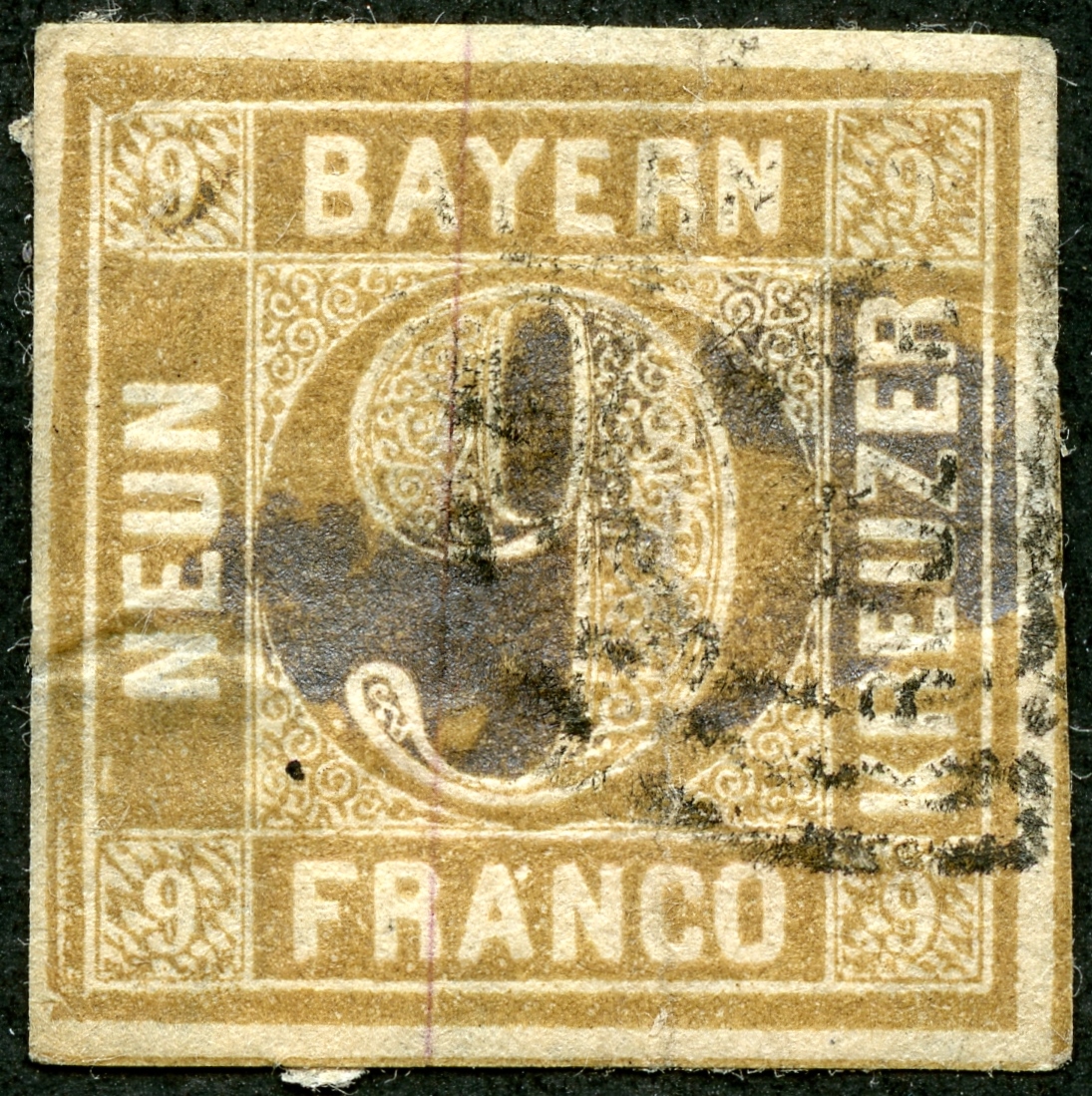
1862 Scott 12 9kr bister
Open Circle-With Silk Thread-Dividing Line between Stamps
This 1862 9kr bister has an open Mill Wheel cancel, but the number is not legible.
The CV for this stamp is $10+. If on cover- CV $50+. It is rather remarkable the relatively low CV for these classic stamps.
The CV for this stamp is $10+. If on cover- CV $50+. It is rather remarkable the relatively low CV for these classic stamps.

1862 Scott 13 12kr yellow green
Open Circle-With Silk Thread-Dividing Line between Stamps
Open Mill Wheel Postmark (325)
Second Distribution (Munich)
The 1862 12kr yellow green has an open Mill Wheel cancel - "325" - which is Munich. Certainly, going after lesser known and rarer town numbers would be an interesting activity for the collector.
The "Numeral" stamps were used until the introduction of the "Coat of Arms" issue in January 1, 1867.
The "Numeral" stamps were used until the introduction of the "Coat of Arms" issue in January 1, 1867.

1867 Scott 17 6kr ultramarine "Coat of Arms"-Embossed-Imperforate-
With silk Thread-Closed wheel Postmark (331)-Second Distribution (Naila)
The Mill Wheel cancels can also be found on the imperforate 1867-68 "Coat of Arms" issue, although not frequently.
The Mill Wheel cancels ceased on March 10, 1869.

Naila, Bavaria
Naila, on the Seibitz river, was a town of some 4,000 circa 1860, and is located 18 km from the city of Hof, Bavaria.
Deep Blue

1862 Issue in Deep Blue
Bavaria in Deep Blue (Steiner) has 24 pages (recall that Bavaria had stamp issues up to 1920). For the imperforate "Numerals", there is one page. All of the major Scott numbers have a space.

1850 Scott 5 6kr brown
Complete Circle-With Silk Thread-Dividing Line between Stamps
Open Mill Wheel Postmark
Out of the Blue
I've learned a lot more about the 1849-1862 Numeral issues, and the accompanying closed and open Mill Wheel cancels. A bonus was learning a bit about the Bavarian towns too. Isn't it fun? !!
Note: The 1849 1kr black stamp image is from the internet, and appears to be in the public domain.
The image of the Fournier Forgeries cancels appear to be in the public domain.
The pics of various German towns appear to be in the public domain.
Links
Bavaria "Coat of Arms" Issues 1867-1911
Bavaria - Bud's Big Blue
The image of the Fournier Forgeries cancels appear to be in the public domain.
The pics of various German towns appear to be in the public domain.
Links
Bavaria "Coat of Arms" Issues 1867-1911
Bavaria - Bud's Big Blue
Comments appreciated!


