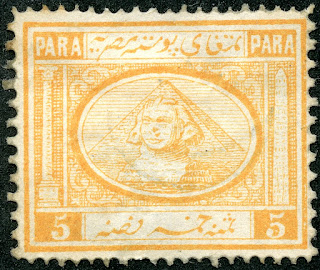
1867 Scott 8 5 Para orange "Sphinx and Pyramid"
Type 1
Into the Deep Blue
The Scott catalogue has, for the USA 1851-57 1c blue "Franklin", eight major numbers and lavish illustrations of each one - all due to some engraving changes around the frame. Very nice.
The lavish discussion and illustration for "types" for 1851-57 Franklin 1c blue
Scott Catalogue
Yet, the major catalogues (Scott, Stanley Gibbons, Michel) essentially ignore the four much more extensive engraving changes for each stamp value found for Egypt's Second Issue. (True, they do mention in passing, using a small font, that there are "four" types.)
As a result, most philatelists and dealers aren't even aware of the four "types" for each value (six stamps- 24 in total!) for this fascinating issue. You see, the lithographic designer engraved the design separately on four stones (creating many differences), combined them into a block of four, and repeated the block of four to make a 200 stamp sheet. Consequently, every block of four stamps will have four "types". Perhaps there is lack of attention because each "type" should be equally common or rare, as the case may be?
Egypt: Stamps and Postal History
A Philatelic Treatise; 1999
Peter A. S. Smith
Be that as it may, one has to look long and hard to find information about the four types. I did track down two sources.
I picked up the now out-of-print so called "bible" of Egyptian Philately, "Egypt: Stamps and Postal History". It is authored by Peter A.S. Smith, an American, who was very much involved with The Egypt Study Circle.
Within this 874 page tome, and at the end of "The Second Issue" chapter, is a four page appendix which gives "a few of the characteristic features of each type", as well as black & white pics of the stamp types. While certainly most helpful (and appreciated!), one has to remember this "types characteristics list" was produced in an era when a magnifying glass rather than a detailed stamp scan was the order of the day. So therefore my description of the types will be based on this venerable list, but I will expand the description with additional findings.
The second source was based on a hunch: I asked for help from the author of the website, Classic Stamp Forgeries. Ron was most generous, and, although he himself has not yet put together a blog post on this topic, he sent me what a had: a lot! Included was the "characteristic types list" , also found in Smith's book, a number of scans of forgeries, and most helpful, scans in color of the four types for each value.
With the two sources, I am able to "type" the stamps I have with confidence, and share with the reader the findings. !!
Now, I will not say much more by way of introduction about the 1867 issue, as I have already published a post about it. Here it is.
I plan is to show a stamp denomination from the 1867 issue if I have all four types for the stamp. I will be using detailed scans ( @1200). The up-close scans of the whole stamp and parts of the stamp should make it relatively easy to discern the four types.
And, to begin, I have all four types of the 5 Para orange available for this post.
Type 1 and Comparisons
1867 Scott 8 5 Para orange "Sphinx and Pyramid"
Copy 1, Type 1
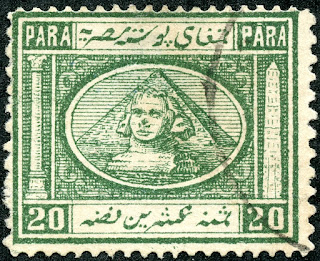
The stamp design shows a view of the sphinx and pyramid, flanked on the left by a Corinthian column (sometimes called "Pompey's Pillar"), with a pedestal on the bottom and the capital on top. And flanked on the right, is a pharaonic obelisk (sometimes called Cleopatra's Needle): I also call it a "tower", !
The place on the stamp to look for type changes? Everywhere! - the relative position of the Sphinx and Pyramid within the oval, the shape and position of the letters and numerals in the upper and lower corner tablets, the shape and position of the Arabic script in the upper and lower panels, and the markings on the column and obelisk. We will pick our favorites. !!
Top Panels: Type 1,2,3,4 Respectively (Top to Bottom)
5 Para
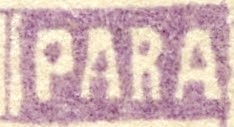
I'm combining in one view all the Types for the top panel, which includes the upper right and left "PARA" letters and the center Arabic inscription.
For Type 1, the P of PARA in the right corner has a larger head than the P of PARA in the left corner. No other types show this combination. The second Arabic letter from the left for type 1 crosses the horizontal frame line below it. Diagnostic! In the other three types, the Arabic letter (ra') only touches the frame line. This is one of my favorite signs for Type 1.
For Type 2, the second A of PARA, in the left Para panel, is quite narrow. No other types have this. For the three dots over the far right Arabic word, the left dot is lower than the other two.
For Type 3, the solid background at left to PARA, for the left Para panel, is wider than other types.
For Type 4, the second A of PARA in the right panel is narrower than other types, and closer to the right edge of the panel. (Note: Type 3 A gives Type 4 a run for the money in terms of narrowness, but Type 4 is definitely closer to the panel edge.)
And, without a doubt, There are a number of other differences between types (shape of letters, placement of Arabic script) that can be seen when comparing types closely.
Type 1 Close-up Corinthian column
Note that the column is placed on the the pedestal- shifted left? Type 3 is also shifted a little left- but not as much.
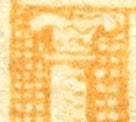
Pay attention to the markings at the top of the column (in the "capital"). The squiggly lines there are characteristic for each type. They can serve as confirmation when one thinks the stamp type is identified. See below...
Markings on "Capital" of the Corinthian Column for Types 1,2,3,4
(Top to Bottom)
The markings on the top portion of the Corinthian Column (the "Capital") are unique for each type. I find myself looking for these markings for identification early in the process
1867 Scott 8 5 Para orange "Sphinx and Pyramid"
Copy 2, Type 1
One advantage of having multiple copies of the same type is one can verify if a marker is consistent, and not just a plate flaw. It is true that some stamps will show off a marker better than another, although the same type, because the stamp print is fresher, and not worn.
Type 1 Close-up Sphinx Head
Copy 2, Copy 3
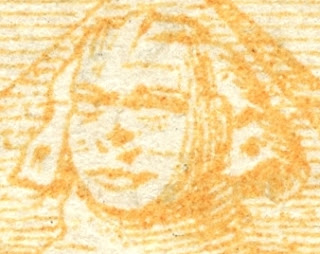
Each Sphinx head type is unique for markings. I usually focus on the forehead. I'm using two stamps here of Type 1 to show the best results. The top head shows clearly the three parallel vertical lines on the upper left forehead, while the most medial (inner) vertical line is faded on the bottom head. On the other hand, the bottom head shows the two short parallel vertical lines of the mid left forehead a bit better. The horizontal sawtooth line of the the right mid forehead is seen better with the top head. Of course, other markings can be looked for, also. Note the position of the head relative to the left (and right) pyramid line. This can change with different types.
Also, note the baleful right eye staring at us, especially the lower head. Creepy!
I use the face markings as a way to verify a stamp type. Note I will compare the type faces all-together later in this blog.
Type 1 Close-up obelisk
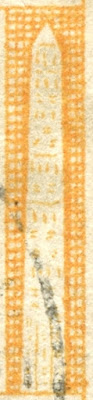
All of the types have a similar pattern marking on the obelisk, but the shape of each line, how long it is, and how it is placed is unique for each type. Note at the top of the obelisk: there is a skewed down left horizontal line, then three short parallel vertical lines below, then a curved horizontal line below etc. One can use this for identification (or confirmation) of a type. I should say that stamps (and plates) that are worn tend to loose the obelisk markings quicker. Note I will compare the obelisk tops as a close-up for types later in the blog.
Type 1 5 Para Copy 3
The placement of the Sphinx and Pyramid within the dark oval, and the placement of the oval within the inner rectangular frame gives important clues for stamp type.
Sphinx and Pyramid within Oval
Types 1,2,3,4 Top to Bottom
Look for the pyramid tip position. Note that, for type 1, it touches the upper horizontal line within the oval. and then there is a small space before one gets to the oval line frame. For Type 2, there is a blunt tip that touches the upper horizontal line, and perhaps goes past it slightly. For Type 3, there is a tip line that goes all the way to the oval frame line. For Type 4, there is a tip that reaches the upper horizontal line, then there is a larger empty gap to the oval frame line. As one can see, each type is a bit different for the pyramid tip position.
Check the dark thick oval and it's position. Does it touch the rectangular frame on any side? Here, for type 1, it almost touches the frame line on the right hand side, but clears on the other sides. (My other Type 1 examples show it does clear - barely.) Each type can have a little different position. Type 2 clears on all four sides. Type 3 almost touches the upper horizontal frame line. Type 4 does touch for sure on the right and upper frame line.
You can count the horizontal lines on each side of the pyramid.
Type 1: I get 20 lines (left) and 21 lines (right).
Type 2: 22 lines; 21 lines
Type 3: 20 lines; 20 lines
Type 4: 20 lines; 19 lines
A bit tedious, but can be done to compare types.
Check the position of the sphinx head within the pyramid. Type 2 head is very close to the left edge of the pyramid.
Check the width of the drawing of the right side face of the pyramid. Type 1 looks wider.
Type 2 and Comparisons
1867 Scott 8 5 Para orange "Sphinx and Pyramid"
Type 2
Let's compare the bottom panels for Type 2 and other types....
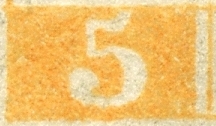
Bottom Panels "5" corners and center Arabic Script
Types 1,2,3,4 Top to Bottom
For Type 1, the second dot from the left does not touch the line above. (This is listed as a "sign". I'm not sure it is all that useful, though, as type 4, for instance also shows this.) For the 3 clustered dots on the right, the top dot is further away from the line above compared to the other types.
For Type 2, the second dot from the left almost touches the line above. (Yes, the dot is closer to the line above, but so is type 3.) Also I notice that the right "5" is placed slightly to the left within the panel. This might be a useful clue. Also, notice the end of the Arabic script on the right is closer to the right side of the panel than the other types.
For Type 3, the numeral 5 is smaller than the other types, and is tilted slightly to the left. (Granted, it is slightly smaller. I find the left tilt a better sign.)
For Type 4, the two "5" numerals are situated higher in the panels than the other types, - there is more solid background below them. (This is subtle, but I like this sign. On the strength of this alone, I was able to buy a stamp from the internet that was indeed Type 4
Type 3 and Comparisons
1867 Scott 8 5 Para orange "Sphinx and Pyramid"
Type 3, Copy 1
Let's compare the Type 3 "Sphinx Head" with other types....
Sphinx Head and Types
Type 1,2,3,4 Top to Bottom
The "Four Types" Appendix list in the Smith Egypt book does not say anything about the differences in markings for the Sphinx Head.
Notice the Head itself is closer to the left side edge of the Pyramid for Type 2. Also, for Type 2, for the left upper forehead area, the leftward most vertical line of three vertical lines is long.
On the forehead - mid-forehead on the left, there are several short vertical strokes.
Type 1- 2 strokes.
Type 2- 3 close strokes with another dot spaced to the left further apart.
Type 3- 3 dot/ strokes wider apart.
Type 4- 3 close strokes.
Admittedly, one would need a good scan and decent printing to see this.
For Type 3, a mid-forehead single long vertical line almost touches the long horizontal line of the right forehead at a right angle.
Type 3, Copy 2
Type 4 and Comparisons
1867 Scott 8 5 Para orange "Sphinx and Pyramid"
Type 4
Let's look at Type 4 and other types, comparing the obelisk....
Type 4 Close-up obelisk
The obelisk always has the same markings, but the way they are placed can offer clues to types.


Tower Top (Obelisk)
Type 1,2,3,4 top to bottom
A good place to look for differences is the Obelisk tower top.
Type 1 has a top horizontal line that downslopes from right to left. No other types have this.
Type 1 then has 3 vertical lines below that are short and thick. In contrast, Type 2 has vertical lines that are long and thin. No other type has such long and thin lines there.
Type 1 then has a curved long horizontal line next. Type 4 appears to have two short horizontal lines separated by a space in the middle in the same position.
Next down are three vertical lines for each type, but Type 3 has four vertical lines there.
Image above is another copy of Type 4. Note the "5's" in the lower panel are situated higher in the panels than the other types, - there is more solid background below them.
Out of the Blue
I realize the discussion and illustrations are way deep in the weeds, but frankly, this evaluation can be very helpful if the collector is trying to determine types for Egypt second issue (1967 Sphinx and Pyramid).
It was not easily available. Now it will be, if I have the four types for a stamp in my collection. !!
Next up for discussion later are the 1867 20 PARA types. But first, I think I will do several blog posts on the fascinating "third issue" of Egypt: The 1872 and 1874-75 stamps.
Comments appreciated!