A is for Aden and Z is for Zanzabar


A is for Aden and Z is for Zanzibar... Now what is between? For the world wide classical era philatelist and stamp collector, a country specific philatelic survey is offered by the blog author, Jim Jackson, with two albums: Big Blue, aka Scott International Part 1 (checklists available), and Deep Blue, aka William Steiner's Stamp Album Web PDF pages. In addition, "Bud" offers commentary and a look at his completely filled Big Blue. Interested? So into the Blues...

Monday, February 10, 2020

Luxembourg - Bud's Big Blue

Grand Duke William III, The Grand Duchy of Luxembourg
Bud's Big Blue
Bud's Observations
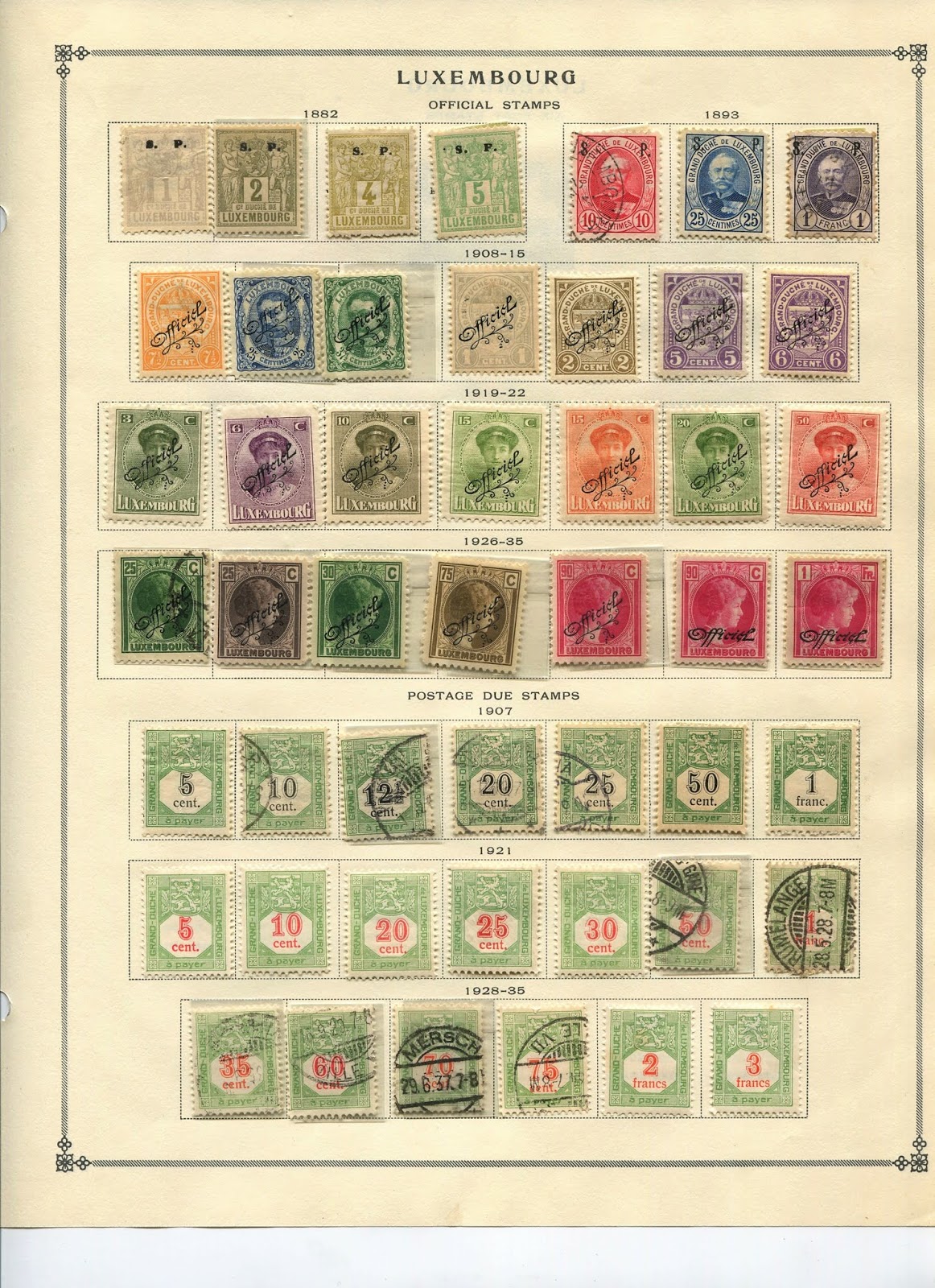
Generalist collectors beware, Luxembourg stamps require specialization and, for many rare stamps, deep pockets. Worse, Luxembourg stamps remain unpopular. Apfelbaum Inc., a stamp dealer’s website, blames this disrespect on four factors: too many expensive stamps, too many cheap stamps, too many poorly designed and executed stamps in the classical era, and too many forgeries, especially among those overprinted “official.”

Throwing caution aside, I’ve forged ahead collecting whatever Luxembourgs I can find. I’m going to a stamp show tomorrow and, as always, missing Luxembourgs are on my list. The result so far amounts to nine supplement pages (shown below), four of them dedicated to official overprints. Some of the forgeries are marked.

Why, I wonder, are there so many “official” stamps? Luxembourg could not have had many government agencies in the classical era to use them. That’s why cancels on rare “official” stamps are scarce. Luxembourg “officials” offered via the internet are commonly frauds, although the sellers may claim otherwise.

Grand Duke William III (above) looks remarkably like King William III (below) on early stamps of The Netherlands. Jim explains why here.  Opposite profiles distinguished them, although. neither stamp bears the name of the issuing country

King William III, The Netherlands
Census: 268 in BB spaces, 2 tip-ins, 236 on supplement page.
.
Jim's Observations
The Grand Duchy of Luxembourg, the only remaining grand duchy, is a small western European country (1000 sq mi) nestled between the Belgium Walloon region, the German Rhineland-Palatinate and Saarland, and the French Lorraine region. The population was 260,000 in 1914.

Luxembourgians speak Luxembourgish to each other, French for official business matters, while German is the first language learned in school. English is understood commonly.


During WW I, Germany occupied Luxembourg, but allowed the government to continue. 

In 1939, Luxembourg issued a specific proclamation of neutrality. But the Nazis invaded anyway on May 10, 1940. The Nazis ignored sovereignty, and treating Luxembourg as an extension of Germany, basically annexed the lands to the Rhineland-Palatinate in 1942.

Luxembourg Blog Post & BB Checklist

Page 1

1a

1b

1c

1d

Page 2

2a

2b

2c

2d

Page 3

3a

3b

3c

Page 4

4a

4b

4c

Page 5

5a

5b

5c

Page 6

6a

6b

6c

Page 7
7a

7b

7c

7d

Page 8

8a

Supplements
Page 1

Page 2

Page 3

Page 4

Page 5

Page 6

Page 7

Page 8

Page 9

Comments appreciated!

Thursday, February 6, 2020

Bud's League of Nations Album: Industrielle Kreigwirtschaft (IKW)


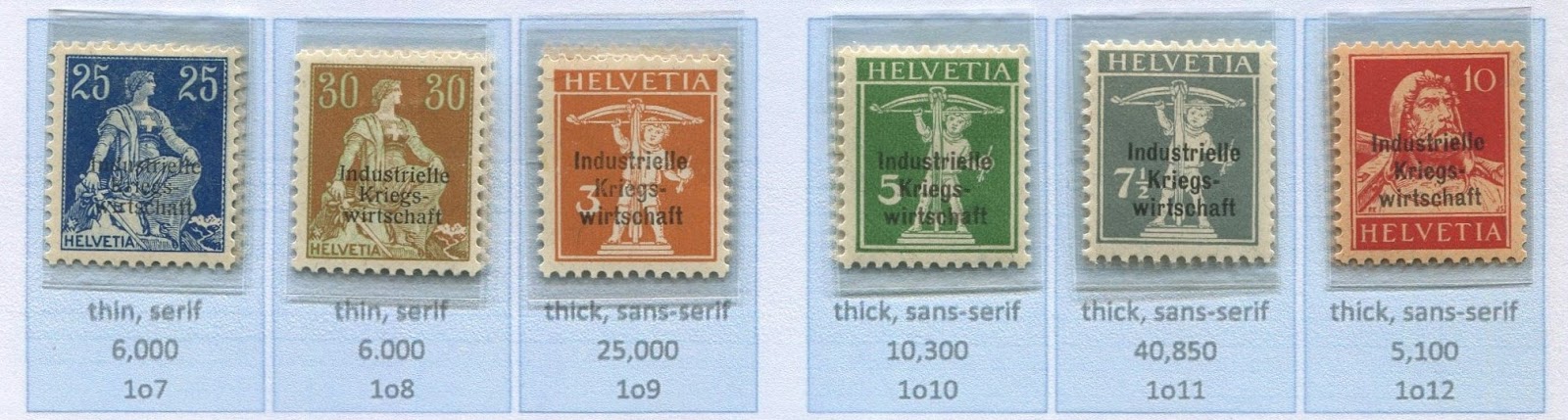
Stylistic precursors of The League of Nations’ official stamps, these sixteen definitive stamps were originally issued in 1907-09, then overprinted toward the end of World War I for the correspondence of the Swiss government’s agency for industrial economic affairs (IKW). In use from 23 July 1918 to 15 May 1919, there are two printings: the first with a thinner overprint font and serifs, the second with a thicker font and sans-serif. The second printing was delivered on 3 September 1918. 


*Listed below each stamp: type of overprint, number issued, and Scott catalog number.

The first printing stamps (thin font, serifs) are more difficult to collect than the second (thick font, sans-serif). They are fewer in number and bogus overprints abound, particularly on unused examples. The second printing mostly escaped falsification. The forger of the middle example below appears to have been entirely undecided about whether he liked serifs or not. What’s more, he either added a bogus cancel or used a previously cancelled stamp for the fakery -- it’s not very convincing.

Scott #1o6, forgery, Scott #1o14
Many countries, including England and the United States, established similar boards or agencies aimed at controlling trade during World War I. The US agency (the War Trade Board) was responsible for licensing exports and imports, rationing supplies to neutrals, and conserving commodities and shipping facilities for American and Allied use. It also sought to keep strategic goods out of enemy hands and prohibit the use of enemy credit and financial holdings in the United States.

Only Switzerland issued stamps restricted to its agency’s use. The following cover carried an official message from “Embroidery Export Central” to Mr. Geo Welti six days before use of IKW overprints was discontinued. Embroidery work was apparently sufficiently important to the Swiss that the IKW had an office dedicated to its prosperity.
Scott #1o10, cancelled at Saint Gallen, 7 May 1919

Concerning the export of limes (for guacamole, no doubt, or scurvy prophylaxis).
Scott #1o12, cancelled in Bern, 23 March 1919. Reverse side photocopied

Following the demobilization of the IKW, mint remainders were sold on 28 June 1919 to collectors -- the number of leftover stamps is estimated at 47,000+. Genuine IKW used examples are, therefore, usually more valuable than mint examples. Scott #1o12 was never issued. Double and inverted overprints are forgeries. A further caution: private reprints of the first issue are almost indistinguishable from the originals.

Sources:
Michael Peter, et al. (2011) The Industrielle Kriegs-wirtschaft Issue of Switzerland 1918-1919. American Helvetia Philatelic Society, 170 pages. A comprehensive analysis of the first official stamps of Switzerland.

Henry Ratz. (1984) “The Sad Story of the IKW Overprints,” TELL, The Voice of the American Helvetia Philatelic Society. Vol. 10, no. 4, pp. 149-54 and no. 5, Pages 224-27.

Note: League of Nations: Introduction and Table of Contents Links is found along the left column of Blog before "Country Posts" or here.