A is for Aden and Z is for Zanzabar


A is for Aden and Z is for Zanzibar... Now what is between? For the world wide classical era philatelist and stamp collector, a country specific philatelic survey is offered by the blog author, Jim Jackson, with two albums: Big Blue, aka Scott International Part 1 (checklists available), and Deep Blue, aka William Steiner's Stamp Album Web PDF pages. In addition, "Bud" offers commentary and a look at his completely filled Big Blue. Interested? So into the Blues...

Saturday, June 15, 2024

Queensland 1860-61 "Victoria"

Queensland 1860 Scott 2 2p deep blue "Victoria"
Imperforate, Wmk 6 "Large Star"

Into the Deep Blue

The Queensland 1860-1881 "Victoria Chalon Head" stamps are a challenge to characterize for the WW collector. One is looking at different Perfs ( and Imperf specimens); various Perf types (clean-cut, regular, rough-perf, square perf, round holes); different paper ( thick yellowish, white wove); unwatermarked/ different watermarked  varieties; and Engraved/Litho prints.

There are some 80 major Scott numbers, and many more minor numbers.

Wow, what a difficult task!....but fun too. !!

This blog post will begin the journey by examining the initial 1860-61 issues (17 major Scott numbers).

Queensland 1860 Scott 1 1p deep rose "Victoria"
Imperforate, Wmk 6 "Large Star"

The initial 1860 engraved issue consists of the One Penny deep rose, the Two Pence deep blue, and the Six Pence deep green. The stamps are watermarked "Large Star" (Wmk 6). The stamps are either found Imperforate, or Clean-Cut Perf 14 to 16.

The above example is a probable* Scott 1 1p deep rose Imperforate (CV $1,050). Note the wide margins, so doubtful this is a fake scissored perf specimen.

(probable* : I will readily admit that all my identifications on this blog post are still tentative, as I will discuss in due time.)

Queensland 1860 Scott 2 2p deep blue "Victoria"
Imperforate, Wmk 6 "Large Star"

Here is a probable Imperforate Scott 2.  CV is $2,250. The perforated specimens are usually pretty close to the design, so this example might be a genuine Imperforate.

Upper Row: Wmk 6 "Large Star"
Lower Row: Wmk 5 "Small Star"

The 1860 issue has a "Large star" (Wmk 6), while the next 1860-61 issue has a "Small star" watermark. 

My Wmk pic above is supposed to show the "large star" (upper row) and "small star" (lower row). 

Frankly, I am having major league trouble really telling the difference.

I've read that the large star is ~15.5 mm diameter, while the small star is ~13.5 mm diameter- a small amount. I note that the "large star" wmks appear to have thicker star rays.

This collection of Queensland I acquired over a year ago.  The collector was quite fastidious with his work-up. I have bought other country collections from this collector where the stamps were correctly catalogued. (Not that common for collections in my experience. ;-)  I am inclined to give this collector the benefit of the doubt. Consequently, I am presenting the stamps as he labeled them, unless I have evidence otherwise.

1860 Scott 5 2p deep blue "Victoria"
Clean-cut Perf 14-16, Wmk 6 "Large Star"

Here is  a clean-cut "Large star" Scott 5. CV is $140.

1860 Scott 6 6p deep green "Victoria"
Clean-cut Perf 14-16, Wmk 6 "Large Star"

The Scott 6 "large star" clean cut 6p deep green. CV is $110.

1860-61 Scott 6A 2p blue "Victoria"
Clean-cut Perf 14-16, Wmk 5 "Small Star"

The rest of the examples for this blog post are Wmk "small star": consequently from the 1860-61 issue.

The Scott 6A 2p blue is CV $135.

1860-61 Scott 6E 6p deep green "Victoria"
Clean-cut Perf 14-16, Wmk 5 "Small Star"

The 6p "small star" 6p deep green clean-cut is CV $95.

1860-61 Scott 6H 1p rose "Victoria"
Regular Perf 14, Wmk 5 "Small Star"

This "regular Perf 14" "small star" 1p rose is CV $62+.

1860-61 Scott 7 1p deep rose "Victoria"
Rough Perf 14 to 16, Wmk 5 "Small Star"

Definitely a "rough perf" stamp: CV is $57.

1861 Scott 9 3p brown "Victoria"
Rough Perf 14 to 16, Wmk 5 "Small Star"

Rough Perf Three Pence: CV $60.

1860-61 Scott 10 6p deep green "Victoria"
Rough Perf 14 to 16, Wmk 5 "Small Star"

A "deep green" specimen: CV $52.

1860-61 Scott 10a 6p yellow green "Victoria"
Rough Perf 14 to 16, Wmk 5 "Small Star"

This looks like a "yellow green" Scott 10a minor number: CV $42.

1860-61 Scott 11 1sh dull violet"Victoria"
Rough Perf 14 to 16, Wmk 5 "Small Star"

The One Shilling "rough perf" is CV $140.

Out of the Blue

The assured identification of these stamps by me was hampered by an inability to be sure of the Wmk large star/small star differences. 

Comments appreciated!

Wednesday, May 15, 2024

Ruanda Urundi - Bud's Big Blue

Ruanda-Urundi 
Bud's Big Blue
Bud's Observations

Belgium gained governing control over Ruanda /Urundi, now renamed Rwanda and Burundi, in 1918 under the Treaty of Versailles. Germany, defeated in World War I, lost its control of German East Africa, the western part of which was given to Belgium. Neither Germany nor Belgium had much knowledge or insight about the people living there but, because the territory bordered on Belgian Congo and none of the other victorious Allies particularly wanted it, Ruanda/Urundi passed to Belgium.

Not until 1924 was the first postage issued, all repurposed stamps of the 1923 Belgian Congo series. These overprints continued in use until 1931, Scott numbers 6 through 36. For some reason, a lower case “i” is used in the spelling of “URUNDi.

Scott 10 green, 12 rose red, and17 red orange,

Scott numbers 1 through 5 no longer appear in the Scott’s Ruanda /Urundi listings. Being wartime occupation stamps, they were shifted to Scott’s section for German East Africa and identified as n25 – n29.

German East Africa n25 green and black, n26 red and black, 
formerly Rwanda/Urundi 1 and 2

In precolonial times the population of Ruanda/Urundi was comprised mainly of the Bantu-speaking Hutu and Tutsi tribes (the latter being known to Europeans as Batutsi or Watusi). Society was organized in a feudal system with the Tutsis as chiefs and Hutus as workers. The lines between the two groups were porous. People could intermarry and move back-and-forth socially. Those identifying as Hutu outnumbered the Tutsi six to one. An additional very small minority identified as Twa, a marginalized pygmy people.

The Germans and Belgians turned this traditional arrangement into a rigid race-based class system, using now discredited European theories of race as justification. Tribal identity was fixed at birth and remained that way throughout life. Moreover, the Belgians favored the Tutsi over the Hutus, giving them European-style education and privileges of power. In 1926, the Belgians introduced separate ethnic identity cards (indangamuntu) for the Tutsi and Hutu to carry, a policy that helped the Tutsi enforce Belgian control.

This hardline classification provoked the tensions that led, in great part, to genocide in the 1990s. During and after the genocide the cards were used to identify victims; most were Tutsi. The card, originally signifying entitlement to power, became a passport to death.

A Tutsi identified.

Credit: Montreal Holocaust Museum

Does anything in the early stamps of Rwanda/Urundi, I wonder, predict the ensuing horrors of the genocide?

In 1931 Belgium issued the first stamps with “Ruanda/Urundi” inscribed. The artwork features native people in a variety of settings. Although the tribal identity of the subjects is not mentioned on these stamps, Tutsis likely posed for the original artwork (or were imagined by the artists). The resulting images conform to the European racial biases of the time – tall body, narrow nose, slender face, etc. Belgium chose their favored subjects for colonial stamp designs.

Scott # 54 brown, 52 gray, and 53 brown violet

Otherwise, I find no philatelic hints about the underlying conditions that led to genocide.

The late 1990s the genocide eventually spent its anger and, in more recent years, Tutsis and Hutus are learning to live together again.

Census: in BB spaces 31, on supplement pages 38. Catalog values for mint and used stamps are basically the same.

Jim's Observations

Of interest, the current Scott catalogue for Ruand-Urundi begins with number 6 - what happened to "Scott 1-5"? It turns out those numbers were for the 1922 Belgium occupation stamps of German East Africa, and they were moved into the Belgium occupation stamp section of German East Africa in the current catalogue. The 40s editions Scott catalogue had the stamps listed under "Belgium East Africa" as Scott 1-5.


Page 1


1a


1b


1c


Supplements
Page 1


Page 2


Comments Appreciated!


Monday, April 29, 2024

USA 1909 Scott 369 2c carmine "Lincoln" "Bluish paper"

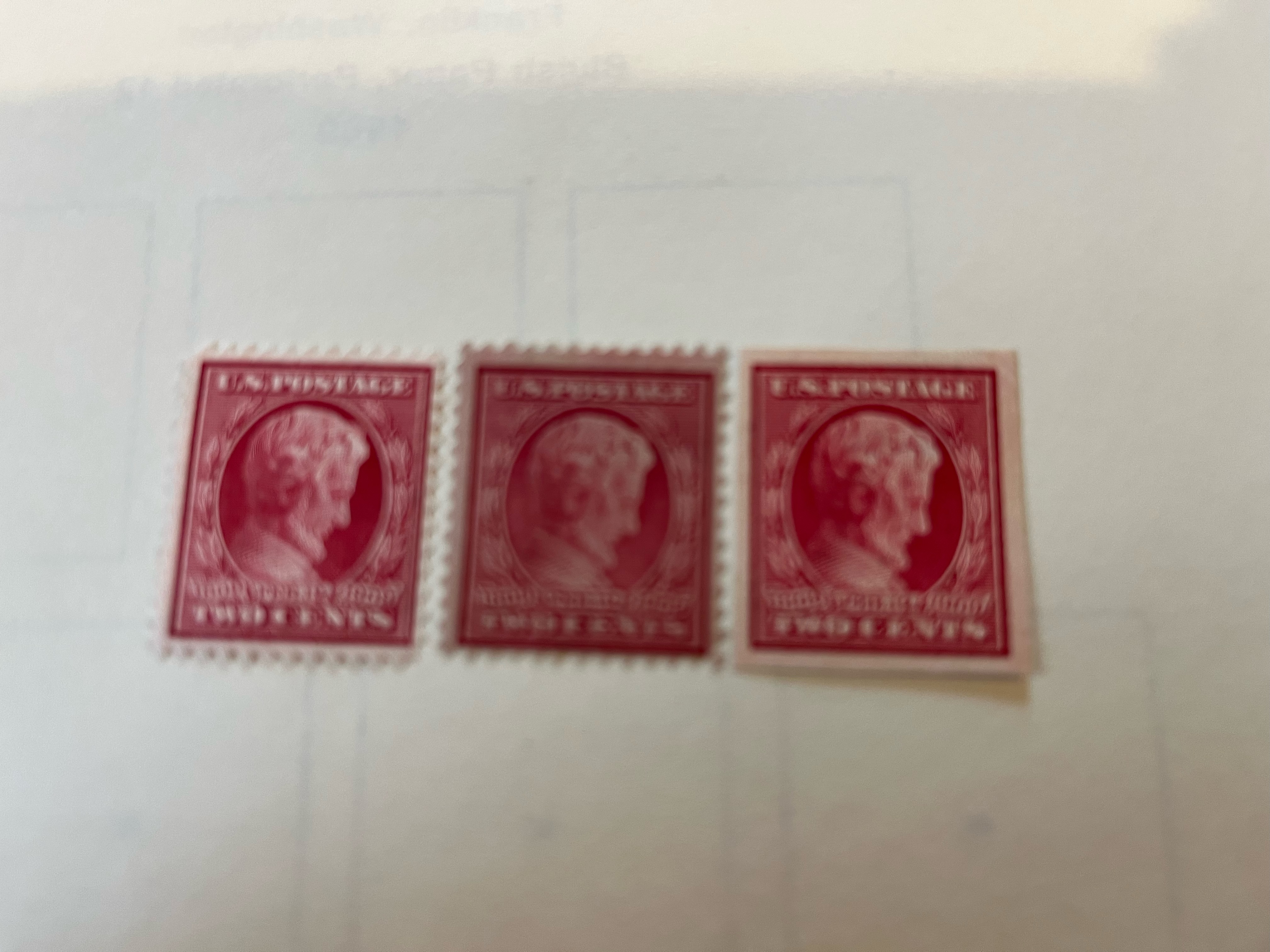
1909 Scott 267-369-368 2c carmine "Lincoln"
Center Scott 369 - "Bluish" paper
i-phone camera pic

Into the Deep Blue

The 1909 2c carmine "Lincoln" is an interesting stamp - both in terms of origin, as well as the "bluish" ,paper variant.

1909 Scott 367 2c carmine "Lincoln"
12 Perf- 100% Wood Pulp Paper, CV $4+

The "Lincoln" stamp came about because the regular issue "Washington-Jefferson's" of 1908-09 did not include a "Lincoln" stamp, and there was an uproar among the public and congress. Fortunately, the hundred year anniversary of Lincoln's birth was Feb 12, 1909, so a the chastised postal officials put out a "Lincoln Centenary of Birth" issue.

1909 Scott 368 2c carmine "Lincoln" Imperforate
12 Perf- 100% Wood Pulp Paper, CV $15

Also at this time, the postal authorities were experimenting with 35% rag paper rather than 100% wood pulp paper to see if that would reduce paper shrinkage during the stamp manufacturing process. It didn't. 

1909 Scott 369 2c carmine "Lincoln"
12 Perf- 35% rag content "bluish", CV $150

Included in the 35% rag paper experiment was the 2c carmine "Lincoln". Sheets of these (not many) so called "bluish paper" stamps were released along with the usual 100% wood pulp paper stamps.

They now command a CV (unused) of $150.

1909 Scott 267-369-368 2c carmine "Lincoln"
Center Scott 369 - "Bluish" paper
Scan

Ok, here is a scan of the "bluish paper" Scott 369 in the center. The paper appears darker- more gray- than the other examples. The scan tends to wash out the difference compared to the human eye.

1909 Scott 267-369-368 2c carmine "Lincoln"
Center Scott 369 - "Bluish" paper
Reverse Side - Scan

The reverse shows the difference better- more tan-gray in actuality than "bluish"

1909 Scott 267-369-368 2c carmine "Lincoln"
Center Scott 369 - "Bluish" paper
i-phone 13 camera

I took a pic with my i-phone, which perhaps shows the shade difference better.

Out of the Blue

So is my recently acquired "bluish" paper Scott 369 a genuine example? I think so, but would need to get a Cert to be sure.

Comments appreciated!

Tuesday, March 12, 2024

Ile Rouad - Bud's Big Blue

Poster stamp celebrating the French occupation of Ile Rouad, ca. 1916
Bud's Big Blue
Bud's Observations

Anymore, only stamp collectors recognize “Ile Rouad” as a real place on planet earth. Most folks, if they at all know about this small dot of an island in the eastern Mediterranean, call it Arwad (أرواد), the Arabic rendering of the ancient Phoenician place name.

In early 1915, the island city was a quiet Ottoman fishing village, although in the process of becoming a haven for French spies eager for intelligence about war preparations in Ottman Syria. On September 1 of that year the French navy invaded and, eventually, used the island to defeat the Ottoman military. Perhaps the French recalled the island’s strategic usefulness to the Crusaders in the late 13th century.

French cruiser Jeanne d’Arc, part of the Ile Rouad invasion forces.

Under a League of Nations mandate (1920), the French maintained a presence in Arwad until 1945 and hoped to build a military base there. After World War II ended, however, the United States pressured France to return the island to Syria unconditionally.

Ile Rouad’s 16 stamps were issued in 1916 and continued in use until 1919 whereupon the TEO (occupied enemy territory) stamps of French Syria replaced them. All are overprinted stamps of French Levant. Big Blue provides space for half of these, Scott numbers 4 through 12. They are cheap and easy to collect. In contrast, numbers 1 through 3, the ones with vertical hand-stamped overprints, are costly. These, the results of a stamp dealer’s speculation (1), were not regularly issued and, if cancelled, were likely not used postally. 

Ile Rouad, Scott #3, 1 pi on 25c, blue

 Census: eight in BBs, four on supplement page.

(1)  https://www.dcstamps.com/ile-rouad/


Jim's Observations 

Ile Rouad (Arwad Island) is located in the Mediterranean Sea just 2 miles off the coast from Tartus, south of Latakia, Syria. But on September 1, 1915, it was occupied by French Forces, and served as a staging ground for incursions into the Ottoman territory (Damascus 1918).

In 1919, the island became part of the French T.E.O ( Territorires Ennemis Occupes), and the stamp issues of French occupied Syria were used.


Page 1

Page 1 Close-up

Supplements
Page 1

Comments appreciated!

Sunday, March 3, 2024

Rare USA & Sweden stamps

USA 1861 A31 Scott 72 90c blue "Washington"

Into the Deep Blue

My local Stamp club recently had a "club auction" for members. This auction was unusual in that there was  a number of "rare" stamps listed. 

By "rare",  I mean stamps that are usually not found in good WW collections, and not that common in specialty USA collections.

Truth be told, some had faults; but to me, the faults were acceptable. And the price was right - 6%-15% CV. !

Shall we take a look?

USA 1859 A11 Scott 29 5c brown Type I "Jefferson"

This example is not the imperforate 1856 Scott 12 5c "red brown" Type I (CV $700), but the perforated 1859 Scott 29 "brown" color variety (CV $350). This example may have been reperforated on the right side.

The 5c Scott 29 "brown" colors also include pale brown, deep- brown, and yellowish brown.

Type I is defined as "projections on all four sides", while Type II has "projections on top and bottom partly cut away" (1861 Scott 30 "orange brown" CV $1200; 1860 Scott 30A "brown" CV $280). 

USA 1857 A16 Scott 36 12c black "Washington"
Plate I

The Scott 36 Plate I is characterized by the outer frame lines are recut on the plate and are complete. It looks like the outer frame line in this stamp, although interrupted by the perforations, does look strong. The other choice is 1859 Scott 36B (plate III) where there is a weak outer frame line which has not been recut. But this was sold as a Scott 36, and I think that is right. CV is $300.

USA 1861 A31 Scott 72 90c blue "Washington"

In my younger days, as a USA collector, I always wanted this stamp, and so here it is. :-) Heavily cancelled, but good color. CV $600.

USA 1862 A26 Scott 75 5c red brown "Jefferson"

This is not the Scott 67 5c "buff" color, but the Scott 75 "red brown" variety. CV $425.

Sweden 1869 Scott 15 17o gray
"Lions and Arms"

In our club we have a Sweden specialty collector, and he was selling this 17o gray from his collection.

CV is $800.  Has a good in-period cancel.

Looking at the sixteen Scott major number Swedish stamps from 1855-1869, only four have a higher CV (One of them is the 1855 Scott 1a 3a orange (error) @ $3,000,000!).

Out of the Blue

Fun! This adds a bit of spice to my WW collection. 

Comments appreciated!

Friday, February 23, 2024

USA Official Stamps, Hawaii additions

Hawaii 1864 Scott 24 2c black

 Into the Deep Blue

Our local club had an in-house auction recently, and I picked up some new specimens. In addition, I will show off some of the USA 1873 Official stamps.

USA 1869 Scott 119 15c brown & blue
"Landing of Columbus"; Type II

It turns out I already had an example in my collection, but this local club auction specimen has a particularly rich blue & brown color. CV = $190.

Hawaii 1864 Scott 24 2c black

It is not the best of copy with the tear, crease, and hole, but I did pick this up at our local club auction for very little. CV = $1,050. These "Numeral"  stamps were typeset in Hawaii between 1859-1865. 

USA Official 1873 Scott O3 3c yellow "Washington"
Agriculture

Each Department of Government were issued stamps to use on official correspondence between 1873-1884. Most of the stamps were produced by the Continental Bank Note Company (Hard paper). Some were produced by the American Bank Note Company (soft paper). The ABNC stamps are given separate major numbers, and often have a higher CV. 

I believe this is a CBNC stamps @ CV $17+.

USA Official 1873 Scott O20 12c vermilion "
"Henry Clay"; Interior

The "Executive" Department stamps (carmine color) have a high CV ($225-$$1,000), and I don't have any.

But I do have this "Interior" 12c CBNC stamp @ $90 (unused).

USA Official 1873 Scott O27 3c purple "Washington"
Justice

The "Justice" 3c purple is CV $35.

USA Official 1873 Scott O40 10c ultramarine
"Jefferson"; Navy

I already had a 10c "Navy", but I picked up this better copy. CV $45.

USA Official 1873 Scott O51 10c black
Post Office

The "Post Office" stamps do not have a portrait. CV $55.

USA Official 1873 Scott O61 7c dark green
"Edwin Stanton"; State

Since my daughter is a Foreign Service Officer with the State Department now, I am partial to these lovely green specimens. Here, the 7c is CV $290 (unused).

USA Official 1873 Scott O72 1c brown
"Franklin"; Treasury

This is a new specimen for me. CV $10.

USA Official 1873 Scott O114 1c rose red
"Franklin"; War; ABNC

I believe this is an ABNC specimen. CV $7+.

Out of the Blue

I have always liked the 1873 "Officials", and think collecting them on cover would be a fun (but sadly too expensive) sub-specialty. :-)

Comments appreciated!