A is for Aden and Z is for Zanzabar


A is for Aden and Z is for Zanzibar... Now what is between? For the world wide classical era philatelist and stamp collector, a country specific philatelic survey is offered by the blog author, Jim Jackson, with two albums: Big Blue, aka Scott International Part 1 (checklists available), and Deep Blue, aka William Steiner's Stamp Album Web PDF pages. In addition, "Bud" offers commentary and a look at his completely filled Big Blue. Interested? So into the Blues...

Tuesday, February 14, 2017

Western Ukraine

1919 Scott 14 15sh on 15h  dull red (on Austria Scott 168)
Austrian Stamps of 1916-18 Surcharged in Shaviv Currency
First Stanyslaviv Issue - With Asterisks
Quick History

[ Today is a sad day. Please pause a moment and honor a great philatelic web site author Gerben van Gelder of Stamp World History. ]

Western Ukraine was a short lived nationalistic inspired Ukrainian (Old term: Ruthenian) independent state (1918-19) that tenuously existed after the WW I collapse of  Austria-Hungary, until the area eventually was incorporated into Poland in 1923 (League of Nations decision).

Stamps were issued (mainly overprinted/surcharged Austrian stamps) from November 20, 1918 through May, 1919.

Land Claims of the West Ukrainian People"s Republic (pink + border)
The lands of  Eastern Galicia, (A province of Austria, but taken from Poland in 1772), were an ethnic mix of 60% Ukrainians (rural -peasants), 25% Poles (urban -leading social class), and 12% Jews (urban). The population of the area was approximately 5 million in 1910, and the largest city was Lviv, an important Polish dominated cultural capital of the region.

The West Ukrainian People's Republic declared independence from the Austro-Hungarian Empire on November 1, 1918, and Lviv was declared the capital. This surprised the majority Polish residents of Lviv, who did not want to be part of a non Polish state.

I should say here that the West Ukrainian People's Republic was definitely Austrian in culture ( Legal, Social, Political), and was appalled by the disorderly uncouth socialist revolutionaries. Although there was an agreement to "unite" Western Ukraine with the rest of Ukraine in December 1, 1918, relations with the Kiev based socialist Ukrainian People's Republic were strained at best.

"The Eaglets -the defense of the cemetery" Kossak (1926)
Polish Youth uprising in Lviv against the West Ukrainian People's Republic
There was a popular Polish uprising in Lviv, and so the Polish-Ukrainian War of 1918-19 began between the Second Polish Republic and the West Ukrainian People's Republic.

March, 1919 - West Ukrainian People's Republic (blue)
Note the Polish corridor and Polish control of Lviv (Polish: Lwow)
By the end of November, 1918, Polish forces, (well equipped by the French in hopes they could stem the Bolsheviks), were in control of Lviv, as well as the railroad corridor linking Lviv with Poland.

The West Ukrainian government evacuated to the city of Ternopil, then to Stanyslaviv by December, 1918. (There are four major stamp issues released from Stanyslaviv from March 18- May, 1919.)

The West Ukrainian army managed to hold off the Poles for nine months, but by July, 1919, the Polish forces had taken over most of the territory.

There was a government-in exile- set up in Kamianets-Podilskyi, and then in Vienna.

Diplomatic maneuvers by the West Ukrainians eventually proved fruitless, and Poland absorbed the territory formally on March 14, 1923.

Casualties, mostly soldiers, would number 10,000 Poles and 15,000 Ukrainians.

The important eastern Galician oil fields essentially came under the control of the French, rather than Poland.

At the start of WW II, the area was annexed by the Soviet Union into Ukraine, which was part of the Soviet Union.

The lands now form the western part of now independent Ukraine.

1919 Scott 83 25h blue
Austrian Stamps of 1916-18 Overprinted
Third Stanyslaviv Issue
Into the Deep Blue
The 2014 Scott Classic Specialized 1840-1940 catalogue has, for Western Ukraine 1918-1919, 119 major number descriptions.

They all are surcharged on Austria stamps, unless otherwise noted.

They consist of the 1918 Lviv issue (5 stamps), the 1918 Kolomyia issue (4 stamps), the 1919 First Stanyslaviv issue (20 stamps), the 1919 Second Stanyslaviv issue (47 stamps - on Postage Due stamps of Bosnia, on Austrian Military semipostal and regular stamps, on Austrian stamps), the 1919 Third Stanyslaviv issue (19 stamps), 1918-19 Registration stamps- Kolomyia issue ( 2 stamps), and the the 1919 Romanian Occupation stamps of Pokutia (which includes Kolomyia) on Austrian stamps (13 stamps). In addition Scott mentions two Definitive issues (12 stamps and 5 stamps respectively) for May, 1919 that were not issued.

And most stamps are expensive to quite expensive ($tens to $hundreds to $thousands), save for the Third Stanyslaviv issue, where 17 of the 19 stamps in the set are CV <$1-$2+.

And Scott has a note: "Forgeries of almost all Western Ukraine stamps are plentiful". !!!!!!

Clearly, Western Ukraine is for the (well-off) specialist. And even then, apparently most of the issues were produced because of demand from Vienna stamp dealers than true need. The WW collector should tread lightly, and save for the Third Stanyslaviv issue (which is ubiquitous and inexpensive), probably move on. ;-)

A closer look at the stamps and issues
100 Shahiv (Sotykiv) = 1 Hryvnia
100 Heller = 1 Krone
1919 Scott 9 3sh on 3h bright violet
Austrian Stamps of 1916-18 Surcharged in Shaviv or Hryvnia Currency
First Stanyslaviv Issue - With Asterisks
The stamp production for Western Ukraine reflect the fortunes of the war with Poland in terms of where and when the issue was released.

The first stamp issue of November 20 from Lviv was only in circulation for two days before the Poles captured the city on November 22.. It consists of five handstamped overprinted Austrian stamps. The government than evacuated to Tenopil. (CV $30+-$200+)

There was also a four stamp issue from Kolomyia in the Pokutia region of southwest Ukraine on December 12, 1918. The four stamp issue consists of Austrian stamps that were surcharged. (CV $90-$1,600)

By the end of December, 1918, the government had moved to Stanyslaviv (Now called Ivano-Frankivsk). On March 18, 1919, 20 surcharged Austrian stamps of 1916-18 were released. This was the first Stanyslaviv issue (See above example). (CV $10+-$30+ for 13 stamps.)

1919 Scott 14 15sh on 15h  dull red (on Austria Scott 168)
Austrian Stamps of 1916-18 Surcharged in Shaviv or Hryvnia Currency
First Stanyslaviv Issue - With Asterisks
Another example (also shown for the blog header) from the first Stanslaviv Issue is shown here. Note the first Stanslaviv issue has asterisks.

The second Stanyslaviv issue, similar to the surcharge of the first issue, but without asterisks, consists of four sets and 47 stamps. Utilized were the postage due stamps of Bosnia, 1904 (first set), 1918 Austrian Military semipostal stamps (second set), 1917 Austrian Military stamps (third set), and 1916-18 Austrian stamps, but with two upper bars (fourth set). The CV is quite high for most of these stamps, but 9 stamps are  CV $10+ $20+..

1919 Scott 81 15h dull red
Austrian Stamps of 1916-18 Overprinted
Third Stanyslaviv Issue
The third Stanislaviv issue of May, 1919 is the one most likely to be encountered by the WW collector, as the 19 stamp set has a CV of <$1-$10+. This provisional issue consists of 1916-18 Austria stamps that was overprinted in Vienna.

Note the Ukrainian trident-in-shield arms, and the letters "3. y. H. P." in the four corners for (Z.U.N.R. = "Zakhidno-Ukrainska Narodna Republyka" = "Western Ukrainian National Republic" ).

Apparently, almost all of the specimens only exist unused, as the issue actually received little postal use, and forged cancellations are not uncommon.

In the meantime, the Austrian State Printing Office in Vienna was preparing two definitive lithographic issues for Western Ukraine. The May, 1919 first definitive set (5 in set CV $5), and second definitive set (12 in set CV $350) were never actually issued. They are given no numbers in the catalogue by Scott, although they are pictured and set valued.

There is also a fourth Stanyslaviv issue (overprinted locally) of May, 1919 (nine stamps) that consist of 1917-18 Austrian Military stamps surcharged in black. The issue was produced while waiting for part of the  third Stanyslaviv issue to arrive from Vienna. CV is $10+ for three stamps.

June 14, 1919 Scott N9 40h on 5h rose red
Austrian Stamps Surcharged in Dark Violet Blue
On Austrian Postage Due Stamps of 1910-1917
Romanian Occupation of Pokuttia
A piece of history I didn't discuss was the November, 1918 occupation of the Duchy of Bukovina by Romanian troops, even though it was "incorporated" by local Ukrainians into the West Ukrainian People's Republic. (Refer to the first map of the post, which shows Bokovina in orange.) The occupation ended on August 20, 1919. The territory was absorbed into the Kingdom of Romania.

North of Bukovina is Pokuttia (Pokutia), and this area was occupied by Romanian and Polish troops in May 24, 1919. The chief city is Kolomyia. In August, 1919, Romania handed over eastern Pokuttia to Poland. Pokuttia eventually became part of Poland in 1923.

And for stamp collectors, there is a tangible legacy from the Pokuttia (Pokutia) occupation by Romania.

Thirteen Romanian occupation stamps of Pokuttia (Pokutia) were  released June 14, 1919 by surcharging Austrian stamps in dark violet blue- See the above example. They can be found on Austrian stamps of 1916-18 (eight stamps), and Austrian postage due stamps of 1910-17 (five stamps). CV is $2+-$20+ for nine stamps.

Deep Blue
1919 Third Stanyslaviv Issue in Deep Blue
Deep Blue (Steiner) has seven pages for the stamps of 1918-19 Western Ukraine. As usual, Deep Blue follows the Scott catalogue for spaces. Plenty of the spaces will remain empty ($!!!) unless one has a particular fascination with Western Ukraine. My classic Steiner pages do not have all the spaces for stamps in the current Scott catalogue available (Part of First Stanyslaviv issue, Lviv issue, and first and second Definitive issues (never issued)). Not that it really makes that much difference for me. ;-) I printed out some supplementary pages if I ever need them -probably doubtful. 

Western Ukraine in Big Blue
Big Blue
Big Blue '69, on two-thirds of a page, (shared with South Russia for the '69 edition; shared with White Russia for the 40s editions) has 19 spaces for the entire 1919 Third Stanyslaviv issue. 

Coverage by Big Blue is 16%, but entirely reasonable, as the other issues are usually expensive and/or fraught with forgeries.

The two highest denominations of the Third Stanyslaviv issue are CV $10+

Checklist

1919
76,77,78,79,80,81,
82,83,84,85,86,
87,88,89,

90,91,92,93,94,

Comments
A) Expensive stamps ($10 threshold):
1919 Scott 93 4k yellow green ($10+)
1919 Scott 94 10k deep violet ($10+)

1919 Scott 84 30h dull violet
Austrian Stamps of 1916-18 Overprinted
Third Stanyslaviv Issue
Out of the Blue
One has to admit this is somewhat fascinating and unknown history. Ukrainians and Poles might be aware of the conflict, because their families were involved (now, a long time ago).

Stamp collectors, of course, can collect tangible evidence following the collapse of the Austro-Hungarian Empire.

Note: Maps and Kossak painting image appear to be in the public domain.

Comments appreciated!

Saturday, February 11, 2017

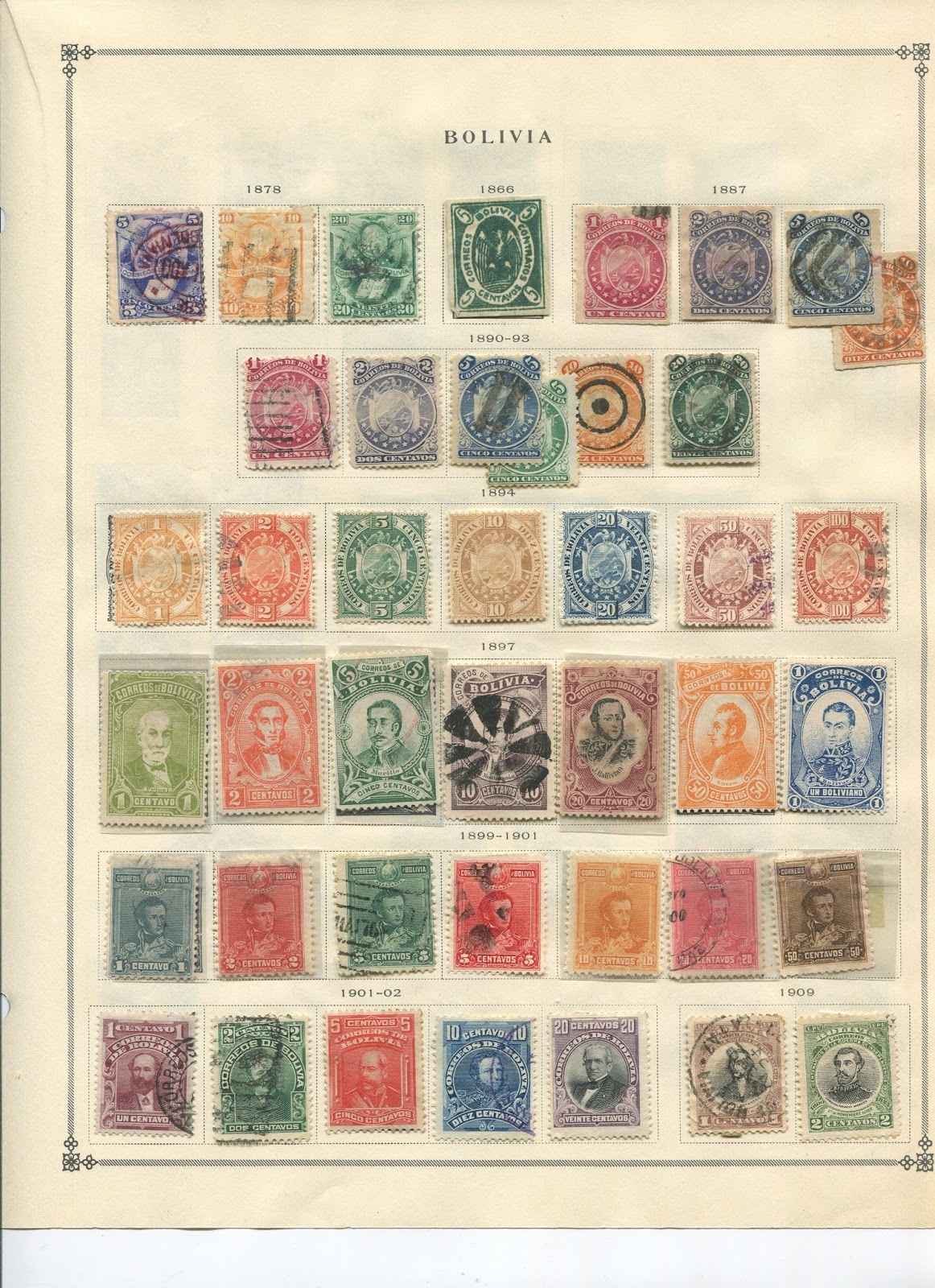
Bolivia - Bud's Big Blue

1960 Scott 450 5000b on 5b gold 
"Gate of the Sun"
Bud's Big Blue
Bud's Observations
An extended visit with Bolivia’s stamps has been on my bucket list for quite a while. So far I’ve only identified some of the things I’d like Bolivia’s stamps to tell me. What do I want to know? to do?

·        * Sort out which early 19th century revolutionaries did what in which South American nations, particularly Bolivar and Sucre.

·        *  Find out the flight and nesting habits of condors and why they’re on Bolivia’s first stamps.
·         Get the full story behind the decision not to release the “Gate of the Sun” series until 1960 when it was made for the 1926 centennial celebration. (See above).

·         * Speculate about Tiwanaku iconography in the “Gate of the Sun” series.

·        * See what traces of Bolivia’s early, relatively primitive postal routes can be found in pre 1895 cancellations (foot-paths, railway, horseback riders and river boats).

·         * Identify the effects of being a land-locked country on Bolivia’s postal history and, more generally, the effects of hostilities between Chile and Bolivia.

·         * Collect more early fancy cancels.

·         * Track the effects of rampaging inflation on their stamps, as evidenced by the many overprints. The “Gate of the Sun” stamp above was to be issued in 1926 at 5 Bolivanos but, when it was finally released in 1960, it had to be overprinted 5000 Bs, an increase of 99,900 percent.

I’d better set aside several months. Maybe some of you already have some of this information, or even better questions to ask of Bolivia’s stamps. If you do, please make a comment.

Census: 164 in BB spaces, seven tip-ins, 114 on supplement pages.

Jim's Observations
Bolivianos are mostly descended from the indigenous native people, which greatly influences Bolivia's cultural folk art and music. The major languages are Spanish(60%), Quechua (20%), and Aymara (15%).

Our family has felt a close kinship with Bolivia for a long time. Our two daughters have been there. We hosted an AFS (American Field Service) high school student from Bolivia. That was nigh 24 years ago, and we are still close to her and her family.

There is a collection of Bolivia in the other room waiting to be broken down. I am looking forward to that with pleasure.

Bolivia Blog Post and Checklist

Page 1 (Click to enlarge for examination.)

1a

1b

1c

Page 2

2a

2b

2c

Page 3

3a

3b

3c

Page 4

4a

4b

4c

Page 5

5a

5b

5c

Supplements
Page 1

Page 2

Page 3

Page 4

Page 5 Airmail

Have a comment?

Sunday, February 5, 2017

An Unusual Approach to a Classical Period Album

1840-1952 Classical Era Collection: 1920-1929 Section
Scott International Brown & Vario Pages housed in Scott Specialty Binders
An Unusual Approach to a Classical Period Album by Ron Olin

Jim's Note: Readers may be aware that I have had reservations about using only stock pages, such as Varios, for a collection. To me, they lack the historical context, fine presentation, and "permanency" of a printed album. 

But no one can deny Varios and other stock pages present a clean and muss-free way to house stamps, without the need to use mounts or hinges, to say nothing about the arrangement freedom they provide.

And, what if there was a way to combine, in a synergistic way, the advantages of both presentations?

That is why I was most taken with the "outside the box" fresh approach of Ron Olin, who recently wrote a comment for the post Which Stamp Album is best for WW Collectors?

I've asked Ron if he would explain his interesting arrangement, and he has graciously agreed.

Jim
USA 1893 Columbians: "Brown" Page mirrored with a "Vario" Page
A couple of years ago, after deciding to step back a bit from a money-management firm that I founded some 30 years ago, I began looking around for a hobby that could expand or contract as time and inclination permitted. 

I tried becoming an AFOL (Adult Fan Of Lego’s) person but, after acquiring the pieces and expanding Lego’s Frank Lloyd Wright house kit to quadruple its size, I found further projects somewhat unsatisfying.  

I then remembered the joy I felt as a kid identifying, sorting, and moving my couple of thousand item world-wide stamp collection from one new album to another (Scott Modern, Ambassador, White Ace, Blue Scott International etc.) and decided to investigate the state of Philatelic pursuit in current times.  I discovered Ebay’s facilitating opportunities, stamp collecting blogs (especially Big Blue, Filling Spaces, and John Apfelbaum’s blog), internet based wholesale stamp dealers, the album choice conundrum, etc.  I relished the decisions and choices represented, attacked them in earnest, and have never looked back.

19th Century Scott International Brown Album
After deciding to become a Classic World Wide Collector (1840-1952), and purchasing several fairly advanced collections housed in the Browns and Stanley Gibbons New Imperial albums, I faced important and deterministic decisions regarding the packaging and presentation of my collection.

I had a barely touched, pristine, three volume set of the Scott Blue International (through 1960) left over from my teen years.  But I remembered having a few stamps even then that could not find a home, and so I rejected the somewhat limiting decision to “collect to Big Blue” (although I highly respect the discipline and satisfactions therein contained).    

I signed up for the Steiner pages, and played around with the PDF pages and reformatting possibilities.  

Classic 19th Century Egypt
From International Scott Brown Album
But I kept coming back to the warm, satisfying feeling I had when viewing the yellowish sepia pages of the Nineteenth Century Brown Scott album which housed one of the collections I had purchased to get started.  

The pages were fairly well populated, and the stamps had been mounted with care (a combination of Dennison hinges and some clear mounts), but the thing was literally “falling apart”.  Loose glassine interleave pages had been inserted often to separate all the stamps mounted on two sides of the pages, but some items would catch on each other and be pulled off the page.  Used stamps were hinge mounted beneath their unused brethren, and the album was “bulging”, as you can imagine.  

This was all very charming from an historical perspective, but far too messy and unkempt for my tastes.  I decided I would love to collect to this album, since it covered all major Scott numbers.  But the prospect of a substantial collection, so housed, offended my sensibilities.

So now you are thinking I would soon discover the Subway reprints of the Classic Scott Brown albums, printed on one side on thick paper, spread across 19 volumes and a lot of shelf space.  Right you are!  This must certainly be the way to go, or so I thought.  

But wait!  I already had some 40,000 or so stamps to identify, classify, cull out, catalog, AND MOUNT.  The good Dennison hinges cost two cents apiece when you can find them on Ebay.  

A better choice for the money, in my opinion, is Hawid clear mounts at about four cents a stamp, which allows you to easily change out and upgrade your collection over time.  However, there is no way around it: you have to carefully cut the mount, insert the stamp (or vice versa), and attach it to the page.  It wasn’t the $1,600 or so bucks for material that bothered me so much as the time and tedium involved in such an undertaking.  I imagine some people love this part of stamp collecting, carefully mounting their painstakingly obtained treasures, but I am not one of them.

I love filling spaces, but hate mounting stamps.

1840-1952 Classical Era Collection: 1840-1900 Section
Scott International Brown & Vario Pages housed in Scott Specialty Binders
Another wrinkle, as I formulated my choices, was a Stanley Gibbons New Imperial Album (since out of print) which housed an advanced British Colonial collection I purchased.  Here stamps were densely mounted on one side of a page only, on numbered squares, with the facing page containing descriptions of the stamps to be mounted in each of the numbered squares (dates, watermarks, perforations, pictures, etc.).  How civilized and organized are the British?  

They only missed one thing.  The page with numbered squares should have been a black Vario Stock page with the requisite number of rows of clear plastic in which to insert one’s carefully obtained acquisitions. 

Here I digress.  Mounting about 30 stamps each on two pages of an album costs $1.20 with Ebay purchased Dennison hinges and costs $2.40 or so in Hawid mounts.  A new two sided Vario Stock page can hold the same number of stamps and be had for about fifty cents.  The more important consideration, in my opinion, is the time and effort it takes to mount 60 stamps versus inserting them in stock pages.

Therein was born my decision regarding the presentation and packaging of my collection, and an idea that I have not previously encountered in my stamp blog and internet Philatelic reading.  

Canada 1851-1869: "Brown" page mirrored with a "Vario" page
I have found that I can purchase relatively pristine original editions of the five Scott Browns on Ebay for less money than Subway charges for their reprint pages.  (I did need to purchase the sixth Brown from Subway as it apparently never existed as an original edition.)  I have become adept at breaking down the binding and square cutting the binding side of each of the original bound pages.

Scott Specialty 3-Ring Binders (Primary Collection)
Vario G Binders (Duplicates)
Each two sided page is then spared any mounting related attack and instead placed in a Scott specialty page protector and the protected (and beautiful, historic, sepia) pages are then placed in a new, Green Leather(ite), hidden metal hinged Scott Specialty 3-ring binder to which I apply my gold, laser printed, removable, custom labels.  In my opinion, my “shelf space” looks great and I have the utmost of flexibility in organizing and expanding my collection as I see fit.

Costa Rica 1923-1924: "Brown" page mirrored with a "Vario" page
Between each two sided, protected original Brown album page, I insert a black, two sided Vario Stock sheet with the requisite number of rows to accommodate the rows of stamps illustrated on the facing album page(s).  It is a very simple and expedient matter to insert each stamp in my collection opposite its place (and description) on the historic Brown album page.  Each stock page shows off its contents simply and beautifully, in my opinion, and each stamp is kept in historic context by glancing at the pristine facing page (which is quite attractive and well preserved in its own right).

Duplicates: 1840-1900 Section - In Vario G Binders
For me, at least at this stage of my Philatelic development, this approach suits me well.  I can focus my time on selecting, cataloging, and musing over my acquisitions and can avoid the messiness, and tedium, of the parts of the process that I don’t like.  Everything stays perpetually neat and organized, and presents well.

Expansion from 1940 to 1952 is handled by patient accumulation of relevant matching Scott Specialty album pages and placement back to back in page protectors.

I maintain my duplicates in a less expensive and attractive, but similarly organized structure. Here I cut down the album pages to fit in inexpensive 8.5 by 11 inch Office Depot protectors and use Vario G Binders. If I were collecting to the "Big Blue" pages, this is probably the approach I would use for my primary collection.

Vario G Binder for Duplicates
Scott Specialty 3-Ring Binder for Primary Collection
For completeness, I should mention a few items as an addendum.  They say perfection is the enemy of practicality.  There are a few “perfections” to my approach (or perhaps “deficiencies”), the resolution of which have so far eluded me, and which I will now chronicle in the hopes that others may have some suggestions or alternatives.

First, Vario black, two sided stock pages are sized at 8.5 by 11 inches.  Scott pages and page protectors for 3-ring binders are 10 by 11.5 inches, which I believe is a much more attractive sizing.  The Vario pages are easily placed in the binders and are large enough to handle the presentation area for stamp placement within the Scott page border, but I wish they were closer to 10 by 11.5 inches in overall dimensions.  This is an aesthetic rather than a practical issue, but it “bugs” me a bit.  The Jumbo StarSheet stock pages offered by Subway purport to be closer to the right size, but they have pockets on one side only, requiring more shelf space (and page turning) and the cost is about eight times more than Vario for the same coverage using my implementation.

USA 1893 Columbians: "Brown" Page mirrored with a "Vario" Page
These are Duplicates housed in Vario G Binders
The second issue has to do with whether one collects unused, cancelled, a mixture, or both.

On less populated album pages, one can envision an attractive presentation on the Vario stock sheet of both unused and cancelled versions of the same stamp.  I have decided that there are attractive aspects to both unused, unblemished stamps and their brethren with interesting, and sometimes historic, cancellations.  Further, there is a certain authenticity and aura related to items that have traveled to exotic destinations and been affixed to actual correspondence, so I have decided to collect both unused and cancelled versions of each stamp.

However, on many Brown album pages, particularly those related to the nineteenth century, there would just not be enough room on the Vario stock sheet for both unused and cancelled versions to be adequately displayed.  The solution here is probably to acquiesce to the use of Hawid mounts for the overflow of unused/cancelled dual items on the actual facing album page under sheet protection.  This would represent a lot of work, particularly tedious work of the type I don’t like, but a substantial collection containing both unused and cancelled versions of most stamps might truly be striking in such a presentation.

Anyway, that is my two cents worth.  Any commentary and observations regarding the above approach would be greatly appreciated by this admittedly neophyte collector.

Ron Olin

A Portfolio of Brown-Vario Country pages (Click and enlarge for examination)

Hungary
Hungary 1920-1925 Semi-Postal: "Brown" Page mirrored with a "Vario" Page

Lithuania
Lithuania 1921-1922 Air Post: "Brown" Page mirrored with a "Vario" Page

Luxembourg
Luxembourg Semi-postal 1927: "Brown" Page mirrored with a "Vario" Page

Martinique
Martinique 1920-1923: "Brown" Page mirrored with a "Vario" Page

Peru
Peru 1920 : "Brown" Page mirrored with a "Vario" Page

End of Portfolio....

Big Blue & Vario Page for Canada
Jim's Comment

Most impressive!

Ron may be relatively new (as an adult) to collecting, but his approach to housing his collection in a novel way is genius itself!

It occurs to Ron and myself that his arrangement could well be used for any printed album or pages. That opens up a myriad of possibilities.

Note: All scans and pics are courtesy of Ron Olin, except for the Brown Egypt page and the 19th Century Brown Album cover scans. 

Comments appreciated!

Inquiry About Lindner-T or the like overlay sheets...

Here is what they look like....