A is for Aden and Z is for Zanzabar


A is for Aden and Z is for Zanzibar... Now what is between? For the world wide classical era philatelist and stamp collector, a country specific philatelic survey is offered by the blog author, Jim Jackson, with two albums: Big Blue, aka Scott International Part 1 (checklists available), and Deep Blue, aka William Steiner's Stamp Album Web PDF pages. In addition, "Bud" offers commentary and a look at his completely filled Big Blue. Interested? So into the Blues...

Friday, October 16, 2015

Paraguay - 1933 "Flag of the Race" Issue Forgeries

1933 "Scott 337" 10p multicolored Forgery
"Flag of the Race" Issue
Into the Deep Blue
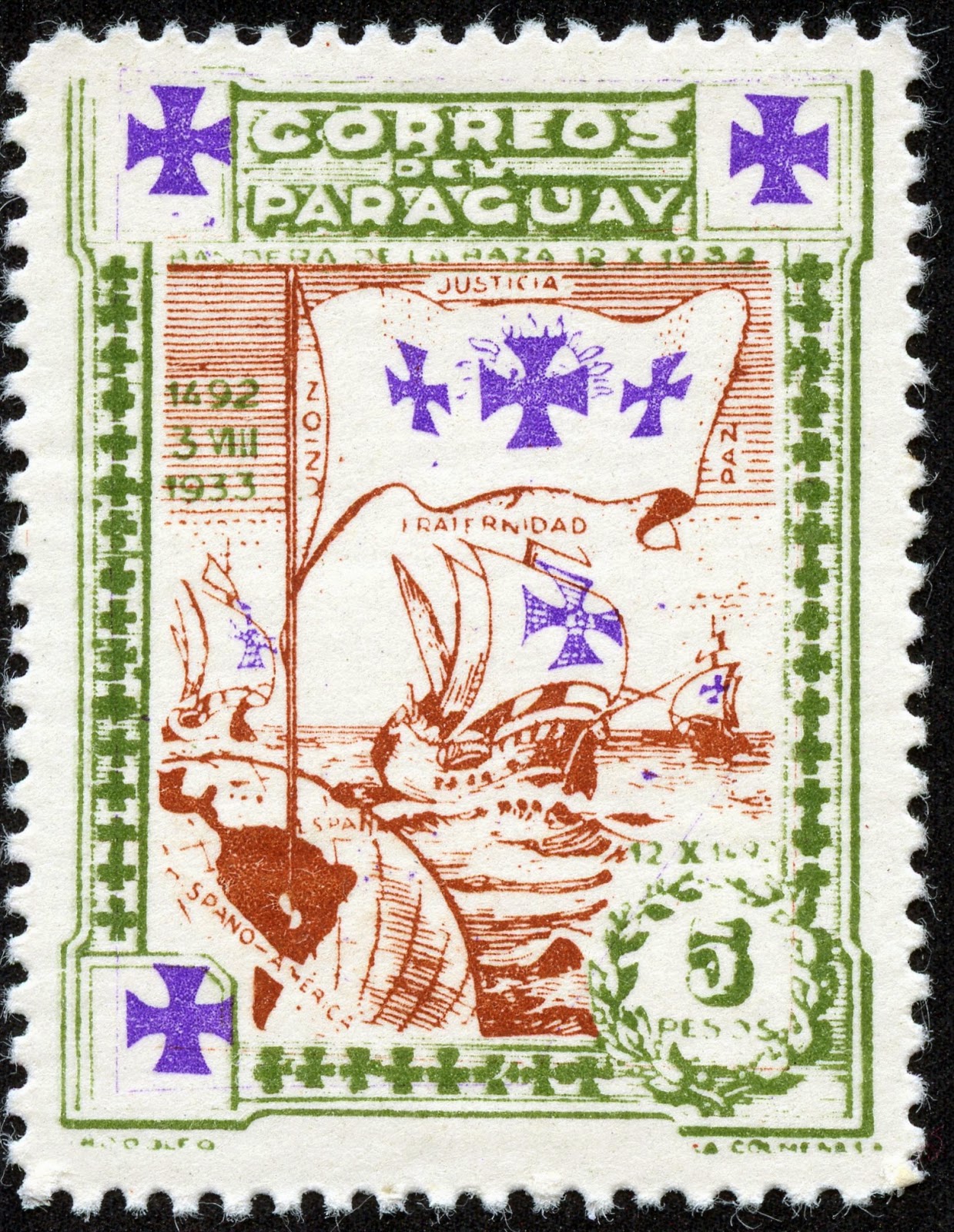
Paraguay has a number of quite attractive issues, not the least the lithographic multicolored 1933 eight stamp "Flag of the Race" ("Bandera de La Raza") emission that celebrates the 441st anniversary of the first voyage of Christopher Columbus. (441st? I have no idea why. ;-)

I needed the last three stamps in the set, and when a national dealer was having a sale on Paraguay, off went my order.

1933 Scott 335 2p multicolored Genuine
"Flag with Three Crosses: Caravels of Columbus
The design depicts the caravels of Columbus on the sea, and the flag with three crosses. Produced by lithography, the stamp has three colors, and would require three pass-through printings of the sheet to make the finished stamp. The first printing would be for the frame design, the second printing for the globe and caravels on the sea central design, and the last printing for the crosses, which are always in a violet color.

Quire striking, Yes? And the entire eight stamp set is only CV $6+ unused.

What could go wrong?

Paraguay Scott 330-337 "Flag of the Race" Issue
Genuines and Forgeries
A lot as it turns out. I was surprised to find, among the apparent genuine 10c and 2p, six stamps that had the look of a sketchy cartoon of the originals.

I believe the sketchy stamps (in more ways than one) are reprint forgeries from someone who had access to the original, but now worn, plates. A quick review of the usual sources could find no information on these reprint forgeries. (I'm sure there has to be information somewhere, perhaps buried in some philatelic journal. If a reader has knowledge about these stamps, I would be grateful.)

Could the "reprint-forgeries" actually be a second stamp printing sanctioned by the Paraguayan postal officials? I suppose it is possible, but they are so bad in appearance, it is highly doubtful. ;-)

Paper and Gum characteristics
Genuine (Left two); Forgeries (Right two)
The paper of the reprint forgeries is thicker than the original, and is quite white. The gum on the originals in my collection is now a brown color, while the reprint forgeries have white horizontally streaked gum.

Horizontal Stamp Perforations
(Presentation is vertical here)
Forgery (~11.4) vs Genuine (~10.9)
Scott states the originals are Perf 11.  But I measured ~10.9 for the horizontal teeth, while the reprint-forgeries appear to be ~11.4 Perf horizontally.

1933 Scott 331 20c multicolored
Genuine vs Forgery
Now let's look at comparisons. (Enlarge the image if it helps.)

The impression of the forgery is that of a stamp on very white paper that has finer sections of the central design missing. The crosses running horizontally and vertically along the frame are more blob like. The colors (red, light blue, purple) are clearly different than the original.

And the second (central design) and third printing (crosses) of the stamp are carelessly shifted compared to the original.

All of the reprint-forgeries show a blob-mark inside the "U" of PARAGUAY.

1933 Scott 332 50c multicolored
Genuine vs Forgery
The differences described for the 20c are found also for the 50c. Note the lack of horizontal lines by the small crosses on the frame.

1933 Scott 333 1p multicolored
Genuine vs Forgery
The violet color crosses on the original are a more purple color on the reprint-forgeries.

1944 Scott 334 1.50p multicolored
The 1.50p reprint-forgery shows all the forgery characteristics particularly well (that is poor and sloppy ;-)

1933 "Scott 336" 5p multicolored Forgery
Out of the Blue
The dealer was not aware that such reprint-forgeries existed. But now he does. And now you do too. ;-)

Comments are appreciated!

Saturday, October 10, 2015

Senegambia & Niger

1903 Scott 7 20c red/green "Navigation and Commerce"
A Hirschburger Forgery - for more on these forgeries, click here.
Quick History
Senegambia & Niger was a short lived administrative French possession territory in West Africa between 1902-04, when it was consolidated with a part of (earlier era) French Sudan territory to become Upper Senegal and Niger. (See clarifying note at the end of the blog post.)

French West Africa
Note "Upper Senegal and Niger", formed from..
"Senegambia & Niger", and parts of (then) French Sudan
Senegambia & Niger territory consisted of the upper basins of the Senegal river and the Niger river and parts east- somewhat ill-defined. The main settlement was Bammako on the Niger. This map shows the successor state (Upper Senegal & Niger), but is easy to read.

Senegambia & Niger
This period map shows the swath of land for "Senegambia et Niger". 

A German map of "French West Africa" territories
Note "Senegambien" for the Senegal and Gambia lands
"Senegambia" was an older term for the Senegal (French) and Gambia (British) lands that the French -especially- hoped to unite under their leadership. That never happened.

Senegambia & Niger administrative territory had one stamp issue: 1903 "Navigation and Commerce" stamps.

As mentioned, the administrative unit was changed to "Upper Senegal and Niger" after 1904. The French Colony of Upper Senegal and Niger, (capital Bamako), issued stamps from 1906-1921, when the name and postage stamps was changed to (later era) French Sudan.  

1903 Scott 1 1c black/lilac blue
Into the Deep Blue
The 2014 Scott Classic Specialized 1840-1940 catalogue has, for Senegambia & Niger 1903, thirteen major descriptions for the "Navigation and Commerce" issue. Of those, CV is $2+-$7+ for five stamps. It is possible to have a representative sampling for not too much expense.

A closer look at the stamps
100 Centimes = 1 Franc
1903 Scott 3 4c claret/lavender "Navigation and Commerce"
Senegambia & Niger stamp output is short and sweet: the "Navigation and Commerce" issue of thirteen stamps produced in 1903.

Since this design is found for virtually all of the French possessions, it is quite familiar indeed.

The issue is typographed, and the name of the colony is in either blue or carmine. Perforations are 14 X 13 1/2. Scott has a note that counterfeits can be found with perforation 13 1/2 X 14.

Deep Blue
1903 Issue in Deep Blue
Deep Blue (Steiner) has one page for the 1903 issue. Naturally, all the major Scott numbers have a space.

Senegambia & Niger coverage in Big Blue
Big Blue
Big Blue '69, has eight spaces for the 1903 issue. Coverage is 62%.

Senegambia & Niger in the '69 edition is located after St. Thomas and Prince Islands, and on the same page as Schleswig and the beginning of the St. Vincent coverage.

The 40s editions have Senegambia & Niger located after Salvador.

All editions have the same coverage.

BB has spaces for Scott 1-8, and includes two spaces @ CV $10+, and one space @ CV $20+.

Checklist

1903

1,2,3,4,5,6,7,8,

Comments
A) Expensive stamps ($10 threshold):
1903 Scott 6 15c gray ($10+)
1903 Scott 7 20c red/green ($10+)
1903 Scott 8 25c blue ($20+)

1903 Scott 2 2c brown/buff
Out of the Blue
French West Africa colony boundaries changed often, as they were "administrative" colonies rather than true nation-states. But, at least for Senegambia & Niger, it exists on a map of the period, and had one stamp issue. ;-)

Note: Regarding the formation of Senegambia & Niger: When (earlier era) French Sudan administratively broke up in 1899, the French authorities apparently formed "Upper Senegal" and "Middle Niger" administrative colonies, which issued no stamps of their own, but continued to use (earlier era) French Sudan Stamps. In 1902, the two administrative colonies were combined into Senegambia & Niger. I've been unable to find a map showing these earlier nascent colonies, which, frankly existed more as administrative/military post entities, rather than "real" colonies, as far as I can tell. The French Delegue General (Administrator) was the same for "Haut Senegal et Moyen Niger" (1899-1902) and "Senegambia & Niger" (1902-04). His name was William Merlaud-Ponty, a civilian. (Thanks to Michael Adkins (Dead Countries Stamps website) and Gerben van Gelder (StampWorldHistory website) for digging into this.)

Note: Maps appear to be in the public domain. I would like to thank Michael Adkins and Gerben van Gelder for locating the "Senegambia et Niger" map.

Have a comment?

Wednesday, October 7, 2015

Senegal Bonus Coverage- The Three Types of the 1914-33 Issue

1914 Scott 80 2c black & blue, Maury Type I
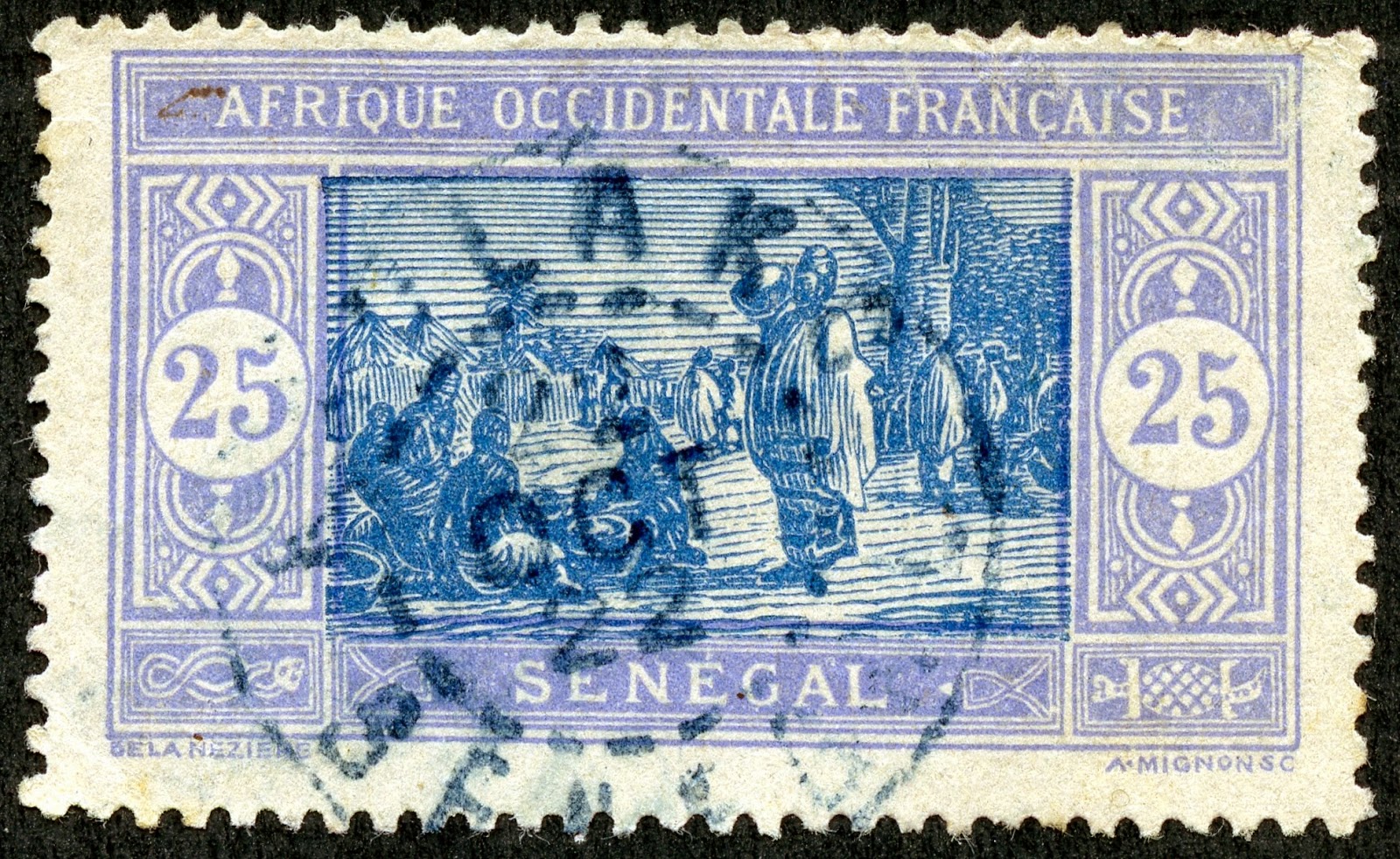
"Senegalese Preparing Food"
Into the Deep Blue
The Senegal typographic issue of 1914-1933 seems relatively straightforward. Typical of many French colony issues, there is a long run of stamps for this production, from 1914 to 1933, and some 44 stamps in the Scott catalogue. There is only one design, a local market scene of the Senegal natives preparing food. As I mentioned in my earlier post, the CV for this series is remarkably inexpensive @ <$1-$3.

But there is more to the story.

DJCMH, who follows the French colonial issues enthusiastically, and recently has begun his own blog  (very nice- check it out!), alerted me to the nuances of this issue.

"And here is another example of where having a specialized catalog can add all sorts of new collecting varieties. The 1914-1933 Market Scene pictorials come in three different types depending on minor variations in the central image. Maury outlines the differences and most of the values have at least 2, if not all 3 types, in existence. Get out a good magnifier and have fun as none of the varieties seem to carry much of a premium, but represent the changes that happen during the course of a long-lived definitive series.

The one interesting thing is that Maury only lists types for Senegal. It may be that more research would be needed but I would not be surprised if other French colonies have similar varieties, but they have not been studied to the same degree as Senegal's issues."


Now, as it turns out, between the time I prepared the Senegal blog post and it's publication, I did receive Maury's catalogue- Timbres de l' ex-empire francais d' Afrique.

Reviewing my own collection, I found a number of "types" for various values. Fun!

So, as a bonus, let's look at the types of this "one pictorial" issue.

Pictorial close-up of Scott 80 - Type I
The Type I print was used between 1914-1922. Measuring horizontally, the pictorial is 22 mm. There are several salient characteristics. (Maury has more detail, discussion (in French naturally), and images- worthwhile to buy the catalogue!)

* The image is generally the clearest and cleanest of the three types. 
* Note the hut in the background on the left? If it has a short vertical line on the top of the hut, that is diagnostic for Type I. (Type II and III do not show this.)
* Note the bowl at the lower left that is cut-off by the frame? (Type II's bowl is elongated here.)

Pictorial close-up of Scott 88- Type II
The Type II print was used between 1920-1933. Measuring horizontally, the pictorial is 22.5 mm. 

* The image is generally a little rougher than Type I.
* The hut on the left does not have a short vertical line at the top.
* Note the bowl at lower left continues through the frame, and is elongated compared to Type I & Type III (diagnostic).

Pictorial close-up of Scott 113- Type III
The Type III print was used between 1922-1933. Measuring horizontally, the pictorial is 23 mm.

* The image is generally quite rough, darker, and smudgy.
* The hut on the left does not have a short vertical line at the top.
* The bowl on the lower left is again cut-off by the frame.

If one is using the Scott catalogue, here are the type possibilities...

Scott number/ Types
79-I,II,III
80-I,II,III
81-I,II,III
82-I,
83-I,II,III
84-I,
85-I,II,III
86-II,III
87-I,II
88-I,II
89-II,III
90-II,III
91-I,II,III
92-I,II
93-I,II
94-I,
95-II,III
96-II,III
97-I,II,III
98-I,II,III
99-I,
100-I,II
101-II,III
102-II,III
103-I,II
104-I,II,
105-II,III
106-II,
107-II,III
108-I,II,III
109-II,
110-II,III
111-III,
112-I,II,
113-II,III
114-II,III
115-II,
116-II,
117-II,III
118-II,III
119-I,II,
120-I,II,III
121-II,III
122-I,II,III

1914 Scott 88 20c chocolate & black, Maury Type II
Out of the Blue
Why should specialists have all the fun? ;-) These stamps are inexpensive, and they offer the thrill of "discovery" in ordinary collections, with a little bit of knowledge.

I highly recommend the Maury group of catalogues for the French sphere. There is much more in them than is presented here.

And thanks to DJCMH for the timely tip about the 1914-33 issue. !!

Have a comment?

Sunday, October 4, 2015

Senegal

1900 Scott 43 15c gray "Navigation and Commerce"
Quick History
Senegal, on the coast of West Africa, has been under French influence since 1677. Initial important settlements included the island of Goree ( slave trade), Saint-Louis (Capital of Senegal 1673-1902, and French West Africa 1895-1902), and Dakar (Capital since 1902).

The country derives its name from the Senegal River that is located on the east and north border.

Of interest, the country completely surrounds Gambia on the Gambia river.

Slave Traders in Goree, 18th Century
Goree is an island, now part of metropolitan Dakar, and is famous (infamous) as part of the Atlantic slave trade. Although it actually was a relatively minor slave trade port (26,000 enslaved Africans out of 12 million exported total), it has a "House of Slaves" (Maison des esclaves) museum (UNESCO World Heritage site), that records and recounts the horrors of the era. It averages 200,000 visitors yearly. The slave trade from Senegal began to decline in the 1770s.

Colonial West Africa 
Note Senegal south of the Senegal River
The illustrated map shows the French Senegal holdings (green) along the coast and the south border of the Senegal river prior to 1880. Only beginning in the 1850s (under Louis Faidherbe, Governor), was there an attempt to colonize the interior of Senegal.

Stamps were introduced in 1887 using surcharged French Colony issues.

Senegal
The population was 1,700,000 in 1942. The prominent ethnic groups include Wolof (43%), Fula (24%), and Serer (15%). Islam is practiced by 92% of the population. French is the official language, but most inhabitants also speak their own ethnic language.

Senegal became independent on June 20, 1960, along with French Sudan  (Sudanese Republic), who together had formed the short lived Mali Federation. But the union split apart August 20, 1960, resulting in independent Senegal and the independent Republic of Mali.

French West Africa 1913
For history's sake, I should mention the federation of eight French colonial territories in Africa that existed between 1895 until 1960. They consisted (eventually) of Mauritania, Senegal, French Sudan, French Guinea, Cote d'Ivoire, Upper Volta, Dahomey, and Niger. The capital of the federation was Dakar (Saint-Louis prior to 1902) in Senegal.

The territories were governed administratively by a single Governor in Senegal from 1895, while each colony had a Lieutenant Governor. The lands were known, beginning in 1904, as French West Africa (AOF- Afrique Occidentale Francaise).

One will note that Senegal stamps, beginning in 1906, are labeled "Afrique Occidentale Francaise" or "AOF".

Of great help, Michael Adkins of Dead Counties Stamps website has recently added a French West Africa transition chart. Take a look!

1926 Scott 105 50c red orange & green
"Senegalese Preparing Food"
Into the Deep Blue
The 2014 Scott Classic Specialized 1840-1940  catalogue has, for Senegal 1887-1940, 250 major number descriptions. Of those, 131 are CV <$1-$1+, or 53%. However, the early surcharged French Colony stamps (1887-1892: 34 stamps) are quite expensive indeed (CV $80+-$5000+), are clearly specialist territory, and I will say no more about them here.

A closer look at the stamps and issues
100 Centimes = 1 Franc
1892 Scott 48 40c red/straw "Navigation and Commerce"
Excepting the quite expensive 34 stamps with a surcharged French Colony design between 1887-92, the first issue most WW collectors will have are the 1892-1900 "Navigation and Commerce" stamps. There are 18 stamps in the issue, and 10 are CV $1+-$6+. There can be counterfeits found: Genuines are Perf 14 x 13 1/2, while the counterfeits are 13 1/2 x 14.

1906 Scott 60 5c green 
"General Louis Faidherbe"
In 1906, a three design eighteen stamp issue was produced for Senegal. The designs were shared by other members of the French West Africa group (Cote d' Ivoire, Mauritania, Dahomey).

The seven lower denomination stamps features "General Louis Faidherbe", Governor of Senegal between 1854-1861 and 1863-1865.  He had opened up the Gum Arabic trade for the French by securing the north bank of the Senegal river.

CV for the Faidherbe stamps are $1+-$4.

1906 Scott 66 35c black/yellow "Oil Palms"
The second design, found on the eight middle denomination stamps, shows the commercially grown "Oil Palm"- Elaeis guineensis. CV is $3+-$8+ for seven stamps.

Oil Palm
The Oil Palm is native to west Africa (Angola to Gambia).  It is the principal source of palm oil, an edible vegetable oil from the Oil Palm's reddish fruit pulp. It is semi-solid at room temperature, and is a saturated vegetable fat. It is found widely in commercial foods.

1906 Scott 71 2fr blue/pink
"Dr. Noel Eugene Ballay"
The three highest denominations honor Noel Ballay, French Navy doctor, explorer, and poet. He was also Lieutenant Governor of Gabon (1886-89), Governor of French Guinea (1891-1900), and the Governor-General of French West Africa (1900-02).

He died at age 54, while stationed in Saint-Louis, Senegal in 1902 of "fever" (Yellow Fever?). One is reminded of the scourge of infectious diseases that felled many, even doctors, back then. 

1912 Scott 74 5c on 20c red/green
Six stamps from the "Navigation and Commerce" issue were surcharged 5c or 10c in carmine or black in 1912. This issue should be familiar to WW collectors, as examples are found for almost all the French colonies. Five stamps are CV $1+-$4+.

1914 Scott 91 25c ultramarine & black
"Senegalese preparing Food"
Forty-four stamps were issued between 1914-1933, all with the "Senegalese preparing Food" scene. The CV is remarkably inexpensive, with all the stamps @ <$1-$3.

1927 Scott 135 3fr on 5fr magenta & olive brown
Between 1922-27, fifteen stamps were surcharged in various ways. Thirteen are CV <$1-$2+.

1935 Scott 149 20c dark carmine 
"Faidherbe Bridge, St. Louis"
Another very long issue- 30 stamps- with two designs was released between 1935-1940. The above design is found on the twelve lower denomination stamps.

1935 Scott 161 1.25fr reddish brown "Diourbel Mosque"
The eighteen higher denomination stamps show the "Diourbel Mosque".

The entire issue's CV ranges from <$1-$2+- remarkably inexpensive.

Diourbel Mosque
Senegal is an Islamic country through the influence of the Almoravids (Berber dynasty of Morocco) in the 11th century.

1939 Scott 182 90d light rose violet
"Senegalese Woman"
There was a nine stamp issue in 1938-40 with the above native motif design. CV is <$1-$1+.

1938 Scott B3 1.75fr + 50c bright ultramarine
"Curie Issue"; Common Design Type
The "Curie Issue", a 1938 semi-postal, was to commemorate the 40th anniversary of the discovery of radium. I don't think I have shown this "Common Design Issue" before on the blog, found on 23 (mostly) French affiliated nation's stamps. (I say "mostly", because Cuba also issued the design!)

1935 Scott C7 3.50fr violet "Caravan"
A 1935 eleven stamp air post issue has two designs: "Plane over Coastal Area Landscape", and "Caravan".  Of interest, there was also a five stamp "Common Design Type" issue of 1940 for the French West Africa countries that also used the "Plane over Coastal Area" design, but with a white rather than a dark background for the country script tablet.

1906 Scott J5 10c red brown 
The French West Africa countries also shared this postage due design of 1906. For Senegal, there were eight stamps, and the CV ranges from $4+-$20+.

1914 Scott J12 5c green
Likewise, the 1914 eight stamp postage due issue for Senegal was shared with other French West Africa countries. CV is a modest <$1-$1+.

Deep Blue
1931 Colonial Exposition Issue in Deep Blue
Deep Blue (Steiner) has 16 pages for the stamps of 1887-1940 Senegal. All the Scott major numbers have a space. Naturally, that includes one page and one line of the very expensive early French Colony surcharged 1887-1892 stamps: I won't be filling those spaces for a long time. ;-)

1935 Scott 168 3fr green "Diourbel Mosque"
Big Blue
Big Blue '69, on seven pages, has spaces for 165 stamps. Coverage is 66%.

The 1940s editions have the same coverage.

There are only three spaces needing CV $10+ stamps.

Of the two long issues, BB provides spaces for 38 / 44 of the 1914-33 issue, and 24 /30 of the 1935-40 issue. "Appears" to be  good coverage, but eight of those missing stamp spaces only require CV <$1-$1+ stamps. ;-)

Checklist

1892
35,36,37,38,40,42,44,45,

1900
39,41,43,

1912
73,74,75,76,77,

1906
57,58,59,60,
61,64,(66),62,

1914-17
79,80,81,82,
84,87,88,91,
93,97,98,(99),

Next Page

1922
83,85,92,94,
100,104,120,123,
127,128,129,130,

1924
131,

1925
124,125,126,

1925-26
86,89,95,101,
105,106,109,113,

1927-28
90,96,102,107,

Next Page

1926-28
133,110,114,132,
134,135,

1930-33
111,116,
117,118,121,

1931
138,139,140,141,

1938
179,180,181,183,185,

1939
188,189,190,

Next Page

1935
142,143,145,146,
147,148,149,150,
151,152,153,154,
156,158,159,160,

1935
161,164,

1937
172,175,
173,174,176,177,

Next Page

1939
191,192,

1939-40
144,155,157,
162,163,165,
182,184,186,187,

Next Page

Semi-Postal

1915
B1,

1918
B2,

1938
B3,

Postage Due
1906
J4,J5,J6,J7,J8,(J9),

1914
J12,J13,J14,J15,J16,J17,J18,J19,

1927
J20,J21,

1935
J22,J23,J24,
J25,J26,J27,J28,
J29,J30,J31,

Next Page

Air Post
1935
C1,C2,C3,C4,
C5,C6,C7,(C8),

1940
C12,C13,C14,

C15,C16,

Comments
A) Expensive stamps ($10 threshold):
1938 Scott B3 1.75fr + 50c bright ultramarine ($10+)
1906 J8 30c red/straw ($10+)
1906 (J9) 50c violet ($10+)
B) (    ) around a number indicates a blank space choice.

1935 Scott J25 20c olive green
Out of the Blue
French colony stamps, at least for the Big Blue collector, are generally less expensive than British colony stamps.. One can fill a lot of spaces in BB with inexpensive French colony stamps as Senegal well demonstrates.

The bonus? They are attractive too!

Note: Maps and image pics appear to be in the public domain.

Comments welcome!

Colonial Saint-Louis 1902