A is for Aden and Z is for Zanzabar


A is for Aden and Z is for Zanzibar... Now what is between? For the world wide classical era philatelist and stamp collector, a country specific philatelic survey is offered by the blog author, Jim Jackson, with two albums: Big Blue, aka Scott International Part 1 (checklists available), and Deep Blue, aka William Steiner's Stamp Album Web PDF pages. In addition, "Bud" offers commentary and a look at his completely filled Big Blue. Interested? So into the Blues...

Wednesday, September 2, 2020

Bud's L of N Album: Conference cancels and early covers 1922-30

League of Nations (SdN) Album
6. SdN-related conference cancels and early covers
1922-30
(part 6 of a series)

It is both possible and quite interesting to trace the League’s history during the 1920’s philatelically. To do that, look to the stamped covers and special authorized cancellations. Some SdN covers continue to be available in on-line auctions, a few of which have near-historical significance. The League’s 100th anniversary (2020) has likely made the covers increasingly scarce, however.

 I’ve chosen two covers from my collection for this post.

The cancellation sheets, favored by collectors in the 1920s, are scarcer than the covers. These sheets are comprised of either SdN or Swiss stamps cancelled on the days of League related conferences and meetings. The SdN overprinted stamps shown here were all cancelled in Geneva while the Swiss stamps were cancelled in the city where the meeting/congress was held. Cancellation sheets for meetings in Lausanne, Rome, and Locarno appear in this post

Giuseppe Motta cover

Motta, a Swiss diplomat, served as the League’s president (1924-1925) and was honorary president of the League’s first assembly, 1920. As the chief Swiss delegate from 1920 until his death in 1940, he advocated membership for Germany, Switzerland’s most important economic partner in the inter-war period, but opposed the admission of the Soviet Union. He wanted to make the League something more than a coalition of WWI victors -- an idea disputed by France and hampered by the absence of the United States.

Motta (1871-1940)

Cover addressed to Motta, 12 November 1930, Scott # 2o13

Hague/Velleman Cover

The International Peace Congress held at The Hague, 10-15 December 1922, was convened by the Amsterdam International Federation of Trade Unions. Delegates attempted to find common ground between unionist and the peace movement, but results were disappointing. Russia introduced a series of pro-labor and war related policies that were never adopted. This was not an SdN-sponsored congress.


The cover, dated 12 December 1922 and addressed to (Antoine) Velleman, was forwarded to The Hague where, possibly, he was translating for the Peace Conference. Velleman is credited with the invention of the simultaneous translation system which allowed the League to conduct its business in real time. The draft reply penned on the reverse of the cover references the Congress.


Velleman cover, 12 December 1922, Scott #s 2o8, 2o18


Lausanne, Conference pour la Paix en Orient, November 1922 - July 1923

The Treaty of Lausanne, finally signed on 24 July 1923, officially ended the war between Turkey and the allied forces of Britain, France, Italy, Japan, Greece, Romania and the Serb-Croat-Slovene State, which had continued since the onset of World War I. The Treaty defined the borders of modern Turkey, except for those with Iraq. Turkey ceded claims to the remainder of the Ottoman Empire and, in return, the Allies recognized Turkish sovereignty within its new borders.

The treaty, composed of 143 articles, deals with such matters as trade, borders, protection of minorities, access to the Turkish Straits, and various binding letters. Among the agreements achieved: foreign governments could no longer operate their own post offices in the new Turkey (see Big Blue’s pre-WWI sections for Russia, Great Britain, Germany and France). The future of Mosel and Iraq, including postal authority, remained undefined and the matter was deferred.

The League authorized two cancelations for the duration of the Conference. The sheet with Swiss airmail stamps (shown below) has both cancels – dated 25 May 1923 – on Lausanne-Palace Hotel stationary. Both French and Turkish delegates stayed at this hotel, causing considerable “chatter” at the time.


Lausanne-Palace Hotel, 14 December 1922 cancel


15 January 1923 cancel

Rome, 32nd Session

The 32nd League session, meeting in Rome on 8-13 December, 1924, had agenda items with philatelic implications -- for example the frontier between Turkey and Iraq and the British mandates for Iraq and Palestine. These matters remained unresolved even though they had been partly “settled” a year earlier.

In commenting on this session, Aristide Briand, the French representative and a former French Premier, said "The League of Nations will become great and powerful only when America enters it" (New York Times, 13 December 1924). He hoped for American assistance in arbitrating wars out of existence which, of course, he did not get.

The sheet of 12 canceled SdN stamps (below), bears Geneva 1 postmarks.

SdN stamps, cancelled 10 December, 1924, day three of the 32nd session

Italy also produced cancellations for the Rome session.


“Consiglio Società Nazioni” Cancels 

Locarno, 1925

The Pact of Locarno (1 December 1925) produced a reconciliation between Germany and the major League members -- France, Belgium, Great Britain, and Italy. Widely acclaimed as a practical pattern for avoiding war, it “guaranteed” permanent peace in Western Europe. Central and South-Eastern Europe, it was hoped, would soon follow, then perhaps the whole world. Germany, as a result of this success, was allowed to join the League (September 1926).

In 1936, however, Germany rejected the Locarno agreements and invaded the neutral Rhineland. Locarno had failed and, for fear of starting a war, the other League members did nothing to prevent it. 

Two Locarno Cancels and a French Delegation Cachet
(from reverse of following postcard)

French Delegation Arrival, backstamped as shown above

Conference session, facsimile signatures, backstamped Locarno

Discussions about the philatelic fruitage of other League sponsored sessions and conferences will continue in future posts of this series.

Comments appreciated!

Saturday, August 29, 2020

Mauritius - Bud's Big Blue

Mauritius #s 1 and 2 (above) rank among the greatest rarities
Bud's Big Blue
Bud's Observations
Mauritius enthusiasts abound. And they’re an argumentative throng -- all for good reason. From Mauritius sprang forth the first British colonial stamps, and the world’s first stamp overprints, too. Early Mauritian postal authorities were stunningly creative. Lacking standard stamps from the homeland, they made a few of their own. Recent online stamp club squabbles tend to cluster around fakes and variations of these early innovations, of which there are many to gloat about or lambast.


Yet, the excitement dies, mostly, before Big Blue’s selection begins. As I glance across my collection (scanned below), I see the glamour of the early make-do issues yielding to the commonplace, so the allure tapers off. I see no rarities, although a few stamps showing on the supplement pages do have high catalog values. 

Two higher value stamps on the supplement pages
Scott 41 and 40
There’s not much history reflected in the designs of the later stamps, no local scenery, no celebrations of Mauritius’ diverse and polyglot population. Common British designs with color variations proliferate as do overprints and overprinted overprints -- not very exciting. Postal moguls back in England lacked the inventive imaginations of their colonial counterparts.

Big Blue places its Mauritius pages next to Mauritania whose stamps, by comparison, shine with local history, scenery, and ethnic people.

(Incidentally, the two countries’ names do not share a common linguistic derivation. “Mauri” in Mauritania comes from the ancient Latin term for the Berber population of North Africa while Mauritius is named after Prince Maurice van Nassau of the Dutch Republic. The Dutch, although the original colonists, 1638, abandoned the island in 1710. The French, arriving there a few years later, renamed it Isle de France. The British claimed it in 1810, booty from the Napoleonic wars, and adopted the original name.)

There are, in the classical era, only two philatelic hints about Mauritius’ diversity:
1) The 1899 commemoration of Admiral Mahe de La Bourdonnais’ birth bicentennial (French governor of Mauritius, 1734-46). It’s a curious issue for a British colony, except for the fact that French and French-based Mauritian Creole is spoken by 90 percent of the population (mostly Creole).

Scott #115, ultramarine

2) The postcards printed by the Central Printing Establishment (see example below) have instructions in French about where to place the address of recipients.  French is currently used in schools and the media. English remains the official language at the Parliament, although even there members may speak French.

 Royal Visit, Duke and Duchess of Cornwall and York, 1901, (George V)

Post-independence Mauritian stamps (1968) do a better job of depicting the island’s history, but it’s mostly colonial history with scant reference to the majority population. Even the above postcard was commemorated on a 1978 stamp.

Scott 460, 1978 ,Royal visit postcard 1901, 5r, multicolor

Census: 81 in BB spaces, one tip-in, 72 on supplement pages.

A guide to Mauritius stamp literature is found at: http://www.stampdomain.com/country/mauritius/

Jim's Observations
Stamps were initially issued in 1847: not just any stamps, but the famous "Post Office" Victoria Mauritius stamps (See Header pic). Mauritius, then, is a rich specialists delight, with some 24 major and minor number "Post Paid" stamps issued between 1847-1859, and a catalogue value in the thousands up to a million. !

But there are also many interesting issues produced that are attractive for the WW classical era collector of modest means, as well.

Mauritius Blog Post & BB Checklist

Page 1

1a

1b

1c

1d

Page 2

2a

2b

2c

Supplements
Page 1

Page 2

Comments appreciated!

Thursday, August 20, 2020

Cilicia 1919-1920 - a closer look

1919 Scott 66 1pi blue; Scott 9 20pa carmine rose; Scott 13 10pa green
Into the Deep Blue
Cilicia was occupied by the British and French in 1918 after the upheaval of WWI, and the French took control in 1919. Stamps were issued under the French Occupation from 1919-1921. Stamps of Turkey were either handstamped or overprinted "Cilicie" initially. Then Newspaper stamps were used, stamps of the French Offices in Turkey were surcharged, and finally stamps of France were surcharged.

Cilicia became part of southern Turkey in 1923, adjacent to the Mediterranean Sea. The population was 380,000, and the Capital was Adana.

Cilicia Blog Post & BB Checklist
Turkey Blog Post
Turkey Overprints - Ten Hints

Since Cilicia stamps present initially with handstamped, and subsequently overprinted stamps of Turkey, it behooves the collector to have a good grasp of Turkish stamps. One might want to review the blog posts on Turkey first.

And then the Scott catalogue for Cilicia is very poorly illustrated in terms of showing the underlying Turkish stamps, only referring back to the Turkey section with Scott numbers for Turkey.

Again, a good knowledge of Turkish stamps will make identification of the stamps of Cilicia much more pleasant.

Cilicia - a closer look
40 Paras = 1 Piaster

Issued under French Occupation


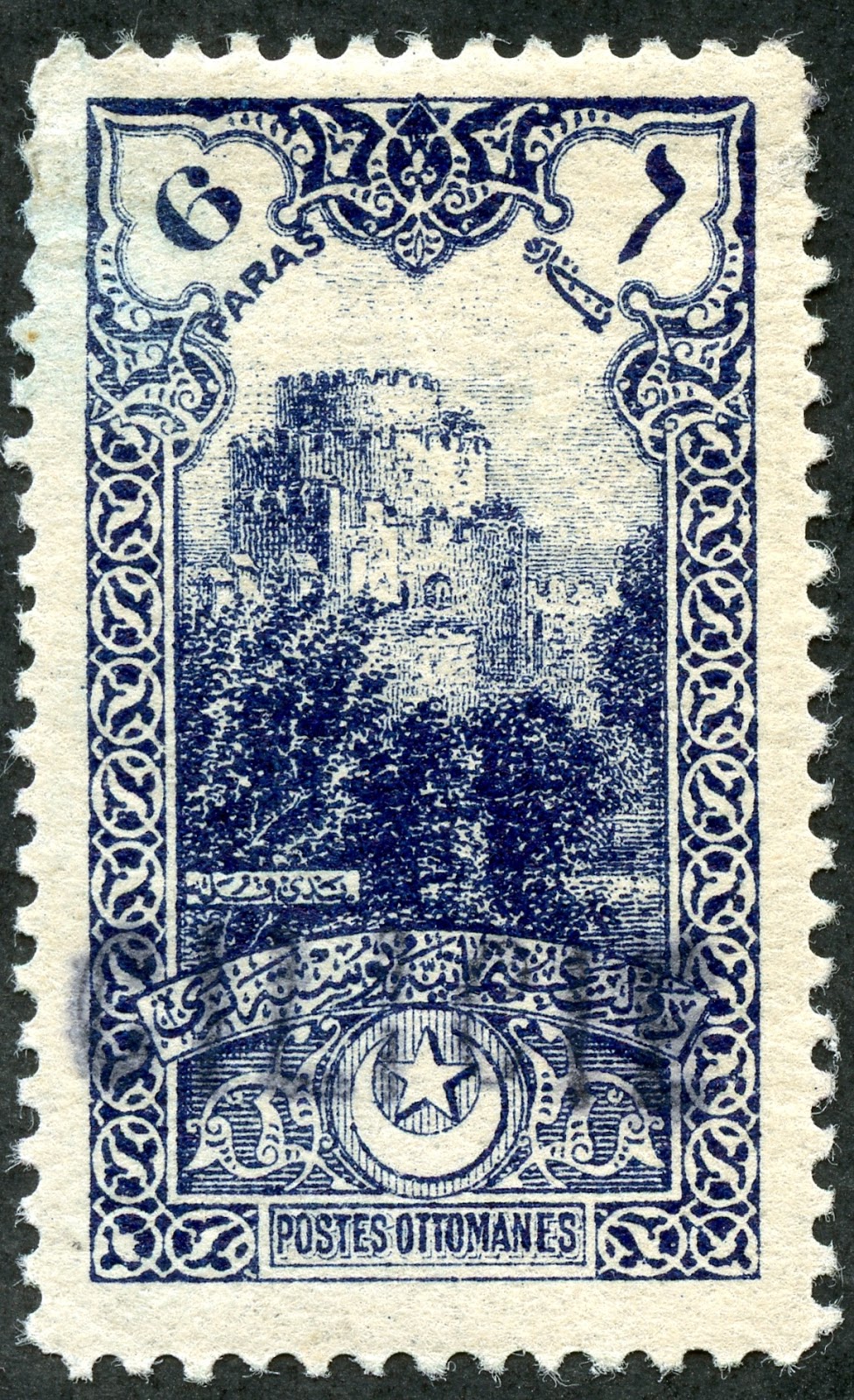
1919 Scott 4 6pa dark blue
On Turkey Scott 257
Turkish Stamps Pictorial Issue of 1913
Handstamped
The initial stamps for Cilicia were handstamped as above beginning in 1919.

This first handstamp was used on 25 stamps from various Turkish issues.

1919 Scott 12 5pi yellow brown & black
On Turkey Scott 349
Turkish Stamps Commemorative  Issue of 1916
The first handstamp, illustrated in the Scott catalogue, is larger than the second handstamp (shown beginning with Scott 32 below).

1919 Scott 21 5pi pale blue & black
On Turkey Scott 557a
Turkish Stamps Issue of 1919
The CVs for these handstamped specimens are moderately expensive: here $30+.

1919 Scott 22A 20pa carmine rose
On Turkey Scott B8
Turkish Stamps Semi-Postal of 1915
One can see how complicated these stamps are (various overprints), and one would be lost without a good grasp of Turkish overprinted stamps.

1919 Scott 32 4pa dark brown
On Turkey Scott 255
Turkish Stamps Pictorial Issue of  1913
The second handstamp type is found on 10 stamps from various Turkish issues.

1919 Scott 41 5pa on 10pa gray green
On Turkey Scott P137
Turkey Stamps Newspaper of 1916
Complicated - Yes? The CV for this stamp is $20+.

1919 Scott 51 2pa red lilac
On Turkey Scott 254
Turkish Stamps Pictorial Issue of 1913
The third handstamp shows cursive writing, and so cannot be mistaken. There are 20 stamps from various issues of Turkey with this handstamp.

1919 Scott 55 5pa ocher
On Turkey Scott 328
Turkish Stamps Issue of 1915
CV here is $30+.

1919 Scott 60 5pa orange
On Turkey Scott 421
Turkish Stamps Issue of 1916-18
Does one have to worry about handstamped counterfeits? Scott makes no mention of counterfeits (for the most part), but of course! Especially for a higher priced CV stamp, check to see if the handstamp resembles the Scott illustration. Unfortunately for WW collectors (and non specialists in these stamps), that is about all one can do, short of sending the stamp off for authentication.

1919 Scott 66 1pi blue
On Turkey Scott B19
Turkish Stamps Semi-Postal of 1916
But this is a fascinating part of the world, and, for myself, I have managed to accumulate some 84 stamps through feeder collections.

1919 Scott 77 20pa ultramarine
On Turkey Scott 347
Turkish Stamps Commemorative Issue of 1916
Overprinted in Black
Beginning with this issue, the stamps for Cilicia using Turkish stamps are overprinted in black, red, or blue.

"T.E.O" means "Territoires Ennemis Occupes".

1919 Scott 93 10pa red violet
On Turkey Scott B46
Turkish Stamps Semi-Postal of 1916
One will note that some Turkish Semi-postals and Newspaper stamps were handstamped or overprinted for Cilicia. In these cases, the stamps were used for ordinary postage.

1920 Scott 99 3 1/2pi on 5pa red 
Blue Surcharge
Issued in 1920, this issue, consisting of two values, is only CV #2+.

1920 Scott 103 20pa on 10c rose red
Stamps of France, 1900-17, Surcharged
The French authorities switched over in 1920 to using French derived stamps. This issue consisted of nine stamps with CV ranging from $1+ to $900!

Note "O.M.F." means "Occupation Militaire Francaise".

1920 Scott 114 2pi on 15c gray green ( on France Scott 139c)
Stamps of France, 1917, Surcharged
The "Eastern County" ("Sand. Est.") issue consisted of seven stamps. CV is $6 to $190. They were prepared for use, but never issued. Hence, one will only find "unused" in collections.

1920 Scott 124 5pi on 40c red & gray blue/grayish (GC)
First Setting: 1.75-2mm spacing between "Cilicie" and figures of value
------------------
1920 Scott 124d 5pi on 40c red & gray blue/grayish (GC)
Second Setting: 1 -1,5mm spacing between "Cilicie" and figures of value
The nine stamp issue of 1920 consisted of two settings.  The first setting (major number) has a space of 1.75-2 mm between "Cilicie" and the figure of value, while the second setting (minor number) have a space of 1 -1.5 mm.

Most of the stamps printed for these issues were on poor quality grayish paper (GC).

Handstamped "Air Post" 1920 France Scott 122d, 123c, 124d, 125d
Genuine Air Post stamps for Cilicia consist of a handstamped overprint (Poste Par Avion), and are quite rare. Only two air mail flights between Adana and Aleppo were flown. CV for these stamps (C1, C2) are $9,000!

However, according to Scott: "At a later date, impressions from a new handstamp were struck "to oblige" on stamps of the regular issue of 1920 (Scott 123-126) that were in stock at the Adana Post Office".

This cover fragment is either an example of this, or possibly an elaborate counterfeit.

Postage Due 1921 Scott J13 1pi on 10c chocolate
Postage Due Stamps of France Surcharged
The earlier 1919 postage dues consisted of handstamped Turkish postage due stamps.

The 1921 postage due issue used four French stamps, and was surcharged as above. 

1919 Scott 14 50pa ultramarine
On Turkey Scott 428
Turkish Stamps Issue of 1916-18
Out of the Blue
Cilicia is a wonderful challenge for the collector, as it gives tangible evidence of a bit of post WW I history, and it requires a decent knowledge of Turkish stamps.

Comments appreciated!