A is for Aden and Z is for Zanzabar


A is for Aden and Z is for Zanzibar... Now what is between? For the world wide classical era philatelist and stamp collector, a country specific philatelic survey is offered by the blog author, Jim Jackson, with two albums: Big Blue, aka Scott International Part 1 (checklists available), and Deep Blue, aka William Steiner's Stamp Album Web PDF pages. In addition, "Bud" offers commentary and a look at his completely filled Big Blue. Interested? So into the Blues...

Monday, January 30, 2023

Peru - Bud's Big Blue

Scott # 20, ultramarine, forgery? (1)
Bud's Big Blue
Bud's Observations

Most of us stamp collectors find our hobby satisfying at many levels, down to the reptilian core of our brains. Who among us has not felt our heart racing or temperature rising upon finding the right stamp? But beyond rewarding our lizard-like cravings, more cerebral satisfactions also accrue from our pet obsession.

Many of us look for stamps with historical relevance. Peru’s stamps, especially those with overprints, oblige nicely. That’s not surprising. Peru’s first inhabitants settled some 15,000 years ago. Conquistador Francisco Pizarro and the first Europeans arrived in 1532. The University of San Marcos (Lima) was founded in 1551, a century before Harvard was chartered. Eventually Peru became the seat of the South American Spanish Empire. So, there is plenty of history to inspire Peru’s stamp designs.

Scott # 2, brown red, wooden paddle wheeler withs sails (1)

Peru’s earliest stamps (1857-94) are devoid of human images -- an unusual omission -- unless you count the barely discernable passengers on the steamship’s deck (Scott #s 1 and 2). Instead, they feature the Inca sun god, wildlife, and Peru’s coat of arms – populated by a vicuna, a quinine yielding tree, and a cornucopia of gold coins. 

Peru coat of arms

The coat of arms is often difficult to discern because of heavy cancellations and indistinct embossing made by the French "Lecoq" machine. Peru’s name did not appear on its postage until 1866.

Scott #15, orange

If you like baroque puzzles, try sorting out the history behind Peru’s late 19th century overprints. Sometimes applied three deep, they reflect Peru’s history between 1874 and 1894 as it actually was happening. Peru’s economic and political upheavals, an invasions by Chile, and the death of a hero/president – all are documented philatelically by a jumble overprints. These appear entirely on Peru’s 1874 issue, seven stamps ranging in value from 1 centavo to 1 sol. Forgeries and special combinations of overprints concocted to please collectors, but never issued, only partly muddle the story that unfolds.

Overprints three deep, unissued

By 1880, Peru’s paper money was practically worthless on the international market, so the 1874 stamps were overprinted with “Universal Postal Union,” “plata” and “Peru” in an oval. In effect surcharged, these stamp required being purchased in silver (plata) and were for international mail only. Domestic postage could still be purchased with paper money.


Scott #32, green, smaller “plata,” “Peru” at the bottom

The Chileans had been warring with Peruvians since 1879. When in 1881 Chile gained control of Lima and took over the government, including the post office, “Peru” was changed to “Lima” at the bottom of the overprint. This hostility, known as the War of the Pacific, was bloody. Both Peru and Bolivia suffered major losses, including Bolivia’s access to the Pacific Ocean.


Scott # 38, green, larger “plata,” “Lima” at the bottom


For further affrontery, in 1881 Chile’s postal authorities cattle-branded their own coat of arms on Peru’s 1874 issue. Some of these were further overprinted with UPU horseshoes for international use (see last supplement page).

Scott # n11, orange, Chilean coat of arms

But the Chileans were dispatched from Lima in 1883, thus requiring new overprints, this time restoring “Peru” in a triangle on, of course, the ever-durable 1974 series.


Scott # 65, orange

Further, the remaining stamps with the “Lima” that the Chileans emblazed required an additional overprint to celebrate Peru’s regaining control.


Scott # 81, rose

At the same time, new UPU horseshoe overprints for international mail were required and issued both with and without the victorious Peruvian triangle.

Scott #s 89 and 95, blue and green

Largely to promote philatelic sales, Peru produced the “correos Lima” overprints in 1884. Only the five centavos denomination was issued, reserving the one and two centavo sun-god-upon-sun-god stamps for curiosity collectors (see first supplement page). BB has space for the five centavos only.

Scott # 103 and unissued, blue and brown on cream

Perhaps running short of postage for international use, Peru reissued the plata-Lima ovals in 1889 with the larger of the two plata fonts. Peru’s paper currency was still suffering from devaluation.


Scott #s 117 and 117A, green and green

Then in 1894 the trustworthy 1874 series was pressed into service for a final time to mourn the death of President Remigio Morales Bermudez, whose grandson that he never saw also became Peru’s president. This last overprint is unique in philately – almost a funerary death mask that appears both alone and with the UPU horseshoes.


Scott #120, rose

While the used and abused 1874 series drops out of sight at this point, other overprints and the upheavals associated with them continue in Peru’s philatelic history. As soon as 1895 vermilion surcharged stamps prepared by revolutionaries emerged in the Tumbus region of northern Peru.

Scott #s 129 and 130, green and vermilion

Peru’s overprints are like baroque puzzles; the one shown below has 30 strange interlocking pieces. The overprints interlock, too. I’m still working on the puzzle and the overprints. And I have yet to start on the local provisional issues that cropped up during the Peru-Chile war – defiant overprints devised in localities that Chile had not conquered.

Bronze baroque puzzle titled Omaggio ad Arcimboldo [homage to Arcimboldo]
 by Miguel Ortiz Berrocal

Census: 314 in BB spaces, 14 tip-ins, 122 on supplement pages (Note: Some stamps in the supplement pages are mounted sideways to facilitate reading the postmarks.)


(1) An often-forged stamp, see https://stampforgeries.blogspot.com/search?q=peru

2) This post, in part, is informed by:  A. L. de la Torre Bueno “The Regular Issues of Peru” The Postage Stamp, Vol 11, No 11, December 14, 1912, p. 123. Originally published in Mekeel’s Weekly Stamp News.


Jim's Observations

The War of the Pacific (1879-1883) was devastating for Peru, as they were defeated by the Chileans. (One can argue the Bolivians had even a worse result, as they lost the Litoral Province and their sea access to Chile.)

Lima was occupied (1881), and the nitrate rich territory of Tarapaca was acquired by Chile. It took until 1929 to solve the Arica province (to Chile) and the Tacna province (to Peru) territorial disputes.

You think the old resentments are gone now? I talked to an acquaintance of mine, who is a professor of Latin American History (and who grew up in Peru), and they certainly are not.

But bad news for a country is sometimes good news for collectors. There are interesting (and inexpensive ) overprinted Chilean occupation stamps, as well the overprinted provisional issues produced in outlying areas; as both Lima and Callao, the source of stamps, were occupied. The fly in the ointment, of course, are the numerous counterfeit overprints.


Page 1


1a


1b


1c


Page 2


2a


2b


2c


Page 3


3a


3b


3c

Page 4


4a


4b


4c


4d


Page 5


5a


5b


5c


Page 6


6a


6b


6c


Page 7


7a


7b


7c


Page 8


8a


8b


8c


Page 9


9a


9b


9c


Page 10


10a


10b


10c


Page 11


11a


11b


11c


11d


11e


Page 12


12a


12b


12c


Supplements
Page 1


Page 2


Page 3


Page 4


Page 5

Page 6


Page 7


Page 8


Comments appreciated!


Friday, January 20, 2023

More Recent Acquisitions - United States

1861-62 Scott 67 5c buff "Jefferson"
Into the Deep Blue

I've had a run on acquiring classic U.S. lately. See...


Well, here is another one. ;-)

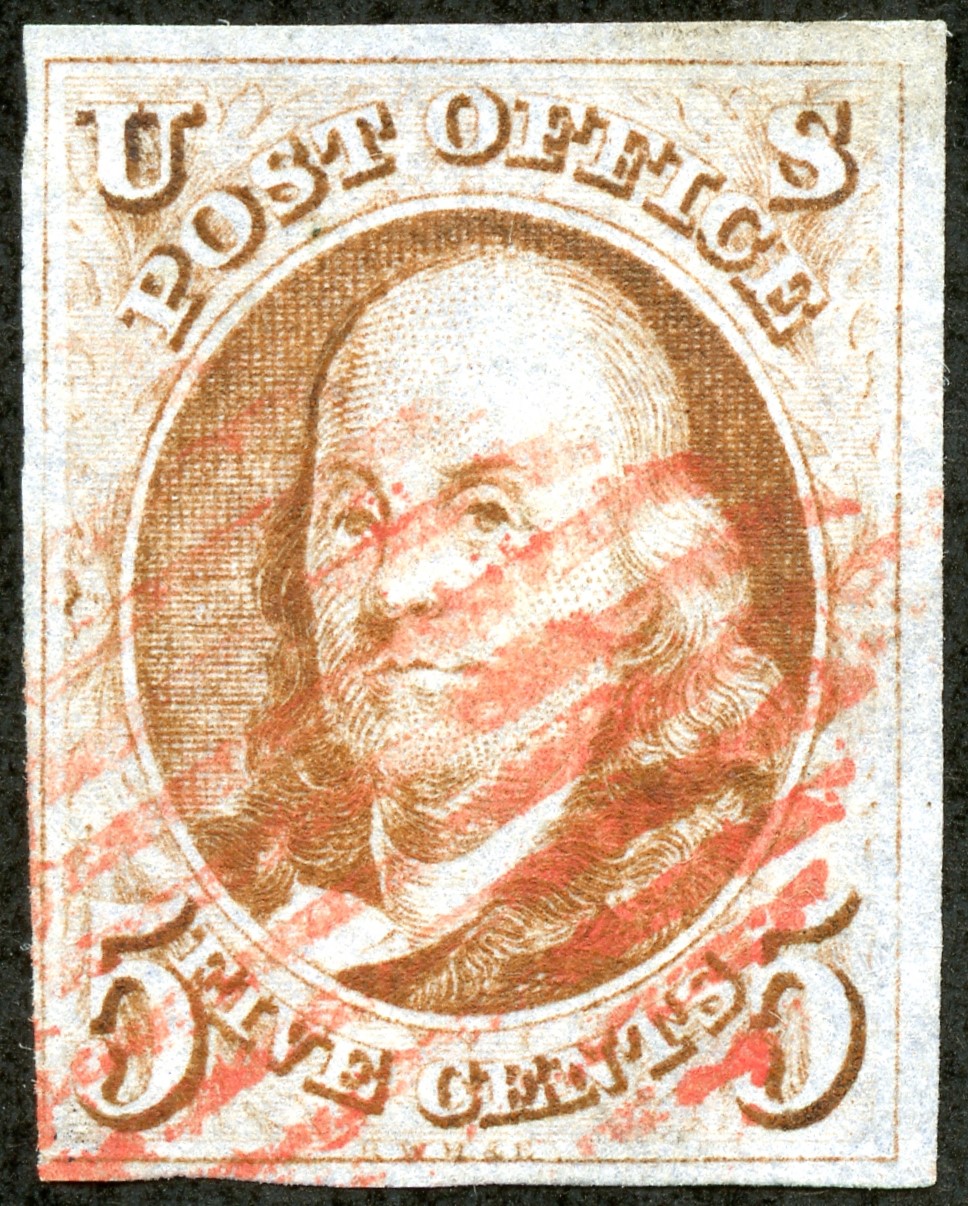
1847 Scott 1 5c red brown "Franklin"
Red Cancel

The local Stamp Club had an auction, and this Scott 1 5c "Franklin" with a red cancel was added to my collection. Actually, although the catalog number "Scott 1" lists "red brown" as the color, this particular example is more "pale brown" CV is $350 (2020), down from $525 (2011).

I bought this stamp @ 40% CV because it is a nice example, and it is a different color hue from the 5c "Franklin" I already had in my collection (shown below).

1847 Scott 1a 5c dark brown "Franklin"

The 1847 5c "Franklin" can be found in color hues of red brown, pale brown, brown, dark brown, grayish brown, blackish brown, orange brown, red orange, and brown orange.

This stamp, already in my collection, is "dark brown" (CV $400).

1861-62 Scott 67 5c buff "Jefferson"

The "buff' colored 5c "Jefferson" was issued in 1861-62. The CV price was $1,150 (2011), but now (2020) is CV $750. This stamp was acquired for 10% CV.

1863 Scott 76 5c brown "Jefferson"

In contrast, note the dark brown color of the 1863 5c already in my collection. Quite the difference. !!

1869 Scott 116 10c yellow "Shield and Eagle"
Red Cancel

I have been working on finding 1869 issue stamps, and I did not have the 10c yellow.

Last week (at the time I am writing this post), our Stamp Club was hosting a dealer bourse. There was a specialist U.S. dealer there, and he had this fine centered (for the issue) 10c yellow with a red cancel in his inventory. CV is listed at $110 (2020), down from $150 (2011). The red cancel adds $40. Naturally, with a nice specimen like this from a specialty dealer, one pays more.  I'm happy. 

1871 Scott 149 7c vermilion ""Stanton"
White Wove Paper; Without Grill
National Bank Note Company

The National Bank Note issue of 1871 does not have the secret marks (1c to 15c) added subsequently in 1873 by the Continental Bank Note Company. It turns out that the "secret marks" on many of the denominations are not always reliable, and one has to additionally rely on change in color or other variables to distinguish the issues.

1871 Scott 149 7c vermilion ""Stanton"
Close-up: No Secret Mark

Fortunately, for the 7c "Stanton", the "secret mark sign - yes or no- is reliable.

I didn't have the 1871 NBNC 7c with no "secret mark", and, as the Club auction had one, I obtained this specimen for 1/3rd the CV $90 price (2020).

1873 Scott 160 7c orange vermilion ""Stanton"
White Wove Paper, Thin to Thick; Without Grill
Continental  Bank Note Company

For comparison, here is the 1873 CBNC stamp already in my collection.

1873 Scott 160 7c orange vermilion ""Stanton"
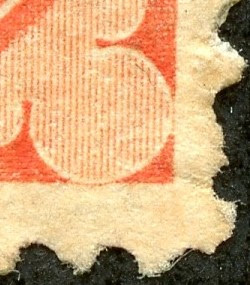
Close-up: Secret Mark

Note the obvious "secret mark": two small semi-circles are drawn around the ends of the lines that outline the ball in the lower right hand corner. 

1870 Scott 151 12c dull violet "Henry Clay"
White Wove paper, Without Grill, Perf 12
National Bank Note Company, No Secret Mark

I attended my local stamp club meeting this week ( at the time I am writing this), and on the "Bid Board" was Scott 151 (CV $200) with an interesting cancel. I took it @ 15% CV, not knowing if I had the stamp. It turns out the specimen is my third copy (The others are better centered), but I still like the cancel.

The ball of the "2" is round - which means this stamp does not have the secret mark, and is a NBNC production without grill. For the Continental BNC 12c stamp of 1873 (Sc 162) - which I still don't have a copy! - the ball of the "2" is crescent shaped (Secret Mark).

Canada 1897 Scott 53 3c bright rose "Victoria"
Jubilee Issue

At our club meetings, we have a stamp giveaway. Random numbers are assigned to the sign-in sheet. My number was called, and this nice unused Canada 3c Jubilee stamp (CV $30) was there for the taking. Not bad!

1855-63 Cape of Good Hope Scott 3a (SG 5b) 1p deep rose red 
"Hope Sitting"; Perkins Bacon Printing

Not all my recent additions are U.S. classic stamps - far from it. I did obtain many copies of the COGH 1853-64 triangular stamps, as my recent posts can attest. This particular stamp has not been shown before, however.

1855-63 Cape of Good Hope Scott 3a (SG 5b) 1p deep rose red 
"Hope Sitting"; Perkins Bacon Printing
APEX Certificate

It turns out that the stamp, represented by the seller as a 1863-64 De La Rue printing, was in fact a "deep red rose" Perkins Bacon printing. This is a reminder that, if one is buying a fairly expensive stamp. perhaps spending an extra $30 for a Cert might be advisable. And rather than the stamp having a CV of $325 (De La Rue printing), the CV for this example is $425 (Perkins, Bacon printing). !!

Out of the Blue

Well, I hope you enjoyed this third! recent post on U.S. (primarily) additions to the collection.

Comments appreciated!