
Goldilocks and the Three Bears
Into the Supremes
"Once upon a time, there was a little girl named
Goldilocks. She went for a walk in the forest. Pretty soon,
she came upon a house. She knocked and, when no one answered, she walked
right in.
At the table in the kitchen, there were three bowls of porridge. Goldilocks was hungry. She tasted the porridge from the first bowl.
At the table in the kitchen, there were three bowls of porridge. Goldilocks was hungry. She tasted the porridge from the first bowl.
"This porridge is too hot!" she exclaimed.
So, she tasted the porridge from the second bowl.
"This porridge is too cold," she said
So, she tasted the last bowl of porridge.
"Ahhh, this porridge is just right," she said
happily and she ate it all up."
And to stretch the metaphor, is the Minkus Global Supreme Album the "Goldilocks" solution for world wide classical era collectors.... not too hot, not too cold, but just about right?
In my opinion....
Yes....
....with lots of ifs, ands, or buts, so read on. ;-)

Minkus Logo
Background
The Minkus brand was the brainchild of Jacques Minkus (1901-1966), an immigrant from Poland (1929), and stamp dealer who established his stamp counter at Gimbells Department store in Manhattan in 1931. Eventually, there were 28 counters within Gimbells stores throughout the United States. (Gimbells closed in 1987, but Macys- its rival on 34th street- is still around.)
Minkus published their own world wide stamp catalog, and country and regional albums.
And, important to WW collectors, they published the Supreme Global Stamp Album in two volumes in 1954 covering the world 1840-1952+ with 76,000 spaces. (Do not confuse the Supreme with the Master Global Album, which offers significantly less earlier coverage of WW issues. OTOH, the supplements for the two albums eventually merged- exactly when, is still unclear to me. See discussion by James in the Comments section for more information.)
The credit for the good attributes of the Supreme has to go to George A. Tlamsa, Editor in Chief of the Minkus New World-Wide Postage Stamp Catalog (which rivals the Scott catalogue in depth and quality), and editor of the Minkus Country and Regional albums. His stamp acumen and knowledge is apparent on every page of the Supreme.
The credit for the good attributes of the Supreme has to go to George A. Tlamsa, Editor in Chief of the Minkus New World-Wide Postage Stamp Catalog (which rivals the Scott catalogue in depth and quality), and editor of the Minkus Country and Regional albums. His stamp acumen and knowledge is apparent on every page of the Supreme.
But the Minkus brands always played second fiddle to Scott in the United States, and today the Minkus catalog numbers are essentially dead.
And no doubt that was the intent of Amos/Scott in 2004, when they acquired the Minkus/Krause holdings.
Fortunately, Amos saw the wisdom of returning the Supreme to print, or "print on demand".

Supreme Global Pages- 1840-1952
"Goldilocks" Evaluation
The problem we WW collectors have is, how, in a reasonable way, are we to house our collection?
Putting stamps into stockbooks is popular in Europe, and with some U.S. collectors.
But, leaving aside that choice (and it may be the right choice for many!), let's look at the realistic possibilities for WW coverage using manufactured album pages.
(Yes, I know, one can do wonders with digital albums, and there are amazing examples out there, but that is another topic.)
(Yes, I know, one can do wonders with digital albums, and there are amazing examples out there, but that is another topic.)
I see these major choices, at least for the Scott-centric stamp world.
Scott Specialty Albums
Many great collections have been housed in the Scott Specialty pages. Not all parts of the world and countries are currently available. Generally, will take a considerable shelf volume, and newly manufactured pages are expensive. If one's aim is to have a WW collection of such scope that it will eventually be handled by one of the major auction firms, then this might be the right choice.
Steiner WW pages "Too Hot"?
Available for little initial outlay- as one generally prints one's own pages, the Steiner will provide all the major Scott numbers with a space. For 1840-1940 plus British Commonwealth to 1952, 6,500 pages are available. For the world up to the present, some 80,000 pages are available as PDF files. I presently house my own collection in Steiner pages. (The more expensive Palo album pages are, not uncommonly, an enhancement of Steiner pages, with color stamp images in the spaces, and on very nice paper. May be worth it for some collectors.)
But, for many WW collectors, the comprehensive coverage may be too much. Too many empty spaces, unless one already has a substantial collection for a country. I think, unless one's collection for the classical era is already 20,000 stamps or greater, the pages will overwhelm the collection. I have 40,000+ stamps mounted for 83,000+ spaces; yet many pages show a few stamps swimming in a sea of empty spaces. Not a good look. And what about expense? This is a hobby for me, not a wealth portfolio. Then there is the space requirements. Plan on some 8-10 feet for the 44 1 1/2" binders.
Some of the same arguments can be made for the Scott/Vintage 1840-1940 six volume "Big Brown" albums. They also offer a space for every stamp issued. Comprehensive is not necessarily good, unless one already has a lot of stamps, and a healthy budget. In addition, the stamp space identifications are frozen in time to reflect the Scott catalogue of that era. But, because of greater density of stamps per page, space requirements should be less than the Steiner. And, this choice is still quite popular among WW classical era collectors.
Big Blue "Too Cold"?
Do not rule out Big Blue 1840-1940- the sum is greater than the parts! Filling 35,000 spaces is not an easy task, accomplished by few. And there is a checklist available. ;-)
If one doesn't mind collecting to the album - as there are probably 10,000 more stamps that could have been included- and watermarks and perforation differences are not that important, then Big Blue is the one!
OTOH, if the above restrictions and simplifications annoy you, then look elsewhere.
Minkus Supreme "Just Right"?
And that brings us to the Supreme.
Well, you might ask, why is the BB blog looking at the Supreme now- doesn't Jim already have 40,000+ stamps mounted in Deep Blue (Steiner)?
Yes, quite true.
But curiosity got the better of me, and perhaps a whiff of fresh grass from the "grass is always greener elsewhere" tendency that I am sometimes susceptible to, so I ordered a new set of Minkus Supreme 1840-1952 pages from Amos last month.
Before the discussion goes further, I need to acknowledge Bob Skinner of "Filling Spaces" blog fame, who has done some incredible spade work with a number of blog posts about the Supreme. In particular his "Revisiting the Supremes" blog post got my attention. (Also, comments by wgrady and James, who own Supremes, offered valuable insights.)
Consistently, the larger countries all had 20% or greater coverage than BB's comparable coverage. (True, some smaller countries and colonies had the same coverage, or sometimes even less than BB.)
Could the Supreme indeed be the "Goldilocks" album for WW classical era collectors?
As a bonus, the Supreme covers all countries to 1952 (actually 1953-54 in some cases). Since I recently have become interested in expanding the collection to include WW II and aftermath, that particular feature was attractive.
Update: The "1954" Part I 1840-1952 edition sold by Amos is, in fact, not the original 1954 edition. It has been enhanced in some cases with additional country coverage.
Specifically, the enhanced pages for the country included in the 1957 supplement are there!
Estonia: 3 DS pages, No Minkus numbers
Fiume: 3 DS pages, No Minkus numbers
K,U, & T: 3 DS pages, No Minkus numbers (Goes up to 1955)
Maldive islands: 1 DS page, No Minkus numbers (Goes to 1956)
French India: 3 DS pages, No Minkus numbers (up to 1954)
Conclusion: The Part I 1840-1952 Minkus Supreme edition sold by Amos now is, at the very least, enhanced with country pages included with the 1957 supplement. No Minkus numbers in the spaces.
Update: The "1954" Part I 1840-1952 edition sold by Amos is, in fact, not the original 1954 edition. It has been enhanced in some cases with additional country coverage.
Specifically, the enhanced pages for the country included in the 1957 supplement are there!
Estonia: 3 DS pages, No Minkus numbers
Fiume: 3 DS pages, No Minkus numbers
K,U, & T: 3 DS pages, No Minkus numbers (Goes up to 1955)
Maldive islands: 1 DS page, No Minkus numbers (Goes to 1956)
French India: 3 DS pages, No Minkus numbers (up to 1954)
Conclusion: The Part I 1840-1952 Minkus Supreme edition sold by Amos now is, at the very least, enhanced with country pages included with the 1957 supplement. No Minkus numbers in the spaces.

The Thick and the Thin of It
I guess I shouldn't have been too surprised, but the entire 1,068 double sided pages (2,136 face pages) fit into eight 1 1/2" binders without difficulty. And since the pages are punched for two posts or three rings, and are not too large, I used the binders I already had. (Note: as the pages are double-sided, one will also need to make room for interleaving.)
O.K., but how to evaluate?
For starters, why not use the very first country page in the Minkus Supreme - which happens to be for the USA? One should be able to learn a lot about the characteristics of album philosophy by looking at how Steiner, BB, and the Supreme handle the USA 1847-1969 issues. (Believe me, it is not to show off the USA collection, which is rather meager. ;-)
So I took my early USA, put them in the respective albums, and scanned the results.
Deep Blue (Steiner)
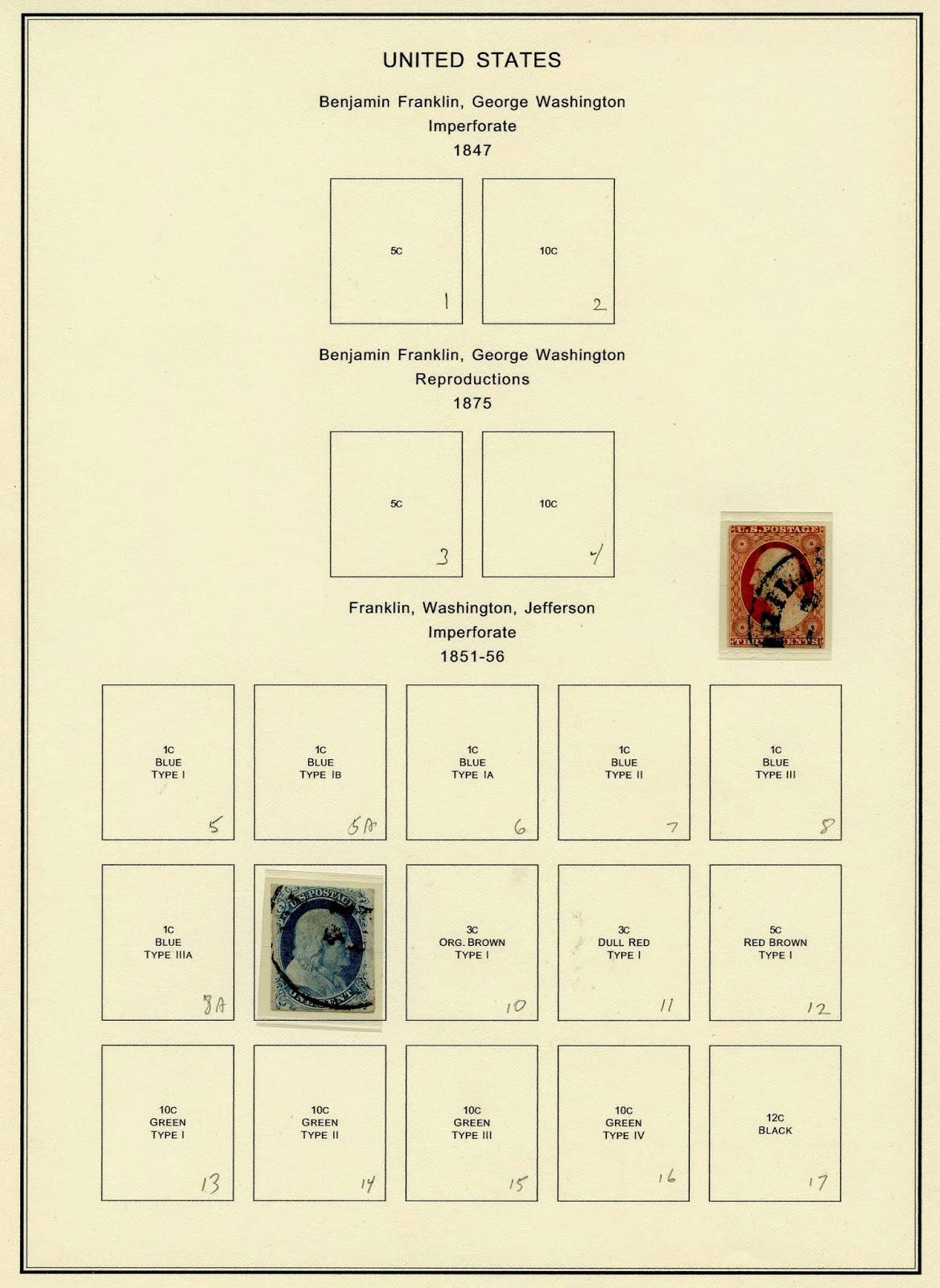
Steiner USA Page 1
Note how Steiner includes the seven major Scott numbers (types) for the 1851-56 1c blue "Franklin" imperforate, and the four major Scott numbers (types) for the 10c green "Washington" imperforate? That coverage would be perfectly acceptable for a comprehensive or specialized collection of early USA, but for a general WW classical collection by collectors of ordinary means?
Overkill, in my view..."Too Hot".
(And just to demonstrate the Steiner isn't "perfect", even for a comprehensive collection, note that Scott 11A 3c dull red type II "Washington" isn't given a space. ;-)

Steiner USA Page 2
Page two has seven spaces for 1c blue "Franklin" types, six spaces for 5c brown "Jefferson" types, and five spaces for 10c green "Washington" types.
Great for USA specialty collectors. ;-)

Steiner USA Page 3
The third Steiner page looks reasonably appropriate for WW classical era collectors, although the 1861 Scott 62B 10c dark green may take awhile to fill @ CV $1,600. ;-)

Steiner USA Page 4
Here Steiner offers a space for the 1867 Scott 85A "Z" grill 1c blue "Franklin" @ $3,000,000. Perfectly appropriate if the collection belongs to Bill Gross. ;-)

Steiner USA Page 5
The coverage of the "F" grills look O.K., but the 1875 "Re-issues of 1861-66" stamp space coverage (CV $Thousands), is probably not for the WW generalist.
Note how lonely the stamps seem to be, swimming in a sea of blank spaces?

Steiner USA Page 6
The coverage looks generous for the WW classical collector, but possible. Note Steiner here offers relatively few spaces for the page- a general characteristic of Steiner pages. Nothing wrong with that, except it will require more pages, and more volume (bulk) to cover the classical era.
Conclusion
For many WW classical era collectors, and certainly for my USA collection, the Steiner coverage is....
...too hot.
Now, I know that an early USA collection is particularly difficult, even for USA specialists. But, truth be told, it is not a good look.
Is there a better way to show off the USA collection?
Big Blue (Scott International Part I 1840-1940)
As Big Blue started out as a "Junior" album, the question, compared to the Steiner, is entirely different: will it offer appropriate spaces and enough spaces to satisfy most WW classical collectors for USA coverage?
Let's take a look....

Big Blue Page 1
Doesn't that look better?
It looks like I have an actual early USA stamp collection- but aren't looks deceiving, as we just reviewed how the collection looked in the Steiner? ;-)
Still, I definitely prefer this presentation as a WW generalist.
But let's look at the particulars..
* One could argue that the 1847 10c black @ CV $1000 is overkill for BB, but I have an admiration for this stamp, and would like to think that maybe someday......
* Only three spaces for the 1851-56 imperforates? One could argue it should be more.
* Only three spaces for the 1857-60 perforates? I wouldn't mind more.

USA Scott 71 30c orange "Franklin"
*The 1861-67 line is completely full with stamps in BB. But clearly, BB doesn't provide enough spaces, as even my meager collection has the 30c orange "Franklin" without a space.
The next line (seven spaces) is for grilled stamps. I think the coverage is actually too generous. And why would BB specify a grilled version of the 1867 Scott 98 15c black "Lincoln" @ $300, rather than the ungrilled 1866 Scott 77 15c black "Lincoln" @ $180?
*1869- coverage is appropriate, if not generous.
Conclusion
I'm thinking of the rest of the USA pages also (In particular, the poor overall coverage of the Washington/Franklin issues), as well as the above analysis, when I conclude that (for me) BB's coverage for the USA is....
...a bit too cold.
(May be a moot point for many BB collectors, who also have a USA collection housed in another album.)
Minkus Supreme 1840-1952
What does the Supreme have in store for us?

Supreme Page 1
I like it! But before we consider specifics, lets glean some general impressions.
*Paper is white tint, thick, and has the feel of lighter card stock. Even if stamps are in mounts on both page sides, the paper should be adequate.
* Lots of stamp images. In fact, the Supreme is quite generous with stamp images, which certainly makes it easier to locate the right space.
* Lots of stamp spaces on a page. That is certainly the "secret" to Minkus providing 76,000 spaces for the Supreme in such a comparatively small volume. (The corollary is that there often is not much room to add an extra stamp to a page- so obtaining blank and/or quadrilled pages for additional stamps is a good idea.)
And one of my concerns was if the Supreme has room for mounts (for the more expensive stamps) within the stamp spaces that are provided? So far, it appears so, although I try to use the smallest mm high mount that fits the stamp, and trim the sides close to the stamp when using the Scott (Prinz) mounts (split-backs). Someone recommended Hawid mounts (open top), which can be trimmed on three sides, although I have no personal experience with them.
And one of my concerns was if the Supreme has room for mounts (for the more expensive stamps) within the stamp spaces that are provided? So far, it appears so, although I try to use the smallest mm high mount that fits the stamp, and trim the sides close to the stamp when using the Scott (Prinz) mounts (split-backs). Someone recommended Hawid mounts (open top), which can be trimmed on three sides, although I have no personal experience with them.
* And note that, for the same 1847-1869 USA coverage, the Supreme has 40 spaces, compared to BB's 29 spaces. Multiply that increase across pages and A-Z countries, and the Supreme might very well be the "Goldilocks" album many WW collectors are looking for to house their classical era collection.
* I will expand a bit on the previous statement. Consider that there are ~25,000 stamps issued WW between 1940-49. (Information obtained from Keijo's superb Stamp Collecting Blog.) Add ~5,000 stamps to 1952, and the Supreme might offer 30,000 spaces for the 1940-1952 era. ( Probably less, as the Supreme wouldn't offer a space for every major number stamp during this period. Of note, The Scott International Part II 1940-1949 states it has 18,000 spaces.) That would leave the Supreme with ~45,000 spaces for the 1840-1940 era. Contrast that estimate with the ~35,000 spaces in BB. In other words, the Supreme might offer 10,000 more spaces for the 1840-1940 era. (Since the specific evaluation has not been done, this is, of course, just reasonable speculation at this time.)
Now, let's look at the Supreme USA page....
* Note the spaces for an issue are expanded- two more spaces for the 1851-57 imperforate issue, four more spaces for the 1861-66 without grill issue, and four more spaces for the 1869 issue, compared to BB. Also note that the 1861-66 without grill issue and the 1869 issue are essentially complete to the highest denomination- in other words, a complete set. That is another general characteristic of the Supreme that applies to all countries: offering more coverage of sets, even to the point of completeness.
That is good news and bad news for the WW collector. The good news is obvious, but the bad news is often the higher denomination stamps are expensive. BB, in general, tends to keep expensive stamps out of the album- but at the price of not including all of the spaces for a set. The Supreme, though, does seem to have expensive stamp spaces- yes, it is a Big Boy and Big Girl album. ;-)
So what about those 10,000 more stamp spaces that the Supreme might have, compared to Big Blue for the 1840-1940 era ? Some (half?) certainly are the watermark varieties and perforation varieties that are major numbers, and other inexpensive stamps and categories that Big Blue ignores. Others, though, might be the more expensive stamps that one finds for the higher denomination values for an issue.
* What about the quality of the stamp image itself on the Supreme pages that Amos now sells? Unfortunately, they often appear to be a "Xerox of a Xerox"- P-O-O-R !. I noticed that some 1960+ published era Supreme pages I have for a feeder collection have a clearer stamp image than the ones now on the pages Amos distributes.
And the image is important, because as most are aware, Minkus mixes and matches regular, air mail, special delivery, semi-postal etc categories on the same page.
But, truth be told, I have been able to eventually identify (by Scott number) any stamp image in the Supreme that I have attempted. So, although the image may be poor, it is not impossible.

Minkus WW Catalog
One will need to obtain Volume One and Volume Two
* And note those numbers in the stamp spaces for the USA? Those are not Scott numbers (ignore the Scott numbers I have written in pencil), but Minkus numbers! Previous 1960+ era edition Supremes had the Minkus numbers in the spaces for all countries, but the version Amos now sells does not. Unfortunately, Minkus numbers are now "deader than a door nail" in terms of buying/selling with dealers or other collectors.
If one obtains a Minkus Supreme, I recommend scouting out a page, and identifying all the stamp spaces by Scott numbers. This will require some flipping back and forth in the Scott catalogue, because regular and BOB are mixed together on a Minkus page. Actually, what Minkus does is the catalogue norm in much of the world, as Michel does this also.
Now this (using a Scott catalogue) should solve 95-100% of the stamp space identifications. For the rest, though, it is nice to have a Minkus catalog handy to solve any conundrums.
I have a 1975-76 Minkus WW Volume One, which covers the Americas, the British Commonwealth, and the Free States of Africa and Asia. My 1974-75 WW Volume Two covers Europe and Colonies.
I have a 1975-76 Minkus WW Volume One, which covers the Americas, the British Commonwealth, and the Free States of Africa and Asia. My 1974-75 WW Volume Two covers Europe and Colonies.
I don't want to minimize the Scott/Minkus hassle that one will need to deal with if one is truly interested in using the Supreme. It is a hassle. But the Supreme may be "worth it", in my opinion.
So what is the verdict on the Supreme?
I think many WW classical era collectors would be ultimately pleased with the Supreme, provided one can get over the Minkus/Scott catalogue translation.

Goldilocks is in for a surprise
Conclusion
For myself, I've come to a few preliminary conclusions. But I've only been pondering about this for a month or so, and I may change my opinion.
It appears to me that the Supreme is the best compact solution for the intermediate WW classical era collector who would like to house their collection in an album, provided that collector is interested in watermark/perforation varieties.
I think of the Supreme as a "Super Big Blue". And let's be realistic- the same problems with not enough or adequate spaces for a country will also be found with the Supreme: I believe, though, less than Big Blue.
I think of the Supreme as a "Super Big Blue". And let's be realistic- the same problems with not enough or adequate spaces for a country will also be found with the Supreme: I believe, though, less than Big Blue.
Big Blue might still be the best choice for "face only" collectors, those that would like to collect to an album with the goal of mostly filling the album, and those that don't like spaces that are expensive.
I have already hinged (Dennison!) stamps for the 1940-1952 period into the Supreme album for several countries. (If you are like me, you have passively accumulated collections/feeder albums with plenty of stamps available for the 1940++ period, even if the intent was to collect 1840-1940.)
I may even expand to the Supreme Part 2 1953-1963 pages someday, ;-)
As far as using the Supreme for my 1840-1940 collection, I already have 40,000+ mounted stamps in Deep Blue (Steiner), and, for the most part, I still like the Steiner.
There is a possibility that I could move some of my less developed countries into the Supreme from the Steiner.
Then there are countries (I'm still discovering them) where the complications (Argentina-watermarks) are too great for the Supreme, and the Steiner is a much better choice.
I would be happy to hear your experiences with using the Supreme, or answer questions, if I can, about the Supreme version that is available from Amos.
I would be happy to hear your experiences with using the Supreme, or answer questions, if I can, about the Supreme version that is available from Amos.
Note: "Goldilocks" Fairy tale story images appear to be in the public domain. The Goldilocks story quote is from the dltk-teach.com web site.


