A is for Aden and Z is for Zanzabar


A is for Aden and Z is for Zanzibar... Now what is between? For the world wide classical era philatelist and stamp collector, a country specific philatelic survey is offered by the blog author, Jim Jackson, with two albums: Big Blue, aka Scott International Part 1 (checklists available), and Deep Blue, aka William Steiner's Stamp Album Web PDF pages. In addition, "Bud" offers commentary and a look at his completely filled Big Blue. Interested? So into the Blues...

Monday, October 10, 2022

Angola 1870-77 "Crown" issue: Genuine vs Fournier forgeries


Angola 1877 Scott 9 300r chocolate
"Portuguese Crown"; Perf 13 1/2
Genuine

Into the Deep Blue

The Fournier forgeries are ubiquitous when it comes to the Portuguese colonies "Crown" issues of the 19th century. They are found for all of the Portuguese crown colonies that have this issue. Our most recent post looked at the differences between the Genuines and the Fournier forgeries that apply for ALL of the Portuguese colonies EXCEPT Angola. The conclusion was it is not too difficult to differentiate the Genuines from the Fournier forgeries.

For review, see Portuguese Colonies "Crown Issues": Introduction to the Fournier Forgeries.

I should mention that there are two additional signs for genuine/forgeries to be aware of, as pointed out by the Michel catalog. First, the Genuines are printed by typography, while the Forgeries are lithographic. And the Forgery perforations are line perforations. 

Now it is Angola's turn.

And here indeed it gets more difficult.

The Angola 1870-77 "Crown" issues are found in Scott with 29 bolded numbers for nine denominations. 

They can be found in Perf 12 1/2 thin to medium paper, Perf 13 1/2, Perf 14 (25r rose), and Perf 12 1/2 thick paper. Additionally, reprints of 1885 & 1905 can be found on smooth white chalky paper, and on thin ivory paper respectively. In addition, there are six minor numbers for shade variations.

I should mention that there are two types of denomination script for the 10r and 40r stamps. Consult Michel for illustrations.

The CVs ("used" least expensive for a denomination) are: 
1870 Scott 1 5r gray black (Perf 12 1/2) $2; 
1870 Scott 2b 10r yellow (Perf 13 1.2) $13; 
1870 Scott 3 20r bister (Perf 12 1/2) $2.25; 
1870 Scott 4 25r red (Perf 12 1/2) $10: 
1877 Scott 5 40r blue (Perf 12 1/2) $175; 
1870 Scott 6 50r green (Perf 12 11/2) $15; 
1870 Scott 7 100r lilac (Perf 13 11/2) $3.50; 
1877 Scott 8 200r orange (Perf 13 1/2 $2; 
1877 Scott 9 300r chocolate (Perf 13 1/2) $3.50.

One can see that most "least expensive" stamps (except 40r blue) have modest CVs. On the other hand, a number of the Perf variants have CVs in the range of  $50 - $475.

And don't be fooled by the modest CVs for the Angola 1970-77 "Crown" stamps. Putting together a collection of "genuine" Angola "Crown" stamps, while keeping out the numerous forgery imposters and borderline stamps requires knowledge that most collectors do not possess (including myself until maybe now).

There is help available however. Classic Stamp Forgeries website has a post on the 1870-77 Angola issue (& other colonies as well), and he does a "Show & Tell" on many of the forgeries found for these stamps. In fact, if it wasn't for his website, I would still be confused. Thanks Ron! 😎

To put in perspective the genuine/forgery or borderline situation: Of the 21 Angola 1970-77 "Crown" stamps I have in my collection, perhaps only 6 are most likely genuine. !!!

OK, let's first look at a Genuine of the 1870-77 Angola Issue...

Angola 1877 Scott 9 300r chocolate
"Portuguese Crown"; Perf 13 1/2
Genuine

For the Genuine, there are a few general principles that should be satisfied.

Is the printing of "Angola" and the denomination (here 300 Reis) clear, detailed and not crude?

Are the letters and numbers evenly sized? Look at the prominent serifs, which is characteristic of Genuines.

Are the corner spandrels (which are different for Angola compared to the other Portuguese colonies) mirror images of each other horizontally and vertically? The spandrels should be clearly (not roughly or oddly) printed.

For counting purposes, there are 121 elongated dots surrounding the ring. There are 9,10.5.10, 9 pearls on the crown (left to right). The pearls are round, and easy to see. If misshapen, or small, suspicion is raised.

The inner frame line, in general, is thinner than the outer frame line. Not always true (especially if over-inking), but often so.

OK, what are some of the more specific signs, especially compared to Fournier forgeries?

The curved shading line through the center of "O" is complete
(Not a partial line, or broken) Genuine

The line through the center of "O" is complete and intact. Genuines show this characteristic, compared to Fournier forgeries, where the lower portion of the line is not complete. This is an important sign.

Also note the circular line below the Angola tablet intersects the lower horizontal line of the tablet for awhile. This is normal on the genuines for Angola. It is also seen with the Fournier forgeries for Angola. Therefore this "sign" does not distinguish, for Angola, the genuine and the Fournier forgery. 

(On the other hand, for the other Portuguese colony "Crown" genuine stamps, the circular line does not intercept the lower horizontal line of the Angola tablet, except quite briefly in some cases. The Fournier forgery does intercept the line. Therefore, except for Angola, this is an important sign for genuines for Portuguese colonies, distinguishing them from the Fournier forgery.)

Genuines: Maltese cross in the shape of a "maltese cross"; "hole" in the center
of the cross; cross is appropriate size, and tilts slightly to the right;
 cross sit atop globe, and is attached

With the Fournier forgeries, the cross is smaller, and not in the "maltese" shape. It can be detached from the globe (base).

Note the large very round pearls. Easily counted. No deformed or very small pearls. The line of pearls on the sides of the crown is rounder for Angola, more angular for the other Portuguese colonies.

The Fournier forgery also has a rounder line of pearls on the sides of the crown, like Angola. The Fournier forgeries for the other Portuguese colonies also exhibit this rounder line of pearls, as Angola served as the template. This can help to distinguish the genuine from the Fournier forgery for Portuguese colonies other than Angola.

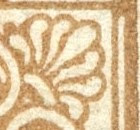
This 300r chocolate "genuine" example shows the scallop design in the 
upper right corner is intact with seven lobes and all lines between lobes intact (no breaks).
Note the largest lobe is the center one. Also note the scallop design does not touch the lower horizontal line of the "Angola" tablet.

Now this is where it gets a bit confusing. Note I have two examples of the "genuine" Angola 300r chocolate, and both of them show an intact scallop design. (This is also found (the intact scallop) in genuines for all the other Portuguese colonies.) In contrast, the Fournier forgery for the Angola "Crown" stamps, as well as the Fournier forgeries for the other Portuguese colonies show a break in at least one of the lines, making up the lobes of the scallop. It is clear that the "scallop" sign can be used to distinguish the Fournier forgeries from the genuines for all of the Portuguese colonies.....EXCEPT this doesn't work always for Angola, as we shall see in a bit. !!

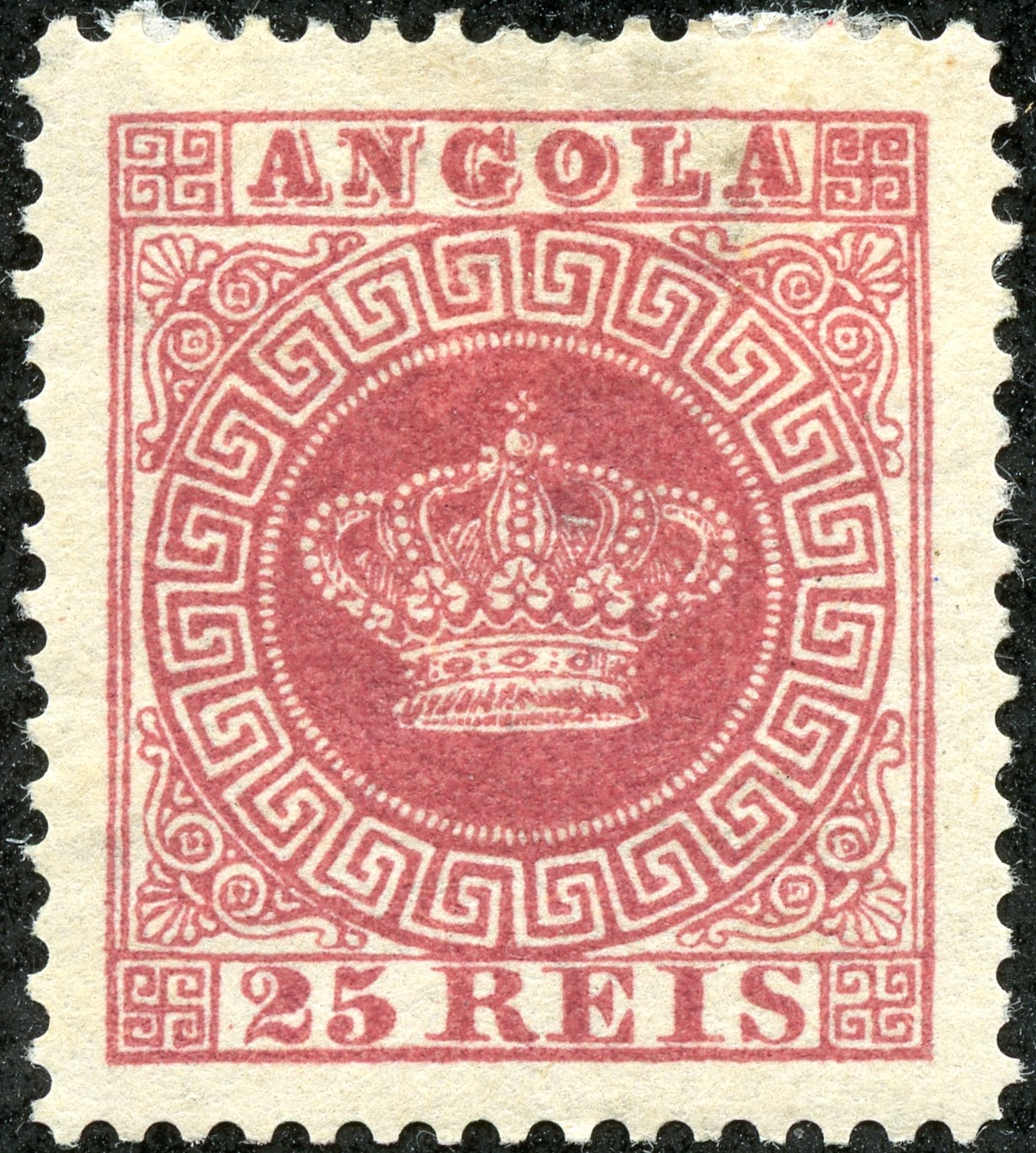
1870 Scott 4 25r red "Portuguese Crown"
Perf 12 1/2; Fournier Forgery

OK, here is a Fournier forgery of then 25r red. Overall, looks pretty good, doesn't it?  I would think, if one didn't do a close examination and knew what to look for, many collectors would think this stamp is genuine. The "Angola" print is perhaps a bit rougher, and portions of the stamp appear over inked and cruder, but it is a bit of a judgement call.

I should mention that Fournier forgeries only are found with Perf 12 1/2.

But let's look at specifics....

The curved shading line through the center of "O" is
a partial line, and broken at the 6 o'clock position. 
Fournier Forgery

One of the more reliable signs is the Fournier forgery has a broken shadow line through the "O" of "Angola". The Genuine has a line that is complete.

Fournier Forgery: "Maltese cross" does not have a true "maltese" shape.
Cross is smaller and a bit deformed. It is separated from the globe (base).
 
As above: compare to the genuine stamp shown prior...

In addition, the pearls seem separated, and the pearls closest to the globe are quite small and deformed (not round). 

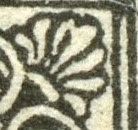
This 25r red "Fournier Forgery" example shows the scallop design in the 
upper right corner having here six intact lobes, with a large center lobe with a left-center thick line incompletely dividing the lobe. In this specimen, there is ink attachment between the scallop and the inner frame.

Compare to the genuine 300r chocolate shown prior - there is clearly a difference (seven vs six intact lobes). 

Will there always be a "intact lobe" difference between genuines and the Fournier forgeries? (No, as we will see with the next example.)

I would also like to point out the corner spandrel here appears over inked and somewhat crude. 

1870 Scott 1b 5r black "Portuguese Crown"
Perf 12 1/2; Genuine

Overall, this stamp looks finely printed. I don't spot any crudeness or over inking.

But when we look at specifics that argue this stamp is genuine, there is also a surprise lurking...

The curved shading line through the center of "O" is complete
(Not a partial line, or broken) Genuine

The curved shading line is intact, which is found for the genuines. The letters are well printed. This sign argues that this specimen is NOT a Fournier forgery.

Genuines: Maltese cross in the shape of a "maltese cross"; "hole" in the center
of the cross; cross is appropriate size, and tilts slightly to the right;
 cross sit atop globe, and is attached

The "maltese cross" image looks genuine.

The pearls close to the globe are slightly smaller, but still essentially round. 

The scallop has six intact lobes, with a center large very heart shaped lobe with a thicker line running up the lobe center-left. The thick line does not complete, leaving six intact lobes, instead of seven.

This is the surprise. Our prior genuine (300r) showed seven intact lobes in the scallop. Here, the 5r, which shows signs of being genuine in all other aspects, has only six lobes, with a large heart shaped lobe in the center, and a partial thick line running center-left. This looks similar to the Fournier Forgery (FF) Scallop's six lobes, except the FF appeared somewhat cruder.

Angola 9 7 lobes/ Angola 1 6 lobes
Both Genuine

As mentioned, other aspects of the 5r stamp shown here argues that Angola 1 black is a genuine stamp. I also checked with Ron of Classic Stamp Forgeries website, and he labeled the Angola 1 stamp as genuine. I am forced to conclude that, for the Angola 1870-77 "Crown" stamps, some genuines show an intact seven lobes in the scallop, while others show six lobes with a large "heart shaped" lobe in the center.

Another comparison
Angola 3 7 lobes/ Angola 8 6 Lobes
Both Genuine

And, in a way, this makes sense. Why would the Fournier Forgery also show six intact lobes? A coincidence, or, in fact, was Fournier imitating a six lobed Angola genuine that he copied, and then never changed subsequently? I strongly suspect the latter.

1870 Scott 1 5r black "Portuguese Crown"
Perf 12 1/2; Fournier Forgery

Fortunately, we also have a 5r black Fournier Forgery to compare.

Upper: Genuine
Lower: Fournier Forgery

First, note there is a significant difference in the shape of the letters, the serifs, and the placement and shape of the "5".

The curved shading line through the center of "O" is
a partial line, and broken at the 6 o'clock position. 
Fournier Forgery

The Fournier forgery shows the characteristic partial shadow line through the "O".

Fournier Forgery: "Maltese cross" does not have a true "maltese" shape.
Cross is smaller and a bit deformed. It is separated from the globe (base).

In addition, the pearls are separated, and the pearls close to the globe are significantly smaller.

"Fournier Forgery": the scallop design in the 
upper right corner having here six intact lobes, with a large heart shaped center lobe
 with a left-center thick line incompletely dividing the lobe. 

Also, here the line between the first and second lobe is slightly open at the bottom.

Also, notice the over-inked cruder appearance of the corner spandrel.

Upper: Genuine; Lower: Fournier Forgery

The scallop design for the Fournier Forgery compared to the "six-lobed" genuines is similar, but is inked in a cruder way.

Here is another example....

Upper: Angola 8 Genuine
Lower: Angola 4 Fournier Forgery

Again, the Fournier Forgery Scallop is cruder than the genuine, although they both are six lobe designs here.

1870 Scott 1 5r gray black "Portuguese Crown"
Perf 12 1/2; Genuine, Copy Two
Out of the Blue

OK, what a trip!

We showed, through careful evaluation, how to differentiate the Genuines from the Fournier Forgeries.

The surprise is, there is, apparently, two kinds of genuines for the Angola 1870-77 "Crowns": a right upper quadrant spandrel seven lobed type, and a right upper quadrant six lobed type. The Fournier forgeries imitate the six lobed type.

Of course, I could be wrong. But the evidence I have at this time points to this conclusion.

Naturally, if I see additional material for the 1870-77 Angola "Crowns, or additional information becomes available, then that might changes my conclusion.

We are still not done with the Angola 1870-77 "Crowns" stamps. I have a number of Spiro forgeries of this issue I will show in a soon forthcoming post. And I would like to go through my remaining Angola 1870-77 :Crown" stamps, and label them Genuine, Borderline or Unknown, or probable forgery (there are many other forgeries besides Fournier, and Spiro, although they are the most common).

Comments appreciated!

Sunday, October 2, 2022

Palestine - Bud's Big Blue

Flags flown in Palestine, 1918-1948
Bud's Big Blue
Bud's Observations

Although the Big Blue album (BB) has only 61 spaces under the heading “Palestine”, they’re all for stamps issued at a fateful time in the history of map slicing. If BB’s hacked-up organization seems baffling, bewildering and befuddling to you, blame the map slicers.

The two great map slicing escapades of the late 19th and early 20th centuries clearly frustrated BB’s editors. Imagine them trying to place their album’s stamps into some order that reflected where and by whom the stamps were meant to be used, only to have new national boundaries invented or old ones changed repeatedly. The editors never did get it quite right, as any review of the succession of BBs will show, but the stamp arrangements must have made some sense at the time.

Europe was obsessed with setting colonial boundaries, whether they seemed reasonable to people who lived in the colonies or not. Embolden by the 15th century Doctrine of Discovery, which by the 1880s was regarded as a point of international law blessed by church leaders, Christian nations had invaded and seized the land of non-Christians throughout the world (1). But what European monarch “owned” what? Enter the map slicers.

The first slicing, known as the Scramble for Africa, reached a climax in 1884. At the Berlin Conference, under the direction of Otto von Bismarck, European nations divided Africa into colonies with firm boundaries. No Africans were consulted. Princeton University library has posted online several historic maps of Africa (1554 to 1880); very helpful for collectors who want to know where, say, Oil Rivers is located and how it evolved. (2)

Bismarck slicing, from a French cartoon

The second slicing followed World War I when the victors divided up the losers’ colonial territories, usually under mandates decreed by the League of Nations. The changes were mostly straightforward; for example, German East Africa became Burundi and Rwanda (Belgian mandate) and Tanzania (British mandate). Previously established colonial boundaries remained largely intact.

Palestine was more complicated. For ages, “Palestine” had been a popular nickname for an ill-defined region associated with the Jordan River, sometimes stretching from southern Syria to the Gulf of Aqaba. The term never denoted fixed boundaries, that is, not until after WWI. No one thought of themselves as being Palestinian.

A Bible school map of Palestine in Jesus’ day, Anna Payne-Krzyzanowski illustrator
Woodlake Books,2008

The area that became Palestine had been ruled by the Ottoman Empire (Turkey) since the 1500s. But the Ottomans sided with Germany in WWI. After they lost the war, they were forced out of the region. The victorious British envisioned an international zone that would be both a homeland for Jewish people and a united, free Arab state under Britain’s benign colonial oversight. They called it Palestine, a name redolent with biblical allusions.

Palestine 1920-1948 (note the number of foreign postal offices)
Map salvaged from Gerben Van Gelder’s now sadly defunct “stamp world history” web site

To say that this idealistic plan didn’t work out too well is understatement; a succession of riots, revolts, and uproars ensued. But the stamps that Britain issued for Palestine do reflect their efforts to make the plan work.

The first among these stamps (1918) were issued while military forces were still administering the area and were meant as a stopgap. They are inscribed simply EEF for the victorious British command known as the Egyptian Expeditionary Force. The EEF maintained control until the mandates for civil administrations began (1920). These stamps were used in Cilicia, Lebanon, Transjordan, and Syria, as well as in what was not-yet-but-was-to-become Palestine. BB provides seven spaces for these in its Palestine section, although they could have been correctly placed in sections for the other four countries. Or they might be thought of as British military stamps appropriate for placing under the Great Britain label. Maybe they could have been squeezed into the Egypt section. 

Scott #6, light brown

With the onset of British mandated civil administration, the existing EEF stamps were overprinted in Arabic, English and Hebrew. This intended, no doubt, to please both Jews and Arabs and to place visually the British between the two potentially hostile indigenous peoples.

Scott # 17, light brown 

It didn’t work. Jews didn’t like the Hebrew transliteration of “Palestine” and Arabs rejected the designation preferred by the Jews. The British High Commissioner struck a compromise: two Hebrew letters, alef and yod, were placed to the left of the transliteration to symbolize “Eretz Yisrael”, the term the Jews wanted.

Alef and yod, from right to left

On postage due stamps, the alef and yod appear in parentheses.

Scott #J1, 1 mill, yellow brown, 
printed by the Greek Orthodox Convent Press, Jerusalem

Six varieties of overprints were used between 1920 and 1923, some printed in London, some in Jerusalem. Scott’s catalog identifies 57 types and subtypes. Gibbons lists 74. BB provides only 18 undifferentiated spaces for these.  The scans of my collection (below) show an undifferentiated assortment.

The same EEF stamps were used in Transjordan, also a British mandate, but with Arabic overprints only.

Jordan Scott #76, scarlet

To be philatelically inclusive of the three major religions that revered Palestine, the British issued definitives depicting sacred sites (1927), balanced to please all three groups: Rachel's Tomb, the Jerusalem Citadel, the Dome of the Rock, and the Sea of Galilee.

Scott #65, rose red, Dome of the Rock 

Deference to the three religions is also reflected in the triangular, dateless cancels used on holidays. Religious holidays were plentiful; mail delivery was doubtlessly slowed.

Scott #63, Prussian blue, with holiday cancel 

 The British Mandate ended in 1948; conflicts continued.

Census: 61 in BB spaces, one tip-in, 12 and an etiquette on the supplement page.

(1) Pope Alexander VI, Papal Bull Inter Caetera, 4 May 1493.

(2) https://library.princeton.edu/visual_materials/maps/websites/africa/maps-continent/continent.html   


Jim's Observations

The 1918-45 British Mandate stamps of Palestine, perhaps, do not capture all of the turbulent activities of the times.

But, incredible history (both ancient and modern), if there ever was one. The juxtaposition of Christian, Jew, and Muslim cultures makes this one of the most fascinating places on earth.


Page 1

1a


1b


1c


1d


1e


Page 2


2a


2b


Supplements
Page 1


Comments appreciated!

Friday, September 23, 2022

Portuguese Colonies "Crown" issues: Introduction to the Fournier Forgeries


Portuguese India 1880 Scott 69 50r dark blue
"Portuguese Crown"
 Fournier Forgery

Into the Deep Blue

The "Portuguese Crown" issues for the Portuguese colonies offer a challenge for the WW collector.

For Angola, they are found in 12 1/2 Perf (thin to medium paper), Perf 13 1/2, Perf 14 (25r rose), and Perf 12 1/2 (thick paper): altogether 29 bolded numbers in Scott for nine denominations. Reprints (1885, 1905) of these issues on smooth white chalky paper or ivory paper were also produced. 

There are also some minor number color variations.

But all the above is not the real problem. Unfortunately, there are plentiful forgeries. The major players were Fournier and Spiro, but there were others also.

Let's talk about the Fournier forgeries of the "Portuguese Crown" issues for Angola and the other Portuguese colonies.

As it turns out, Fournier first used the Angola "Portuguese Crown" issue for his forgery template. That consequently makes it more difficult to tell Fournier forgeries apart from the genuines for Angola, as they appear ( without close scrutiny and certain signs) to be identical. There will be much more about this later with the next post.

For the other Portuguese colonies, the design of the genuines are somewhat different than Angola's design. But Fournier kept some of the attributes of his Angola forgeries for the other Portuguese colonies forgeries, which makes it easier to spot a Fournier forgery for the other Portuguese colonies.

Let's take a look at a genuine and a Fournier Forgery for Portuguese India, as an example.

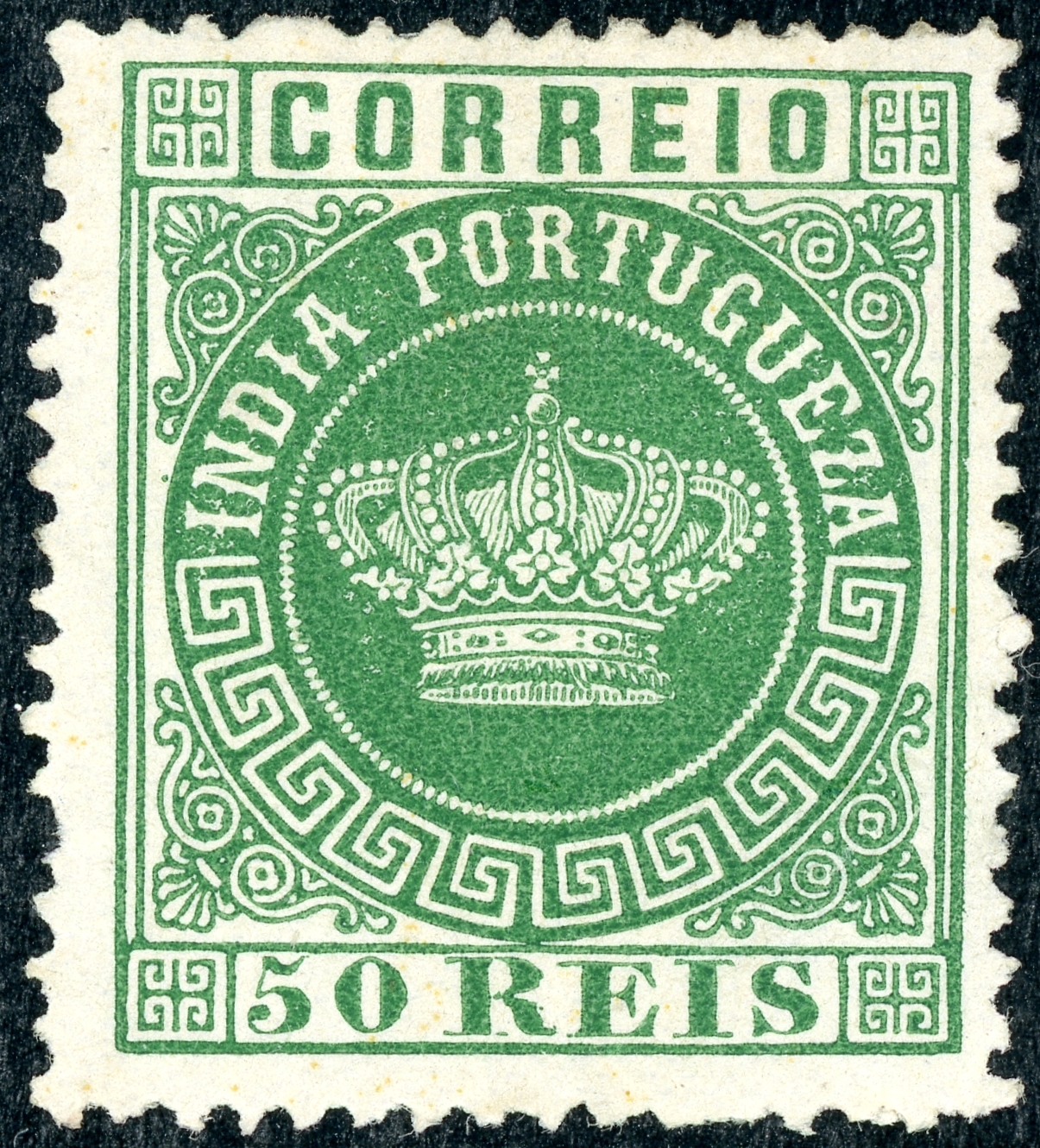
Portuguese India 1977 Scott 61 50r yellow green
"Portuguese Crown"; Genuiine

1) Note the solid green circular tablet (with India Portugueza script on it) is below the lower horizontal line of the "Correio" tablet. All genuines of the Portuguese colonies (except Angola) have this characteristic.

2) The clamshell design in the upper right corner (below horizontal line that separates "Correio") has all it's lines intact, creating seven lobes without a line break. This is characteristic for all genuines of the Portuguese colonies (except Angola).

3) The Maltese cross (which has a definite Maltese cross shape) on the crown has a white button in the center, and is attached to the globe below.

4) The line of crown pearls on the sides of the crown are more angular in shape for the Portuguese colonies stamps than the "rounder" line of pearls found for the Angola stamps. This will become clearer as we show more examples.

Now, let's look at a Portuguese India Fournier forgery...

Portuguese India 1877 Scott 60 40t blue
"Portuguese Crown"
Fournier Forgery

The following signs are valid for the Fournier forgeries for all Portuguese colonies, except Angola- which is a special case.

1) Note the solid blue circular tablet (with India Portugueza script on it) intersects heavily with the lower horizontal line of the "Correio" tablet. This is a sign that this is a Fournier forgery for all Portuguese colonies, except Angola. Also note the right upper clamshell appears to also touch the line.
These signs are easily used to separate out the genuines from the Fournier forgeries for all Portuguese colonies, except Angola.

(For Angola, both the genuines and the Fournier forgeries show the circular solid line below the "Correios" tablet to intersect heavily with the lower horizontal line of the "Correios" tablet. Therefore, this sign is not helpful for Angola. The reason this sign is helpful for the other Portuguese colonies is because the genuine design was changed, but Fournier did not change his, after he made the forgery template for Angola.)

2) The clamshell design in the upper right corner (below horizontal line that separates "Correio") has a line broken, specifically creating a large center lobe with a partial center-left thick open line, leaving six intact lobes. This is a sign of a Fournier forgery for Portuguese colonies, excepting Angola. (Angola's situation is complex and a bit confusing. We will address it later with the next post.)

3) The "Maltese" cross on the crown does not have a "Maltese" shape, and is smaller, and sometimes deformed. There is no white button in the center, rather a "hole". Often the cross is detached a bit from the globe. These are all signs we may be dealing with a Fournier forgery. These signs can be found for all the Portuguese colonies AND Angola.

4) For the Fournier forgery, the line of crown pearls on the sides of the crown are "rounder", compared to the angular line shape of the crown pearls in the genuines.  This is true for all the Portuguese colonies stamps, except Angola. 

I think I will show another example of a Portuguese colony "Crown" stamp vs a Fournier forgery, just to make sure we know the differences. (Remember these differences are valid for all Portuguese colonies, EXCEPT Angola.)  Let's look at Mozambique...

Mozambique 1877 Scott 6 25r rose
"Portuguese Crown"
Genuine

1) Note the solid red circular tablet (with Mocambique script on it) is below the lower horizontal line of the "Correio" tablet, or just touches it for a short while. All genuines of the Portuguese colonies (except Angola) have this characteristic.

2) The clamshell design in the upper right corner (below horizontal line that separates "Correio") has all it's lines intact, creating seven lobes without a line break. This is characteristic for all genuines of the Portuguese colonies (except Angola). There is no touching of the horizontal line of the "Correio" tablet.

3) The Maltese cross (which has a definite Maltese cross shape) on the crown has a white button in the center, and is attached to the globe below.

4) The line of crown pearls on the sides of the crown are more angular in shape for the Portuguese colonies stamps than the "rounder" line of pearls found for the Angola stamps. This will become clearer as we show more examples.

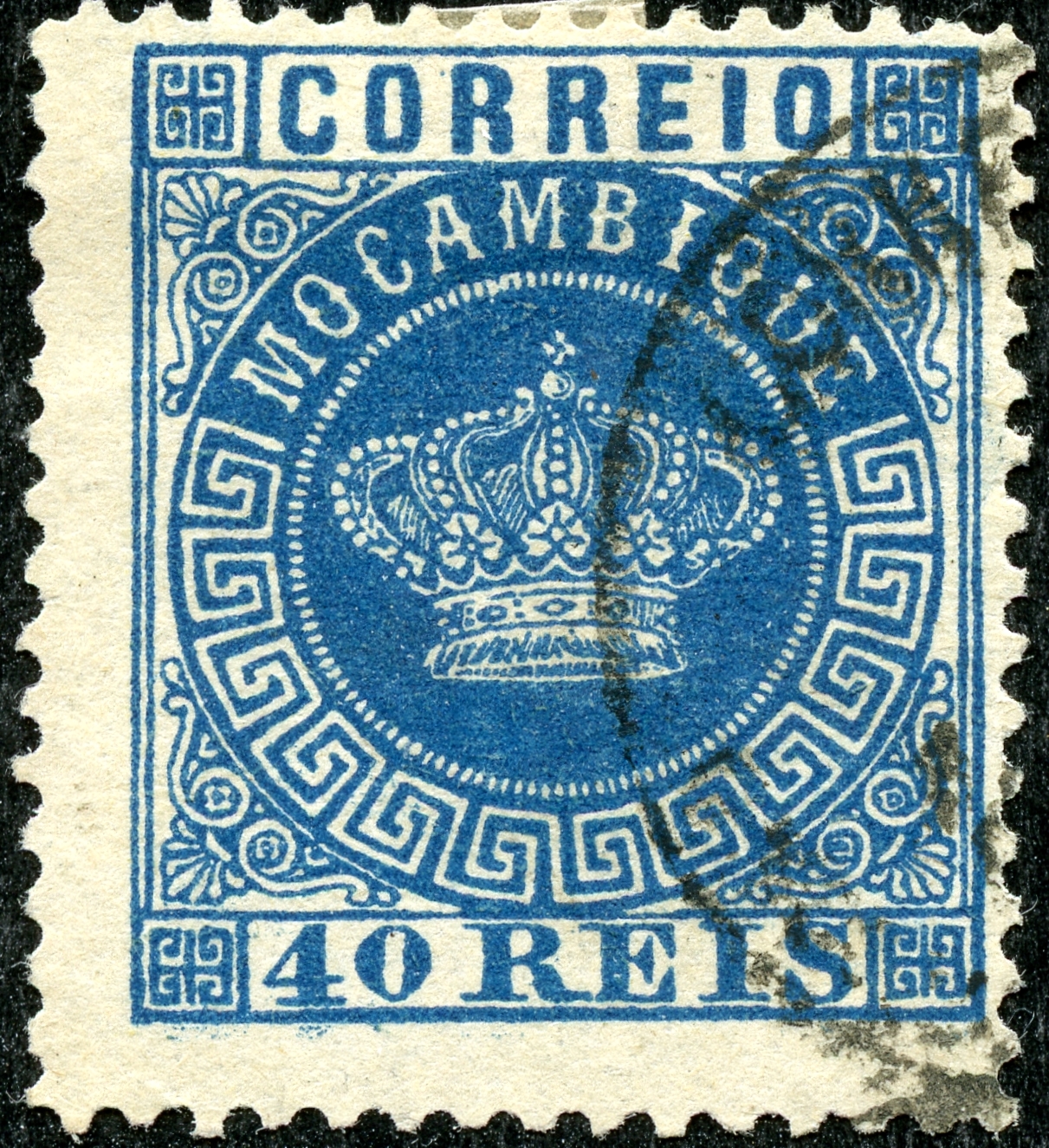
Mozambique 1877 Scott 8 40r blue
"Portuguese Crown"
Fournier Forgery

The following signs are valid for the Fournier forgeries for all Portuguese colonies, except Angola- which is a special case.

1) Note the solid blue circular tablet (with Mocambique script on it) intersects heavily with the lower horizontal line of the "Correio" tablet. This is a sign that this is a Fournier forgery for all Portuguese colonies, except Angola. Also note the right upper clamshell appears to also touch the line.
These signs are easily used to separate out the genuines from the Fournier forgeries for all Portuguese colonies, except Angola.

(For Angola, both the genuines and the Fournier forgeries show the circular solid line below the "Correios" tablet to intersect heavily with the lower horizontal line of the "Correios" tablet. Therefore, this sign is not helpful for Angola. The reason this sign is helpful for the other Portuguese colonies is because the genuine design was changed, but Fournier did not change his, after he made the forgery template for Angola.)

2) The clamshell design in the upper right corner (below horizontal line that separates "Correio") has a line broken, specifically creating a large center lobe with a partial center-left thick open line. (This is obscured here because of the cancel). This is a sign of a Fournier forgery for Portuguese colonies, excepting Angola. (Angola's situation is complex and a bit confusing. We will address it later with the next post.)

3) The "Maltese" cross on the crown does not have a "Maltese" shape, and is smaller, and sometimes deformed. There is no white button in the center, rather a "hole". Often the cross is detached a bit from the globe. These are all signs we may be dealing with a Fournier forgery. These signs can be found for all the Portuguese colonies AND Angola.

4) For the Fournier forgery, the line of crown pearls on the sides of the crown are "rounder", compared to the angular line shape of the crown pearls in the genuines.  Also, some of the pearls may be smaller. This is true for all the Portuguese colonies stamps, except Angola. 

Portuguese India 1877 Scott 57 10r yellow
"Portuguese Crown"
Fournier Forgery

Out of the Blue

I hope this introduction to the "Crown" Fournier forgeries for the Portuguese colonies, other than Angola, was helpful. Actually, in most cases, other than Angola,  determining these Fournier forgeries is not too difficult.

Also, I should mention that Ron of Classic Stamp Forgeries website fame, has recently updated his "Portuguese Crown" Genuines & Forgeries post. He has lots more examples of Fournier forgeries and other forgeries for the Portuguese colonies. Check it out!

But we have left the challenging determinations for the next several posts, where we will be looking at Angola. There, we not only encounter the Fournier forgeries, but also Spiro forgeries, and other more obscure forgery examples. Then there are the "borderline" examples where it is difficult to tell for sure if genuine/forgery. 

Stay tuned. 😎

Comments appreciated!