A is for Aden and Z is for Zanzabar


A is for Aden and Z is for Zanzibar... Now what is between? For the world wide classical era philatelist and stamp collector, a country specific philatelic survey is offered by the blog author, Jim Jackson, with two albums: Big Blue, aka Scott International Part 1 (checklists available), and Deep Blue, aka William Steiner's Stamp Album Web PDF pages. In addition, "Bud" offers commentary and a look at his completely filled Big Blue. Interested? So into the Blues...

Sunday, July 12, 2020

Kiauchau, Mariana & Marshall Islands - Bud's Big Blue

Kiauchau 1905 Scott #26 10c ultramarine
"Kaiser's Yacht "Hohenzollern""
Bud's Big Blue
Bud's Observations
I decided, since they’re all in the German Pacific area and their stamps feature mostly the Kaiser’s yacht, to make one brief post about all three: Kiauchau, the Mariana Islands, and the Marshall Islands.

As noted in several of this blog’s posts, Germany was, in the late 19th century, a greenhorn at colonization schemes. Initially, Bismarck opposed German colonial expansion, then capitulated to pressures from pro-imperialist business leaders who thought they were missing out on big profits. As it turned out, the colonies cost more to establish and maintain than they were worth. Commerce never thrived. Nevertheless, Germany did scrape a few colonies together which, if not cost-effective, were thought necessary for established the Aryan race as pre-eminent.


I think the Kaiser’s yacht, Hohenzollern II, is a telling symbol in this regard. It reflects not only Germany’s economic ambitions, but also its determination to advance the master race. “Social Darwinism,” not an idea developed by Charles Darwin himself but by Herbert Spencer, holds that Darwin’s theory about survival of the fittest can be applied to human societies, thereby validating all sorts of social inequalities such as imperialism, classism, sexism, and racism. Spencer’s thought readily grafted onto Germany’s late 19th century nationalistic agenda. This strain of Social Darwinism sank to its lowest, of course, a few years later with Hitler at the helm.

Mariana Islands 1901 Scott #27 2m blue

The yacht, steaming through the waves while leaving lesser ships behind, is clearly a fit vessel and a befitting badge for a master race. At the time, however, there were not many “Arians” living in Kiauchau, the Mariana Islands, and the Marshall Islands. Those few no doubt felt their chests swell with pride upon seeing the stamps. Hohenzollern II herself never sailed that far from home, though. And, I imagine, the stamps rallied little enthusiasm among Asians.

Marshall Islands 1901 Scott #24 3m black violet

Census: Kiauchau                 8 in BB spaces, one tip-in, seven on the supplement page.
Mariana Islands      13 in BB spaces, four on the supplement page
Marshall Islands     13 in BB spaces, three on the supplement page

Jim's Observations
Bud is giving you three-in-one here!

If you want to read a bit more about the history of each place, as well as maps, check out my posts on...

Kiauchau Post & BB Checklist
Mariana Islands Post & BB Checklist
Marshall Islands Post & BB Checklist

Kiauchau 
Page 1

Kiauchau Supplement
Page 1

Mariana Islands 
Page 1


Mariana Islands Supplement
Page 1

Marshall Islands 
Page 1

Marshall Islands Supplement
Page 1

Comments appreciated!

Wednesday, July 8, 2020

Bud's League of Nations Album: First Issues 1922-31


League of Nations (SdN) Album
5. First Issues 1922-31
(part 5 of a series)

In 1922, the League of Nations commenced using Swiss definitive stamps overprinted ‘Société des Nations’. Intended solely for the League’s official business, they could not be sold or given away and were unavailable to the philatelic market in mint condition except by unusual, often illicit means. Collectors had to content themselves with used or cancelled-to-order examples, the latter ordinarily struck in the center of a block of four with a Geneva 1 cancel. Beginning 1 February 1944, the remainder stock of mint stamps was sold publicly[i].

Authorities differ on how many varieties were issued overall, depending whether or not stamps with grilled gum, errors, color changes, plate flaws or redrawn designs are counted. Scott’s Catalog[ii] lists 90 major numbers and 21 minor variations, a total of 111, but, as is made clear by stamps throughout this album, there are many additional minor differences. Nevertheless, Scott numbers and dates of issue are used to identify the stamps; the quantities printed listed under each stamp shown below follow an accounting published by Charles Misteli.[iii]
Scott #s 2o1-2o30

Only one of the stamps showing above, #2o30, is in mint condition. It was either a part of the sets sent to the Universal Postal Union (UPU) for their archives, part of a set awarded to a dignitary, or stolen. Maybe the cancelling device failed to strike this one. In any case, all the others have the Geneva 1 or Geneva 10 cancellations.

Four additional stamps, Scott #s 2o31a-2o34a, complete the issues in use from 1922 through 1930. These bear the Switzerland Coat of Arms emblazed over the Matterhorn (apparently on a partly cloudy day). A more detailed examination of these four and their variations appears in Post #9 of this series (not currently on-line). 

Scott #2o31a-2o34a
Although mint stamps with SdN overprints could not be purchase by the public, the League did provide carnivalesque pages with favor cancels -- cotton candy for collectors. The one showing below, the earliest in my collection, features all League stamps issued in 1922, each bearing a Geneva 1 cancel struck on 25-1-1923. It is the first of many such pages commemorating League-sponsored events and congresses.

Favor page, 25 i 1923


Full sheets of the older SdN stamps are scarce. My earliest example, Scott #2o10 (1931), was not cancelled until 1937 when rules regarding the sale of League stamps were beginning to relax. It’s missing the top selvage.

Scott #2o10 (1931)

Two varieties of cancels are commonly found in early usage, the first being more frequent than the latter.

6 x 1922, three days after
the release of the first issue

5 vi 1923

The Table of Contents for the League of Nations posts is here.

Comments appreciated!


[i] Felix Ganz. “False Overprints of League of Nations and International Labor Office Stamps of Switzerland.” American Philatelist. (August 1983), p. 699.
[ii] Scott Publishing Co. 2013 Classic Specialized Catalog of Stamps and Covers. Sidney, Ohio (2012).
[iii] Charles Misteli. Etude sur les timbres poste et obliterations de la Société des Nations…. Club Philatelique et Aeropostal de Geneva (1943, sup. 1984), pp. 11-20.


Monday, June 29, 2020

Chile 1910 Issues - a closer look

1910 Scott 88 12c vermilion
"Capturing the "Maria Isabel""
Center in Black
Into the Deep Blue
This is the third "closer look" post for the stamps of classical era Chile.

The first two posts....
A beginner's guide to Chile's 1853-1865 issues
Chile 1867-1909 - a closer look

This third emission frankly serves as an excuse for me to show off the 1910 issue commemorating the centenary of independence for Chile. This gorgeous bi-color fifteen stamp issue (Scott 83-97) was produced by the American Bank Note Company of New York,

A closer look
100 Centavos = 1 Peso
1910 Scott 79 5c on 12c (Blue)
Overprinted "Islas de Juan Fernandez"
Also, in 1910, there was a four stamp surcharged issue released.

Here, the Scott 73 12c lake & black "Columbus" was surcharged in blue. Although the surcharge states "Islas de Juan Fernandez", the stamps were authorized to be used throughout Chile.

Islas Juan Fernandez off the coast of Chile
By the way, the islands are now a protected area and park. Including most of "Robinson Crusoe Island", the archipelago is a habitat for fur seals and the firecrown hummingbirds.

1910 Scott 81 20c on 1p (Red)
The three higher denominations were surcharged in red.

CV for the issue ranges from <$1 to $3 (unused).

1910 Scott 83 1c dark green
"Oath of Independence"
It would be interesting, and a nice side- collection, to gather all the stamps that were bi-colored between 1901-1910 and issued by many countries. Most were engraved, as is this issue from Chile.

BTW, there is a "center inverted" (Scott 83a) that catalogs for $50,000 unused. !!

1910 Scott 84 2c lake
"Battle of Chacabuco"
Lovely- yes?

It is clear that the supply/demand curve for this gorgeous issue is on the side of the collector even today.

The CV for this stamp (unused) is only $1+, with only a modest increase (CV $10+-$30+ unused) for higher denominations.

The history of the Chilean War of Independence is fairly complicated to understand. The 1910 "Independence Centenary Issue" illustrated here will help with the highlights.

1910 Scott 85 3c red brown
"Battle of Roble"
As one likely would suspect for the era, a number of the stamps in the issue illustrate the decisive battles.

"Combate de El Roble de Octobre 1813"
Pintura de Manuel Tapia  Portus (1835-1915)
This painting illustrates the first battle that was won by the patriots against the royalists.

This is where Colonel Bernardo O'Higgins gave his famous speech....

"Lads! To me! Live with honour, or die with glory! The one who is brave is the one who follows me!"

...and became a hero. He subsequently was named a commander of the patriot forces.

1910 Scott 86 5c deep blue
"Battle of Maipu"
The Argentine general Jose de San Martin won a the decisive "Battle of Maipu" near Santiago on April 5, 1818. This assured the independence of Chile from Spanish domination.

1910 Scott 87 10c gray brown
"Naval Engagement of "Lautaro" and "Esmeralda""
On April 26-27, 1818, the "Lautoro" engaged the Spanish frigate "Esmeralda". The boarding party, including Captain O'Brien, lost their lives, but did succeed in breaking the Spanish blockade of Valparaiso.

1910 Scott 89 15c slate
"First Sortie of Liberating Forces"
The tableau (from the O'Higgins monument) shows General O'Higgins pointing out the vessels of the liberating naval squadron setting out in search of the Royalist navy.

1910 Scott 90 20c red orange
"Abdication of O'Higgins"
In 1823, O'Higgins abdicated, and a new junta was formed. He planned to return to Ireland, his ancestral home. But General Freyre had him arrested and he was put in prison. But the people, who had not forgot his heroism, demanded his release.

1910 Scott 91 25c ultramarine
"Chile's First Congress"
In June, 1811, the first Congress was held.

1910 Scott 92 30c violet -Closeup
"Monument to O'Higgins"
Bernardo O'Higgins, son of a former Governor of Chile, Ambrosio O'Higgins, was a major key in several battles, and he was eventually was named supreme director of an elective government. But after his release from prison in 1823 (see script for the 20c), he lived in Lima until his death in 1842.

1910 Scott 93 50c olive green
"Monument to Jose M. Carrera"
Complicated history.  Carrera was initially General-in-Chief of the patriot army in 1811. He then decreed himself president, but his fortunes changed and he was imprisoned along with his two army officer brothers. (O'Higgins was then commander of the army.)  Carrera then became a refugee in the United States, but then returned to Chile where he learned his two brothers had been executed by order of San Martin. He then carried on guerilla warfare with a small group of 500 men against the Generals of the Independents for three years. He and his officers were captured and shot at Mendoza September 4, 1821.

1910 Scott 94 1p yellow orange
"Monument to San Martin"
First Argentina, then Chile and Peru: San Martin did more than anyone to rid South America of Spanish Rule. In July, 1821, he entered Lima and proclaimed the independence of Peru.

1910 Scott 95 2p red
"Gen. Manuel Blanco Encalada"
The General deserted the Spanish forces and joined the Revolutionary forces, serving with distinction. He was rear-admiral in 1819, and major general of the infantry in 1820. He became president of the republic after 1826.

1910 Scott 96 5p yellow green
"Gen. Jose Ignacio Zenteno"
Zenteno was San Martin's secretary at Mendoza. He was then governor of Valparaiso in 1821.

Official 1907 Scott O10 3c on 1p brown
Regular Issues of 1892-1909 Overprinted in Red
To finish off, here is an example of an official stamp for the era. The 1907 issue of eight stamps (O9-O16) are rather expensive CV wise ($50-$300+). In addition, counterfeits exist.  (I don't know if this stamp is genuine or not.)

1910 Scott 97 10p dark violet
"Adm. Lord Thomas Cochrane"
Center in Black
Out of the Blue
The stamps are lovely, but the history is complicated. It appears it was not in the best interests to one's health to want to be a leader during these turbulent times. ;-)

Note: Painting image ("Combate de El Roble de Octobre 1813"), and map are sourced from the internet, and appear to be in the public domain. They are used here for educational purposes.

Comments appreciated!

Thursday, June 25, 2020

Manchukuo - Bud's Big Blue

                 1935 Scott 64 ocher
Emperor’s Standard, Manchukuo
Bud's Big Blue
Bud's Observations

The internet has made a huge impact on stamp collecting, as all collectors know. But the jolt is felt not only in the marketplace -- the shift from stamp shows to online sales -- but also in how collectors display their treasures -- the shift from albums on shelves to non-commercial websites. Having a virtual collection online, while storing the actual stamps somewhere away from thieves and sticky fingers, has become increasingly popular, to wit, my own Big Blue posts.


The presenters of collections online often add valuable commentary, none more so than Simon Watt for his impressive Manchukuo collection: http://manchukuostamps.com/ (accessed 4/19/2020). 


Simon introduces his Manchukuo website with this explanation:

This website is being built and operated as a hobby, instead of mounting the stamps in an album and then writing them up, I thought that I would scan them and do the write-up online. This means I can leave the stamps in the bank but still see my collection whenever I want. It is not yet finished and I doubt that it ever will be....you know what it's like when you collect things!
Of course, his is a highly specialized website. But his observations and examples provide valuable information that generalists will find useful. Here are six of his many insights. (The comments in italics are Simon’s and the stamp scans are mine, except for the cover, which is Simon’s.)

The [first Manchukuo] stamps went on sale on 26th July 1932, and the set contains eighteen values. Looking at the list of postal rates shown separately it is hard to see how some values would have been used, which might mean that the level of pricing had not been agreed at the time of printing.
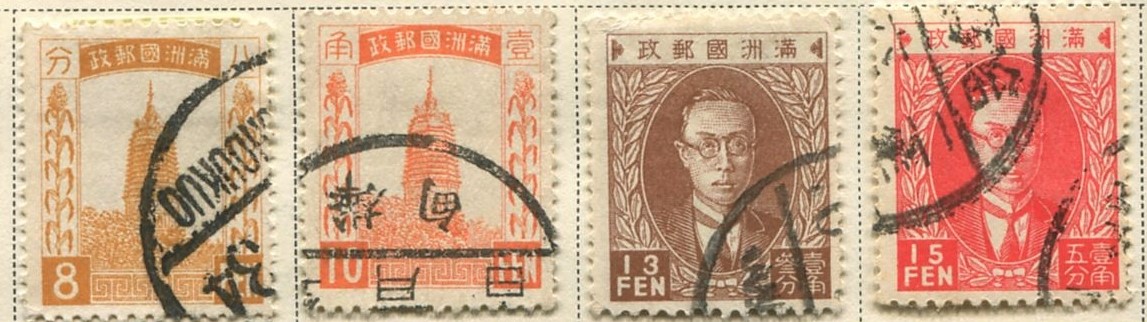
        1932 Scott 10-13

The ½fen to 10fen stamps depict the White Pagoda. This is a 13 story 70m tower, carved with images of the Buddha and stands in Paita Park in the city of Liao-yang, 64 kilometres South of Mukden. The pagoda is all that remains of the once important Guan Yu temple. The remainder of the issue 13fen to 1Yuan show the Chief Executive of Manchukuo, Puyi, later to become Emperor Kāngdé. In reality Puyi had no power and was completely under the control of the Japanese.
Few countries recognised Manchukuo and it never became part of the Universal Postal Union, fortunately most nations, did deliver the mail from Manchukuo. (One of the few to recognise Manchukuo as a sovereign state was the Vatican, and anyone who looks closely at covers from this area will see that a large number are from Catholic missions).
Registered cover sent from the Danish Mission (Lutheran) in 鳳凰城 Feng-Huang-Ch'eng to Dairen on 28th March 1939
In an act of true independence Manchukuo rejected the stamp colour regimes of both the Universal Postal Union and Japan.
1934-5 Scott 84-87, non-standard colors

The [air mail] 18f and 19f show an aircraft flying above a shepherd. The 38f, and 39f show an aircraft flying over the Sungari River railway bridge (Sungari is the Russian name, 松花江 Sōnghuā Jiāng in Chinese).
1936-37 Scott c1-4
At the end of the war there were 1000's of sheets of stamps in stock and those not subject to Manchurian Local Overprints (MLO's) quickly found their way to the philatelic market. This is the reason why the unused stamps of Manchukuo are mostly inexpensive, and why stamps cancelled, or on covers as a result of genuine postal use are often considered more valuable.
1938 Scott 128-9
Intelligent commentary on specialist websites, of course, is neither new nor surprising. It has been around for many years. But I suspect that generalists do not make enough use of these resources. I had not looked for a Manchukuo specialized site before I started writing this post. I’m glad to have found one.

A common stamp placement error that I find on Manchukuo pages of feeder albums is the confusion of the 1932 series with the almost identical 1934-36 series. The former has five Chinese characters in the top banner while the latter has six.
Census: 79 in BB spaces, 3 tip-ins, 16 on supplement page.

Jim's Observations
Manchuria, located in northeast China and inner Mongolia, was traditionally ruled by the ethnic Manchus: hence the name. But when Imperial Japan seized the lands in 1931, the Han Chinese were, by far, the largest ethnic group, although there was also a stewing pot of Japanese (increasing during the puppet years), Koreans, Mongols, and White Russians. To add some legitimacy to the raw takeover from China, Japan formed a puppet government for Manchukuo ("Manchu State"), and brought back the "last emperor" from the Qing Dynasty, Asin-Giorp Puyi.

Manchukuo Blog Post & BB Checklist

Page 1

1a

1b

1c

1d

Page 2

2a

2b

2c

2d

Supplements
Page 1

Comments appreciated!