A is for Aden and Z is for Zanzabar


A is for Aden and Z is for Zanzibar... Now what is between? For the world wide classical era philatelist and stamp collector, a country specific philatelic survey is offered by the blog author, Jim Jackson, with two albums: Big Blue, aka Scott International Part 1 (checklists available), and Deep Blue, aka William Steiner's Stamp Album Web PDF pages. In addition, "Bud" offers commentary and a look at his completely filled Big Blue. Interested? So into the Blues...

Thursday, September 3, 2015

Sarawak

1869 Scott 1 3c brown/yellow
"Sir James Brooke"
Quick History
Ever have a desire to be a King (Rajah) of your own Country? Perhaps the next best thing is indulge in the stamps and history of the Kingdom of Sarawak and the Brooke dynasty.

Map of Sarawak
The lands were located in northwest Borneo, west of Labuan and North Borneo (now Sabah). 

As a reward for helping to put down insurrection and piracy, the Sultanate of Brunei (Raja Muda Hassim) awarded the Kingdom of Sarawak to Sir James Brooke, a British adventurer, in 1841. He became the first White Rajah of Sarawak. In addition, he presented the island of Labuan to the British government in 1846, and served as governor.

He was awarded "Knight Commander of the Order of Bath" in 1848 by the British.

Sir James Brooke (1847) by Francis Grant
His fame and notoriety grew with a naval battle victory in 1862 over the Moro Pirates, of whom more than a hundred were killed.

It is said that James Brooke served as a model for the hero in Joseph's Conrad's novel
"Lord Jim".

The United States (1850) and the United Kingdom (1863) both recognized the sovereignty of Sarawak.

The first stamp for Sarawak was issued March 1, 1869 with a portrait of Sir James Brooke, posthumously, as he died August 18, 1868.

Sarawak in now part of Malaysia
As Sir James Brooke never married, the second White Rajah in 1868 was Charles Anthoni Johnson Brooke, his nephew and sister's son.

Sir Johnson Charles Brooke appeared on all Sarawak's stamp issues between 1871-1908.

Sarawak, Brunei, and North Borneo lands as of 1890
The Kingdom of Sarawak become a British Protectorate in 1888, as did Brunei. North Borneo was already a British protectorate since 1882.

Sir Johnson Charles Brooke was also appointed the "Grand Master and Knight Grand Cross of St Michael and St George" in 1888 by the British.

With his passing in 1917, his son, Charles Vyner Brooke became the third (and last) White Rajah.

Vyner appeared on Sarawak's stamps between 1918-1947.

Vyner was granted knighthood in 1927. He tended to side with the native and Dayak indigenous tradition (although headhunting was outlawed), and Christian missionaries were banned.

The capital of Sarawak since the establishment of the country was Kushing, and the population was 490,000 in 1940.

Japan invaded and occupied Sarawak (and the island of Borneo including the Dutch East Indies portion) from 1941 to 1945, until liberated by the Australians. Vyner and his family spent the war period in Sydney, Australia.

On July 1, 1946, Vyner ceded Sarawak to the British as a crown colony, thus ending White Rajah rule.

Sarawak became independent in 1963, and formed the Federation of Malaysia with Malaya, North Borneo, and Singapore on September 16, 1963.

1892 Scott 25 1c on 3c brown/yellow
Into the Deep Blue
The 2014 Scott Classic 1840-1940 catalogue has, for Sarawak 1869-1950, 215 major number descriptions. Of those, 73 are CV <$1-$1+, or 34%. The earlier issues tend to be somewhat more expensive, and the 1942 Japanese Occupation stamps (26) are quite expensive.

A closer look at the stamps and issues
100 Cents = 1 Dollar
1871 Scott 2 3c brown/yellow
"Sir Charles Johnson Brooke"
The initial two lithographed stamps (1869,1871) are both brown/yellow in color, and show Sir James Brooke and Sir Charles Johnson Brooke respectively, the first two "White Rajahs" of Sarawak. Of interest, there is apparently only one authenticated cover of each known.

The Sir James Brooke stamp is shown at the blog post header.

Note the letters in the four corners, a bit similar to the Great Britain stamps of the same era.

The top two letters, "J,B," and "C,B," no doubt refer to the initials of James Brooke and Charles Brooke respectively.

The bottom two letters, "R,S,"- Rajah (of) Sarawak.

1875 Scott 3 2c gray lilac/lilac
"Sir Charles Johnson Brooke"
A five stamp set was issued in 1875 for Sir Charles Johnson Brooke. Four of the stamps have a modest CV $4-$9.

1888 Scott 13 6c lilac & brown 
"Sir Charles Johnson Brooke"
A new fourteen stamp typographed set was released between 1888-97. The stamp design may look familiar. The Malay States and Thailand have somewhat similar, but not identical, designs for the same era.

1889 Scott 22 2c on 8c green & carmine
Three stamps from the preceding issue were surcharged in black between 1889-91. 

1895 Scott 28 2c red brown
"Sir Charles Johnson Brooke"
An older looking Charles Brooke is found on four engraved stamps issued in 1895.

1899 Scott 33 2c on 12c red/rose 
Stamps of 1871-75 Surcharged in Black or Red
Four stamps were surcharged in 1899, as illustrated. Three stamps are CV $2-$8.

1901 Scott 36 1c blue & carmine
"Sir Charles J. Brooke"
A similar twelve stamp set to the 1888-97 issue, except in different colors, was released between 1899-1908. This issue, as well as the issues preceding, are unwatermarked.

But the 2c gray green, initially released in 1899 unwatermarked, was also issued watermarked (Wmk 71-"Rosette") in 1901. It appears to be the only stamp of Sarawak with the "Rosette" watermark, and has a higher CV ($19 vs $1). Watch for it!

This would prove to be the last general stamp issue for the second "White Rajah".

1923 Scott 56 4c purple brown
"Sir Charles Vyner Brooke"
The third "White Rajah", Charles Johnson's son, Sir Charles Vyner Brooke, was enthroned in 1917. An unwatermarked twenty-one stamp typographed issue for him was released between 1918-1923.

Of interest the usual 1c slate blue & rose (CV $2+) was also printed by mistake in slate blue & slate in 1918. This stamp color combination was never released for use, but can be found in the philatelic marketplace for CV $22.

1928 Scott 79 1c slate blue & rose
"Sir Charles Vyner Brooke"
Between 1928-29, a fifteen stamp issue, similar to the 1918-23 issue, but on watermarked paper (Wmk 47 "Multiple Rosettes") was released.

Get out the watermarking tray. ;-)

Wmk 47 "Multiple Rosettes"; Wmk 231 "Oriental Crown"
Here is a pic of the "Multiple Rosettes" watermark, found with the 1928-29 issue, as well as a pic of the "Oriental Crown" watermark, found with the 1932 issue, shown below.

1932 Scott 105 25c orange brown & yellow
"Sir Charles Vyner Brooke"
An engraved fifteen stamp set, some in bi-color, was issued in 1932.  Rather lovely. As just mentioned, this set is on watermarked paper ("Oriental Crown").

1934 Scott 112 3c black
"Sir Charles Vyner Brooke"
Another set of twenty-six stamps, this time unwatermarked, was issued in 1934 (20) and 1941 (6). Note the stunning oriental columns on either side of Vyner Brooke.

This would be the last issue before the Japanese occupation.

In 1945, with the return of the allies, a 20 stamp set of this issue, but overprinted "B M A", for "British Military Administration" was re-issued.

The remaining 1934-41 issue Kingdom of Sarawak stamps were used up during the Crown Colony era by overprinting a "GR & Crown" on them.

1946 Scott 157 50c red & black
"Sir James, Sir Charles V., and Sir Charles J. Brooke"
A 1946 four stamp set celebrating 100 years of "White Rajah" rule between 1841-1941 proved to be the last stamps issued before the Kingdom of Sarawak became a Crown Colony on July 1, 1946.

1950 Scott 181 2c orange red "Western Tarsier"
A very nice twenty-one stamp "George VI" issue was produced between 1950-52 during the Crown Colony era. They feature local animals or plants or native activities.

Horsfield's Tarsier in Sarawak
The "Western Tarsier" (Horsfield's Tarsier) is a nocturnal creature native to Borneo.

1950 Scott 183 4c brown 
"Kayan Girl & Boy"
The Kayan ethnic group (part of Orang Ulu- "upriver people") were former headhunters who were known for their extensive tattoos and stretched earlobes. They converted to Islam. They lived in long houses on river banks, and cultivated dryland rice and sago.

1950 Scott 186 10c orange
"Scaly Anteater"
The "Scaly Anteater" (Pangolin) is nocturnal, and is found throughout tropical Asia and Africa. They are considered endangered to the point of extinction, because of trafficking in their skin, scales, and meat.

1950 Scott 191 50c purple & brown
"Iban Woman"
The Ibans are the largest part (30%) of Sarawak's  population, and are mostly concentrated in Sarawak. The British called them Sea Dayaks during the colonial era, and they were known for their headhunting.

Iban Longhouse
Most were converted to Christianity. Many Ibans still live in longhouses, although today with modern conveniences.

Deep Blue
1875 Issue in Deep Blue
Deep Blue (Steiner) has nine pages for the 1869-1950 stamps of Sarawak. All of the major numbers issued for Sarawak have a space. The Steiner classical group bundle of pages does not include the 26 Japanese Occupation overprint stamps of 1942 (it is probably included in the general Sarawak pages group, but I didn't check). Since the Japanese Occupation stamps are quite expensive (CV $40+-$2000+), and is specialist territory, the page shouldn't be missed by most WW collectors. 

1950 Scott 184 6c aquamarine "Bead Work"
Big Blue
Big Blue '69, on one page, has 50 spaces. Total coverage is 23%. Subtracting the post 1940 issues in the 1840-1940 catalogue (93 stamps) brings the coverage up to 41%. Still, I found some 28 stamps CV $1+-$5 that could have been included. 

The BB 40s editions have the same coverage.

And there is a curious omission of no coverage of the 1875 issue, three stamps of which are CV $4-$5.

There are five stamps CV $10+ that are required by BB. 

Checklist

1871
2,

1889-92
8,9,10,

1892
25,

1895
28,29,

1899
32,33,

1899-1908
36,37 or 48*,38,39a or 39*,40,

1918-22 (-29 here)*
50 or 79,51 or 52 or 80,53,54 or 81,55,57 or 83,58 or 84,
59,60 or 85,61,63,64 or 87,(68),

1931
94,95,96,97,98,99,100,101,
102,103,104,105,106,

1934
109,110,112,

114,115,116,118,120,121,123,

Comments
A) Expensive stamps ($10 threshold):
1895 Scott 28 2c red brown ($10+)
1918 Scott 59 8c yellow & black ($10+)
1918 Scott 63 12c violet ($10+)
1932 Scott 105 25c orange brown & yellow ($10+)
1932 Scott 106 30c red orange & olive brown ($10+)
B) *1918-22 (-29 here)- Choices are unwmk vs wmk 27 "Multiple Rosettes". I  expanded the date range to 1929 to admit the 1928-29 issue, and accepted slight color differences as choices.
C) *37 or 48- Be aware that the 1901 Scott 48 2c gray green has watermark 71 "Rosette", while the 1899 Scott 37 2c gray green is unwatermarked.
D) *39 or 39a- BB specifies 1899 Scott 39a 4c rose, while the current major number is Scott 39 4c aniline carmine.

1950 Scott 188 15c deep blue "Fire Making"
Out of the Blue
The stamps of Sarawak, until they joined the UPU in 1897, were not valid outside of the country, except for British North Borneo, Labuan and Singapore. From 1859, stamps of India were used for overseas correspondence, then Straits Settlements stamps after 1867. Apparently, a stock of these stamps were kept by the Sarawak post Office.

Note: Maps, Pic of James Brooke, Tarsier and Longhouse all appear to be in the public domain.

Have a comment?

1950 Scott 193 $2 rose carmine & blue
"Map of Sarawak"

Friday, August 28, 2015

San Marino

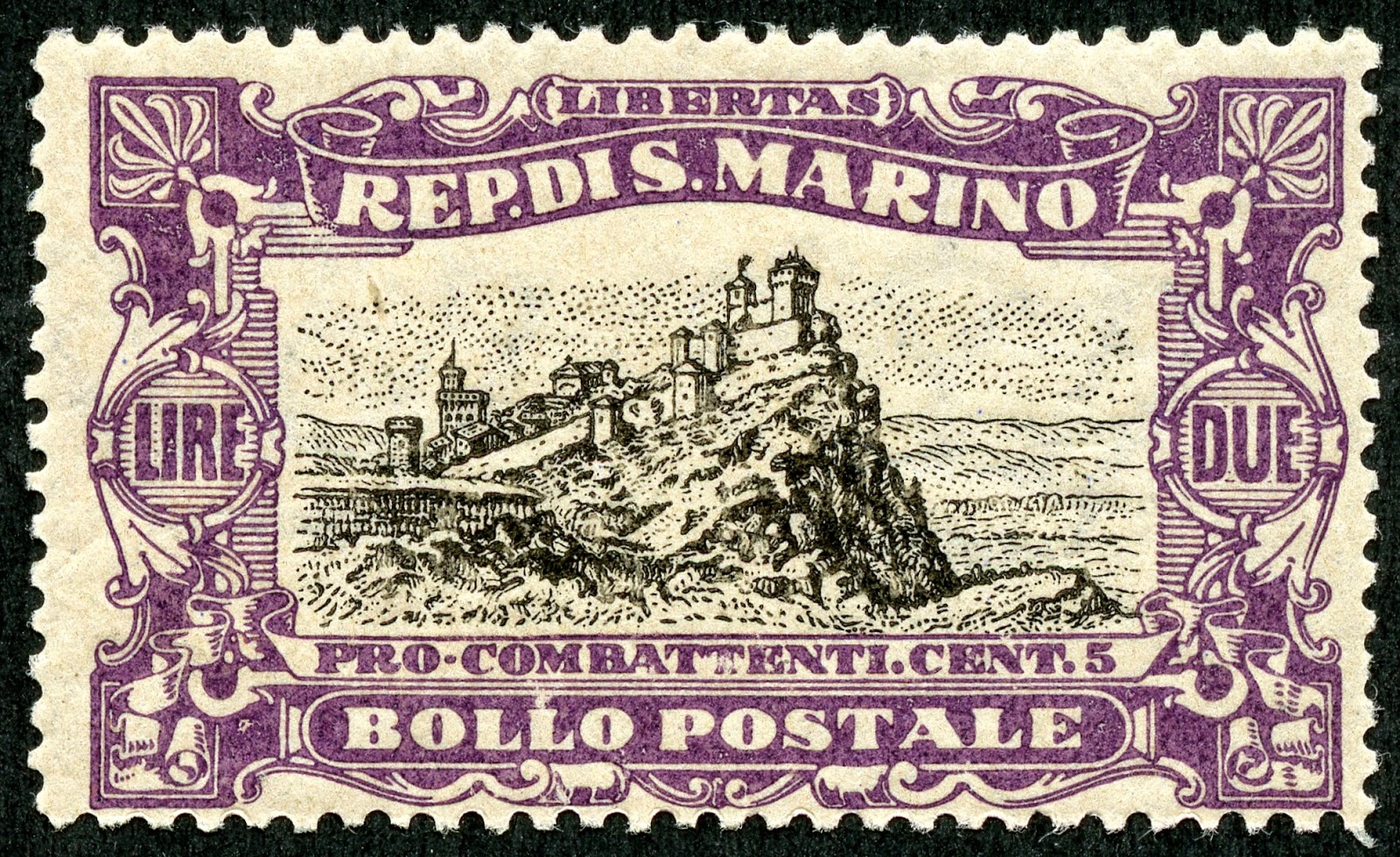
1918 Scott B10 2 l violet & black "View of San Marino"
Quick History
The Republic of San Marino, all 24 square miles of it, is located on the north-eastern side of the Apennine Mountains on the Italian Peninsula twenty miles from the Adriatic Sea, and surrounded by Italy.

San Marino and the Italian Peninsula
Saint Marinus of Arba founded a church on Monte Titano on September 3, 301, and thereby began the city and state of San Marino.

The Papacy recognized the independence of San Marino in 1631.

The independence was threatened by Napoleon's army in 1797, but Regent Antonio Onofri, through his friendship with Napoleon, was able to protect the Republic.

When Italy unified during the 19th century, Giuseppe Garibaldi, the Italian patriot, agreed to not incorporate San Marino into the developing Italian state.

Stamps, with the "Coat of Arms" design, were introduced in 1877.

We will meet all of these historical characters through their images on San Marino stamps.

Map of San Marino
During WW I, there was diplomatic tension with both Italy and Austria-Hungary, as San Marino attempted to stay neutral.

Between 1923 and 1943, the country was under the rule of the Sammarinese Fascist Party (PFS), closely allied with the Mussolini regime.

The population was 14,545 in 1939.

"Republic of San Marino -Neutral State" Sign 
Border of San Marino during WW II
During WW II, San Marino again attempted to remain neutral. When Benito Mussolini's government collapsed in Italy, the PFS rule also fell.

Nevertheless, the Royal Air Force bombed San Marino on June 26, 1944, killing 35 people, in the belief that the Germans were stockpiling supplies there..

In September 1944, it was occupied by German forces, who were then driven out by the Allies in the Battle of San Marino.

San Marino had a democratically elected communist government between 1945 and 1957.

1910 Scott 78 1c brown, Type II
"Coat of Arms"
Into the Deep Blue
The 2014 Scott Classic 1840-1940 catalogue has, for San Marino 1877-1940, 345 major descriptive numbers. Of those, 96 are CV <$1-$1+, or 28%. San Marino is somewhat expensive for the WW classical era collector, as one would expect for an  attractive "postage stamp" size country situated in Italy and Europe.

When I was much younger, I was fascinated with the "postage stamp" sized countries- Monaco, Liechtenstein, and, of course, San Marino. And it seemed like H.E.Harris knew this also. Glowing approval descriptions had their effect on the young child's imagination, until it became certain that "tiny" and "rare" were interlinked. And, I must admit, the psychology is still there. ;-)

A closer look at the stamps and issues
100 Centesimi = 1 Lira
1877 Scott 1 2c green "Numeral"
"Liberty" is found on many San Marino stamps, as the tiny Republic has indeed managed that. The first typographed issue had the lower three denomination stamps with a "Numeral" design (1877-1895).

1892 Scott 18 40c dark brown "Coat of Arms"
The "Coat of Arms" design is found on 21 stamps between 1877-1899. CV is $10+ for fourteen stamps, although no gum unused may be less.
Coat of Arms of San Marino
The COA features three hills --the three summits of Monte Titano. On them are three towers- the citadels La Guaita, La Cesta, and La Montale. Each has an ostrich feather design weather vane on top. 

1894 Scott 29 25c blue & dark brown
"Government Palace"
For the opening of the new Government Palace, and the installation of new Regents, a  three stamp bi-color lithographed issue was released in 1894.

1899 Scott 32 2c brown "Statue of Liberty"
An eight stamp "Statue of Liberty" issue was used in San Marino between 1899-1922. CV ranges from <$1-$4+.

Watermarks
Top Left: Wmk 174 "Coat of Arms"; Top Right: Wmk 217 "Three Plumes"
Bottom: Wmk 140 "Crown"
San Marino has some issues that are unwatermarked, while other discrete and different issues are watermarked. (In other words, one will not find the same stamp issue on both watermarked and unwatermarked paper.)

Here are the three watermarks that can be found for the classical era.

 The "Statue of Liberty" issue shown above has the "Crown" watermark. The 1894 "Government Palace" issue, already illustrated, has the "Coat of Arms" watermark, which has a shield with a large cross in the center. Finally, the "Three Plumes" watermark can be found on issues after 1929. 

Since there is no confusion, fortunately, in terms of identification for a specific issue, I will say no more about unwatermarking/watermarking.

1903 Scott 45 10c claret "Mt. Titano"
The most prolific (37 stamps), and probably most familiar issue for classical collectors, is the "Mt. Titano" typographed  stamp of 1903-1925. It clearly shows the three summits- and citadels- of Mt. Titano. CV ranges from <$1-$7+ for 25 stamps. On the other extreme, the 2 lire violet is $400+. !

I should mention that, for many of the earlier issues of San Marino, the perfs often cut into the design.

1923 Scott 81 30c dark brown
"St. Marinus"
Marinus, a stonemason by training, fled to Mt. Titano to live as a hermit, and founded a monastery and chapel in 301. When he died in 366, legend says he uttered "I leave you free from both men". The cryptic phrase was interpreted as referring to the two powers of the day, the Emperor and the Pope. The "Freedom Affirmation", even if apocryphal,  has been the inspiration for tiny San Marino to continue going their own way.

1924 Scott 87 1l deep blue
"San Marino Sheltering Garibaldi'
When the Italian patriot for unification, Giuseppe Garibaldi, needed help, San Marino offered shelter and refuge. For this, Garibaldi, in turn, acceded to the wishes of the inhabitants of San Marino to not be incorporated into the new Italian state.

For the 75th anniversary of Garibaldi taking refuge in San Marino, a five stamp issue was released in 1924.

1926 Scott 101 1l orange & black
"Antonio Onofri"
An engraved six stamp set was issued in 1926 in honor of the Regent Antonio Onofri, whose friendship with Napoleon maintained tiny San Marino's independence. Four stamps have CV <$1-$1+.

1927 Scott 109 1.25l blue "War Memorial"
Although San Marino was neutral during WW I, a group of San Marino volunteers did join Italian forces. A three stamp set was issued in 1927 in their memory.

1929 Scott 127 2.50l carmine rose & ultramarine
"Government Palace"
A nice engraved bi-color nineteen stamp issue was released between 1929 and 1935 with three designs.

Please click on and enlarge the 2.50 lire carmine rose & ultramarine stamp illustrated above, and just enjoy!

1932 Scott 144 20c violet "Garibaldi"
An eight stamp set was released in 1932 featuring Garibaldi (1807-1882) on two designs. The last stamp of the issue, a 5 lira olive green, is quite expensive @ $340, and also has a space in Big Blue. !

1935 Scott 167 1.25l blue & black
"Ascent to Mt. Titano"
San Marino was ruled by a fascist government between 1923 and 1943, closely allied with Mussolini's fascist regime. For the 12th year anniversary of the founding of the fascist movement, a seven stamp set was released.

1935 Scott 172 15c rose carmine
"Melchiorre Delfico"
A twelve stamp engraved bi-color issue was released in 1935 in honor of Melchiorre Delfico (1744-1835), Italian economist and historian. His published works corrected many abuses, including the abolition of feudal rights over landed property and their sale.

I'm not sure why San Marino wanted to honor him, though?

1918 Scott B13 25c ultramarine & black, Overprinted
"Statue of Liberty"
For the celebration of Italian victory over Austria, six stamps from the previous 1918 semi-postal issue were overprinted as shown. The previous 1918 semi-postals were sold at a 5 Centesimi advance over face value to support a hospital for Italian soldiers. So much for neutrality. ;-)

1923 Scott E3 60c on 25c carmine
Type of 1907 Special Delivery Issue Surcharged
The original special delivery stamp of this design was released in 1907. It was then surcharged in 1923 (illustrated above), and again in 1927.

Postage Due Stamps
1897 Scott J1 5c blue green & dark brown;
 1925 Scott J19 5c blue & brown;
1939 Scott J61 5c blue & brown
San Marino's postage due stamps are rather functional, but some attention needs to be directed to distinguish the various issues based on color and script.

Postage Due Stamps of 1925 Surcharged in Black and Silver
1931 Scott 48 40c on 30c blue & brown;
1931 Scott 40 20c on 5c blue & brown (reverse)
The 1925 postage due issue was subsequently surcharged in black and silver in 1931. The problem, for me, is the surcharge is so heavily applied on many of the stamps, that it is difficult to determine the underlying value. Sometimes, turning the stamp over (reverse) will reveal the underlying value. But I am also left with a number of "unknowns' in my collection. ;-)


Deep Blue
1877-99 Issue in Deep Blue
Deep Blue (Steiner) has 24 pages for the classic era San Marino. All of the major Scott numbers have a space.

1924 Scott 85 50c olive brown 
"Giuseppe Garibaldi"
Big Blue
Big Blue '69, on six pages, has 146 spaces.

Coverage is 42%.

The '69 editors rearranged the first page, and compared to the 1940s editions, offers slightly better coverage. The '69 editors also offer more spaces for the 1931 air mail issue. (Overall, the 1940s editions have 140 spaces.)

As I mentioned earlier, San Marino stamps can be expensive. And the BB collector is unfortunately not immune. In BB, there are eighteen stamp spaces that are in the "expensive" category ($10+-$30).

And there would have been even more, except for a "trick" I pulled to make the  1877-99 "Numeral" and "Coat of Arms" Issue (eleven spaces) not included. Conventional CV ranges from $11- $19. But they all are also listed in the catalogue as unused "no gum" for under $10. Therefore I am not formally including them in the "expensive" category, although one may still need to pay in that range to obtain a specific stamp.

What about the "Most Expensive" ($35+) category?

Hold on to your hats, because there are nine stamps in that range. 

The 1932 "General Post Office" issue (Scott 134-138) have two stamps @ $190 and $105.

The 1932 "Garibaldi" Issue has Scott 150 5l olive green @ $340!!!!!!

And the 1935 "Statue of Delfico" stamp (Scott 180) 1.75l brown orange is $100.

A list of all the "most expensive" and "expensive" stamps is provided under the Comments section following the checklist.

Checklist

1877-99*
1,2,3,6,7 or 8,9,
11,14,16,18,19,

1899-22
32,33,34,35,36,37,38,39,

1903-25
40,41,42 or 43,45,48,51,53,
54,57,60,63,65,(46),

1894
29,

1905
77,

1907
78 or 78a,

Next Page

1923
81,82,

1924
84,85,86,

1925
44,47,49,55,58,61,64,

1926
97,98,99,100,

1929
115,116,117,

1929
118,119,120,121,122,123,124,

1927
108,(109),

1928
111,112,

1932
139,140,141,

Next Page

1932 "General Post Office"*
134,135,136,137,138,

1932 "Garibaldi" *
143,144,145,146,
147,148,149,150,

1935
161,162,163,164,
165,166,167,169,
170,171,172,173,174,175,

Next Page

1935
176,177,178,
179,180,

Next Page

Semi-Postal
1918
B3,B4,B5,B6,B7,B8,

1923
B18,B19,B20,B21,B22,B23,B24,

Postage Due
1897-1925
J1 or J10 or J19,J2 or J11 or J20,J24,J26,J27,(J28),

1931-40
J37,J38,J39,J40,J41,J42,
J61,J62,J63,

Parcel Post
1928
Q1,Q2,Q3,
Q4,Q5,Q6,

Next Page

Special Delivery
1929
E6,E7,

Semi-Postal Special Delivery
1923
EB1,

Air Post
1931
C1,C2,C3,
C4,C7,C8,

C9,(C5),(C6),

Comments
A) Expensive stamps ($10 threshold):
* 1877-99 "Numeral" and "Coat of Arms" Issue
There are eleven spaces for the issue (Scott 1,2,3,6,7 or 8,9,
11,14,16,18,19), and conventional CV ranges from $11- $19. But they all are listed in the catalogue as unused "no gum" for under $10. Therefore I am not formally including them in the "expensive" category, although one may still need to pay in that range to obtain a specific stamp.

1903 Scott 53 25c blue ($10+)
1905 Scott 77 15c on 20c brown orange ($10+)
1928 Scott 111 50c red ($10+)
1928 Scott 112 1.25l deep blue ($10+)
1932 Scott 134 20c blue green ($20+)
1932 Scott 135 50c dark red ($20+)
1932 Scott 136 1.25l dark blue ($190) !!!!
1932 Scott 137 1.75l dark brown ($105) !
1932 Scott 138 2.75l dark violet ($60)
1932 Scott 141 1.25l dark blue ($10+)
1932 Scott 146 50c yellow brown ($10)
1932 Scott 147 75c dark red ($20+)
1932 Scott 148 1.25l dark blue ($30)
1932 Scott 149 2.75l brown orange ($60)
1932 Scott 150 5l olive green ($340) !!!!!!
1935 Scott 172 15c rose carmine ($20+)
1935 Scott 177 75c red ($10+)
1935 Scott 179 1.50l dark brown ($70)
1935 Scott 180 1.75l brown orange ($100) !
1931 Scott C1 50c blue green ($20+)
1931 Scott C2 80c red ($20+)
1931 Scott C3 1l bister brown ($10+)
1931 Scott C4 2l bright violet ($10+)
1931 Scott C8 7.70l dark brown ($10+)
1931 Scott C9 9l deep orange ($10+)
1931 Scott (C5) 2.60l prussian blue ($65)
1931 Scott (C6) 3l dark gray ($55)
B) *1932 "General Post Office"Issue (5 stamps)-very expensive! ($20+-$190)
C) *1932 "Garibaldi" Issue - Five stamps range from CV $10-$340!!!!
D) (    ) around a number indicates a blank space choice.

1923 Scott B24 1l + 5c black & blue "Liberty"
Out of the Blue
I've been more interested in obtaining the classical era stamps of San Marino than, perhaps, most other countries. Could it be that child in me that still equates "tiny" and "rare"? ;-)

Note: Maps, "Coat of Arms" image, and border pic of San Marino during WW II appear to be in the public domain.

Comments always welcome!