A is for Aden and Z is for Zanzabar


A is for Aden and Z is for Zanzibar... Now what is between? For the world wide classical era philatelist and stamp collector, a country specific philatelic survey is offered by the blog author, Jim Jackson, with two albums: Big Blue, aka Scott International Part 1 (checklists available), and Deep Blue, aka William Steiner's Stamp Album Web PDF pages. In addition, "Bud" offers commentary and a look at his completely filled Big Blue. Interested? So into the Blues...

Thursday, November 13, 2014

Pakistan

1947 Scott 14 1r brown & slate 
Stamps of India 1937-43, Overprinted
Quick History
The Dominion of Pakistan came into existence as a sovereign country on August 15, 1947, when it and the Dominion of  India were partitioned from British India. Both Pakistan and India then joined the British Commonwealth.

The borders of Pakistan separated out the Muslim majority in the northwest and east from Hindu India.

The Dominion of Pakistan 1947-1956
West Pakistan & East Pakistan
In the east, the province of Bengal was divided into East Bengal ( "East Pakistan"), and West Bengal, which remained in India.

In the northwest, the western portion of Punjab became part of Pakistan, while the east part remained with India.

The other provinces that joined as a federation within Pakistan included Balochistan, Sindh, and the North-West Frontier Province. The Native (Princely) States (including stamp issuing Bahawalpur) within the Provinces also joined the federation.

The Capital of the Dominion was Karachi. ( The Capital was moved to the planned city of Islamabad in 1960.)

Pakistan
The Dominion and the monarchy was abolished in 1956, with the development of an Islamic Republic. In 1971, after a bloody civil war,  East Pakistan left the Republic to become the country of Bangladesh.

So ends this rather too quick history. ( A deeper historical review by readers is encouraged.)

1947 Scott 4 1a carmine rose
Stamps of India 1937-43, Overprinted
Into the Deep Blue
The 2011 Scott Classic 1840-1940 catalogue has, for Pakistan 1947-49, 32 major descriptive numbers for the regular and official stamp categories. All of these stamps are "Pakistan" overprinted stamps of 1937-43 India. Of those, 20 ( 62%) are CV <$1-$1+.

Pakistan's own stamp designs, which were issued beginning in 1948, are not part of the Scott Classic catalogue. Therefore, I will  not include them here.

A closer look at the stamps and issues
12 Pies = 1 Anna
16 Annas - 1 Rupee
1947 Scott 6 2a scarlet
Stamps of India 1937-43, Overprinted
Beginning October 1, 1947 (Recall Pakistan came into existence August 15, 1947), 19 stamps of India were overprinted as shown for Pakistan. As Pakistan was a Dominion, the image of George VI was appropriate. The truth is, though, this issue ( and the 1947-49 Official issue) were the last to show a monarch, even though the Dominion lasted until 1956. Queen Elizabeth, as "Queen of Pakistan", never appeared on a Pakistan stamp during this era. The times were a changin'.

1947 Scott 11 8a blue violet
Thirteen stamps in the issue have a CV of <$1-$1+.

1947 Scott 15 2r dark brown & dark violet
The six higher denomination values were in a large stamp bi-color format.

1947 Scott O3 9p green
Official Stamps of India, 1939-43, Overprinted
Between 1947-49, thirteen Official stamps were issued by overprinting India "service" stamps.

1947 Scott O6 2a scarlet
Note the "Local" overprint
What do you make of this large overprint? The 2012 Stanley Gibbons Commonwealth & British Empire Stamps 1840-1970 catalogue states: " Numerous provisional "Pakistan" overprints, both handstamped and machine-printed, in various sizes and colors, on Postage and Official stamps, also exist".

1947 Scott O11 2r dark brown & dark violet
CV for eight stamps in the Official issue range from <$1-$2.

Deep Blue
1947 Issue in Deep Blue
Deep Blue (Steiner) has two pages for the overprinted "Pakistan" stamps of 1937-43 India, and includes spaces for all the Scott major numbers.

1947 Scott 9 4a chocolate
Big Blue
Big Blue ( Part I 1840-1940) does not include Pakistan, as that country is covered in the Part II (1940-1949+) volume. Therefore, I will not include a checklist here.

I must admit, though, I am strongly tempted to actively collect the world's stamps of 1940-1949, as WW II and the aftermath create a highly interesting stamp era. ( I am already doing this with the 1940-52 George VI British Commonwealth countries.)

1947 Scott O9 8a blue violet
Out of the Blue
These transitional "Pakistan" overprinted stamps of India do little to exhibit the interesting stamps and history of this important country, which was birthed in 1947.

Note: Map images appear to be in the public domain.

Have a comment?

Monday, November 10, 2014

Algeria- a closer look at the stamp issues

1936 Scott 89 45c deep ultramarine
"Sidj Bon Medine Cemetery at Tiemcen"
Into the Deep Blue
The 2011 Scott Classic Specialized 1840-1940 catalogue has, for Algeria 1924-1940, 130 regular, 35 semi-postal, 24 postage due, and 2 newspaper stamps with major numbers. Total = 191. Of those, 154 are CV <$1-$1+, or 81%. Clearly, Algeria is quite affordable for the classical collector.

A closer look at the stamps and issues
100 Centimes = 1 Franc
1924 Scott 24 65c rose, blue overprint "Sower"
The initial issue of French Algeria used overprinted stamps of France. The 1924-26 production had 32 stamps, and the overprint is found in red, blue, and black.

1926 Scott 31 3fr violet & blue
"Liberty and Peace"
The CV for the issue is remarkably inexpensive, with only one stamp valued higher than $1+. And the beauty of French stamps is not to be denied. Thus series alone would make me want to collect classical WW!

1926 Scott 34 2c red brown 
"Street in Kasbah, Algiers"
A street scene from Kasbah -  intriguing. Go ahead and click on the image and enlarge :-). The street scene stamp is the first design in the 35 stamp issue of 1926-39.

1926 Scott 65 5fr red & violet
"Marabout of Sidi Yacoub"
The higher denominations share this image, and only here does the CV begin to climb above $1+.

1927 Scott 72 90c on 80c orange red
"La Pecherie Mosque"
Stamps of 1926 Surcharged with New Values"
In 1927, seven stamps from the preceding 1926 issue were surcharged.

La Pecherie Mosque
 Another view of the Mosque.

1936 Scott 94 75c slate blue
"Oued River at Colomb-Bechar"
Between 1936-41, a lovely 31 stamp pictorial issue was released. We will take a look at the eight designs, in no particular order.

The Oued Ksob is a river in (now) western Morocco that empties into the Atlantic ocean. A French Foreign Legion post was once located at Columb-Bechar.

1936 Scott 102 2.25fr yellow green
"Travel across the Sahara"
The Sahara, the hottest desert in the world, can have sand dunes up to 600 feet in height. BTW, this is the most expensive stamp in the set @ $10+.

1936 Scott 101 2fr dark brown
"Arch of Triumph, Lambese"
Except for three stamps, all the stamps in the issue are CV <$1-$1+.

1936 Scott 97 1.25fr light violet
 "Admiralty Building, Algiers"
The heavy scroll work around the frame is characteristic of the issue.

1936 Scott 88 40c brown violet
"Kings' Tombs near Touggourt"
Touggourt is located next to an oasis in the Sahara.

1936 Scott 86 25c rose violet
"El-Kebir Mosque, Algiers"
The great Mosque of Algiers was built in 1097.

1938 Scott 118 65c ultramarine
"Ruins of a Roman Villa"
Philippeville (now Skikda) was founded in 1838 by the French on the ruins of an ancient Phoenician city. For the centenary, a five stamp issue was produced in 1938.

1930 Scott B20 50c + 50c ultramarine
"Ruins at Djemila"
This 1930 semi-postal shows Djemila, a village in mountainous Algeria, where some of the best Berbero-Roman ruins have been preserved.

Deep Blue
Deep Blue (Steiner) has 12 pages for Algeria, and all the major numbers in Scott have a space.

1925 Scott 21 45c red, blue overprint
"Louis Pasteur"
Out of the Blue
I'm adding more stamp images (and discussion) to the earlier published posts. The French inspired Algerian stamps are worthy indeed.

Note: La Pecherie Mosque pic appears to be in the public domain.
Note: These images are added to the original Algeria post.

Comments?

Tuesday, November 4, 2014

Orange Free State & Orange River Colony

Orange Free State
1894 1p violet "Orange Tree"
Quick History
The Orange Free State (Oranje-Vrijstaat), founded by Dutch (Boer) settlers in 1854, was located between the Orange and Vall rivers in southern Africa. The Orange river, by the way, was named for the House of Orange, the ruling Dutch royal family.

Orange Free State circa 1900
The Capital was Bloemfontein, the population was 100,000 in 1875, and the official language was Dutch.

The Boers, some 3000 strong, had initially left the Cape Colony area on "The Great Trek" to try to escape from British administration. They originally settled in Natal, but the British had then extended their reach there also. So they again moved in 1843 north to the lands that would become the Orange Free State.

Orange Free State "Coat of Arms"
The Xhosa and Zulu tribes were not pleased with the newcomers, but the Boers had superior firepower. Eventually, the British recognized the sovereignty of the Orange Free State in 1854.

Stamps were introduced for the Republic in 1868.

Diamond and Gold discoveries would make Transvaal, and to a lesser extent the Orange Free State, much more wealthy and financially secure. The Cape Colony and Cecil Rhodes began a concerted effort to annex the Boer Republics. 

The hard fought and bloody Second Boer War (1899-1902) lead to a British victory and the annexation of both independent Boer Republics. (This is fascinating history, but this is a stamp blog, so I will reluctantly stop here.)

British Cape Colony (blue), Natal (red)
South African Republic / Transvaal (green), Orange Free State (orange)
British Occupation stamps were created in 1900 by overprinting on the Orange Free State issues "V.R.I." ( Victoria Regina et Imperatrix), and surcharging them.

Also, in 1900, Cape of Good Hope stamps were overprinted "Orange River Colony".

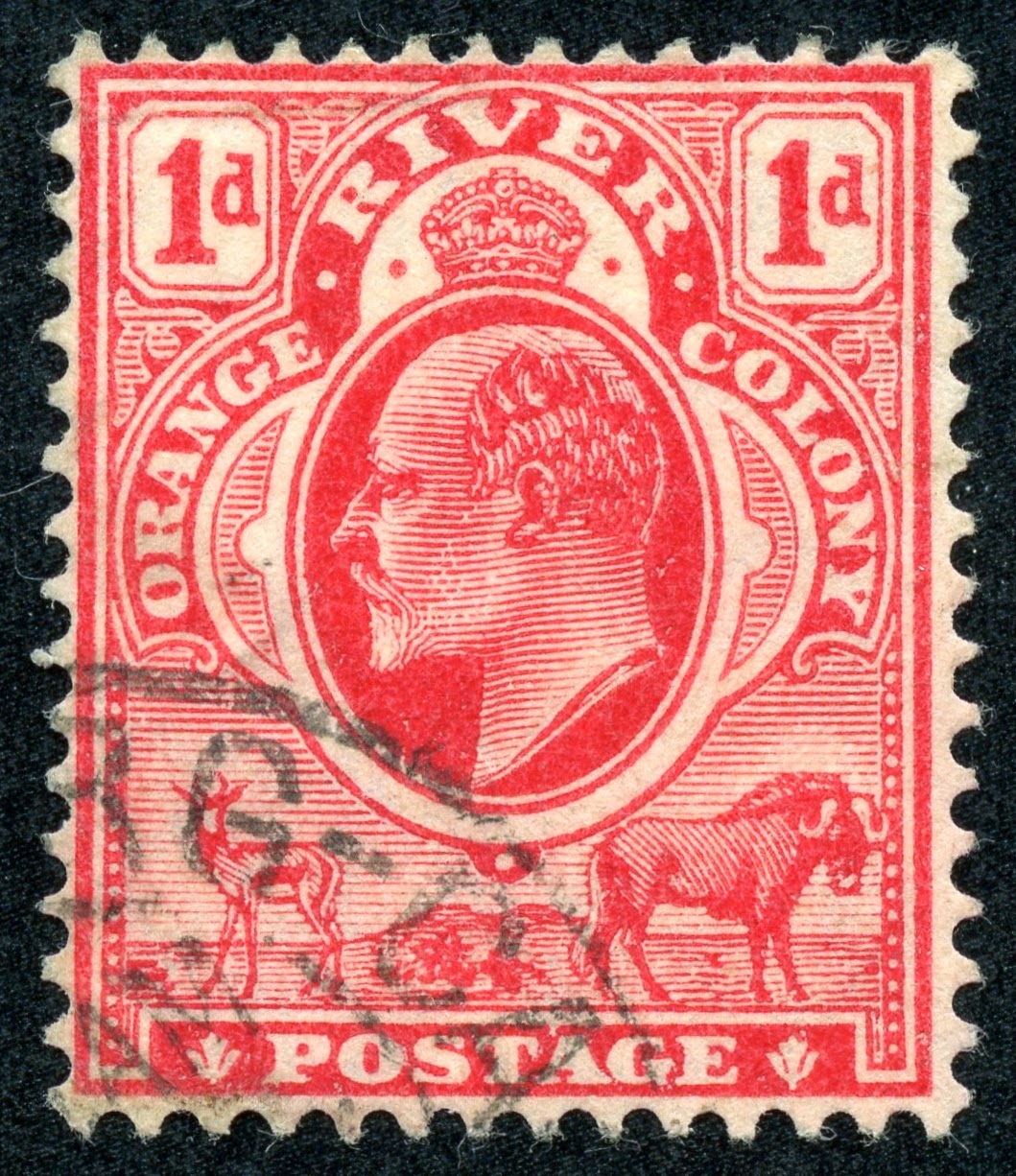
Between 1903-08, Orange River Colony "King Edward VII" stamps were issued. 

In June, 1910, the Orange River Colony was joined with Cape of good Hope, Natal, and Transvaal to form the Union of South Africa. "Orange River Colony" stamp production then ceased.

Orange River Colony
1900-01 Scott 44j 1/2p on 1/2p orange
Into the Deep Blue
The 2011 Scott Classic Specialized 1840-1940 catalogue has, for Orange Free State & Orange River Colony 1868-1908, 76 major descriptive numbers. Of those, 28 are CV <$1-$1+, or 37%. Delightfully, many stamps of Orange Free State/ Orange River Colony are affordable for the WW classic era collector.

In addition, there are many Scott minor numbers listed, primarily for overprint errors. Although these errors are of interest to the specialist, the WW collector may find some in his/her own collection too.

A closer look at the stamps and issues
Orange Free State Pound
12 Pence = 1 Shilling
Orange Free State
1868 Scott 3 1p red brown "Orange Tree"
The first (and only) design for Orange Free State stamps was used between 1868-1900, and is found on twelve major issue stamps. Nine stamps are quite inexpensive  @ CV <$1-$2+. There are minor numbers for color variations.

Orange Free State
1894 1p violet "Orange Tree"
This 1p violet has a nice postmark from the capital, "Bloemfontein". I can imagine this issue would be an interesting specialization.

Orange Free State
1891 Scott 29 1p on 3p ultramarine
The rest of the Orange Free State era stamps- some 32 major descriptive numbers issued between 1877-1897- are all of the surcharged variety. Their CV tends to be fairly expensive ($10+- $50+), so I don;t have many.

But I do have this 1891 example with CV <$1.

1896 Scott 42 1/2p on 3p ultramarine
Another inexpensive example from 1896. As one can imagine, there are also a tidy group of minor numbers with surcharge printing variants.

Orange River Colony
1900-01 Scott 46e 2p on 2p violet
Arriving at the beginning of the British occupation, the "V.R.I." overprint comes in two major types. The March-April 1900 issue ( 12 stamps- major numbers) has the periods in "V.R.I." level with the bottom of the letters. CV ranges from <$1- $4 for seven stamps.

The 1900-01 "V.R.I." overprint ( 11 stamps- minor numbers) has the periods raised above the bottom of the letters:  this is illustrated here. CV ranges from very inexpensive (<$1) to very expensive ( $1,500).

The 1900-01 raised "V.R.I." overprints also have numerous ( minor number) printing variants. One is shown later in the blog post.

It might be advantageous to check one's collection for possibilities.

1902 Scott 56 1p carmine rose
Overprinted on Cape of Good Hope Stamp
The "Orange River Colony" was declared by the British on October 6, 1900, although guerrilla warfare continued until 1902. In 1900 ( two stamps), and in 1902 ( this stamp illustrated) were overprinted as shown on Cape of Good Hope stamps. The CV for the three stamps is <$1.

1902 Scott 57b 4p on 6p on 6p ultramarine
Note inverted "1" on this stamp
In 1902, three stamps were additionally surcharged. This example is interesting, because it shows an example of the numerous printing variants found for the Orange Free State/ Orange River Colony overprinted/surcharged types.

Here, an upside down "1" was substituted for the "I".

1903 Scott 61 1/2p yellow green "Edward VII"
Watermark 2 Issue
The Orange River Colony received their own proper stamps in 1903-04 with the "Edward VII" nine stamp issue. CV is <$1-$2+ for eight stamps.

This issue is characterized by the Colonial Watermark 2, " C A and Crown".

1907-08 Scott 71 1p carmine "Edward VII"
Watermark 3 Issue
A Watermark 3 "Multiple C A and Crown" issue of four stamps was produced in 1907-08. The 1/2p, 1p, 4p, and 1sh denominations can only be differentiated from the earlier 1903-04 issue by checking the watermarks Refer to the Gilbraltar post if a review of the British Colonial watermarks is needed.

In June, 1910, the Orange River Colony was joined with Cape of Good Hope, Natal, and Transvaal to form the Union of South Africa. However, the stamps of the provinces were still valid for postage up to January 1, 1938, when they were demonetized.

Deep Blue
1900-01 surcharged issues under British occupation in Deep Blue
Deep Blue (Steiner) has five pages for the Orange Free State and the British occupation (Orange River Colony), and includes a space for all the major numbers. In addition, the Steiner has eleven spaces for the minor number 1900-01 Issue ( where the periods are raised above the bottom of the letters). Nice!

1900 Scott 54 1/2p green
Overprinted on Cape of Good Hope Stamp
Big Blue
Big Blue '69, has Orange River Colony (Orange Free State) on one page, with 31 spaces. Coverage is 41%. The page is  located between "Oltre Giuba" and "Palestine".

The 40s editions have Orange River Colony located between "Panama" and "Papua". There are only 22 spaces on 2/3 page in those editions.

True-  the '69 editors cut out a number of smaller countries and BOB issues. But, in other cases (such as here), there is better coverage. ;-)

Checklist

(Orange Free State)
1868-1900
1,2,3,4,5,
6,8,(11),

1890-91
29, (31),

1896
42,43,

(Orange River Colony)
1900*
44,45,46,47,48,49,51,(52),

1900-02
54,55,56,

1903-08*
61 or 70, 62 or 71, 63,64,65,66 or 72, 67, (68 or 73),

End

Comments
A) Expensive stamps ($10 threshold):
1890 Scott 8 6p carmine rose ($10+)
B) (    ) around a number indicates a blank space choice.
C) *1900- the illustration in BB shows the major number "V.R.I.", where the periods are level with the bottoms of letters. The minor number variety (1900-01), where the periods are raised above the bottom of the letters, may be put into the spaces also-  but perhaps they are not quite as ideal, considering BB's illustration. ;-)
D) * 1903-08- either wmk 2 or 3 are eligible.

1907 Scott 70 1/2p yellow green "Edward VII"
Watermark 3 Issue
Out of the Blue
The stamps for Orange Free State and Orange River Colony are tangible small pieces of history for a time, era, and place when one of the more horrifying wars that mankind has waged took place. (Neither the Boers nor the British come out looking particularly good IMHO.)

Note: Maps, "Coat of Arms" image, and war image pic all appear to be in the public domain.

Have a comment?

British Casualties- Battle of Spion Kop-1900

Saturday, November 1, 2014

Alexandretta- a closer look at the stamps

1938 Scott 2 20c brown orange
Into the Deep Blue
The 2011 Scott Classic Specialized catalogue has, for Alexandretta 1938, 17 regular, 8 air post, & 6 postage due major descriptions. Total = 31 stamps. Of those, thirteen (42%) are CV $3-$4+. There are no $1-$2 CV stamps for Alexandretta, but raising the bar slightly does yield a representative selection for the WW classical collector.


 Alexandretta (Iskenderun) is located today in the Hatay Province of Turkey.

A closer look at the stamps and issues
100 Centimes = 1 Piaster
1938 Scott 1 10c violet brown "View of Hama"
Stamps of Syria 1930-36, overprinted
Scott 1-9 stamps were issued April 14, 1938. Syrian stamps were overprinted as shown. The only issue year 1938 reflected the short life of Alexandretta.

1938 Scott 7 4p yellow orange 
"Square at Damascus"
As the territory was on the border between Turkey and Syria, one would expect a fight over which nation would obtain sovereignty. If you wish to read more about the machinations, view my Hatay post.

1938 Scott 10 75c orange red 
"Mosque at Homs"
Scott 10-12 were issued September 2, 1938. The CV for the issue ranges from $3-$10+.

1938 Scott C1 1/2p dark violet, red overprint
"Ancient Citadel at Aleppo"
An eight stamp air post issue was produced by overprinting Syrian 1937 air post stamps. CV ranges from $3-$10+.

Deep Blue
Deep Blue (Steiner) has three pages for Alexandretta, and includes spaces for all the issued stamps.

1938 Scott 4 1p bister brown
"Citadel at Aleppo"
Out of the Blue
I am fascinated by the history of this part of of the world, and hence find the stamps quite attractive too.

Note: This "Into the Deep Blue" blog post and stamp images have been added to the original Alexandretta post.

Have a comment?