A is for Aden and Z is for Zanzabar


A is for Aden and Z is for Zanzibar... Now what is between? For the world wide classical era philatelist and stamp collector, a country specific philatelic survey is offered by the blog author, Jim Jackson, with two albums: Big Blue, aka Scott International Part 1 (checklists available), and Deep Blue, aka William Steiner's Stamp Album Web PDF pages. In addition, "Bud" offers commentary and a look at his completely filled Big Blue. Interested? So into the Blues...

Wednesday, February 15, 2012

French Oceania (Polynesia) and Tahiti

1929 Postage Due 2fr brown red & dark brown "Tahitian Youth"
Quick History
French Oceania was a French colony formed in 1903 from several groups of South Pacific Polynesian islands. The islands included the Marquesas, the Tuamotu Archipelago and Gambier, and the Austral and Bass groupings. The most important group was the Society islands; and above all Tahiti with the Capital Papeete. The population was 51,000 in 1941.

French Polynesia on the globe
A French protectorate was established over the islands in 1889, but Tahiti has been a French protectorate since 1842. By 1880, Tahiti was declared a colony. Stamps overprinted "Tahiti" can be found on the French Colonies issues beginning in 1882. Overprinted stamps through 1903 are separately catalogued until Tahiti became a member of the French Oceania grouping colony.

French Polynesia
The French Oceania colony stamps began in 1892 with the familiar "Navigation and Commerce" issue. They were imprinted as "ÉTABLISEMENTS DE L'OCEONIE". French Oceania continued until 1946, when the Polynesians were granted French citizenship. Then the islands status became an overseas territory, and the name was changed to Polynésie Française. 

French Polynesia today
Finally, French Polynesia became an overseas collectivity of France in 2004.

1937 90c red "France and the Empire"
Paris International Exposition: Colonial Arts Exposition
Into the Deep Blue
The 2011 Scott classic catalogue has 59 major descriptions for Tahiti between 1882-1903 for overprinted regular and postage due stamps. A few are found in the $10-$40 CV category, but many are several hundred dollars in valuation. I don't have any. ;-)

For the French Oceania colony, Scott has 154 descriptions for regular, semi-postal, air post, and postage due categories from 1892-1940. Seventy-six stamps, or 49%, are valued at a very reasonable <$1-$2+.

A closer look at the stamps and issues

1893 Scott 10 15c blue
Stamps of French Colonies
Handstamped in Black
As mentioned, Tahiti stamps can be found overprinted/surcharged on French Colony stamps from 1882-1903. This is illustrated above with a 1893 issue. If one was specializing, collecting some of these stamps ( minimum CV $10-$60) might be attractive.

1900 10c red "Navigation and Commerce"
Part of the first issue for French Oceania
The first issue for the new grouping of islands-French Oceania- has the familiar "Navigation and Commerce" design. This 20 stamp issue from 1892-1907 has five stamps valued <$5, and twelve more for <$20.

1927 20c brown red & dark brown "Tahitian Girl"
Part of a 34 stamp issue 1913-30
The first issue featuring local portraits/scenes was a 34 stamp three design bi-color series produced from 1913-1930. Twelve stamps had the striking "Tahitian Girl" motif illustrated above.

1926 50c gray & blue violet "Kanakas"
Second design in issue: SON Papeete Tahiti
Sixteen stamps in the 1913-30 issue had the "Kanakas" design. "Kanakas" means Pacific Island Worker. But, Polynesian men were often referred to as "Kanakas", which can also mean "boy". This word now has pejorative connotations, and is an offensive term for a Pacific islander.

1925 85c on 1fr dark blue 7 olive "Fautaua Valley"
Third design: Type of 1913-30 surcharged in red
The last design (illustrated above) was found on six higher denomination stamps, and CV is $3+-$15. Between 1916-27, thirteen of the 1913-30 series were overprinted/surcharged, as illustrated above.

1934-40 5c violet "Spear Fishing"
Part of a 37 stamp issue.
In 1934, a new series was produced featuring three local portraits/scenes. This design was found on the eight lower denomination stamps.

1938 80c violet brown "Tahitian Girl"
The second design had a "Tahitian Girl", obviously posing and looking at the us, as the subject. This motif is found on 14 stamps.

1939 1.60fr dull violet "idols"
The last design, found on 15 stamps, has totems or idols as the motif. Well designed; I like it. ;-)

Deep Blue
French Oceania has thirteen pages in Deep Blue, and I have stamps on ten pages. I didn't check the Fiji section, as I have no stamps presently.

First page of a two page layout for the 1913-30 issue in Deep Blue
One of the strong points of Bill Steiner's (Deep Blue) album is the simple, but elegant layout presented for a stamp series. Very visually attractive and appealing. And of course the stamps are listed in chronological Scott order for the most part which makes as easy transition into the album.

1924-27 Stamps of 1913-30 Surcharged
New values and bars
Small series are logically together and attractively presented. What's not to like? ;-)

1929 3fr green & dark brown "Papetoai Bay, Moorea"
Big Blue
Listed under "French Polynesia", BB '69 has four pages with 104 spaces for regular, semi-postal, air post and postage due categories. Coverage is 68%. Among the  more expensive stampsis the 1892 "Navigation & Commerce" 15c blue (quadrille paper) @ $12.


Simple Checklist

1892-1900
1,2,3,4,5,7,8,

1913-15
21,22,23,24,26,29,30,
33,39,40,41,47,49,

1916
56,

1922
25,27,34,36,43,60,

1924
64,65,66,

1925
61,

Next Page

1925
62,

1925-26
28,31,37,44,45,

1927
63,68,

1927-30
32,38,46,48,
51,52,72,

1934-38
80,
81,83,84,85,
86,87,88,89,
91,92,93,95,

Next Page

1934-38
96,98,100,101,
102,103,104,107,
109,110,

1938
117,120,

1937
118,119,121,122,

1939
82,90,94,97,
99,105,106,108,

Next Page

1940
111,112,113,114,

Air Post
1934
C1

Postage due
1926
J1,J2,J3,J4,J5,

1929
J10,J11,J12,J13,J14,
J15,J16,J17,

Semi-postal
1915-16
B3,B4,

1938
B5

Comments
A) ( ) indicates a suggested blank space choice
B) Expensive stamps ($10 threshold):
1892-1900 
Scott 8 15c blue, quadrille paper "Navigation and Commerce" $10+

1927-30
Scott 52 1.50fr indigo & black “Fautaua Valley” $10+

Semi-postal
1938
Scott B5 1.75fr + 50c bright blue “Curie” $20

1934 Air Post 5fr green "Seaplane in Flight"
Out of the Blue
It's not hard to find Papeete (The Capital) or Tahiti (Most populous island) postmarks on these stamps. A challenge would be to find them for the other island groups. ;-)

Links
French Oceania - Bud's Big Blue
Would appreciate a comment!

Sunday, February 12, 2012

One Year Big Blue!

1908 1pi deep blue on blue "Emperor Franz Josef"
Austria Offices in the Turkish Empire
One Year Anniversary
On February 12, 2011 the "Big Blue" blog began as a way to provide a checklist for collectors of the Scott International 1840-1940 Part I album.

Since then, 144 blog entries have been published, and 112 countries have been covered. The checklist database is expanding every week. And the scope has been enlarged to include a discussion of a countries stamps and issues, as well as adding coverage for the Deep Blue (Steiner) albums.

A deep THANK YOU to my readers. Your participation and comments have been most helpful. And THANKS to Bob of  "Filling Spaces" fame, who continues to inspire, and a must read!

And this year should be even better. :-)

There is clearly more information available now for world wide classical era collectors. We have two blogs devoted to, in part, "filling" the Scott International Part I. Not least, the blogs have demonstrated that an impressive classical collection can be accumulated without necessarily a large expense.

The intersection of history and stamps and postal history that the classical era provides, giving almost a three dimensional perspective, is hard to beat.  And the interest is worldwide, as evidenced by Big Blue's audience count. Here, listed below for your curiosity, are the stamp collecting countries that have visited Big Blue during the first year.

Top Ten Countries (Updated July, 2013)
United States

United Kingdom

Canada

Germany

Australia
Italy
France
India
Greece
Netherlands


All Countries  (96 Total February 12, 2012)
Update July, 2013- 158 countries.
Afganiastan
Albania
Algeria
Andorra
Angola
Antigua-Barbuda
Argentina
Armenia
Aruba
Australia
Austria
Azerbaijan
Bahamas
Bahrain
Bangladesh
Barbados
Belarus
Belgium
Belize
Benin
Bermuda
Bolivia
Bosnia & Herzogovina
Botswana
Brazil
British Virgin Islands
Brunei
Bulgaria
Burma (Myanmar)
Cambodia
Cameroun
Canada
Cayman Islands
Chile
China
Colombia
Cook Islands
Congo (P.R.C.)
Costa Rica
Croatia
Cyprus
Czech Republic
Denmark
Dominican Republic
Ecuador
Egypt
Estonia
Ethiopia
Fiji
Finland
France
French Guiana
French Polynesia
Gabon
Georgia
Germany
Ghana
Greece
Grenada
Guam
Guatemala
Guernsey
Guyana
Haiti
Heligoland
Hong Kong
Honduras
Hungary
Iceland
India
Indonesia
Iran
Iraq
Ireland
Isle of Man
Israel
Italy
Ivory Coast
Jamaica
Japan
Jersey
Jordan
Kazakhstan
Kenya
Kuwait
Latvia
Lebanon
Libya
Lithuania
Macao
Macedonia (Republic)
Madagascar
Malaysia
Malawi
Mali
Malta
Mauritius
Mexico
Moldova
Mongolia
Montenegro
Morocco
Mozambique
Namibia
Nepal
Netherlands
Netherlands Antilles (Curacao)
New Zealand
Nigeria
Norway
Oman
Pakistan
Palestinian Territories
Panama
Papua New Guinea
Paraguay
Peru
Philippines
Poland
Portugal
Puerto Rico
Qatar
Reunion
Romania
Russia
St Kitts & Nevis
Saint Maarten
Saint Vincent & the Grenadines
Salvador El
Saudi Arabia
Serbia
Singapore
Slovakia
Slovenia
South Africa
South Korea
Spain
Sri Lanka (Ceylon)
Sudan
Sweden
Switzerland
Syria
Taiwan
Tanzania
Thailand
Trinidad and Tobago
Tunisia
Turkey
Uganda
Ukraine
United Arab Emirates
United Kingdom
United States
Uruguay
Uzbekistan
Venezuela
Vietnam
Yemen


Comments?  Please Do!


Jim

Thursday, February 9, 2012

French Morocco

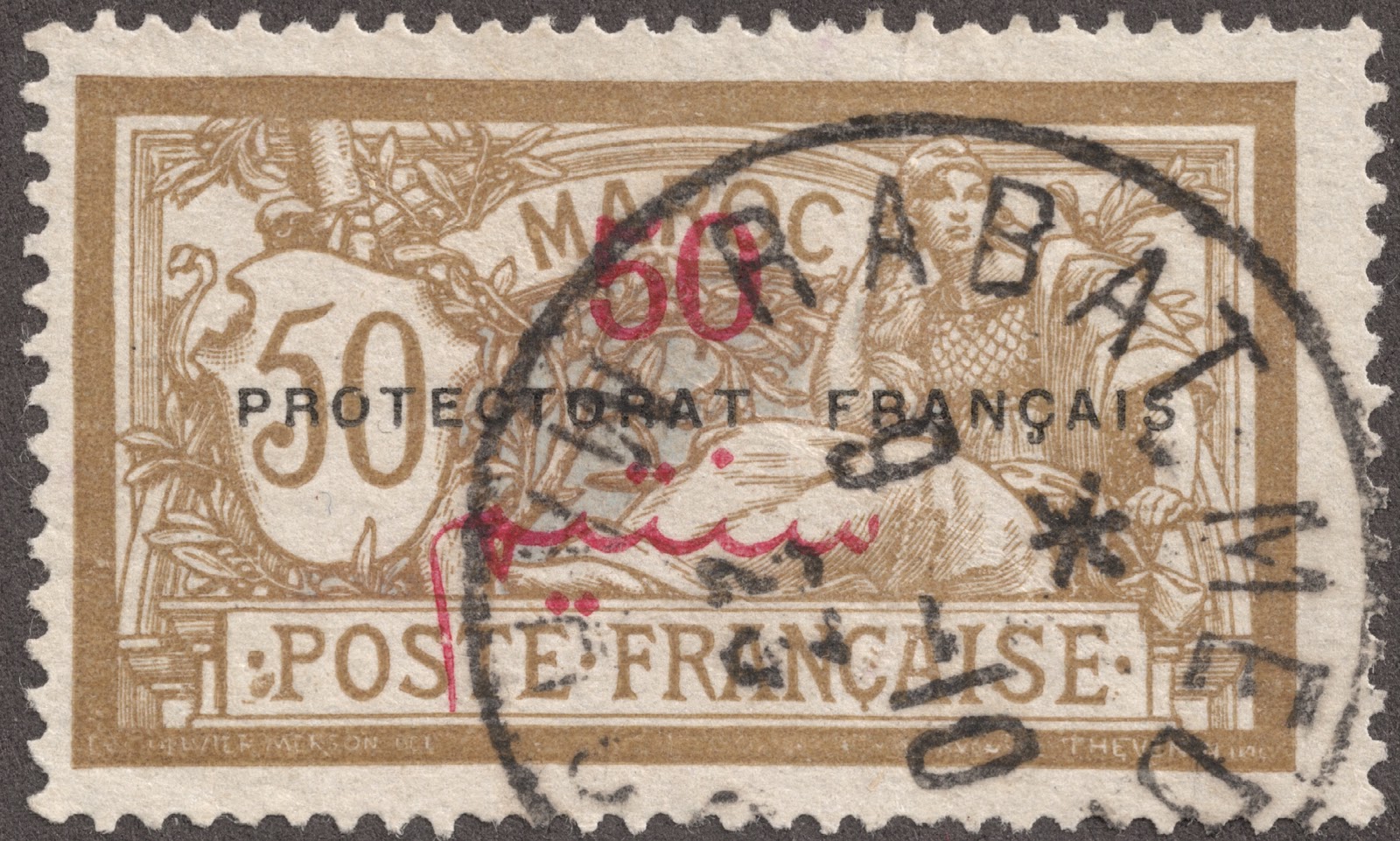
1914-21 50c on 50c bister brown & lavender
Overprinted "Protectorat Français"
Quick History
Located on the northwest coast of Africa, the French had Offices in Morocco from 1891, but most of Morocco became a French Protectorate under the Treaty of Fez in 1912. This Protectorate lasted until 1956, when Morocco established independence.

French Morocco consisted of the area between Fez and Rabat and Casablanca south to Marrakesh , Mogador (Essaouira) and Agadir. The north of the country was actually a Spanish protectorate. Tangier was an "international" city with a French presence.

French Morocco Protectorate in 1912 ( light green)
Strictly speaking, the 'Protectorate" did not end the sovereignty of Morocco; the Sultan reigned but did not rule. Also, there was not much mixing of cultures; France practiced a version of apartheid in Morocco, building "Villes" next to "Medinas".

Arabic and Berber in Morocco
Today, about 90% of the population speaks Moroccan Arabic, with more than half able to speak Berber. French is the language of commerce and education. The Capital is Rabat, and the population was 4,400,000 in 1912.
1939 40c on 50c  dark blue green surcharged in red
"Kasbah of the Oudayas, Rabat"
Into the Deep Blue
The 2011 Scott Classic catalogue has 300 descriptions for regular, semi-postal, air post, air post semi-postal, postage due, and parcel post categories for the years 1891-1942. The coverage consists of 37 "French offices in Morocco" entries, with the rest for the "French Protectorate" era. Also, Morocco proper under the Sultan issued 14 stamps in 1912-13. Of the group, 172 or 55% are reasonably at <$1-$1+.

A closer look at the stamps and issues


1902-10 3c on 3c red orange & 25c on 25c blue
Second surcharged issue during the "French Offices in Morocco" era
The "French Offices in Morocco" era began in 1891 with an eight stamp "Navigation and Commerce" surcharged issue. Three are valued @ $3+. The next issue, illustrated above, had 12 stamps; six of them valued @ $1-$2+.

1911-17 5c on 5c green & 10c on 10c rose
Red or Blue surcharge with Arabic script
A 12 stamp series was then issued between 1911 and 1917 with a surcharge/overprint, including Arabic. Nine of these stamps are valued between <$1-$5.

1914-21 15c on 15c orange & 25c on 25c violet
First French Protectorate issue: overprinted "Protectorate Française"
With the Treaty of Fez in 1912, the French presence was strengthened considerably as Morocco became a French protectorate. With that reality, stamps from the previous issue were overprinted "Protectorate Française". Ultimately, 17 stamps were produced; 14 of them valued @ <$5.

1918-24 issue: 1fr claret & olive green overprinted "Tanger"
Although most of Morocco was a French protectorate, some parts were not; including the city of Tangier.
Consequently, an 18 stamp overprinted "Tanger" issue was used from 1918-1924 for posting from the "international" city of Tangier. Thirteen are valued @ <$2.

1917 engraved issue: 5c yellow green 
"Mosque of the Andalusians, Fez"
In 1917 a 17 stamp engraved issue was produced featuring various "monuments" in French Morocco. Twelve stamps are valued at $3.50 or less.

1917 line engraved 15c dark gray 
1923-27 photogravure 15c dark gray
The 1917 issue was line engraved. The next issue of 1923-27 has some stamps with the same colors and scenes. Specifically, the 15c dark gray, and the 20c red brown are similar except the 1923-27 issue was printed in photogravure. Observe the difference in printing outcome with the two methods illustrated above.

1923 -27 issue: 25c ultra "City Gate Chelia"
40c orange red ""Koutoubiah, Marrakesh"
The 1923-27 issue borrows many of the same scenes from the 1917 issue, but usually is printed in a different color, other than the stamps mentioned previously. This 26 stamp issue was printed in photogravure, and has an identifying "Helio Vaugirard" imprint on the lower right margin of the stamp.

1933-24 issue: 5c brown red ""Roadstead at Agadir"
The 23 stamp 1933-34 issue featured eight scenes of Morocco in heavy ornamental frames. Twenty of these stamps are valued @ <$1, with the most expensive @$6.50.

1939-42 1fr chocolate "Cedars" & 2fr prussian green "Fez"
The 1939-42 issue had a much more "modern" design, compared to the previous issue, as one can clearly observe. This 37 stamp eight design series spills over until 1942, but is included in the Deep Blue pages. Big Blue has some of these stamps in Part I, and some in the Part II volume.

1922-27 25c deep ultra & 75c deep green "Biplane over Casablanca"
These denominations can be found in different types
The 1922-27 eleven stamp Air Post issue has some interesting types; specifically the 25c,50c,75c, and 1fr.
Some come with a hyphen in the "Helio-Vaugirard" imprint ( The 25c illustrated), or a thicker frame (The 75c above). Take a look at your collection for differences. ;-)

Deep Blue
French Morocco has 22 pages in the Deep Blue album,, and presently I have stamps on 18 pages. All of the Scott major numbers are represented.

Comments....
1) The 1939-42 issue has 37 stamps, 12 of them issued between 1940-42. They are all included in the classic package download at the Bill Steiner website. So far so good. ;-)  But there are actually additional stamps issued later in the 1940's in the series. These stamps have no space (naturally) in Deep Blue, and can lead to confusion.

2) The Scott catalogue mentions, but does not list the Sultan of Morocco government stamp issue of 1912-13 in the "French Morocco" section. These are listed, however, under Morocco in the catalogue. There were 14 stamps issued, 10 of them between $1+-$9+ CV. These "Cherifien Posts Issues" are given space in Deep Blue.
1917-28 postage due 5c blue "numerals"
Big Blue
Big Blue '69 houses the French Moroccan stamps under "Offices in Morocco" in the France section. This was consistent with earlier Scott's catalogues (i.e., my '47 ), whereby French Moroccan stamps were also listed under the France section. But the 2011 Scott gives the French Moroccan stamps their own section, as most of the entries are for the "French Protectorate", not just "Offices" stamps.

Big Blue has 196 spaces on seven pages for the regular, semi-postal, air post, air post semi-postal, postage due, and parcel post categories. Coverage is 62%.

Comments...
1) The coverage looks good for the inexpensive French Moroccan stamps.
2) The 1939 issue has 26 spaces (Deep Blue has 37 spaces), as BB cuts off coverage at 1940. Additional spaces for the issue, which continues into 1942 and beyond, can be found in the Part II volume of the International.


Simple Checklist

French Offices in Morocco
1891-93
1,3,5,

1902-10
11,12,13,14,
15,16,18,

1911-17
26,27,28,29,
30,31,

French Protectorate
1914-21
38,39,40,41,42,
43,46,45,48,51,52,

1918-23
72,73,74,75,77,79,80,81,

1917
55,56,57,61,62,64,65,

Next page

1917
58,59,60,67,

1923
90,91,92,96,98,99,101,
102,103,93,94,95,
104,106,108,112,

1930
120,121,97,100,105,107,
109,110,111,113,

Next Page

1933
124,125,126,127,
128,129,130,131,
132,133,134,135,
136,141,143,144,
137,138,139,

1939-40
149,150,151,
152,153,154,155,156,

Next Page

1939-40
157,158,159,159A,
160,160A,162,163,
164,166,167,168,
161,165,169,170,172,173,

Next Page

Air post
1922-23
C2,C3,C4 or C5,C7,
C10,C1,C6,C8,

1927
C9,C11,C12,C13,

1923-40
C14,C15,C16,C17,
C18,C20,C21,C25,C19,
C22,C23,C24,

Next Page

Parcel Post
Q1,Q2,Q3,Q4,Q5,Q6,

Postage due
1911
J13,J14,J16,

1915-17
J18,J19,J20,J21,J23,J24,J25,

1917
J27,J28,J29,J30,J32,

1918
J35,J36,J37,J42,J43,(J44),

1926
J33,J34,

Next Page

Air post semi-postal
1928
CB1,CB2,CB3,CB4,
CB5,CB6,CB7,CB8,
CB9,CB10,

1929
CB11,CB12,
CB13,CB14,CB15,CB16,
CB17,CB18,CB19,CB20,

Semi-postal
1914-17
B6,B7,B8,B9,(B2),

Comments
A) ( ) around a number indicates a suggested choice for a blank space.
B) Expensive stamps (Threshold $10):
Postage due
1911
Scott J16 50c on 50c red $10+

1922-27 air post 3fr gray black "Biplane over Casablanca"
Out of the Blue
The French designers of Moroccan stamps had the good sense to make the issues culturally appropriate for this Arabic and Berber Islamic country. Certainly, much different designs are found here than for French India (Brahma-also appropriate), or French Guinea. In general, the British Colonial stamps do not show as much cultural design work for a country, as they are on purpose heavily themed with the British Monarch. 

Note: Maps appear to be in the public domain.

Links
French Morocco - Bud's Big Blue

Would like a comment!

Monday, February 6, 2012

Big Blue goes to China and Hong Kong

In Downtown Guangzhou, a very busy store for China Philately
I had the fortune recently to spend two weeks in Guangzhou (mostly), and Hong Kong. Although this blog entry does not cover classical era philately specifically, some readers may be interested in my impressions of what is generally considered the "hottest" philatelic country at the moment.

The trip was for family reasons, not specifically philatelic. We have a wonderful new Daughter-in-law who is originally from Guangzhou ( Canton). We stayed with her parents in Guangzhou, and were given the "Royal Treatment", to say the least. We were far from the usual tourist Hotels, and the only foreigners we noted were two Russians on the subway.

The Cantonese love their fresh food, all sorts, and find ways to present almost everything into the cuisine. My Son told me I had to try one new "animal" a day. I must admit, the Diving Beetle tastes remarkably like salted sunflower seeds. ;-)

Guangzhou is perhaps the third most important city in China (after Beijing and Shanghai), and is impressive indeed. Because 99% of the population lives in high rise apartments (condos), the density is very high and the skyline is "Chicago" like. The infrastructure (highways, subways, recent buildings, parks) is first rate.

The only jarring problem in this very busy 24/7 city is the air: specifically the smog.

Guangzhou from the Canton Tower
I don't want to give an impression that the air caused difficulty in breathing; it did not. And there is clear evidence among the people and government of interest in recycling, "going green", and improving the air quality. There are thirteen million people in Guangzhou, and another thirteen million in Shenzhen, 50 miles south. That amount of humanity and economic activity is a challenge indeed on the environment.

Lovely green botanic gardens in Guangzhou
As a respite from city life, we spent time hiking the green semi-tropical foliaged hills around Guangzhou.

But back to the city..

Typical street scene in Guangzhou
Many people in the streets day and night. Shops line every street, and are open until 11 in the evening. Capitalism is definitely alive and well in China. We got around by foot, by bus, and most importantly by subway.

This is not during rush hour. ;-)
There are eight interlacing subways that connect the whole city. And each subway train comes every three-four minutes. Although life is hectic, it is also polite. We were offered a seat by a younger person more than once when we were left standing.

Although we preferred mass transit, we were also driven by car the first several days. Let's just say that driving is not for the faint of heart. Lanes are only suggestions, and the horn is used liberally. "Never give an inch" is the motto, and it reminded me more than once of an amusement park "bumper cars" ride. But we survived because Guangzhou drivers are actually very good.

At the end of the Gondola ride to Biyun Mountain a surprise..
A Post office with their own cancellation!
Now turning to philatelic impressions, I was surprised and pleased at how popular and pervasive "stamp collecting" is among the people I met. Clearly, the Chinese government also promotes the hobby. As an example, we happened to ride a gondola in Guangzhou up Biyun Mountain. There on top was a Post Office for mailing letters with their very own cancellation.

A very modern stamp store for PRC stamps.
In downtown Guangzhou, as mentioned, there was a stamp store: something literally not seen today in the U.S. I couldn't tell if it was government sponsored or private, but it was quite busy, and had a "land-rush" intensity about it. They seemed to deal exclusively with PRC stamps. When I asked about China stamps for the 1930's or earlier, they suggested E-Bay. :-) What was particularly popular were the theme stamp albums or yearly stamp albums produced by the China National Philatelic Corporation for Chinese stamps. There was a "sell list" for these stamp albums, with the 1980 album listing for thousands of dollars.

1980 Golden Monkey stamp
The "Golden Monkey" stamp for that year is quite valuable, listing in the four figures.

16th Asian Games Commemorative Stamps Album
Held in Guangzhou in 2010
I bought the Asian Games Stamp Album for $11 U.S., an absolutely lovely presentation.

Three dimensional view of the Asian Games - along with stamps- inside the album
Opening the album, some of the pages were cut-out three dimensional: what a delight! No wonder collecting these high quality albums for Chinese issues is popular!

2007 presentation stamp album
The most preferred way to collect among the folks I talked to were the yearly presentation stamp albums with all the issues and souvenir sheets. Beautifully presented, and, no doubt, bought with the idea that PRC stamp prices will only go up. ;-) Time will tell.

The presentation for the"Dancing Dragons and Lions" stamps in the 2007 album
An informative English translation is found on the opposite page
Now the folks I talked to about 'stamp collecting" are not what we would call "serious philatelists". But remember when many U.S. citizens casually put away stamps or sheets in anticipation of riches down the road? I think that is where many Chinese are today. With interest in PRC stamps by so many people, some should advance their interest and indeed become "serious philatelists".

Sun Yat-sen
Statue in Guangzhou
We couldn't leave Guangzhou before learning more about Sun Yat-sen, Guangzhou's favorite son, at the museum devoted to his life. He is considered the "Father of the Nation" in the Republic of China (1912-47), and the "forerunner of democratic revolution" by the PRC.

Some of the many Sun Yat-sen stamps issued by China
For a philatelist, the reason for being interested in  this fascinating revolutionary should be obvious. After all, he is reported to be listed on more catalogued numbered stamps than any other person in history!

Hong Kong
After China, we took a bullet train 70 miles to Hong Kong. Yes, Hong Kong is now part of China, but it didn't feel like it. :-) The border crossing was as arduous as any between two countries. And Hong Kong can keep their own institutions for 50 years. That means the Hong Kong Postal Service continues to issue their own stamps.

The main Post Office in Hong Kong
Although most everything about the Hong Kong mail service is the same: one thing is not. They had to change the color of their post office mailboxes from British red to China green, ;-)

Main philatelic store at the Hong Kong Post Office
The philatelic store at the main Post Office was also quite busy as one can observe from the picture. It was stocked with an ample supply of philatelic necessities such as stamp storage albums.

Old China Post Mail Box in Guangzhou
So what conclusion can one make about "stamp collecting" in China? As mentioned, I have the clear impression that many Chinese citizens do avidly collect PRC stamps, especially in an album format. Whether this is a "bubble", like tulip mania, baseball card collecting, or U.S. housing prices, or rather an entry to riches, I cannot say. One cannot disagree, though, that the stamps and the presentation albums themselves are very nice indeed.

Note regarding the Chinese Internet
I was unable to reach my blog site with the usual Chinese Internet. A VPN connection was successful.

Note" "Monkey Stamp" image appears to be in the public domain.

If the reader has additional experiences with China philately, please share in the comment section!