A is for Aden and Z is for Zanzabar


A is for Aden and Z is for Zanzibar... Now what is between? For the world wide classical era philatelist and stamp collector, a country specific philatelic survey is offered by the blog author, Jim Jackson, with two albums: Big Blue, aka Scott International Part 1 (checklists available), and Deep Blue, aka William Steiner's Stamp Album Web PDF pages. In addition, "Bud" offers commentary and a look at his completely filled Big Blue. Interested? So into the Blues...

Friday, May 13, 2016

Tete

1914 Scott 37 30c brown/green "Ceres"
Quick History
Tete, along the Zambezi river- (still full of crocodiles and hippos!),  was a region of the Portuguese East Africa Colony (Mozambique Colony), and is located in southeast Africa in the central-eastern part of Mozambique.

The capital was Tete, and the population was 367,000 circa 1940.

Tete is one of the hottest parts of Mozambique, and is on a plateau at 1500 feet (500m).

The economy consists of coal and iron mining, and fishing.


1922 Map of Portuguese East Africa (Mozambique)
Tete is located here between Northern Rhodesia and Southern Rhodesia
The reality was that, within the Mozambique Colony, settlements were scattered, and these outposts by necessity had their own stamps. One can find issues for Lourenco Marques (1895), Inhambane (1895), Zambezia (1894), Quelimane (1913), Tete (1913), Mozambique Company (1892), Nyassa Company (1898), and Mozambique (1877) for the Portuguese East Africa lands. Eventually, the stamps of Mozambique were exclusively used.

For a nice  Mozambique Area Transition Chart, I refer you to the Dead Countries Stamps website. Thanks Michael !


Note Tete on this present day Mozambique map
A postal district for Tete was formed in 1913 from parts of Zambezia. (Another part of Zambezia formed the postal district of Quelimane.) Stamps for Tete were issued in 1913-14. 


Tete Province within Mozambique
In 1920, Tete formed a separate province. The stamps of Mozambique then replaced those of Tete.

1913 Scott 8 15c on 24a bister "Vasco da Gama"
On Stamps of Macao
Into the Deep Blue
The 2014 Scott Classic 1840-1940 catalogue has, for Tete 1913-14, 40 major descriptive numbers. Of those, 27 are CV $1+, or 67%. Tete's stamps are fairly inexpensive for the WW classical era collector.

The entire output for Tete consists of three surcharged issues of the common design 1913 "Vasco da Gama" set (from Macao, Portuguese Africa, and Timor), and a 1914 "Ceres" issue. That's it.

One fly in the ointment is I am using "old" Scott numbers here for the "Ceres" issue. As some of you know, Scott has been upgrading and parsing more finely all of the Portuguese colonies "Ceres" issues in the 2013-2016 catalogues. Many Portuguese colony stamps, consequently, have "new" Scott numbers for the "Ceres" issues. But my 2014 catalogue does not reflect those changes for Tete, if any.

Fortunately, I do have the Selos Postais 2011 Colonias Portuguesas Afinsa Portugal catalogue, which gives more information on the colonial issues, compared to my Scott catalogue. I will make some comments based on that catalogue.

A closer look at the stamps and issues
100 Centavos = 1 Escudo
1913 Scott 1 1/4c on 1/2a blue green "Fleet Departing"
On Stamps of Macao
The Vasco da Gama issues of Macao, surcharged for Tete, was issued in 1913 on eight stamps. CV is $1+ for six stamps.
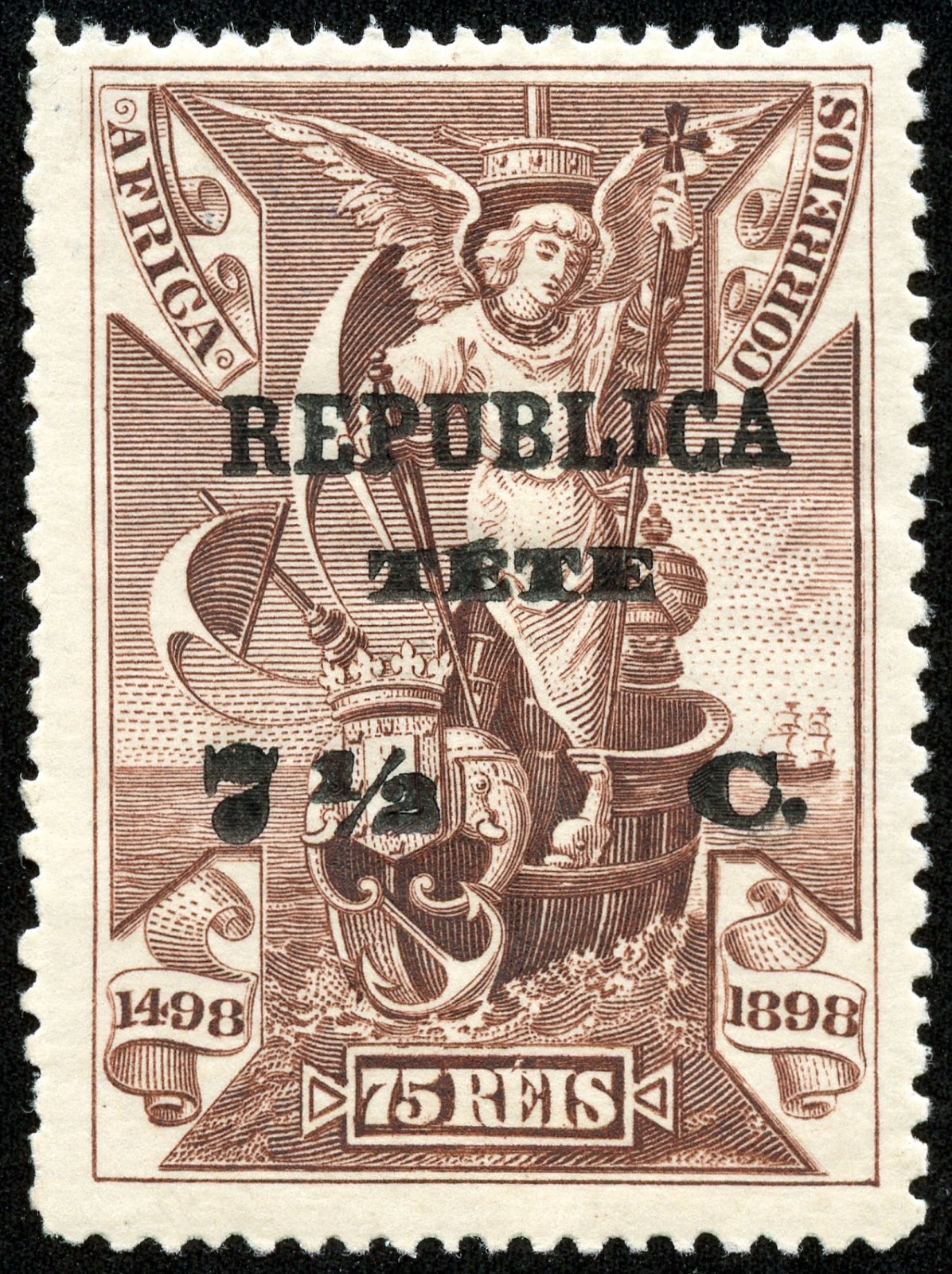
1913 Scott 14 7 1/2c on 75r violet brown
"Archangel Gabriel, the Patron Saint"
On Stamps of Portuguese Africa
The common Vasca da Gama issue  for Portuguese Africa was likewise surcharged for Tete.

An interesting observation is the Scott catalogue has slightly higher prices for used Tete stamps, but unused is far far more common in collections. I don't actually have any used examples myself.

1913 Scott 19 1c on 2a red violet
"Embarking at Rastello"
On Stamps of Timor
A third colony- Timor- also had the Vasco da Gama issue surcharged for Tete. CV is similar to the other Vasco da Gama surcharged Tete issues, with a CV $1+ for seven out of eight stamps.

1914 Scott 30 2 1/2c light violet "Ceres"
Type I-I
In 1914, Tete issued a sixteen stamp "Ceres" set. CV is $1+-$4 for thirteen stamps.

Note the "star" on either side of the "Tete" label is oriented so that a star point is at the 12 o'clock position? The Afinsa catalogue labels this Type I-I. This stamp (2 1/2c)  can also be found as Type I-II or Type II-I. The star orientation for this stamp other than Type I-I is @ a higher CV.

1914 Scott 36 20c yellow green "Ceres"
Type II-II
The 20c shows a Type II-II, where the star point is @ the 6 o'clock position.. The 20c can also be found as Type I-I for a higher CV.

There also exists a Type III star orientation, where there is no star point @ 12 o'clock or 6 o'clock for the 1/4c & 1/2c denominations. A Type III has a higher CV.

As one can see, a specialty catalogue can add very useful information!

( I should note that the Portuguese colonies with "short" names (Tete, Timor etc) have the "star" on either side of the name label for the "Ceres" issue, (and the potential for "types"), while the colonies with longer names (Quelimane, Angola etc) do not.)

Deep Blue
1914 "Ceres" Issue in Deep Blue
Deep Blue (Steiner) has four pages for the 1913-14 stamps of Tete, and includes a space for all the major numbers. (My Steiner also, at this time, does not reflect any changes in the Scott numbers for the "Ceres" issue.)

1913 Scott 10 1/2c on 5r red 
"Fleet Arriving at Calicut"
On Stamps of Portuguese Africa
Big Blue
Big Blue '69, on one half page, has 21 spaces for the stamps of Tete. Coverage is 52%.

The coverage is located on the same page as Tibet, and just before Timor.

The BB 40s editions have the same coverage.

BB, characteristically, offers one space for the three choices ( three surcharged issues from Macao, Portuguese Africa, and Timor)  of the common design 1913 "Vasco da Gama" set.

There are no "expensive" (Threshold $10) stamps required for the BB spaces.

Checklist

1913*
1 or 9 or 17, 10 or 18, 3 or 11 or 19, 7 or 15 or 23, 8 or 16 or 24,
4 or 12 or 20, 5 or 13 or 21, 6 or 14 or 22,

1914*
25,26,27,28,29,30,31,

32,33,34,35,36,37,

Comments
A) Expensive stamps ($10 threshold): None
B) *1913 - three choices (surcharged issues from Macao, Portuguese Africa, and Timor) for each space.
C) *1914- Scott numbers for the "Ceres" issue reflect those found in the 2014 catalogue. 

1913 Scott 21 5c on 8a dark blue
"San Gabriel, da Gama and Camoens
On Stamps of Timor
Out of the Blue
Quelimane, the other section of Zambezia to gain their own stamps , had similar stamp releases in 1913-14. Curiously, Scott values Quelimane issues more than the output of Tete ($66 vs $47 for the surcharged Vasco da Gama issues). Supply/demand working here, or market inefficiencies ? ;-)

Note: Maps and Boroma Church pic appear to be in the public domain.

Comments Appreciated!

Boroma Church at Tete

Saturday, May 7, 2016

Tasmania

1857 Scott 13 4p pale blue "Victoria"
Wmk 75 "Double Lined Numeral"
Quick History

Updated Links:

Tasmania, an island just off south-eastern Australia, was one of the six British colonies that merged to form the Commonwealth of Australia in 1901.

The capital was Hobart, and the population was 172,000 in 1901.

But Tasmania, as the other Australian colonies, has a prior rich philatelic history, with stamp issues from 1853-1912.

Van Diemen's Land, the second British colony after 1788 New South Wales, was established in 1803.

In 1812, British convicts were sent to the island as a "prison without walls".

The first settlements include Hobart Town, Launceston, and George Town.

Van Diemen's Land 1852
The first 1853 stamps, known as "Couriers", after the Hobart Town Courier newspaper office, where they were printed, were issued as a 1p blue and a 4p orange. (All of the Tasmanian stamps had Queen Victoria's image until 1899.) Each stamp can be "plated", and CV is $500+ (4p) and $1300+ (1p). One can, however obtain a 4p for CV $25, cut to an octagonal shape. (However, I don't have any.)

The engraved Chalon Heads (portrait by Edward Chalon 1838) were issued in 1855, and used for the next 25 years. They are the "meat and potatoes" of Tasmania specialty stamp collecting: I count some 132 major/minor varieties in the Scott catalogue. They are also generally expensive for the WW collector, and, except for a representative collection, may need to be left alone.

Tasmania- Australia 1916
The Chalon Heads come in different papers (wove, pelure), imperforate, various perforations, pin-perf, various roulettes, serrated, many different shades, unwatermarked, three watermarks, and reprints.

Van Diemen's Land was changed to Tasmania in 1856, which appears on the Chalon Heads in 1858.

The typographic "Sidefaces" appeared in 1870, and are similar in design to those from Nova Scotia.

They were issued through 1891, and offer different watermarks (five), perforations and shades. The 28 major Scott numbers for the "Sidefaces" are generally not as expensive CV- wise as the preceding Chalon Heads.

Tasmania joined the U.P.U. in 1891, and the Victorian "Keyplate" issue was launched in 1892, and used throughout the 1890s.

Postal Fiscal stamps were also used between 1882-1890.

The "Pictorials"- scenes around Tasmania- were issued between 1899-1912. They were produced by engraving, lithography, and typography, and have different watermarks (three), shades, and perforations.

The "Roo" stamps for Australia were not issued until 1913, even though Tasmania and the other Commonwealth states had joined together in 1901. Consequently, Tasmanian stamps were used until as late as 1914.

1878 Scott 61 2p deep green
Wmk 77 "TAS"
Into the Deep Blue
The 2014 Scott Classic 1840-1940 catalogue has, for Tasmania 1853-1912, 123 major number descriptions. There are also many minor numbers because of perforation changes and color shade variations. For the major number count, I did not include the 35 "AR" postal fiscal stamps stamps in the catalogue.

Of the major number count, only 5 (4%) can be found @ CV $1+. Raising the bar to CV $10, yields 35 stamps, or 28%. Clearly, the early classical era Tasmania issues are somewhat expensive for the WW collector who wishes to obtain a representative collection. The very early 1853-1868 issues (50 major numbers) are expensive ( $27-$60+) to very expensive ($ Hundreds- $ Thousands). But those early listings are specialty territory anyway.

Be aware that some eleven different watermarks were used, and there can be many different perforation varieties. All in all, a pretty complicated and expensive country. ;-)

A closer look at the stamps and issues
12 Pence = 1 Shilling
20 Shillings = 1 Pound
1864 Scott 29 1p carmine "Victoria"
The Chalon Heads were issued between 1855-1868, and there are some 49 major Scott numbers. They can be found especially with multiple perforation and roulettes, as well as imperforate.

The Chalon Heads are specialty territory.

Pen cancels (as above), are valued at a lesser CV.

1871 Scott 56 3p red brown "Victoria"
Wmk 76 "Barred TAS"
The "Sidefaces" were issued in 1870, and continued through 1891.

Tasmania has many different watermarks- I count eleven.

The 3p denomination (above) can either be Wmk 76 "Barred TAS" or Wmk 77 "TAS".

Wmk 75 Double Lined Numeral; Wmk 76-Barred TAS
The "Barred TAS" is distinguished by the lines connecting the "TAS" letters above and below.

The Double Lined Numeral watermark can be found on the Chalon Heads.

1878 Scott 60 1p rose "Victoria"
Perf 14; Wmk 77 "TAS"
The 1878 issue of three stamps is found with perforation 14, and the plain (not barred) "TAS" watermark.

1878 Scott 62 8p violet brown "Victoria"
Perf14; Wmk 77 "TAS"
The three stamp 1878 set ranges in CV from $3-$10+. I don't usually show many pen cancelled stamps, but they are not uncommon. 

1891 Scott 75 2 1/2p on 9p light blue "Victoria"
The single surcharged 2 1/2p on 9p stamp of 1891 has two varieties. Scott 74 is perf 11 1/2, with the surcharge 14 mm high. The Scott 75 (illustrated) is perf 12, with the surcharge 15 mm high. 

The CV is $9+ and $7+ respectively.

1892 Scott 77 2 1/2p magenta "Victoria"
The Victorian "Keyplates" were issued between 1892-99. There were 10 stamps in the set.

Note the town cancellation of Launceston.

1899 Scott 80 10p red brown & green "Victoria"
CV for the Victorian "Keyplates" range from $4+-$40+ for eight stamps.

1892 Scott 81 1sh rose & green "Victoria"
Note another town cancellation for Launceston. It was and is the second largest city in Tasmania next to Hobart.

Clock Tower Post Office Building
The Post Office building in Launceston is topped by a Clock Tower.. This landmark was completed in 1910.

 1904 Scott 100 1 1/2p on 5p blue & brown
In 1904, the 1 1/2p keyplate was surcharged as shown. One can also find surcharges on the keyplate series between 1889-1891 on eleven stamps.

1899-1900 Scott 87 1p carmine "Mt. Wellington"
Engraved; Perf 14; Wmk 78 "Multiple TAS"
Between 1899-1900, an eight stamp "Pictorials" engraved issue was released.

The watermark on the paper was Wmk 78 "Multiple TAS". Perforation is 14.

The "Mount Wellington" 1p stamp was based on a painting by Australian artist Haughton Forrest.

Rincarooma is a small town in north-eastern Tasmania.

1902-03 Scott 94 1/2p green "Lake Marion"
Lithography; Wmk 70 "V and Crown"
The 1902-03 second issue of "Pictorials" on six stamps had the same scenes as those for the first issue, bur printed by either lithography or typography. Perforations can be 11, 12 1/2, 11 X 12 1.2.

The paper watermark is Wmk 70 "V and Crown"  

Wmk 78 "Multiple TAS";  Wmk 70 "V and Crown"
Here are the watermarks found for the first two "Pictorial" issues.

1905-08 Scott 105 3p dark brown 
"Spring River, Port Davey"
Typography; Wmk 13 "Crown & Double-lined A"
Between 1905-08, another "Pictorial" issue, using typography, on ten stamps was released. The watermark is Wmk 13 "Crown & Double-lined A".

Wmk 13 "Crown and Double-Lined A"
Shown is the watermark for the 1905-08 "Pictorial" issue.

1912 Scott 117 1p on 2p bright violet
Red Surcharge; "View of Hobart"
The last stamp produced for Tasmania was this one. The surcharge was put on a redrawn 1911 2p bright violet (Scott 114).

Deep Blue
1892-99 Issue in Deep Blue
Deep Blue (Steiner) has nine pages for the stamps of Tasmania, and, for the most part, has spaces for all the major varieties. I did find some half dozen instances where bolded minor numbers or bolded suffix major numbers were not given a space. I did set up a quadrilled page for those. Chances are, I have nothing to worry about, as these stamps are expensive (hundreds-thousands). !!

If one is collecting the numerous minor number shade colors, or minor number perforation changes, Steiner will need to be expanded significantly.

1899-1900 Scott 88 2p violet "View of Hobart"
Engraved; Wmk 78 "Multiple TAS"
Big Blue
Big Blue '69, on one page, located between Tannu Tuva and Thrace, has 27 spaces.

Coverage is 22%.

The 40s editions offer two less spaces for the 1870-96 issue, and three less spaces for the 1892-99 issue, compared to the '69 and later editions.

There are eight "expensive" (CV $10+-$20+) stamp spaces, and one "most expensive" (CV $35) stamp space. See the specific listing under the "comments" section after the checklist.

The "1892-1911" BB section have up to three issue choices for one space.

The "1865-68" one penny (illustrated) space has ten choices!

The "1870-96" one penny (illustrated) space has six choices.

Checklist

1855-68
One Penny (Illustrated): 4 or 7 or 10 or 11 or 17 or 23 or 29* or 35 or 39 or 45,
(25),

1870-96
66,
One Penny (Illustrated): 49 or 51 or 53* or 60 or 67 or 72,
2 pence: 48c or 48 or 54d or 54 or 61,
56a or 56 or 63, 69 or 73, 62, 70,

1892-99
76,77,78,79,80,81,(82),

1892-1911*
86 or 94 or 102, 87 or 95 or 96 or 103, 89, 91 or 106 or 115, 88 or 97 or 104 or 114,
90 or 105, 92, 93 or 107 or 116,

1891
74 or 75,

1912
117,

1904

100,

Comments
A) Expensive stamps ($10 threshold):
1864 Scott 29 1p carmine ($20+)
1864-69 (Scott 25) 4p blue ($20+)
1878 Scott 62 8p violet brown ($10+)
1869 Scott 69 4p bister ($20))
1899 Scott 80 10p red brown & green ($20+)
1892 (Scott 82) 2sh6p brown & blue ($35)
1899-1900 Scott 89 2 1/2p dark blue ($10+)
1899-1900 Scott 92 5p ultramarine ($20+)
1905-08 Scott 107 6p lake ($10+)
B) * 29 & *53- the least expensive among multiple choices.
C) (    ) around a number indicates a blank space choice.
D) *1892-1911- The space offers one choice for three issues.

1905-08 Scott 106 4p ocher "Russell Falls"
Typography; Wmk 13 "Crown & Double-lined A"
Out of the Blue
At one point in my collecting years, I was interested in specializing in the Australian States. I never followed through with that intent, but I still see the attraction and the logic for such an interest.

Note: Maps and Launceston Clock Tower pic appear to be in the public domain.

Have a comment?

Sunday, May 1, 2016

Tannu Tuva

1927 Scott 28 1r yellow brown & violet
"Tuvan Riding Reindeer"
Quick History
Exotic doesn't describe the stamps of Tannu Tuva. The 1926-1936 issues are found multi-colored, with scenes such as a Tuvan impaling a bear, all on diamond, triangle, and rectangle shapes.

What schoolboy would not want these stamps?

Map of Tannu Tuva
1935 Scott 54 1k yellow orange
The Bolshevik supported Tuvan People's Republic, located in southern Siberia in the Tannu-ola Mountains, forests, and steppes, on the northwestern border of Mongolia, existed between 1921-1944, when it was formally annexed into the Soviet Union. It's 1926 affirmation of independence was recognized solely by the Soviet Union and the Mongolian People's Republic.

Tuvan Republic's location in Russia currently
The capital was Kyzyl, and the population in 1931 was 65,000 Tuvans and 17,000 Russians.

Tannu-Tuva
The issues of Tannu-Tuva were considered of dubious legitimacy by some, but there are enough (mostly philatelic) covers from Tannu-Tuva to Moscow to establish that the stamps were postally used in the mail, and all the major catalogues now list the stamps.

The reality, of course, is that almost all of the stamps were produced in Moscow, and sold directly through the philatelic trade to collectors for hard currency.

Remember, I mentioned that the issues were naturally popular with schoolboys in the 1930?

One of them was the Nobel prize winning physicist Richard Feynman, who, during the 1970s, recalling the exotic images on those stamps, took up a 10 year quest to visit Tannu Tuva (youtube video).

1932 Scott 34 15k on 14k, Black Surcharge
"Bactrian Camel Caravan"
Into the Deep Blue
The 2014 Scott Classic Specialized 1840-1940 catalogue has, for Tannu Tuva 1926-1943, 141 major descriptive numbers that are in the regular or air post categories. There are, in addition, some 24 bolded minor numbers that are varieties (imperforate, different perforation).

Of the major numbers, 55 are CV <$1-$1+, or 39%. The WW collector should want to have a nice representative selection from this interesting part of the world. For a few dollars more, there is even more selection available.

Russian or Soviet stamps were used in Tuva prior to 1926, and after 1944.

Most Tuvan stamps, except for the 1942 Scott 117-123 & overprints, were printed by the State Security Printers in Moscow.

There are also a group of 31 stamps- the 1938-1943 handstamped surcharged with new values stamps and locally hand printed stamps- that are quite expensive (CV $ hundreds). This is specialty territory.

A closer look at the stamps and issues
100 Mongo = 1 Tugrik
100 Kopecks = 1 Ruble
100 Kopecks = 1 Tugrik (1934)
100 Kopecks = 1 Aksha (1936)
1926 Scott 5 10k violet "Wheel of Truth"
The first 1926 ten stamp issue for Tannu Tuva was lithographed, and depicts the wheel of cyclic existence, as found on the outside walls of Buddhist temples in the Indo-Tibetian geographical region.

The script is Mongolian.

The Bhavacakra,
Sera Monastery, Tibet
The paintings of the bhavacakra, or cyclic existence, or wheel of life, represent, in part, the God realm, the Demi-god realm, the Human realm, the Animal realm, the Hungry ghost realm, and the Hell realm.

1927 Scott 15 1k black, light brown & red "Tuvan Woman"
In 1927, an interesting bi-color fourteen stamp issue with multiple shapes was released. CV ranges from <$1- $6+.

Clearly, the Tuvan woman appears to be Mongolian, and indeed the Tuvan people (or Tyvans) were Mongolian.

Geographic Map of Mongolic Peoples
The map shows the present extent of Mongolic peoples (red), with the outline (orange) showing the reach of the Mongol Empire.

1927 Scott 17 3k black, blue green & yellow
"Mountain Goat"
Tannu Tuva has over 8,000 rivers, and the Yenisei River, the fifth longest river in the world. The eastern part has forests, and has mountains (highest: Mount Mongun-Tayga- 13,020 ft- 3,940 meters). The west is the dryer lowland steppe region. Ubsunur Hollow is a UNESCO World Heritage Site.

1927 Scott 23 18k dark blue & red brown
"Sheep Herding"
The 1927 issue showed husbandry (sheep), but also a depiction of Tuvans riding Reindeer, as illustrated for the post header.

In point of fact, in 1931, 80% of Tuvans were involved in nomadic cattle breeding. The Stalin loyal Peoples Revolutionary Party and government, meanwhile, was pushing collectivisation, and trying to destroy Buddhism in Tuva.

1927 Scott 25 40k rose & blue green 
"Fording a Stream"
With 8,000 rivers, there were plenty of streams to ford. ;-)

1932 Scott 30 2k on 50k black, green & red brown
Brown Surcharge; "Weaving"
In 1932, six stamps from the 1927 issue were surcharged in various colors. This surcharged issue was, apparently, to promote the Romanization of the alphabet. The surcharges were applied in Moscow.

1934 Scott 49 5k ultramarine 
"Tuvan Milking Yak"
That Yak appears huge! The 1934 photogravure issue consisted of eight stamps. The stamps are labeled "registered", but apparently were used for ordinary postage.

1934 Scott 51 15k dark lilac
"Herdsman Lassoing Reindeer"
Like the old west, except with Reindeer. ! CV for the issue is $1-$2+.

The 1934 issue is also found imperforate, with minor Scott numbers.

1935 Scott 63 5k rose red "Ermine"
The 1935 issue, knowing a good thing, had seventeen more stamps in various shapes featuring local wildlife and scenes of the Yenisei River. CV is $1-$2+. Clearly, considering the modest cost today, the issue was well distributed to the philatelic trade.

Who is to deny, though, that the designs are attractive. ;-)

1936 Scott 71 1k bronze green "Tuvan Arms"
The 1936 issue- 20 stamps, both in perf 14 (major) and perf 11 (minor)- was dedicated to the 15th anniversary of independence (albiet as a Soviet satellite).

1936 Scott 83 30k plum  "Bactrian Camel & Train"
The designs, although exotic, were not entirely true to real life in Tannu Tuva. This Moscow-designed stamp shows a train: There is no railway in Tannu Tuva.

Bactrian Camels
BTW, the camels are Bactrian camels with two humps on the back, and are native to the central Asian steppes.

1936 Scott 90 2a rose red
"Partisans Confiscating Cattle"
The 1936 major (perf 14) issue has a CV <$1-$3 for 18 stamps.

1936 Scott C11 10k purple & cinnamon
"Tuvan Plowing"
There are two air post issues: 1934 (nine stamps) and 1936 (nine stamps). CV is $1-$4 for 16 stamps. Large diamonds, triangles, and rectangles makes these issues (and really, all of Tannu Tuva) hard to ignore.

Deep Blue
1926 Issue in Deep Blue
Deep Blue (Steiner) has sixteen pages for the 1926-1943 stamps of Tannu Tuva, and all major Scott numbers are given a space. In addition, the 1934 eight stamp imperforates (Scott 45a-52a) are also given spaces. The 1936 Perf 11 varietals (minor number) are not, however, given a space- only the major number (Scott 71-92)  perf 14 have spaces.

The expensive 1938-1943 handstamped numeral surcharged stamps also have spaces. These will remain empty, unless one wished to specialize in this country.;-)


1934 Scott 52a 20k gray black, Imperforate
"Hunter Shooting Fox with Arrow"
Big Blue
Big Blue '69, on one page located between Syria and Tasmania, has 20 spaces for the 1927 (actually 1926) and 1932 issues. All very colorful designs!

Coverage is 14%.

The 40s BB editions have the same coverage.

For some reason, BB does not have any spaces for the 1934, 1935, 1936 regular issues, and the 1934 & 1936 air post issues. These inexpensive releases have 52 stamps @ CV $1-$2+. I wonder if the question of legitimacy (at the time) had to do with the fact that there are no spaces for these issues? 

BB does have spaces, as mentioned, for the 1932 surcharged issue. The inclusion yields six stamps @ CV $10 or $10+.

Checklist

1927 (actually 1926)
15,16,17,18,19,
20,21,22,
23,28,24,
25,26,27,

1932
29,30,31,

32,33,34,

Comments
A) Expensive stamps ($10 threshold):
1932 Scott 29 1k on 40k ($10)
1932 Scott 30 2k on 50k ($10)
1932 Scott 31 3k on 70k ($10)
1932 Scott 32 5k on 8k ($10)
1932 Scott 33 10k ($10)
1932 Scott 34 15k on 14k ($10+)

1936 Scott 79 12k black brown "Tuvan Impaling Bear"
Out of the Blue
I must have a lot of schoolboy in me.  True, as an adult, I am fully aware that Tannu Tuva issues bordered on being exploitative,  Yet I like them. ;-)

Note: Map scans and image pics appear to be in the public domain.

Have a comment?