A is for Aden and Z is for Zanzabar


A is for Aden and Z is for Zanzibar... Now what is between? For the world wide classical era philatelist and stamp collector, a country specific philatelic survey is offered by the blog author, Jim Jackson, with two albums: Big Blue, aka Scott International Part 1 (checklists available), and Deep Blue, aka William Steiner's Stamp Album Web PDF pages. In addition, "Bud" offers commentary and a look at his completely filled Big Blue. Interested? So into the Blues...

Thursday, November 24, 2016

Upper Volta

1920 Scott 19 45c blue & brown  "Camel with Rider"
Red Overprint; Stamps and Types Upper Senegal and Niger, 1914-17
Quick History
Upper Volta (Haute-Volta) has had an exist/ doesn't exist/exist history, but the classical era saw Upper Volta adjacent and north of the British Gold Coast carved out from a southern section of Upper Senegal and Niger to form a separate colony on March 1, 1919 within French West Africa.

Stamps were released in 1920 using the overprinted Upper Senegal and Niger 1914-17 issue and types.

Population was approximately 3,000,000.
Upper Volta (green); French West Africa (lime green)
The colony lasted until September 5, 1932, when, in an economic move, the colony was divided among its neighbors- French Sudan, Ivory Coast, and Niger Territory.

French West Africa circa 1936
Note "Upper Volta" has disappeared
Upper Volta stamps were discontinued on January 1, 1933.

Mossi Kingdom circa 1530
The area of the Upper Volta river and surrounding savanna was dominated by the Mossi Kingdoms from the 13th century until 1896, when the French captured their capital of Ouagadougou.

Mossi Horsemen 1890
The Mossi were a formidable group, both as farmers (millet, sorghum), and soldiers. They were able to resist some of the inroads (not all) of both Christianity and Islam, while looking to their ancestors for spiritual guidance. Little wonder that the French left the Mossi chief /village administration substantially intact. Their language, Moore, is still spoken by the majority of the population today.

Reconstituted Upper Volta
After WW II, the Mossi were successful in having the French reestablish Upper Volta as a separate French West African territory on September 4, 1947.

Upper Volta became independent on August 5, 1960.

On August 4, 1984, the name was changed to Burkina Faso, meaning "the country of honorable people".

1922 Scott 29 0.01c on 15c, Black Surcharge
On 1920 Scott 9 15c chocolate and orange
Issue Surcharged in Various Colors
Into the Deep Blue
The 2014 Scott Classic Specialized 1840-1940 catalogue has, for Upper Volta 1920-1931, 89 major descriptive numbers. Of those, 58 are CV <$1-$1+, or 65%. Clearly, the WW collector should be able to form a representative collection without too much expense.

The 1920-28 issue uses overprinted 1914-17 Upper Senegal and Niger stamps. Some were issued in a change of color (color types).

Upper Volta had its own issue proper in 1928.

A closer look at the stamps and issues
100 Centimes = 1 Franc
1925 Scott 15 30c violet & brown red
Black Overprint; "Camel with Rider"
Stamps and Types Upper Senegal and Niger, 1914-17
We have come across the "Camel with Rider" design before, as it was used by Upper Senegal and Niger 1914-17. With the advent of "Upper Volta", having been given colony status in 1919 from a former portion of Upper Senegal and Niger, this issue was overprinted  "Haute- Volta". Between 1920-28, twenty-eight stamps, many of them color "types", were released.

1925 Scott 22 50c red orange & blue
Black Overprint; "Camel with Rider"
Stamps and Types Upper Senegal and Niger, 1914-17
Finding used examples for the colony can be done, but it is not common. My collection consists of 90% unused.

CV is <$1-$1+ for 24 stamps. Perhaps reflecting the lack in collections of genuine "used", CV is modestly higher for that state.

1922 Scott 31 0.05c on 15c, Red Surcharge
On 1920 Scott 9 15c chocolate and orange
Issue Surcharged in Various Colors
In 1922, the 15c chocolate and orange was surcharged in three colors (black, blue, red), creating a three stamp issue.

The 1922 surcharged stamp issue in various colors can be found for other French colonies as well, such as Senegal.

1922 Scott 32 60c on 75c violet/pinkish
Type of 1920 Surcharged
The 1922 60c on 75c, with bars over the former value, is similar to other 1922 French colony surcharged stamps, such as found for the Ivory Coast.

1924 Scott 34 25c on 5fr violet & black
Stamps and Types of 1920 Surcharged
With New Value and Bars
Between 1924-27, ten stamps were surcharged as shown.

CV is <$1-$1+ for six stamps.

1928 Scott 43 1c indigo & green
"Hausa Chief"
The colony issued a new set with three designs ("Hausa Chief", "Hausa Woman", "Hausa Warrior") in 1928.

The twenty-three stamp set is CV <41-$2+ for seventeen stamps.

1928 Scott 47 10c indigo & pink
"Hausa Chief"
The Hausa people are one of the largest ethnic groups in Africa (50 million), but, as important, the Hausa language developed into the lingua franca across Western Africa for trade. They are centered in Nigeria and Niger.

The twenty million nomadic Islamic Fulani (Peul) are found, in part, in northern Upper Volta. They often used the Hausa language for trade. In many cases, the Hausa and Fulani people have absorbed parts of each other's culture. But, I believe the portraits in this stamp set are actually Fulani, rather than Hausa, if the native images purport to be from Upper Volta.

Ethnic Groups West Africa
Specifically, the "Mossi" people and language is 40% of the population of Upper Volta (part of Central Bantoid group (purple)).

The Mande ethnic group (pink) inhabits part of western Upper Volta, while the Fulani group is located in the north.

1920 Scott J2 10c rose
Postage Due Stamps of Upper Senegal and Niger, 1914,
Overprinted in Black or Red
The 1920 postage due set of eight stamps are overprinted in black or red on 1914 Upper Senegal and Niger stamps.

CV is <$1-$1+ for all eight stamps.

1928 Scott J11 5c green
The Upper Volta postage due set proper was released in 1928 on ten stamps.

CV is <$1-$6+ for eight stamps.

Deep Blue
1920-28 Issue in Deep Blue
Deep Blue (Steiner) has six pages for the 1920-1931 issues of Upper Volta. All of the major Scott numbers have a space.

1924 Scott 33 25c on 2fr green & blue
Stamps and Types of 1920 Surcharged
With New Value and Bars
Big Blue
Big Blue '69, on four pages, has 75 spaces for the stamps of Upper Volta.

Coverage is a generous 84%.

There are two "expensive" (CV $10+) stamp spaces for the 1928 postage due issue.

Checklist

1920
1,2,3,4,6,9,
10,17,18,19,25,26,

1922
5,7,12,14,21,32,

1922
29,30,31,

1924
33,34,

1925
35,36,8,15,22,23,

Next Page

1926
38,

1927-28
37,39,16,14,

1928
43,44,45,46,
47,48,49,50,51,52,
53,54,55,56,57,
58,59,60,61,

Next Page

1931
66,
67,68,
69,

Next Page

Postage Due
1920
J1,J2,J3,
J4,J5,J6,J7,J8,

1928
J11,J12,J13,J14,J15,J16,J17,

J18,J19,J20,

Comments
A) Expensive stamps ($10 threshold):
1928 Scott J19 2fr lilac rose ($10+)
1928 Scott J20 3fr orange brown ($10+)

1920 Scott J1 5c green
Postage Due Stamps of Upper Senegal and Niger, 1914,
Overprinted in Black or Red
Out of the Blue
Unraveling the 1928 "Hausa" set- which actually portray "Fulani" - resulted in a three hour pleasant diversion. One never knows where stamps will take you. ;-)

Note: Maps and Mossi Horsemen image appear to be in the public domain.

Have a comment?

Tuesday, November 22, 2016

Ascension - Bud's Big Blue

1934 Ascension issue in Bud's Big Blue
Bud's Big Blue
Bud's Observations
Ascension Island’s stamps put me in the mind of an evening at a British explorers’ club. An expedition has just returned from this tiny dot in the mid-Atlantic anxious to tell stories and show pictures. One presenter talks about mountains and sea shores (Scott 27, 28 and 43). Another comments on the little settlement of Georgetown (Scott 23, 25 and 40) which has the island’s only post office. An ornithologist delivers an emotional disquisition on the Onychoprion fuscatus (sooty tern, Scott 30) and its threatened extinction by feral cats shamelessly introduced by previous expeditions. The evening ends with the chapter chair raising a toast to the Crown (vintage port, of course). A satisfying evening, entirely, but inconsequential.

Cancels are rare and expensive.

Census: 31 in BB spaces, 8 tip-ins, no supplement pages.

Jim's Observations
Bud - I don't have vintage port, but I've laid away some more modern stuff. ;-)

Looking for possible additional stamps to collect with a $4 catalogue limit yields basically...none!

No bargains here, nothing to see, please move along. 

Ascension stamps are popular. We all dream about living on a tropical island. Only nine hundred lucky souls actually live there. But we can have a little piece of paradise by buying their stamps.

Ascension Blog Post and Checklist

Page 1 (Note: Click on image to enlarge for examination.)

1a

1b

1c

Page 2

2a

2b

2c

Have a comment?

Monday, November 21, 2016

Armenia - Bud's Big Blue

1921 Armenia in Bud's Big Blue
Bud's Big Blue
Bud's Observations
Stamps often celebrate a nation’s history or promote its current affairs. Armenia’s stamps do neither. They were issued during the time 600,000 Armenians were being killed, some say as many as 1.5 million, for political and religious reasons. Some were offered the choice of converting to Islam or death. Most chose martyrdom. Many fled to Russia and a few to the United Stated. It was the 20th century’s first mass refugee migration and genocide.

Of course, none of this is reflected in Armenia’s stamps. At a time when Russian stamps were celebrating the new triumphant motherland, Armenian designs featured Hayasdan devices, mythic monsters, ruins, and peasants. Safe subject matter, I suppose, given the times. They do seem passively concerned about preserving something of Armenia’s heritage but with, of course, a heavy Russian gloss.

Last year (2015) marked the 100th anniversary of this genocide. Sadly, no stamps commemorated the event, although in 2014 Lebanon issued a stamp showing a memorial statue to the Armenian martyrs.

Understandably cancelled stamps are difficult to find, sometimes non-existent, and often expensive. Fakes abound.

I’m glad BB provides a page for Armenia.

Census: 26 on the BB page, two tip-ins, 28 on the supplement page

Jim's Observations
For me, the most interesting issue is the 1920 set of ten stamps that were never used because they were overtaken by history. Let me explain. In 1920, the National Republic prepared a ten stamp design. The printing was done in Paris, but a large quantity was lost on their way to Armenia. Before they could be used, the National Republic collapsed as the Soviet Eleventh Army entered Yerevan. The use of these stamps was prohibited, and the stamp issues of the new Soviet Republic were used.

Big Blue has illustrations for five of these stamps, but they no longer have active Scott numbers. The set was used fiscally, but not for postage.  For myself, I'm going to be happy to fill the spaces with this issue. Stamp collecting really is more than stamp collecting; and here it gives us a little tangible piece of significant history.

Armenia Blog Post and Checklist

Page 1 (Note: Click on image to enlarge for examination.)

1a

1b - See Post Header Scan

1c

Supplements
Page 1
Have a comment?

Tuesday, November 15, 2016

Upper Silesia

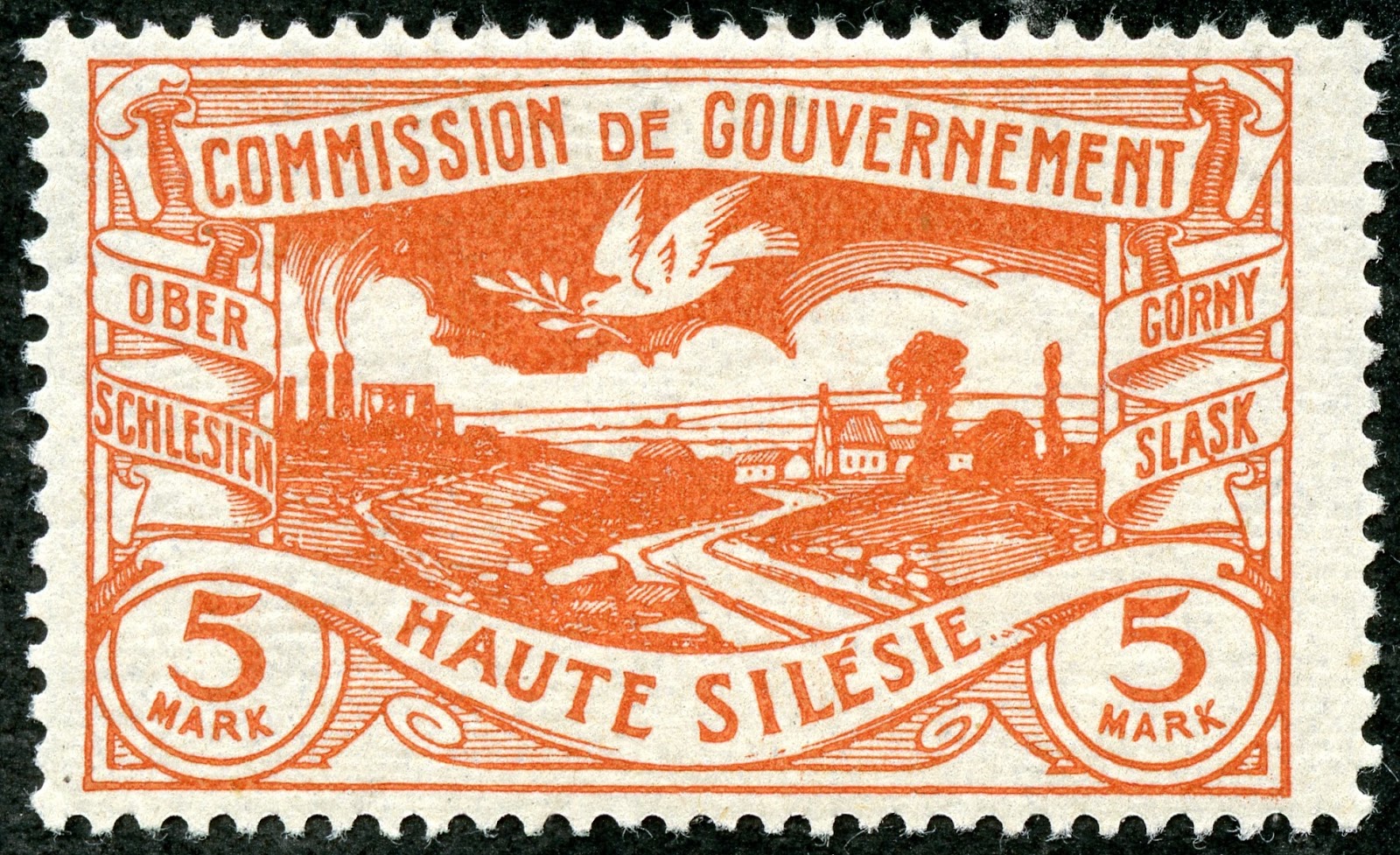
1920 Scott 31 5m orange 
"Dove with Olive Branch Flying over Silesian Terrain"
Quick History
Upper Silesia had been part of Germany prior to WW I. It was situated in the far eastern portion of Prussian territory, sandwiched between the newly created Poland and Czechoslovakia.

Upper Silesia 1919
After WW I, the question was, what do do with Upper Silesia? It was a mineral and industrial rich area, accounting for 20% of German coal production. It had both a significant German and Polish population. Poland laid claim to it, and Germany wished to retain the territory.

North of Upper Silesia to the Baltic Sea, a large swath of West Prussia (including Posen) was transferred to Poland without a plebiscite to give Poland access to the sea via the "Free City" of Danzig.

At the 1919 Paris Peace Conference, the future of Upper Silesia was strenuously contested, and the original draft of the Treaty of Versailles had the area as Polish territory. But the final draft of the Treaty Of Versailles determined that a plebiscite (referendum) would determine the question.

In February 1920, the Allied Commission (with occupation of British, French, and Italian Forces) assumed control of the territory.

The Plebiscite issue "Numerals" were released on February 20, 1920.

Feelings were running high, and there were clashes between Germans and Poles during the plebiscite period. 

A propaganda campaign, backed by the respective Polish and German governments, was instituted.

Vote for Poland and You will be Free

Prayer of the Homeland: Upper Silesia remains German!
The plebiscite was held on March 21, 1921 with 1.1 million votes cast, with the vote for German retention winning overall @ 60%-40%.

But the Poles objected to allowing German migrant worker non resident votes. There was a large scale Polish uprising between April-June, 1921. The Germans responded with volunteer paramilitary units. The final position of the opposing Polish and German forces became, de facto, the eventual partition. 

The Allied Commission was unable to come to a decision about Upper Silesia, and turned the question over to the League of Nations in August, 1921.

League of Nations: "There now, I've given you each a Fair Share"
Germany or Poland (Bitterly): "He's got all the Stuffing!"
The League of Nations basically confirmed the new "de facto" border. Germany was awarded two-thirds of the territory, but Poland retained half the population. More significantly, Poland also received 80% of the industrial area.

Partition of Upper Silesia
Orange to Germany (Pink), Yellow-Green to Poland (Green)
The result of the plebiscite failed to determine the status of the country. But the partition of Upper Silesia, with the agreement of the League of Nations, is shown on the map.

Upper Silesia and Auschwitz Camps 1941-45
During WW II, Upper Silesia was the location of the infamous Auschwitz camps.

It became part of the Republic of Poland in 1945.

1921 Scott 33 15pf violet
Overprinted in Black
Into the Deep Blue
The 2014 Scott Classic Specialized 1840-1940 catalogue has, for Upper Silesia 1920-1922, 90 major number descriptions in the regular (Plebiscite) and official categories. Of those, 60 are CV <$1-$1+, or 67%. Clearly, a representative collection can be accumulated by the WW collector without much financial outlay.

A closer look at the stamps and issues
100 Pfennig = 1 Mark
100 Fennigi = 1 Marka
1920 Scott 9 5m orange "Numerals"
On February 20, 1920 a nine stamp "Numeral" set was issued. The Commission of Government / Upper Silesia had the stamps printed in Paris.

The stamps name the territory in three languages: French, German, and Polish.

CV ranges from <$1-$5. Used are valued @ twice unused. It annoys me to find a "used" stamp, as above, that is clearly CTOed to  increase value. I won't pay a premium for an example like this.

1920 Scott 11 5pf on 20pf blue
Black Surcharge, Type I
Between March and May, 1920, surcharges were applied to the 15pf, 20pf, and 5m "Numeral" denominations.

Each surcharge can be found in multiple types. 

The 5pf on 20pf surcharge, using black ink, (shown above)  comes in four types. The 1840-1940 Scott catalogue has the details.

1920 Scott 12c 10pf on 20pf blue
Red Surcharge, Type IV
The 10pf on 20pf surcharge, using red ink, also has four types.

1920 Scott 12, 12a,12b,12c 10pf on 20pf blue, Red Surcharge
Type I, Type II, Type III, Type IV
All four types are shown here (click and enlarge for inspection).

CV is $1+-$2  for the types.

1920 Scott 15 2 1/2pf gray
"Dove with Olive Branch Flying over Silesian Terrain"
On March 26, 1920, a seventeen stamp issue (nine stamps- small format; eight stamps- large format) was released. The scene depicted is both rural and industrial, with a peace dove (carrying an olive branch) flying over the landscape.

Shown is the small format stamp. CV is <$1.

1920 Scott 28 1m claret
"Dove with Olive Branch Flying over Silesian Terrain"
Although the scene is peaceful, the campaign to annex or retain the territory by the Polish and German partisans - not so  much.

Illustrated is the large format stamp. CV is <$1-$2+.

Of note, for the 75pf, usually found in deep green, there are some rare minor number shades: blackish green (CV $800+), bluish green (CV $1200+), and deep gray green (CV $2400+).

1920 Issue Cancels on Supplementary Page
Feeder albums often have many interesting examples of cancelled stamps for the 1920 issues. I have a supplementary page for them.

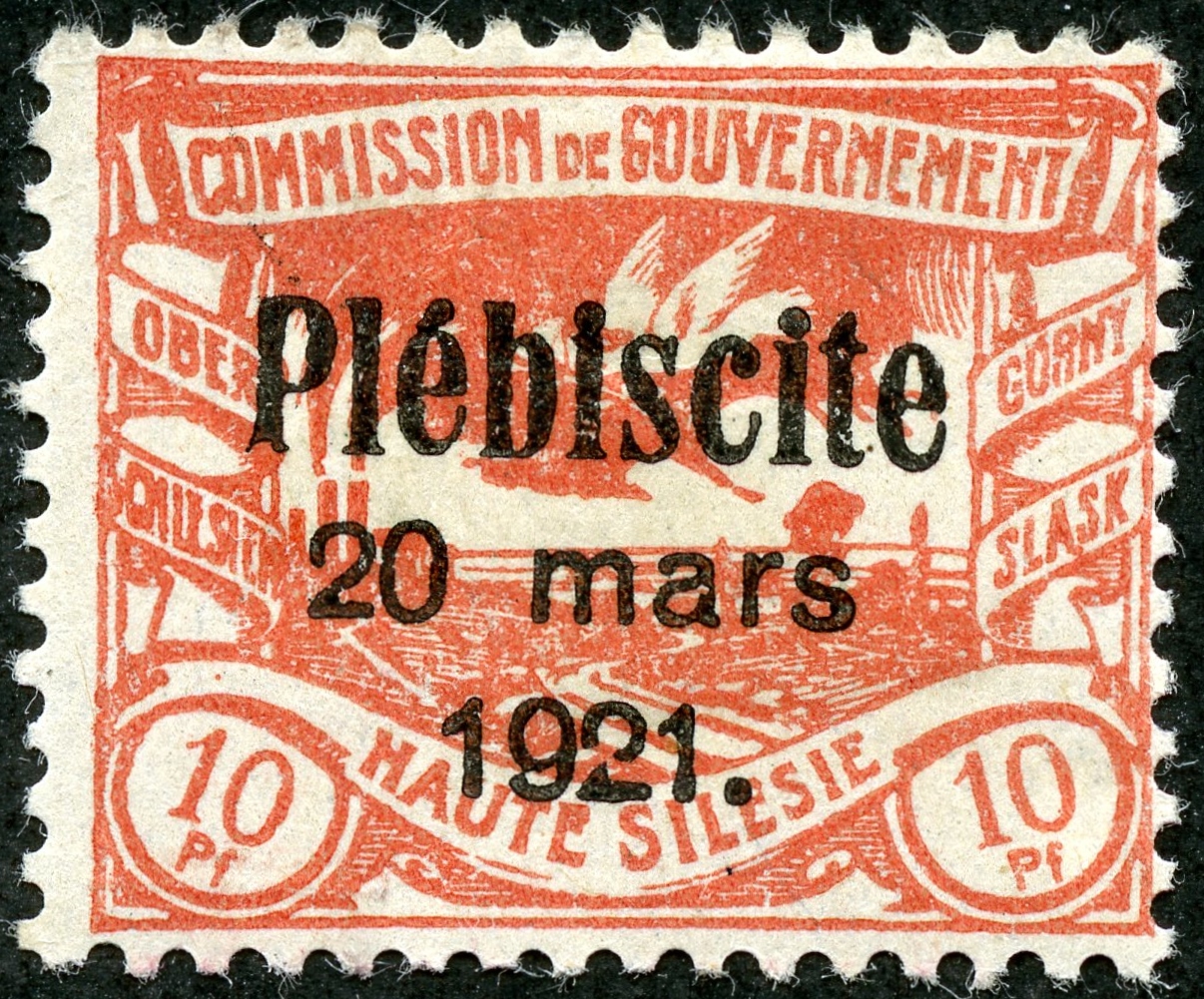
1921 Scott 32 10pf dull red
Overprinted in Black
On March 20, 1921, the date of the plebiscite, eleven stamps were overprinted on the 10 Pf. to 1 Mk. denominations.

CV is $4-$20+.

1922 Scott 46 10m on 75pf red
Type of 1920 and Surcharged
In March, 1922, three stamps from the 1920 issue, but in different colors, were surcharged as shown. No doubt the surcharged stamps reflect the German inflationary period.

CV is <$1-$6+.

1920 Scott O34 15pf violet brown
Local Official Stamps of Germany, 1920, Overprinted
In February, 1920, German stamps of 1905-20 were handstamped in blue "C.I.H.S." for use as official stamps by French occupation forces. Reprints are common, while originals are rare. CV is <$1 for thirteen stamps. Despite the low CV for reprints, I do not have any at the moment.

Illustrated above is an example of the local official stamps of Germany, 1920, overprinted "C.G.H.S." on seven stamps. "C.G.H.S." are initials for Commission de Gouvernement Haute Silesie.

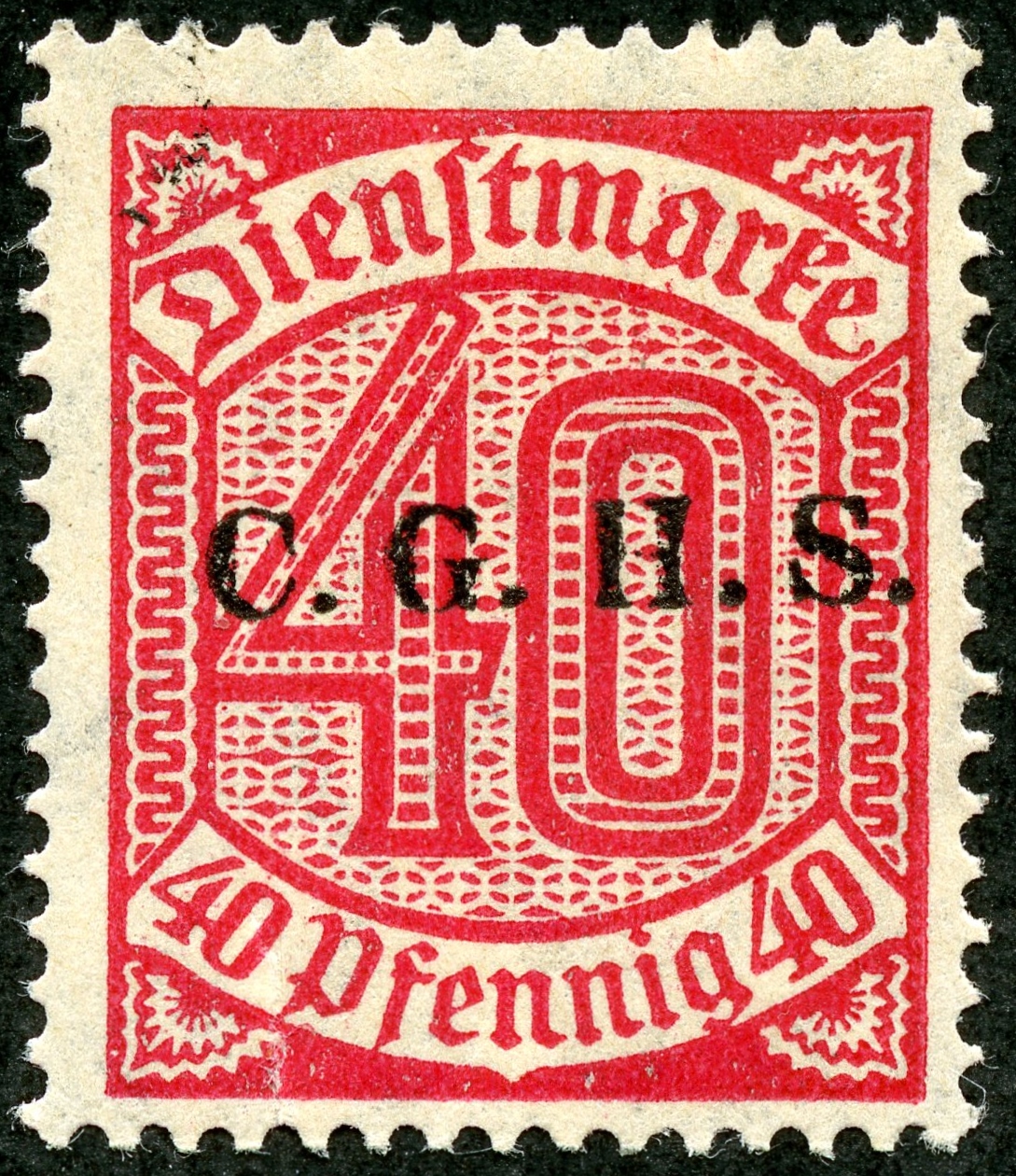
1920-21 Scott O44 40pf carmine rose
Official Stamps of Germany, 1920-21, Overprinted
Thirteen stamps with the "C.G.H.S." overprint on official stamps of Germany, 1920-21, were also issued.

Official Stamps of Germany, 1920-21
Overprint Variations
The "C.G.H.S." overprinted officials can be found with numerous overprint variations, as shown. Generally, the variations command little, if any, premium CV-wise. The Michel catalogue, in a most thorough German way, breaks the variations down into 20 recognizable types.

Deep Blue
1920 "Numerals" Issue in Deep Blue
Deep Blue (Steiner) has five pages for the stamps of Upper Silesia, and all major numbers have a space. In addition, there are spaces for the minor number "types" of the surcharged 1920 issues (Scott 10-13).

One may want to also have supplementary pages for the many cancelled 1920 stamp examples found in collections, and also for the official overprint variations.

1922 Scott 45 4m on 60pf olive green
Type of 1920 and Surcharged
Big Blue
Big Blue '69, on one page, has 36 spaces for the stamps of Upper Silesia.

There are no expensive stamps.

BB's coverage is adequate, but not great. Missing are any examples of the surcharged 1920 issues (Scott 11 and 12 types are inexpensive), and the overprinted or surcharged 1921-22 issues. The 1920 "Handstamped in Blue" Official issue has no spaces, even though 14 are CV <$1-$1+.

What is present is the 1921 Polish Occupation stamp issue which is no longer listed in the Scott catalogue. ;-) Scott has a note that stamps of this design were a private issue, and not recognized by the Inter-Allied Commission of Government. Value, Set of 7, $65 unused. The '47 Scott catalogue, though, had them included as "N1,N2,N3,N4".

Checklist

1920
1,2,3,4,5,6,7,8,
15,16,17,18,20,21,
24,26,29,30,

Official Stamps
1920
O32,O33,O34,O35,O36,O37,O38,
O40,O41,O42,O43,O44,O45,O46,

Occupation-Polish*
1921

“N1” 10f red,”N2” 20f purple,”N3”30f orange ,”N4”40f dark green,

Comments
A) Expensive stamps ($10 threshold): None
B) * Occupation-Polish - Scott has a note that stamps of this design were a private issue, and not recognized by the Inter-Allied Commission of Government. Value, Set of 7, $65 unused. The '47 Scott catalogue, though, has them included as "N1,N2,N3,N4". They are still in Big Blue. But, they are no longer listed in today's Scott catalogue.

1922 Scott O51 2m dark blue, Wmk 126 
Overprint on Official Stamps of Germany, 1920-21
Out of the Blue
Plebiscite issues are some of my favorites, as the stamps are clearly linked with a historical moment.

Note: Maps, poster scans, image of League of Nations cartoon- all appear to be part of the public domain.

Have a comment?