A is for Aden and Z is for Zanzabar


A is for Aden and Z is for Zanzibar... Now what is between? For the world wide classical era philatelist and stamp collector, a country specific philatelic survey is offered by the blog author, Jim Jackson, with two albums: Big Blue, aka Scott International Part 1 (checklists available), and Deep Blue, aka William Steiner's Stamp Album Web PDF pages. In addition, "Bud" offers commentary and a look at his completely filled Big Blue. Interested? So into the Blues...

Wednesday, January 19, 2022

Nicaragua - Bud's Big Blue

Arms of Nicaragua (United Provinces of Central America), 1823-25
Bud's Big Blue
Bud's Observations

Nicaragua’s stamps fill more pages in my Big Blue than those of any other country – 19 original album pages and 22 supplement pages. Why? Overprints and double overprints, anomalies (inversions, color shades, imperfs, misperfs, fold-overs), trial proofs, official stamps, unofficial officials, and split currency areas (silver in the east, paper money in the west). Add to these the irrelevant and unusable stamp values produced by Nicolas Seebeck, Nicaragua’s favored printer in the late 19th century. Nicaragua album pages fill quickly with many redundant mint images.

This excess, however, is not without attractiveness and historical interest. Take, for instance, the frequent appearance of the liberty cap, el gorro frigio, sometimes hoisted on a pike atop a mountain and sometimes floating mid-air.

El gorro frigio

The roughly conical cap with a floppy top originated in ancient Phrygia. It was adopted during 18th century American revolution as a symbol for freedom from colonial oppression, although the ancient cap had nothing to do with freedom. Nevertheless, Nicaragua follow suit.

Scott #s 1 dark blue, 54 slate, 103 violet, 305 green and chestnut, o128 carmine
(Remember to click on an image to enlarge it)

On stamps, the cap hovers over the five volcanic mountains that represent the five Central American countries -- Costa Rica, El Salvador, Guatemala, Honduras, and Nicaragua. Usually the cap is very small, as on Scott #o128, and easily mistaken for a crucifix or overlooked altogether.

Scott# 54, cap magnified

Beyond the USA and Nicaragua, many countries in Central and South America have adorned stamps and coins with Phrygian caps, including Mexico and Argentina.

Liberty with a Phrygian cap on a pike, USA one cent, 1795

 Scott #305 has a close resemblance to the Nicaragua coat of arms – a triangle showing a free floating, glorified cap, as well as the water of two oceans, perhaps a hope-inspired rainbow, and the five mountains. A second cap can be seen below the triangle in an image similar to Scott #54.

A particularly interesting and treacherous area of Nicaraguan philately is the local stamps of Cabo Gracias a Dios and Bluefields. These are mostly regular Nicaragua stamps overprinted for use in the eastern part of the country where currency was denominated in silver; they’re treacherous because the double and sometimes triple overprints are expensive and easily faked (Scott’s catalog says so).

Scott #s 2L50 violet, 2L1 plum, 2L16 plum, unlisted yellow, 2L31 slate

Cabo Gracias a Dios is thought to have been named by Christopher Columbus in 1502 in thanksgiving for deliverance from rough seas, perhaps a hurricane. The above scan shows four hand-stamped Cabo overprints, the most impressive being the yellow one peso with a clear Cabo cancellation. Sadly, Scott doesn’t list it as a legitimate stamp. So, I tend to regard it as a fancy flimflam. But then, there are hundreds of unlisted and unauthorized hand-stamped surcharges.

Bluefields, located south of Cabo on the Atlantic coast, derives its name from Abraham Blauvelt, a Dutch pirate in the early 17th century. The stamps commonly have two overprints, a capital “B” for Bluefields and “Dpto Zelaya” for the Province of Zelaya, the latter overprint being the smaller. Inking and clarity vary greatly.

Scott #s 1L22 carmine rose, 1L2 vermilion, 1L3 green, 1L13 violet, 1L67 blue and black

 Largely isolated from the rest of the country, Bluefields was only recently connected by a highway to the western part of Nicaragua. Railways in eastern Nicaragua were a political dream (although a philatelic reality). Ferrocarril de Nicaragua never delivered mail (or anything else) to Bluefields or Cabo.

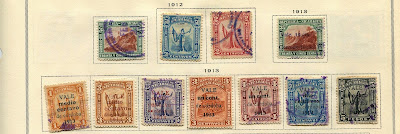
Hence the double irony of Scott #s 1L109-1L123: locomotives are featured on the one series of stamps issued specifically for purchase with the silver coins of eastern Nicaragua, a place without trains. Moreover, in 1912, the year after this series was issued, Ferrocarril de Nicaragua changed its name to Ferrocarril del Pacifico de Nicaragua. A gesture of honesty, I suppose. The last effort to extend rail service to the Atlantic succumbed in 1909, never to be revived.

Scott #s 1L111 orange brown, 1L119 brown and black, and 1L120 olive green

The philatelic locomotive is generic, not a likeness of Nicaraguan rolling stock. Produced by Waterlow and Sons of London, this series must have been printed in excessive numbers for, within a matter of months, they were overprinted for use in the silver-bereft western part of Nicaragua. Regardless, the series has become popular with collectors.

Recently, appreciation of Nicaragua’s stamps has grown, in large part, because of the pioneering work of the Nicaragua Study Group, NICARAO, and their website http://www.bio-nica.info/NICARAO/00-NICARAO.htm. Beginning specialists and even worldwide collectors will find their work helpful. For a discussion of Seebeck’s impact on Nicaraguan philately, see https://www.linns.com/news/postal-updates-page/seebeck-made-many-cheap-stamps-for-collectors.html.

Census: 568 in BB spaces, 28 tip-ins, 603 on supplement pages.


Jim's Observations

Nicaragua was one of the Central American countries that agreed to let Nicholas Frederick Seebeck and the Hamilton Bank Note Company print their stamps in exchange for unlimited reprinting rights.

From 1890-99, regular, postage due and official stamp sets were printed yearly. Even today, most of these stamps can be had  "mint" for pennies.

The good news for classical WW collectors is most stamps of Nicaragua are inexpensive even today- if you can find them. !


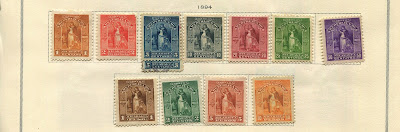
Page 1


1a


1b


1c


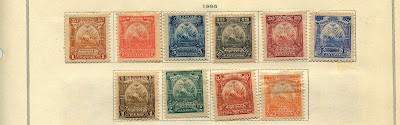
Page 2


2a


2b


2c


Page 3


3a


3b


3c


3d


Page 4


4a


4b


4c


4d


4e


Page 5


5a


5b


5c


Page 6


6a


6b


6c


Page 7


7a


7b


7c


7d


Page 8


8a


8b


8c


8d


Page 9


9a


9b


9c


9d


Page 10


10a


10b


10c


10d


Page 11


11a


11b


11c


11d


Page 12


12a


12b


12c


12d


Page 13


13a


13b


13c


13d


Page 14


14a


14b


14c


14d


Page 15


15a


15b


15c


Page 16


16a


16b


16c


Page 17


17a


17b


17c


17d


Page 18


18a


18b


18c


18d


18e


18f


Supplements
Page 1


Page 2


Page 3


Page 4


Page 5


Page 6


Page 7


Page 8


Page 9


Page 10


Page 11


Page 12


Page 13


Page 14


Page 15


Page 16


Page 17


Page 18


Page 19

Comments appreciated!


Tuesday, January 11, 2022

Pitcairn Islands 1940-51 "Mutiny on the Bounty" Issue

1940 Scott 5 3p dark blue & yellow green 
"Map of Pitcairn and Pacific Ocean"
Into the Deep Blue

Many school boy stamp collectors of my era would revel in the story of  "Mutiny on the Bounty" and Pitcairn Island- and not a few adults! 

Unfortunately, "Big Blue", the Scott International 1840-1940 album, left out the October 15, 1940 initial Pitcairn Islands issue commemorating the event, and hence I have never published a post about Pitcairn Islands.  (Stamp spaces for the issue do appear in Scott Part II 1940-49 album.) 

Joe Lil, one of the longtime collectors using Big Blue, wondered about the vacancy. So, this post is for you Joe!

1940 Scott 6 6p slate green & deep brown
"H.M. Armed Vessel "Bounty""

Since the Pitcairn Islands was a British colony under the British High Commissioner of New Zealand, it is not surprising that a bi-color pictorial issue was produced. Most colonies issued their sets in 1938, but Pitcairn Islands, with a grand total of 177 people (1943), issued eight stamps on 10/15/40, and two additional stamps on 9/1/51. BTW, a more recent population count (1984) found 57 people there.

One might argue that 177 people do not need their own stamp issue, but we are talking about a very romantic high seas story indeed, and no doubt 99.9% of the stamps were sold to stamp collectors for revenue. And many other British colonies, although having a much larger population, had very few literate mail writing citizens for their issues - so, really, not that unusual. 

1940 Scott 4 2p dark brown & bright green
"William Bligh and H.M. Armed Vessel "Bounty""

The issue was engraved (my favorite!), and produced by Bradbury Wilkinson & Co Ltd. (1940 1p, 3p, 2sh6p; 1951 4p, 8p); and Waterlow ( 1940 1/2p, 1 1/2p, 2p, 6p, 1sh).

CV ranges from <$1 to $10+. The 1951 stamps (4p, 8p) are at the higher end.

Close-up: "Wm Bligh"

Pitcairn Island was not inhabited until 1790, when then it was occupied by the mutineers of H.M.S. 
"Bounty". 

For more on Captain Bligh, see here. He and his loyal men were set adrift in Bounty's launch, and they finally  reached Timor alive, some 4,160 miles away. !!

The settlement by the "Bounty" mutineers was not discovered until 1808 when an American whaler (Topaz) called there. (Can you imagine - 18 years!)
.
Overcrowding led to resettlement in 1831 (Tahiti), and 1856 (Norfolk Island), but a number of families went back to Pitcairn in 1859 and 1864,

1940 Scott 7 1sh slate & violet
"Fletcher Christian and View of Pitcairn Island"

For those interested in the philatelic history, there is the Pitcairn Island Study Group, and the Pitcairn-Norfolk Philatelic Society.

1940 Scott 2 1p red lilac & rose violet
"Fletcher Christian with Crew and View of Pitcairn Island"

In 1920, regular mail service was introduced. There were no stamps available, but the letters were allowed free postage along as they carried a cachet indicating their origin. The Stanley Gibbons catalogue (Commonwealth & British Empire Stamps 1840-1970)) carries illustrations of these cachets, which state: "Posted in Pitcairn. No Stamps available".

Close-up: "Fletcher Christian with Crew"
Note the Breadfruit Tree

For more on Fletcher Christian see this. 

Fletcher Christian and the mutineers seize HMS Bounty on 28 April 1789. 
Engraving by  Hablot Knight Browne, 1841

1940 Scott 8 2sh6p dark brown & bright green
"Fletcher Christian and Crew and Coast of Pitcairn"

Fletcher Christian, with eight mutineers, six Tahitian men and eleven Tahitian women, settled on Pitcairn island, and the "Bounty" was burned. Conflict ensued between and among the mutineers and the Tahitian men over the next several years, and Fletcher Christian was subsequently murdered along with others.

1940 Scott 3 1 1/2p rose carmine & black
"John Adams and His House"

John Adams  was the last surviving mutineer. 

1951 Scott 5A 4p dark blue green & black
"Bounty Bible"

The Bounty Bible  is an important artifact, now residing, after years in Connecticut, in a museum on Pitcairn. As the tale goes, there were significant disputes on Pitcairn Island over land, women and so forth by the men there - with murders back and forth - until there were only two men left. 

One of the surviving men was John Adams. He amended his brutish ways, and took up reading the Bounty Bible. A "Christian civilized" order, guided by the Bounty Bible, was then adopted.

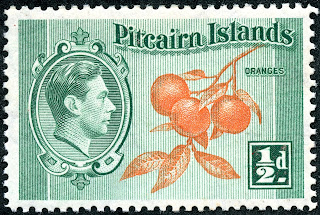
1940 Scott 1 1/2p blue green & orange
"Cluster of Oranges"

What did people eat and sell in the smallest and most remote place in the world? 

"Adapting themselves to the needs of their seafaring visitors the islanders became skilled market gardeners, producing potatoes, yams, coconuts, bananas, oranges, limes and chickens, for which they accepted in return clothing, tools and money."

1951 Scott 6A 8p lilac rose & green
"Pitcairn School, 1949"

The 1951 issue stamp shows the development of a school, established in 1949. Today, after age 13, education is continued at a boarding school in New Zealand.

I should mention that I do have "used" copies of Pitcairn stamps (pictured below). No doubt virtually all of the "used" stamps are philatelic in origin.  But to think that the stamp was once on Pitcairn island: that is still thrilling.

1940 Scott 3 1 1/2p rose carmine & black
"John Adams and His House"
Cancelled "Pitcairn Island Post Office"
Out of the Blue

I think we all have a secret desire to move to Pitcairn Island - but this will have to do. ;-)

Note: Quote is from Wikipedia search. The Engraving print is from the public domain, and used here for educational purposes.

Comments appreciated!