A is for Aden and Z is for Zanzabar


A is for Aden and Z is for Zanzibar... Now what is between? For the world wide classical era philatelist and stamp collector, a country specific philatelic survey is offered by the blog author, Jim Jackson, with two albums: Big Blue, aka Scott International Part 1 (checklists available), and Deep Blue, aka William Steiner's Stamp Album Web PDF pages. In addition, "Bud" offers commentary and a look at his completely filled Big Blue. Interested? So into the Blues...

Wednesday, March 2, 2016

Sudan

1902 Scott 18 2m brown & green  "Camel Post"
Quick History
Nubian Pyramids.... and sand
Sudan is home to the ancient Nubian Kingdom of Kush, at the confluence of the Blue Nile and the White Nile.

But the Suez Canal, built in 1869, meant that, in more recent times, the British and French became interested in the area, mainly to assure security of the enterprise.  

And that most definitely affected Sudan.

Anglo-Egyptian Sudan, on the southern border of Egypt, and tied by the Nile River and culture to Egypt, was a Condominium of Great Britain and the Kingdom of Egypt from 1899-1956. In reality, the British controlled the Sudan: not least because Egypt was occupied by British forces of various strengths from 1882-1936, and Egypt was a British Protectorate from 1914-1922.

Even after 1936, when the British forces withdrew from Egypt proper, with the exception of the Suez Canal Zone, they maintained their forces in Sudan.

(For more on the Anglo-Egyptian relationship, see my Egypt blog post.)

Anglo Egyptian Sudan in Northeastern Africa
Map shows exploration and partition history to 1914
Stamps were introduced in 1897 by overprinting Egyptian stamps of 1884-93.

Then Anglo Egyptian Sudan received their own iconic philatelic design beginning in 1898: the "Camel Post". The design was used as late as 1954.

Egyptian Sudan under British Control, 1912
The population was ~6,500,000 circa 1940, and the Capital is Khartoum.

Independence was achieved in 1956.

Sudan Today
Since independence, Sudan has had multiple coups d' etat, Marxist/ Non-Marxist conflict, north-south civil war (X2), Islamic Sharia law imposed on the national level, purges, executions, the Darfur genocide, and the South Sudan secession.

Two million people have died from civil war and famine.

Smiles in Khartoum
And yet life, as it should, goes on.

1903 Scott 28 5m Surcharge
On 1898 Scott 15 5p green & orange brown
Into the Deep Blue
The 2014 Scott Classic Specialized 1840-1940 catalogue has, for Sudan 1897-1941, 180 major number descriptions. Of those, 77 are CV <$1-$1+, or 43%. Sudan's stamps are reasonably affordable for the WW classical era collector.

Aside from the first issue, which consists of overprinted Egyptian "Sphinx" stamps, the overriding design over multiple issues for Sudan is the "Camel Post": and handsome it is.

No doubt because Sudan was jointly administered by Great Britain and Egypt, the script is in both English and Arabic.

Besides the usual categories of regular, air post, and postage due, Sudan also offers official stamps ( overprinted and perforated), and army official stamps (overprinted and perforated) categories.

A closer look at the stamps and issues
10 Milliemes = 1 Piaster
100 Piasters = 1 Pound
1897 Scott 2 2m green
Egyptian Stamps of 1884-93 Overprinted in Black
Eight Egyptian stamps were overprinted in March 1, 1897 by the Government Printing Works in Cairo for the first provisional issue of Sudan.  Note that the script here is in both French ("Soudan") and Arabic. All subsequent issues had English and Arabic script.

Both Scott and Stanley Gibbons mention that numerous overprint forgeries exist for this issue.

1898 Scott 16 10p deep violet & black "Camel Post"
Wmk 71: "Rosette"
De La Rue, London, was the printer for the "Camel Post" eight stamp issue in 1898. The issue is on watermark "Rosette" paper. De la Rue actually printed almost all of the stamps for Sudan during the classical era.

The "camel post" stamps here are large format- 25.5 mm X 30 mm.

Kitchener (center right) and the Anglo- Egyptian Nile Campaign, 1898
The "Camel Post" design was based on a sketch by Captain Edward Stanton, who, in turn, did it at the request of Sir Herbert Kitchener. Field Marshal Kitchener was victorious in the 1898 Battle of Omdurman, ensuring British control of Sudan.

He was given the title "Lord Kitchener of Khartoum", and he became Governor-General of the Sudan in September, 1898.

 
1905 Scott 17 1m carmine rose & brown 
Wmk 179: "Multiple Crescent and Star"
The second "Camel Post" issue of eleven stamps was produced between 1902-21, and was on "Multiple Crescent and Star" watermarked paper.

Update note: In the blog post header, which features the 1902 Scott 18 2m brown & green from this issue, there is a break in the frame above the "N" of Sudan.   This was noted by Rodney Allen (Rod222) of Perth, Australia, when I posted a link to this blog post on the The Stamp Forum website. Thanks Rod!

One will need to check watermarks to parse the issues. (See below.)

I should mention a bit more about Edward Stanton, who was given five days to come up with a stamp design by his commander, Field Marshal Kitchener! (The story was posted by Dave R. on the Stampboards forum. Thanks Dave!)

Stanton, an amateur artist, was always sketching Sudan scene images on the edges of maps he was drawing. As said, he had to quickly come up with a drawing suitable for stamps.

Nothing came to him, but on the third day the English mail arrived via camel rather than the usual steamer.

Ah-Ha! He had the local Sheikh gallop past him on a camel with straw-filled bags as if on a postal run. ;-)

Left Top- Wmk 71: "Rosette"
Right Top- Wmk 179: "Multiple Crescent and Star"
Bottom- Wmk 214: "Multiple S G"
Here are the watermarks found for classical era Sudan stamps. As there are identical color denomination stamps for similar issues, watermarks need to be checked.

BTW, "S G" stands for "Sudan Government".

1922 Scott 33 5m black & olive brown 
Wmk 179: "Multiple Crescent and Star"
A smaller format "Camel Post" seven stamp issue- 19.5 mm X 22.5 mm - was released in 1921-22.

Note the watermark.

All the printing of the "Camel Post" issues were produced by typography.

1927 Scott 42 15m orange brown & ultramarine
Chalky Paper; Wmk 214: "Multiple S G"
A similar small format seven stamp "Camel Post" issue, but on chalky paper and "Multiple S G" watermarked paper, was released between 1927-40.

Fair enough- just check the watermarks, right?

Not exactly. There is also a 1941 war-time issue on thick, smooth unsurfaced paper that has minor bolded numbers in Scott. The "ordinary" paper issue of 1941 was a substitute for the chalky paper.

I admit telling the difference between ordinary paper and chalky paper (especially used specimens that have been soaked in water) is not always easy. But do your best. ;-)

But that is not all....

1927 Scott 36  1m orange yellow & black "Posta Sudaniya"
1948 Scott Scott 79 1m dark orange & black "Barid-al-Sudan"
Both with Watermark "Multiple S G"
In 1948, a similar, but not identical issue with the same watermarked paper was produced. The Arabic script at the base of the "Camel Post' vignette is different. I admit I had placed a 1948 issue stamp among the 1927-40 issue spaces. ;-)

1927 Scott 46 5p dark green & orange brown
Chalky Paper; Wmk 214: "Multiple S G"
Also, the 1927-40 issue includes eight larger format stamps. Same thing as the 1927-40 smaller format stamps- there is also a '41 ordinary paper issue, and a similar '48 issue.

1940 Scott 44 3p dark blue & red brown
1948 Scott 87 3p dark blue & red brown
Same watermark "Multiple S G"; Different Arabic script
Here is a look at the similar, but not identical 1927-40 and 1948 issues for the large format stamps.

Now you know. ;-)

1931 Scott C3 2p orange & violet brown
1927 Scott 43 Overprinted in Black
In 1931, a three stamp air post issue was produced by overprinting in black on Scott 40,41, and 43. The air mail stamps were issued in conjunction with the England- Cape Town "Blazing the Mail" air route in March, 1931- which took 6 days, 10 hours to fly. ;-)

Imperial Airways' routes, April, 1935
Here is a map which shows the air routes to Africa and Australia by Imperial Airways in 1935.

 
1931 Scott C7 15m dark brown & brown
"Statue of General C. G. Gordon" 
Charles George Gordon was a Major-General that met his death January, 1885 in Khartoum in the face of a Sudanese revolt led by a Mahdi, Muhammad Ahmad. Gordon had evacuated 2,500 British citizens from the area. 

General Gordon's Last Stand - 1885
By George William Joy
He was also supposed to depart, but he and a small group of soldiers organized a defense of Khartoum which lasted a year. The government reluctantly sent a Khartoum Relief Expedition, because of popular British sentiment. But it was too late, as Khartoum had been overrun two days prior, and Gordon had been killed.

1901 Scott J6 4m blue green & brown
"Steamboat on Nile River"
Wmk 179: "Multiple Crescent and Star"
In 1901, a four stamp postage due issue was released. The fact that it has a nice scene, "Steamboat on the Nile River", is unusual for a British (Protectorate - in all but name) postage due.

1927 Scott J11 10m violet & blue green
Wmk 214: "Multiple S G"
The 1927-30 three stamp postage due issue is quite similar (in color) to the 1901 issue. But observe- the watermark is different. ;-)

1906 Scott MO8 5m black & rose red
Army Official Stamps
Regular Issues of 1902-11 Overprinted in Black
Sudan offers some 27 Army Official stamps- some overprinted, some perforated.

The stamp shown here is part of a eleven stamp issue of 1906-11.  The 2p, 5p, and 10p denominations can be found with wmk "Multiple Crescent and Star" (1902-11 issue stamps), or with wmk "Rosette" (1898 issue stamps).

1903-12 Scott O6 1p yellow brown & ultramarine
Official Stamps
"O.S.G.S." Overprint on Stamps of 1902-11
There are 46 stamps in the Official category for Sudan in the 1840-1940 Scott catalogue.

The 1903-12 issue of seven stamps is overprinted in black. The initials signify "On Sudan Government Service".

1913 Scott OA23 1p brown & ultramarine
On Second Large Camel Post Issue 1902-21
Perforated Official Stamps
"S G" for "Sudan Government"
There are also perforated Official stamps. The above is from a nine stamp perforated issue, with 12 holes in "S", and 13 holes in "G".

1946 Scott O19 4p black & ultramarine
Regular Issue of 1927-40 Overprinted in Black
The 1936-48 Official issue has fifteen stamps, and is overprinted as shown. Be aware that there are similar overprints for later issues- in 1948, 1950, and 1951.

Deep Blue
1903-12 Official Issue in Deep Blue
Deep Blue (Steiner) has 12 pages for the 1897-1941 stamps of Sudan, the period of time covered by the 2014 Scott Classic catalogue.

Contrary to the usual complete coverage, my Steiner pages do not offer spaces for several issues...

* The 1941 Issue with bolded minor numbers (Scott 36a-50a) on thick smooth unsurfaced paper (fourteen stamps) have no spaces. I used a quadrilled page.
* 1912-22 perforated Army official issue (Scott MOA17-MOA27) - nine stamps, and the 1922-24 perforated army issue (Scott MOA30, MOA33-MOA34)- three stamps. A quadrilled page was used.
* Perforated Official stamps for the years 1900, 1913-22, 1922, 1927-30 (22 stamps). Again, I used a quadrilled page. 

1940 Scott 60 5m on 10m black & carmine
1927 Scott 41 Surcharged in Black
Big Blue
Big Blue '69,  on two pages, has 61 spaces for the stamps of Sudan.  Coverage is 33%.

The 40s editions have the same coverage, except a space is given for the 1903 Scott 28 5m on 5p (CV $10+).  (Note: This stamp is illustrated at the head of the "Into the Deep Blue" section.)

The perforated stamps found with the Official and Army Official categories are not included. 

The "S G" Official overprinted stamps of 1936+ are not given a space.

Only one stamp with CV $10+ is required for the spaces.

There is the usual (for BB) one space for watermark different stamps.

Checklist

1897
1,2,3,4,(5),

1898 (-1911)*
9 or 17, 10 or 18, 11 or 19, 12 or 22, 13 or 23,
14 or 24, 20,21,15 or 26, 16 or 27,

1921-36*
29 or 36, 30 or 37, 31 or 38, 32 or 39, 33 or 40, 34 or 41, 35 or 42,
43,45,47,48,50,

1934
51,52,55,53,54,

Next Page

Postage Due
1897
J1,J2,

1901*
J5,J6,J7,J8,

Official Stamps
1903-12
O3,O4,O5,O6,O7,

1906-11
MO5,MO6,MO7,MO8,MO9,

Air Post
1931
C1,C2,C3,

1932
C4,C9,

1931-37
C5,C6,C7,C8,
C10,C11,C12,(C13), 

Comments
A)Expensive stamps ($10 threshold):
1931 Scott C12 1 1/2p gray & brown ($10+)
B) (    ) around a number indicates a blank space choice.
C) * 1898-(1911): I include the second issue as well. That means there is the Wmk 71 vs Wmk 179 choice for a space.
D) *1921-36: Wmk 179 vs Wmk 214 choice for a space. Be aware that, in 1941, there was a fourteen stamp issue (bolded minor numbers) that was on thick smooth unsurfaced paper. Technically, because of BB date specifications, the '41 issue should not be put in: your decision though.
E) *1901- because of BB's date specifications, the 1927-30 Scott J9-J11 are not eligible.

1912-22 Scott MOA18 2m brown & green
On Second Large Camel Post Issue 1902-21
Perforated Army Official Stamps
"A S" = Army Service
Out of the Blue
The "Camel Post" stamps are iconic- who wouldn't want their mail delivered by camel? ;-)

Note: Maps, and pics of smiling lady, Nubian Pyramids, and Kitchener, and 1935 Imperial Airways map, and Gordon's painting appear to be in the public domain.

Comments appreciated!

Thursday, February 25, 2016

Straits Settlements

1883 Scott 41 2c carmine rose "Victoria"
Quick History
Straits Settlements (on or near the Malacca Strait, hence the name) was a group of British territories established in 1826 by the British East India Company.

Penang (Pinang), Malacca, Singapore (Red outlines)
Straits Settlements 1844 under East Africa Company
The Straits Settlements  were a consequence of the Anglo-Dutch Treaty of  1824, where the Malay archipelago was divided between the Dutch south zone and the British north zone.

British Malaya 1922
Straits Settlements (Red)
Federated Malay States (Yellow)
Unfederated Malay States (Blue)
Stamps of India were used in the Straits Settlements from 1854-1867 with octagonal postmark B/172 (Singapore), B/147 (Penang), and B109 (Malacca).

Initially, Penang was the administrative center, but quickly (1832) Singapore, with its advantageous location, became the leading settlement.

In 1867, Straits Settlements became a crown colony, and De la Rue produced new Victoria stamp designs. 

The population was 572,000 in 1901, with the Chinese and the Malays far outnumbering the Europeans.

The Governor of the Straits Settlements was also High Commissioner for the Federated Malay States, British North Borneo, Sarawak, and the sultanate of Brunei.

Labuan joined the Straits Settlements in 1907.

(There were smaller entities as well- Dinding (which never had much population or development), Christmas island, and Cocos (Keeling) islands. A map of all of the parts of Straits Settlements is available at the fine Dead Countries Stamps website.)

For further reading and viewing of the history and stamps of the British Malay Peninsula region, see my blog post- Malay and States.

The Japanese occupied the Malay Peninsula during WW II until 1945.

Straits Settlements was broken up in 1946. Penang and Malacca became part of the Malayan Union. Labuan was attached to  British North Borneo, while Singapore became a Crown Colony.

Present Day Singapore and Malaysia
The British led Malayan Union of 1946 was changed quickly to the Sultan led Federation of Malaya in 1948. Independence was achieved for Malaya in 1957. Then, with the addition of Singapore, Sarawak, and North Borneo (State of Sabah), Malaysia was born in 1963. Finally, Singapore exited in 1965.

1935 Scott 213 5c black & ultramarine "George V"
"Silver Jubilee Issue"
Into the Deep Blue
The 2014 Scott Classic Specialized 1840-1940 catalogue has, for Straits Settlements 1867-1948, 310 major number descriptions. Of those, 93 are CV <$1-$1+, or 30%. As a former British Colony composed of Singapore and parts of Malaysia, there is demand and interest, and consequently cost for these stamps.

There are also pockets of expensive to very expensive stamps for the Straits Settlements...
* 1854-1867 stamps of India used in Straits Settlements (Singapore; Penang; Malacca) (79 stamps with Scott "A" prefix).
* 1867 surcharged Stamps of India issue (nine stamps)
* 1880 surcharged (10c) on  the 1872 Scott 18 30c claret (fourteen stamps)
* 1883-1887 surcharged issues (fourteen stamps)
* 1907 Issue (eleven stamps)- Stamps of Labuan 1902-03 surcharged (Some are inexpensive, but I don't have any).
* 1922 Issue for Industrial Fair- overprinted  "Malaya-Borneo Exhibition"(fifteen stamps- minor numbers)
* 1942-43 Japanese Occupation Issues (thirty stamps)

The above categories, attractive as they are, are really specialist territory, and, at the moment, I don't have any. I will, however, mention a few of the issues briefly.

A closer look at the stamps and issues
100 Cents = 1 Dollar
1867 Scott 10 2c bister brown "Victoria"
Wmk 1: "Crown and C C"
The initial production  for Straits Settlements proper was on September 1, 1867, with a nine stamp overprinted crown and surcharged issue, using stamps of India. The least expensive is CV $40+, and I don't have any.

As mentioned, with the advent of "Crown Colony" status in 1867. Straits Settlements also received their own stamps, printed by Dr la Rue. The 1867-72 nine stamp design shows a center portrait of the queen, surrounded by script on a white background.

The watermark is "Crown and C C". One will need to pay attention to this, as the similar 1882-99 series repeats some of the same denominations and colors, but with a "Crown and C A" watermark.

Upper Left: Crown and C C (wmk 1)
Upper right: Crown and C A (wmk 2)
Lower left: Multiple Crown and C A (wmk 3)
Lower right: Multiple Crown and Script C A (wmk 4)
As a refresher, here are the British Colonial Watermarks 1-4.

1894 Scott 50 8c ultramarine "Victoria"
Wmk 2: "Crown and C A"
In 1880-81, there were some 21 stamps of the 1867-72 issue surcharged with either 5 cents or 10 cents. Most are quite expensive, and I don't have any. (Are you getting the feeling it may be costly to specialize in Straits Settlements? ;-)

The next major issue was produced between 1882-99, and utilized the four designs from the 1867-72 issue, as well as two new designs. The eighteen stamp production was printed on "Crown and C A" watermark paper. Since the denomination and colors for some of the stamps are the same as the earlier 1867-72 issue, one will need a watermarking tray.

CV is <$1-$4+ for eleven stamps.

1894 Scott 74 3c on 32c rose
Between 1883-94, there were some 25 stamps of preceding issues surcharged (1c,2c,3c,4c,8c,10c,30c). Clearly, there was specific and wide denomination stamp shortages during this period. The Straits Settlements, especially Singapore, was growing, and the available stamps were not keeping up with the mail volume.

1892 Scott 82 1c on 8c gray green
During the 1883-94 surcharge period, there are both inexpensive and expensive stamps. The 1c on 8c gray green, illustrated above, is only CV $1+.

On the opposite end, the 1884 Scott 69 4c (red surcharge) on 1884 Scott 68 4c on 5c ultramarine is CV $37,000+: only found on ten letters sent by the Postmaster General to his wife. ;-)

1892 Scott 83 1c gray green "Victoria"
Between 1892-99, six "keyplate" type stamps were issued. Three stamps are CV <$1.

1899 Scott 89 4c on 5c ultramarine
Stamps of 1883-94 Surcharged
In 1899, four stamps were surcharged 4c. This was the last occurrence of surcharged issues for the Straits Settlements.

1902 Scott 97 8c violet/blue "Edward VII"
With the ascension of Edward VII, a thirteen stamp issue was released in 1902, using the keyplate design on Wmk 2 paper.

1903-04 Scott 107 4c violet/red "Edward VII"
Wmk 2: "Crown and C A"
In 1903-04, an oval portrait design of Edward VII was issued on four stamps. Watermark is "Crown and C A".

1910 Scott 128 $5 green & red/green "Edward VII"
Wmk 3; Chalky Paper
The 1904-11 twenty-two stamp chalky paper issue used the previous Edward VII 1902 keyplate and the 1903-04 oval portrait designs. The watermark is "Multiple Crown and C A".

The values go up to denomination $100. !! Clearly, the higher denominations are found more frequently on revenue cancellations, and the CV is much less for a revenue cancel.
Chalky paper can be tricky. Soaking a stamp in water tends to remove the chalky character. Obviously, most "used" stamps have been subject to this process. Examining the perforation area of the stamp sometimes reveals chalky evidence.

But the entire twenty-two stamp issue was printed on Wmk 3 "Multiple Crown and C A" paper, which should differentiate this issue from the preceding ones.

1911 Scott 132 4c lake "Edward VII"
Wmk 3; Ordinary Paper
Lastly, for Edward VII, a six stamp issue on ordinary paper was printed between 1906-11. Fortunately, these stamps have different colors compared to the preceding issues. CV is <$1-$3.

I should mention that when Labuan joined the Straits Settlements in 1907, a group (ten stamps) of their 1902-03 stamps were overprinted and/or surcharged for use in the Straits Settlements. Some are only moderately expensive ($3-$10: five stamps). They were not given spaces on Big Blue and I don't have any. But they are on my Bucket List. ;-)

1918 Scott 154 4c scarlet "George V"
Wmk 3; Chalky Paper
A long (23 stamps) issue for George V was produced between 1912-18 using six designs. The entire issue is found on Wmk 3 "Multiple Crown and C A" paper": helpful. Some denominations/colors are found both on chalky and ordinary paper (10c violet/yellow, 45c, $2, $5).

Also, the A24 design on nine stamps (see next illustration) is Die I for this issue.

1932 Scott 187 5c dark brown "George V"
A24 Design; Wmk 4; Die II; Ordinary Paper
The 1921-32 twenty-six stamp issue uses the same designs as the 1912-18 issue, but on watermark 4 "Multiple Crown and Script C A" paper: again helpful. The lower denominations through the 10c ultramarine are on ordinary paper; while the higher denominations, beginning with the 10c violet/yellow, are on chalky paper.

The A24 design (ten stamps) is found as Die II.

Die I/Die II illustrative/descriptive differences can be found on "Dies of the British Colonial Stamps" in the introduction section (page 38A) of the 2014 Scott 1840-1940 catalogue, or link to my Gold Coast post.

1921 Scott 199 $1 black & red/blue "George V"
Wmk 4; Die II; Chalky Paper
The CV for the 1921-32 issue is <$1-$1+ for twelve stamps.

1936 Scott 226 25c rose red & violet "George V"
The 1936-37 "George V" issue is found exclusively on chalky paper, and has a CV of <$1-$1+ for fourteen stamps.

1937 Scott 241 5c brown "George VI"; Die I
1939 Scott 241a 5c brown; Die II
(Enlarge for examination)
The 1937-41 George VI issue of eighteen stamps with one design, but two dies.

This issue proved to be the last before the Japanese invasion. The issue can be found with Japanese handstamped overprints in 1942 (5 stamps) , and 1942 ( 15 stamps), Some of the handstamped overprints are inexpensive (CV $3-$4: four stamps), but I don't have any at the moment.

The interest (for me) is that the issue was printed with two dies.

Die I: printed from two plates. Horizontal lines of the background touch outside the central oval. Palm frond in front of King's eye has two points.

Die II: printed from one plate. Lines of background separated from central oval. Palm frond in front of King's eye has one point.

Usually, the denomination was printed with either Die I or Die II, but not both. However, the 4c brown orange, and the 5c brown ( illustration) were printed with both dies. Can you find an example of both in your collection?

1924 Scott J4 8c red
A functional appearing six stamp postage due issue was released between 1924-26. The French had more fun with their colony postage dues (Here, specifically St. Pierre and Miquelon), if one would like a comparison. ;-)

Deep Blue
1882-99 "Victoria" Issue in Deep Blue
Deep Blue (Steiner) has 17 pages for the 1867-1948 stamp issues, and all major Scott numbers have a space. Unless one is a specialist with deep pockets- because of expense-, sections of Deep Blue for the Straits Settlements are unlikely to be filled.

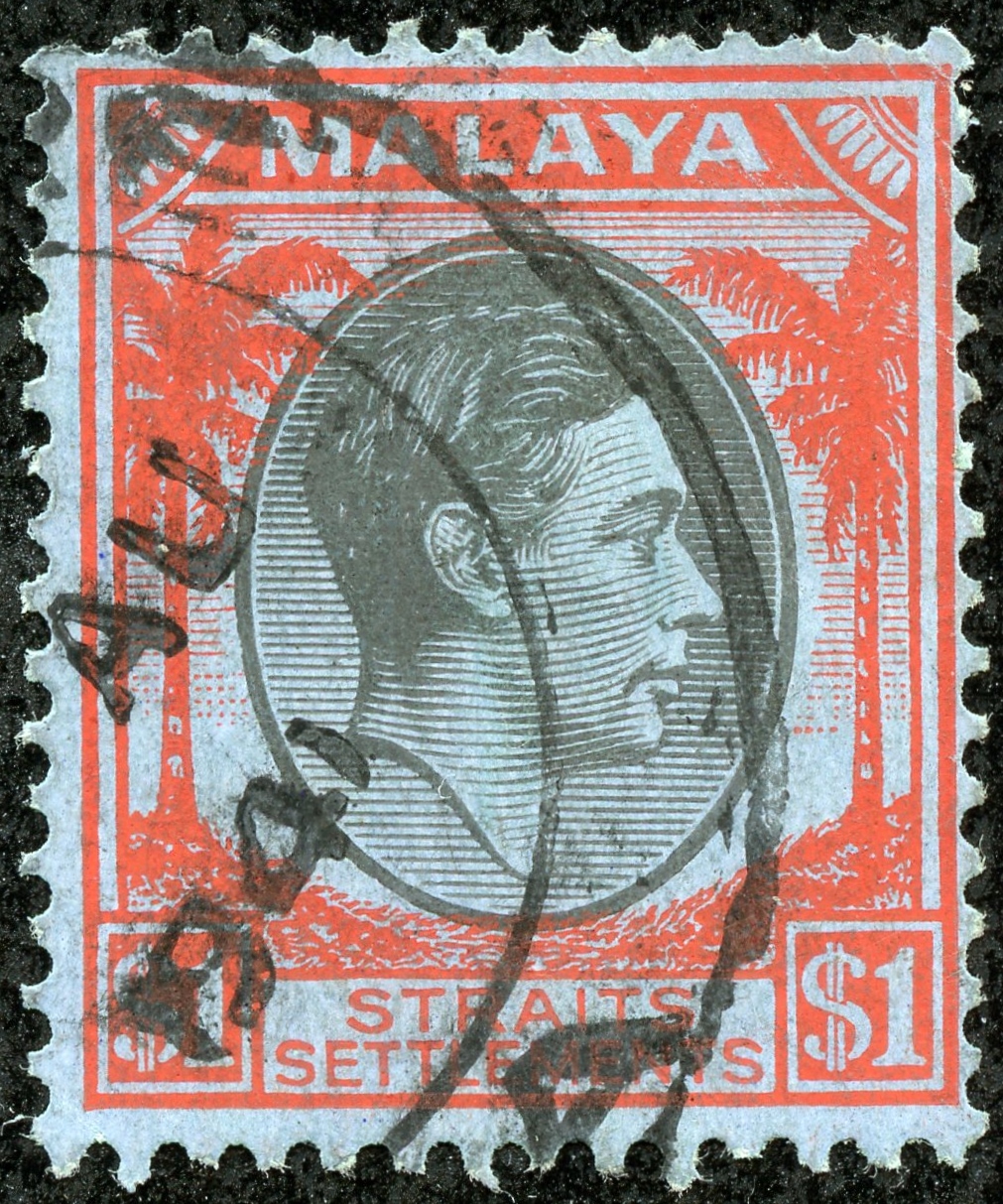
1938 Scott 250 $1 red & black/blue "George VI"
Big Blue
Big Blue '69 has just two pages and 92 spaces for the stamps of Straits Settlements  (Malacca, Penang, and Singapore). The '69 editors separated out "Malaya" and gave them their own section.

The 40s BB editions, as noted, had the Federated Malay States, Johore, Kedah, Kelantan,  Negri Sembilan, Pahang, Perak, Selangor, Sungei Ujong, and Trengganu still included under the "Straits Settlements" section.

Subtracting the 46 stamps for the 1942-48 period (which BB doesn't cover) leaves 264 major numbers in the catalogue. Overall, then, coverage in BB is 35%.

To BB's credit (and the fact I altered the 1882-91 issue stamps to 1867-91 dates ;-), there are no expensive stamps ($10 threshold).

There is the usual wmk 2 vs wmk 3; wmk 3 vs wmk 4 choices for stamp spaces to be made.

The '69 editors dropped the postage due category (eight spaces), which was in the 40s editions.

Checklist

1882-91* (Actually 1867-91 here)
10 or 40, 12 or 48, 13a or 49, 51, 41,45,54,

1887-92
73,75,77,78,79,80,82,

1892-1900
83,84,85,43,46,47,50,

1894
74,

1899
90, 91a or 91, 92,

1902-04
93,94,95,96,97,98,(99),(100),

1903-11*
105 or 109, 129, 106 or 110, 130, 107 or 111, 131, 112,
132, 133, 108 or 114, 134, 116, 118, (119),(120),

Next Page

1912-22*
149,150 or 179,151 or 180,152,182,153,154,

1912-22*
155 or 186, 156 or 188,157,158 or 191,159 or 190,192,

1929-32
185,187,

1935
213,214,215,216,

1936-37
217,218,220,222,223,224,226,227,
229,(230),

1937
235,236,237,

1937-38
238,239,240,241,242,243,

244,245,246,247,248,(249),

Comments
A) Expensive stamps ($10 threshold): None
B) (    ) around a number indicates a blank space choice.
C) *1882-91- there is no reason to keep this narrow coverage, so I expanded the date range to 1867-1891, which allows other and less expensive stamps to be considered. You are, of course, free to keep BB's original time period if you wish, ;-)
D) *1903-11- choices are wmk 2 vs wmk 3.
E) *1912-22- choices are wmk 3 vs wmk 4

1945-48 Scott 266 25c rose red & violet 
Stamps of Type of 1937-41 Overprinted in Red or Black
B M  A = "British Military Administration"
Out of the Blue
192, 194X3, 223 on Envelope
Fascinating part of the world, and the philatelic history, especially with the addition of  covers, would be a great  specialty collection. Many of the stamps are priced in the inexpensive range, but others will tax the pocketbook. I feel drawn to it... wait! I still need to finish the WW classical era blog posts.... Oh, well...  ;-)

Note: Map scans appear to be in the public domain.

Have a comment?

Friday, February 19, 2016

Spanish Sahara

1924 Scott 3 15c turquoise blue
"Tuareg and Camel"
Quick History
Spanish Sahara or Spanish Western Sahara, as it was formerly known, was established in 1924 from the colony of Rio de Oro and the territory of Saguiet el Hamra.

1913 Map of Colonial Africa
Magenta Color shows the Spanish Claims in North-West Africa
With the Berlin Conference of 1884, and the European Powers setting up spheres of influence in Africa, Spain declared an African Coast protectorate from Cape Blanc to Cape Bojador, and informed the other powers on January 14, 1885. (The Sahrawi had nothing to say about it. ;-) The colony was called Rio de Oro.  But the "Rio" was a wadi, there was no gold, and the landscape mainly consisted of coastal fog and desolate sandy escarpments.

(See the Rio de Oro blog post for more history- both real and philatelic.)

 Map showing the Spanish Region of Western Sahara circa 1912
The borders of the Spanish claims were not well defined until France and Spain, through treaties, established limits in the early 20th century.

But in 1924, Spanish Sahara was created, and the "Tuareg and Camel" stamp issue was released.

Besides Rio de Oro and Saguiet el Hamra, the lands also included La Aguera, the Cape Juby strip and Ifni.

Spanish Morocco was administered separately.

The capital was Aaiun (Laayoune), and the population was 32,000 in 1940.

Spain had opposition to "ownership", both internally (indigenous Sahrawi tribes), and externally ( Morocco, after gaining independence from France in 1956, laid claim to Spanish Sahara as part of its historic territory). To appease Morocco, Spain ceded the Cape Juby strip to them in 1958. Mauritania also claimed the lands (The Mauritania claims were eventually withdrawn) . Ifni was returned to Morocco in 1969.

Western Sahara
Finally, with additional UN resolutions demanding decolonization, Spain withdrew in 1975, and Morocco occupied the country. But, in turn, there was a Sahrawi guerilla war against Morocco, lasting sixteen years, until the UN negotiated a cease-fire.

Western Sahara is considered a "Non Self-Governing Territory" by the UN
Morocco has resisted allowing a referendum on independence to be held, and the sovereignty of the lands is still under dispute. 

Vertical Stripes: Territory under de facto Moroccan control
Light Solid Gray: Territory under de facto SADR control
The African Union (54 countries) considers Western Sahara to be the sovereign state of the Sahrawi Arab Democratic Republic- although occupied.

1929 Scott 21 1p blue black "Exposition Buildings"
Seville-Barcelona Issue of Spain, Overprinted in Blue or Red
Into the Deep Blue
The 2014 Scott Classic Specialized 1840-1940 catalogue has, for Spanish Sahara 1924-1931, 47 major descriptive numbers in the regular and semi-postal categories. Of those, 29 are CV <$1-$1+, or 62%. From the point of view of CV, the WW classical era collector should be able to put together a representative collection without much cost. The problem for U.S. based collectors, as I've mentioned before, is Spanish colony stamps are not that prevalent in general collections. One may need to hunt for them.

For myself, when I was ready to review Spanish Sahara, and prepare this blog post, I had only two! stamps in my collection. Fortunately, I found an auction lot on the 'bay, and ended up with 100% coverage. That was lucky- my other Spanish colony holdings are not nearly so complete. ;-)

A closer look at the stamps and issues
100 Centimos = 1 Peseta
1924 Scott 12 10p claret "Tuareg and Camel"
The first issue for Western Spanish Sahara proper as a new administrative and colonial entity was the twelve typographic stamp issue of 1924 with "Tuareg and Camel" design. For prior issues of the region, see Rio de Oro.

Sahrawi and Camel
The Tuareg people and language is a subset of the Berber branch, and they are found within the Saharan interior of North Africa. Traditionally, they live a pastoral and nomadic existence.

Specific to Western Sahara, the Sahrawi people are found, and have mainly a mixture of Berber-Tuareg culture.

Of interest, my 1947 Scott catalogue labels the scene "Moor and Camel".

The 2014  Scott catalogue has a note that this issue was for use in La Aguera and Rio de Oro.

As is usual for Spanish colonial stamps, there are control numbers on the back.

1929 Scott 23 10p brown 
"King Alfonso XIII and View of Barcelona"
Seville-Barcelona Issue of Spain, Overprinted in Blue or Red
Like Spanish Guinea and Spanish Morocco, Spanish Sahara also had the Seville-Barcelona issue of Spain overprinted for use in 1929 on eleven stamps.

1931 Scott 34 4p chocolate 
Stamps of 1924 Overprinted in Red or Blue
Spain in 1931 replaced the Constitutional Monarchy of Alfonso XIII with the Second Spanish Republic. Alfonso XIII left the country, but did not abdicate until 1941.

The overprinted Spanish Sahara twelve stamp issue of 1931 reflects the new reality.

The overprint can be found going up (usual), going down, and horizontal.

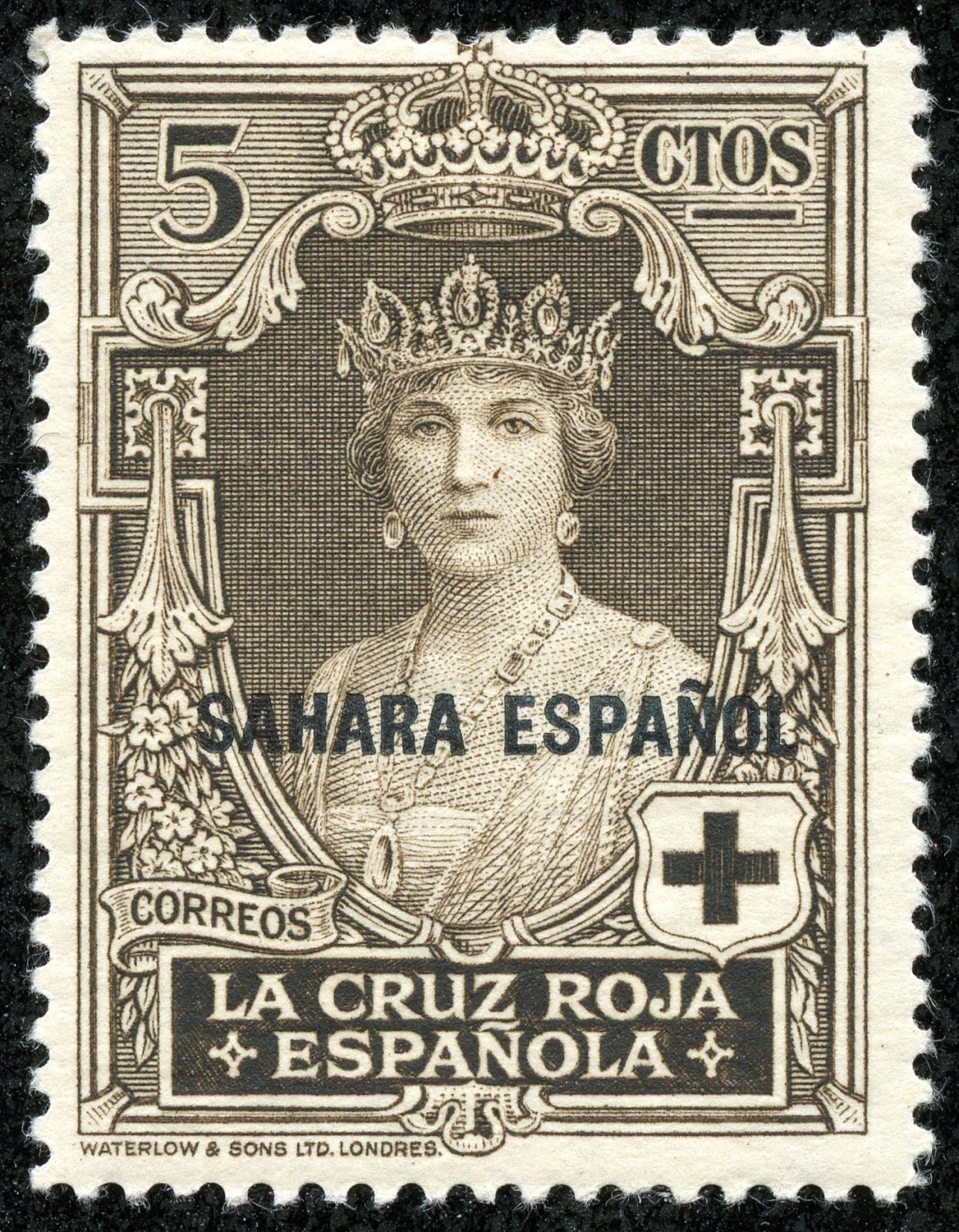
1926 Scott B1 5c black brown
"Queen Victoria Eugenia"; Red Cross Issue
Types of Semi-Postal Stamps of Spain, 1926, Overprinted
The 1926 engraved semi-postal stamp issue of Spain was also printed in some different denominations and different colors, and overprinted for use in the various Spanish colonies ( Cape Juby, Spanish Guinea, Spanish Morocco, Spanish Guinea), also in 1926. The twelve stamp issue for Spanish Sahara has a CV ranging from <$1-$8+.

Of interest, the 20c violet brown color, intended to be overprinted for use in a Spanish colony (as the ordinary color for the Spain 20c is dull violet), has been found without overprint, and so is considered a color error, valued @ CV $375.

Deep Blue
1931 Issue of Spanish Sahara in Deep Blue
Deep Blue (Steiner) has three pages for the 1924-31 stamp issues of Spanish Sahara, and includes a space for all the Scott major number stamps.

1926 Scott B2 10c dark green "Prince of Asturias"
Red Cross Issue
Types of Semi-Postal Stamps of Spain, 1926, Overprinted
Big Blue
Big Blue '69, on two pages has 43 spaces for the stamps of 1924-1931 Spanish Sahara. Coverage is a remarkable 91%. !!

The coverage significantly increased, compared to the 40s editions, (Then labeled "Spanish Western Sahara"), where there were only 25 spaces on one page. 

The flip side to the generous coverage in the '69 ( and subsequent editions) is there are some expensive stamp spaces to fill. ;-)

Specifically...

"Tuareg and Camel" Issue
1929 Scott 11 4p chocolate ($30+)
1929 Scott 12 10p claret ($105) !!

I suspect these stamps may be a couple of the more difficult ones to find for those collectors who are attempting to complete a  Big Blue. To wit, a stamp buddy, who has less than 360 spaces to fill in BB, is looking for these stamps. !

Checklist

1924
1,2,3,4,5,6,7,
8,9,10,11,12,

1929
13,16,18,20,21,
14,15,17,19,

1931
24,25,26,27,28,29,
30,31,32,33,

Next Page

Semi-Postal
1926
B3,B1,B2,B6,
B4,B5,B7,B8,B9,

B10,B11,B12,

Comments
A) Expensive stamps ($10 threshold):
1929 Scott 11 4p chocolate ($30+)
1929 Scott 12 10p claret ($105) !!

1926 Scott B5 25c deep carmine "Alfonso XIII"
Red Cross Issue
Types of Semi-Postal Stamps of Spain, 1926, Overprinted
Out of the Blue
The lands are some of the most inhospitable and arid of any on our earth. We should be grateful for any stamp from there so bright and tangible. ;-)

Note: Maps and pics appear to be in the public domain.

Have a comment?

Desert Coast of Morocco and Western Sahara from the International Space Station