A is for Aden and Z is for Zanzabar


A is for Aden and Z is for Zanzibar... Now what is between? For the world wide classical era philatelist and stamp collector, a country specific philatelic survey is offered by the blog author, Jim Jackson, with two albums: Big Blue, aka Scott International Part 1 (checklists available), and Deep Blue, aka William Steiner's Stamp Album Web PDF pages. In addition, "Bud" offers commentary and a look at his completely filled Big Blue. Interested? So into the Blues...

Wednesday, October 9, 2019

Cape Verde 1877-1913 - a closer look

1886 Scott 19 40r chocolate "King Luiz"
Perf 12 1/2
Into the Deep Blue
Cape Verde, under Portuguese influence, has to be one of the more remote island spots on earth, some 500 miles out in the Atlantic Ocean west of Senegal.

Cape Verde
From StampWorldHistory
If you take a look at the....

Original Cape Verde Post & BB Checklist,

you will notice that it is heavy on information, but sparse on illustrating Cape Verde stamps, save for a few cropped photos.

As I have presently a nice collection of classical era Cape Verde (226 spaces filled in Deep Blue out of 287 total spaces (78%)), how about a revisit? This post will cover the 1877-1913 issues, while the next post will handle 1914-1938 & "back-of-the-book" issues.

One question a collector may ask is why I don't show more scans of the various issues (showing multiple stamps in my collection) rather than featuring a single stamp from the issue? Actually, I think it is more interesting and aesthetically more pleasing  to look at one (high resolution scan) stamp from an issue - a miniature piece of art! - rather than a scan of multiple stamps from the issue.

I should mention that when I give a ball park CV(s) for a stamp or an issue, it is for a used example. Unused commands a higher CV.

1877-1913 - A closer look
1000 Reis = 1 Milreis
100 Centavos = 1 Escudo (1913)
1877 Scott 8 200r orange "Crown of Portugal"
Perf 12 1/2
The first issue for Cape Verde was a nine stamp "Crown of Portugal" typographic issue, released in 1877.

Although the "Crown" design is common across many of the Portuguese colonies, for Cape Verde, the collector has to be aware of perforation differences.

Scott lists the Perf 12 1/2 as major numbers. In addition, there are some five minor numbers for color variations.

1877 Scott 1a 5r black "Crown of Portugal'
Perf 13 1/2
The Perf 13 1/2 stamps are given minor numbers. Of interest, the Perf 13 1/2 stamps have, not uncommonly, a lower CV than the Perf 12 1/2 major numbers.

The Perf 12 1/2 stamps range in CV from $1+ to $70+. The Perf 13 1/2 stamps have CVs from $1+ to $50. 

1881 Scott 14 50r blue "Crown of Portugal'
Perf 12 1/2
A change in color for five denominations was issued between 1881-85 for the "Crown" design. CVs are $1+-$4+.

I should mention there is an error for the 40r denomination (1887 40r blue; 1881 40r yellow buff): a Cliche of Mozambique in the Cape Verde plate - this can be identified if there are at least pairs attached. CV ranges from $110 to $1,500.

1886 Scott 18 25r violet "King Luiz"
Perf 12 1/2
The embossed "King Luiz" issue of 1886 has nine stamp denominations.

Again, look for differences in perforation. All denominations have a Perf 12 1/2 example.

1886 Scott 17a 20r carmine "King Luiz"
Perf 13 1/2
Some denominations can be found in Perf 13 1/2. They can be either major or minor numbers.

CV for major numbers for the "King Luiz" issue ranges from $3 to $10+. One will note that CV prices for Cape Verde in general tend to be modest.

1894 Scott 27 20r lavender "King Carlos"
Perf 11 1/2
The 1894-95 "King Carlos" typographic issue of twelve denominations actually is found with three possible perforations. Most (but not all) Perf 11 1/2 stamps (nine denominations) are major numbers

1894-95 Scott 32a 100r brown/buff "King Carlos"
Perf 12 1/2
Perf 12 1/2 (six denominations) are mostly minor numbers.

1895 Scott 33 150 carmine/rose "King Carlos"
Perf 13 1/2
Perf 13 1/2 is a mixture of major and minor numbers (five denominations).

CV for the 1894-95 issue (major numbers) range from $1+ to $20+.

1898 Scott 37 5r orange "King Carlos"
The quite large (23 stamp denominations) and well known "King Carlos" issue of 1898-1903 is only found Perf 11 1/2, save for the rare minor number 25r sea green Perf 12 1/2 (CV $180).

I chose this used 5r orange, as it shows a Sao Vicente island cancel for Cape Verde.

CV for the issue ranges from <$1 to $30.

1902 Scott 62 115r on 10r green "King Luiz"
On Issue of 1886
Surcharged in Red or Black
In 1902, a large number of previously issued stamps were surcharged.

Nine stamps from the issue of 1886 were utilized. CV is $2+-$3+.

1902 Scott 78 400r on 300r dark blue/salmon
"King Carlos" ; On Issue of 1894
Surcharged in Black
Eleven stamps form the issue of 1894 were surcharged also. (In addition, the Newspaper stamp of 1893 was surcharged.)

CV (major numbers) is $2 to $6+. Be aware that the surcharged issue can be found with Perf 11 1/2, 12 1/2, and 13 1/2. Some of the minor number perfs have a high CV ($300). Check Scott for details.

1903 Scott 83 75r rose "King Carlos"
Overprinted in Black
Between 1902-03, four stamps were overprinted "Provisorio" as shown. CV is $1+-2+.

1905 Scott 84 50r on 65r slate blue "King Carlos"
1903 Scott 46 Surcharged in Black 
On July 1, 1905, the 65r slate blue was surcharged and released as shown. CV is $3.

1911 Scott 91 50r brown "King Carlos"
Stamps of 1898-1903 Overprinted in Carmine or Green
In 1911, a fifteen stamp overprinted "Republica" issue was released, using the "King Carlos" issue of 1908-1903.

CV is <$1-$6.

1912 Scott 105 50r dark blue :King Manuel II"
Overprinted in Carmine or Green
The ill fated King Manuel II (the revolution caught up with him) had a twelve stamp "Republica" overprinted issue released in 1912.

CV is <$1 to $3+.

1913 Scott 116 5c on 8a dark blue 
"San Gabriel, da Gama and Camoens"
On Stamps of Macao; Vasco da Gama Issue
The "common issue" Vasco da Gama themed stamps were overprinted and surcharged for Cape Verde in 1913, first on the stamps of Macao (eight stamps).

1913 Scott 121 1/2c on 5r red 
"Fleet Arriving at Calicut"
On Stamps of Portuguese Africa; Vasco da Gama Issue
Then, on the stamps of Portuguese Africa (eight stamps)..

1913 Scott 131 2 1/2c on 4a yellow green
"Muse of History"
On Stamps of Timor; Vasco da Gama Issue
Finally, on the stamps of Timor (eight stamps).

Overall, CV ranges from <$1 to $6.

1914 Scott 139 75r rose "King Carlos"
Overprint on 1903 Scott 83 in Green
In 1914, the 75r rose "Provisorio" overprinted stamp of 1903 was green overprinted "Republica", as shown. CV is $3+.

So ends our first survey. We will pick it up again with the "Ceres" issue of 1914 with the next post.

Deep Blue
1912 "King Manuel II" Issue in Deep Blue
Deep Blue (Steiner), for 1977-1913, has nine pages for Cape Verde. All of the major numbers have a space. However, if the collector has accumulated minor numbers ( mostly different perfs), then one will need to add them nearby on the issue page, or add blank pages to the binder.


1912 Scott 110 400r black & blue "King Manuel II"
Overprinted in Carmine or Green
Out of the Blue
Our Cape Verde odyssey is half done! To be continued...

Note: I used Gerben van Gelder's map of Cape Verde for this blog post. I had general permission from him to use his maps, and as his StampWorldHistory web site is not presently active, I have included it here.\

Links
Cape Verde - Bud's Big Blue

Comments appreciated!

Saturday, October 5, 2019

Latakia - Bud's Big Blue

Roman “Arch of Triumph” at Latakia, ca 183 CE
on Syria, regular issue, 1961
Bud's Big Blue
Bud's Observations
If Big Blue’s Latakia stamps seem familiar, there’s good reason. They’re Syrian stamps overprinted in French and Arabic, like the stamps of the Alaouites which preceded them, for postal service in the ancient city of Latakia (Laodicea ad Mare, الْلَاذِقِيَّة‎ al-Lādhiqīyah), now part of Syria.

The French overprint continues the saga of post-World War I reconstruction, a recurring theme in Big Blue and in my comments about its stamps.

The Ottoman Empire, of which Latakia was a miniscule part, had a long and glorious history. Reaching a peak around 1500 CE, it stretched from what is now Bulgaria, through Greece and Israel and Syria, and extended into much of Saudi Arabia and along the north coast of Africa. But, at least for 200 years before WWI, it had been declining both in influence and territory. The Ottomans were accommodating to modernity poorly. Then they sided with the Central European powers during WWI and, tragically, exterminated 1.5 million of their own citizens, the Armenians. When the war ended, the victors deemed the Ottoman Empire ripe for dissolution, which occurred formally in 1922.

The League of Nations assigned (mandated) France to establish order in the Syrian part of the Empire, including Latakia, an area populated mostly by Alawites (Alaouites). 

The Alawites and the French got along badly with each other, the former being highly factional and implacably separatist. As a concession in 1930, the French renamed the area Latakia. The Alaouites stamps, as a result, stopped and the Latakia stamps started, although they were in use only until 1936 when Latakia became part of Syria. The annexation displeased the Alawites but, weak and disorganized, they mounted little resistance.

So, for some collectors the stamps of Latakia become monuments to a lost cause while, for others, only scraps in the dustbin of WWI’s aftermath (aka Big Blue).

Census: 25 in BB spaces.

Jim's Observations
The French mandate era in the Middle East following WW II  resulted in some interesting overprinted issues. And obscure and short lived states- such as Latakia. Fascinating.

Latakia Blog Post & BB Checklist

Page 1

1a

1b

1c

Comments appreciated!

Tuesday, October 1, 2019

Lagos - Bud's Big Blue

Lagos Post Office, about 1910
Bud's Big Blue
Bud's Observations
Two themes crop up repeatedly in BB. Both themes produced stamp avalanches and, no doubt, headaches for BB’s designers and editors. One is World War I and its aftermath and the other is Europe’s colonization schemes, particularly “the scramble for Africa,” as it came to be known.

Lagos stamps need to be studied in connection with this scramble, and also with the stamps of the Oil Rivers Protectorate (renamed Niger Coast Protectorate), Southern Nigeria, Northern Nigeria and, beginning in 1914, Nigeria proper.  BB awards spaces to all of these except the Oil Rivers stamps.

Britain had long claimed and fought for territorial rights in Lagos, a group of islands narrowly separated from the African continent and home to several combative African peoples. It became a colony in 1862; the rest of modern Nigeria followed suit in 1887.

Meanwhile, German Chancellor Otto von Bismarck, who wasn’t particularly interested in Africa but didn’t want Germany to lose out in the scramble for African resources, called a conference to negotiate and settle how European nations lay claim to African territories. No native African leaders participated. At the Berlin Conference of 1884–1885 Europeans set the guidelines, then quickly seized what they could -- a colossal land-grab.

By 1900, 90 percent of Africa was a colony or protectorate of a European nation. For the most part, the boundaries set following the Berlin Conference still exist today.
Moreover, decisions made at that conference shaped Big Blue’s table of contents, although I don’t suppose Bismarck intended any philatelic fallout.

Nevertheless, the Berlin Conference’s effects on world-wide stamp collections is profound. It’s a topic I’ll return to in future posts.

Census: 14 in BB space, seven on the supplement page.

Jim's Observations
Big Blue '69, on two lines of one page (after Labuan), has 14 stamp spaces. Coverage is 24%.

Notes
• BB provides a nice representation for Lagos.
• Despite some close calls, and  using a judicious selection for the four blank spaces, no stamps need to cross the CV $10 threshold.
• BB has the usual dilemma of one space for multiple choices. The BB checklist describes the choices.

Lagos Blog Post & BB Checklist

Page 1

Supplements
Page 1

Comments appreciated!

Sunday, September 22, 2019

Filling Deep Blue: St. P&M, Samoa, Somaliland, Japan additions

1891 Scott 45 4c on 40c red/straw
Stamps of French Colonies surcharged in Black
Into the Deep Blue
Additions to a collection are always intriguing to look at.

What did I pick up recently? Read on...

St. Pierre & Miquelon Additions
100 Centimes = 1 Franc
1891 Scott 21a 2c brown/buff
Inverted Overprint
Stamps of French Colonies overprinted in Black or Red
St. Pierre & Miquelon, off the coast of eastern Canada, and (now) part of France, has left a complicated (and expensive) legacy of early issues. The stamps of 1885-1891 (35 major numbers) are all handstamped, surcharged, or overprinted, and there were plenty of overprint variations that have entered the catalogue (see above).

Naturally, this is the playground of the well-heeled specialist. I am not that, but it doesn't mean I couldn't pick up a few examples.

There is a dealer in Oregon who has a nice selection of these stamps, and one Saturday in March of this year, I spent several pleasant hours in his shop (real brick & mortar!).

Saint Pierre & Miquelon
From StampWorldHistory (By Permission)
The original post (& BB checklist) is here.

1891 Scott 23 4c claret/lavender
Stamps of French Colonies overprinted in Black or Red
The 1891 issue of seventeen stamps consisting of stamps of French Colonies overprinted in black or red are moderately expensive to expensive (CV $10+-$400). There are many varieties of mislettering on the overprint that can be found (CV 2-3X). This example, though, appears normal.

1891 Scott 25 5c green/greenish
Stamps of French Colonies overprinted in Black or Red
An example where the printing placement on the stamp causes some overlap (upper left).

I read somewhere that there was some shenanigans involved with all the availability of misprinted overprint stamps to the philatelic trade. Seems to not have harmed the CV though. 

1891-92 Issue
Stamps of French Colonies Surcharged in Black
The 1891-92 issue (ten stamps) are from stamps of the 1891 overprinted issue, and an additional surcharge was applied in black. The header stamp for this post is from this surcharged issue. CV ranges from a modest $10+ to $20+. Again lots of variations known (double-triple surcharges, missing letters).

1892 Scott 47 2c on 5c green/greenish
French Colonies 1881-86 Stamps Surcharged in Black
In 1892, the 5c green/greenish and the 25c black/rose were each surcharged with 1c, 2c, or 4c (total six stamp issue). CV is $10+. 

1906 Scott 73 35c black/yellow 
"Navigation & Commerce'
1892-1908 Issue
The familiar "Navigation & Commerce" colony stamps naturally are found for St. P&M. CV ranges from $1+ to $60+.

Samoa Additions
12 Pence = 1 Shilling
20 Shillings = 1 Pound
Express Issue - 2p Reprint
A local dealer had me look over a grouping of Samoa "1877-1882 Express Issue" stamps: I suppose in the hope that I would find a genuine. As usual, I found reprints and forgeries. In fact, I can't think of an issue where the dross to the gold ratio is more skewed: 90% reprints: 9% forgeries: 1% genuine.

For more background on this issue, see my original Samoa 1877-1899 & Forgeries post.

This poorly printed two pence example is either a Type IV (1882 2p lilac rose) or a reprint. Both have a spot of color below the "M". The reprints usually are perforated on all sides - this one obviously not. The Type IV is distinguished by the color of the stamp (lilac rose).

By the way, the 2p denomination only exists "unused", as it was never placed in use (Samoa Express service discontinued late 1891).

Note "Dot" below "M" on curved line
As one can see, the "Dot" indicates either a Type IV or a reprint. 

So is this stamp a reprint or Type IV (CV $25)? Frankly, I don't know. Because it is poorly printed, and much more likely, I am labeling this a reprint until proven otherwise.

Express Issue -2p Fournier Forgery
I picked up another example of a Two Pence, but this is clearly a Fournier forgery.

From my previous post blog on Samoa...

"There is no dot of color under the center of the "M", so this is not a reprint. The right leg of the "M" is rather thick, and the pearl dots between the curved lines seem larger also.


Note the line above "X" is "roughly retouched", as if it is a Type III, but the horizontal lines along either side of the "X" are rough and thick.

The clincher is the colored pearl dot below the white line on which the "X" rests is not complete or surrounded by white! This is the necessary and sufficient sign that the stamp is a Fournier counterfeit."

Express Issue - 9p Reprint
Here is another example where one has to make the best (probable) guess. This could be a Type IV, a reprint, or a Fournier forgery. The colored pearl dot below the white line on which the "X" rests is not complete or surrounded by white, which suggests Fournier, but I also see a dot below the "M" (not seen with Fournier).


Nine Pence Close-up
Note "Dot" below "M" on curved line
I think then that this is a reprint most likely. I would need to send this in for expert analysis if I thought Type IV (CV $75).

Express Issue - 2s Reprint
Also picked up a Two Shillings denomination -probably a reprint.

Two Shillings close-up
Note "Dot" below "M" on curved line
Note the dot on the curved line. The 2s denomination is not found as Type IV, so this must be a reprint.


1896 Scott 15 2 1/2p black, Perf 10 X 11
"King Malietoa Laupepa"
Wmk 62 "N Z and Star Wide Apart" 
I love it when an unassuming mixture of stamps (this time Samoa) yields something I don't have. Sure enough, I found this CV $1+ 1/2p black. Be sure to check the watermark (3 types) and perfs (See this blog post for details). A Perf 11 stamp would be worth CV $100.

1900 Scott 18g 1sh carmine "Palms"
O.K., if this is "carmine", it is a minor number with a CV of $1+. The Scott major number (18f 1sh rose) has a CV of $10. This looks "carmine" to me. There are plenty of shade variations to sort through for the "Palms" stamps.

1895 Scott 23a 5p vermilion "Flag Design"
Perf 11
The first "Flag Design" typographic stamp was released in 1894 (major number) with Perf 11 1/2 X 12 (CV $10). This example, however, is a Perf 11 1895 release (minor number) with a CV of $20. Pays to check perfs. ;-)

1899 Scott 33a 2p deep ochre 
Stamps of 1886-99 Overprinted in Red or Blue
Color.

I had the major number 2p "bright orange". I think, though, this example is the minor number "deep ochre". Both are CV $2.

Somaliland Protectorate Additions
16 Annas = 1 Rupee
100 Cents = 1 Shilling (1951)
1938 Somaliland Protectorate Issue
Although I put my stamps into Deep Blue (Steiner pages), I'm always on the lookout to add to my virtual Big Blue collection in which I have 30,000+ spaces filled out of 34,000+ total spaces. All nine of these stamps are in Big Blue, and hence I added them from an internet sale site.

1938 Scott 92 1r green 
"Map of Somaliland Protectorate"
It is always instructive to show a map stamp, especially for an obscure classical era territory.

The original Somaliland Protectorate (British Somaliland) blog post is here.

1938 Scott 87 3a ultramarine
"Blackhead Sheep"
The 1938 Issue can be confused with the 1942 issue. What is the difference?

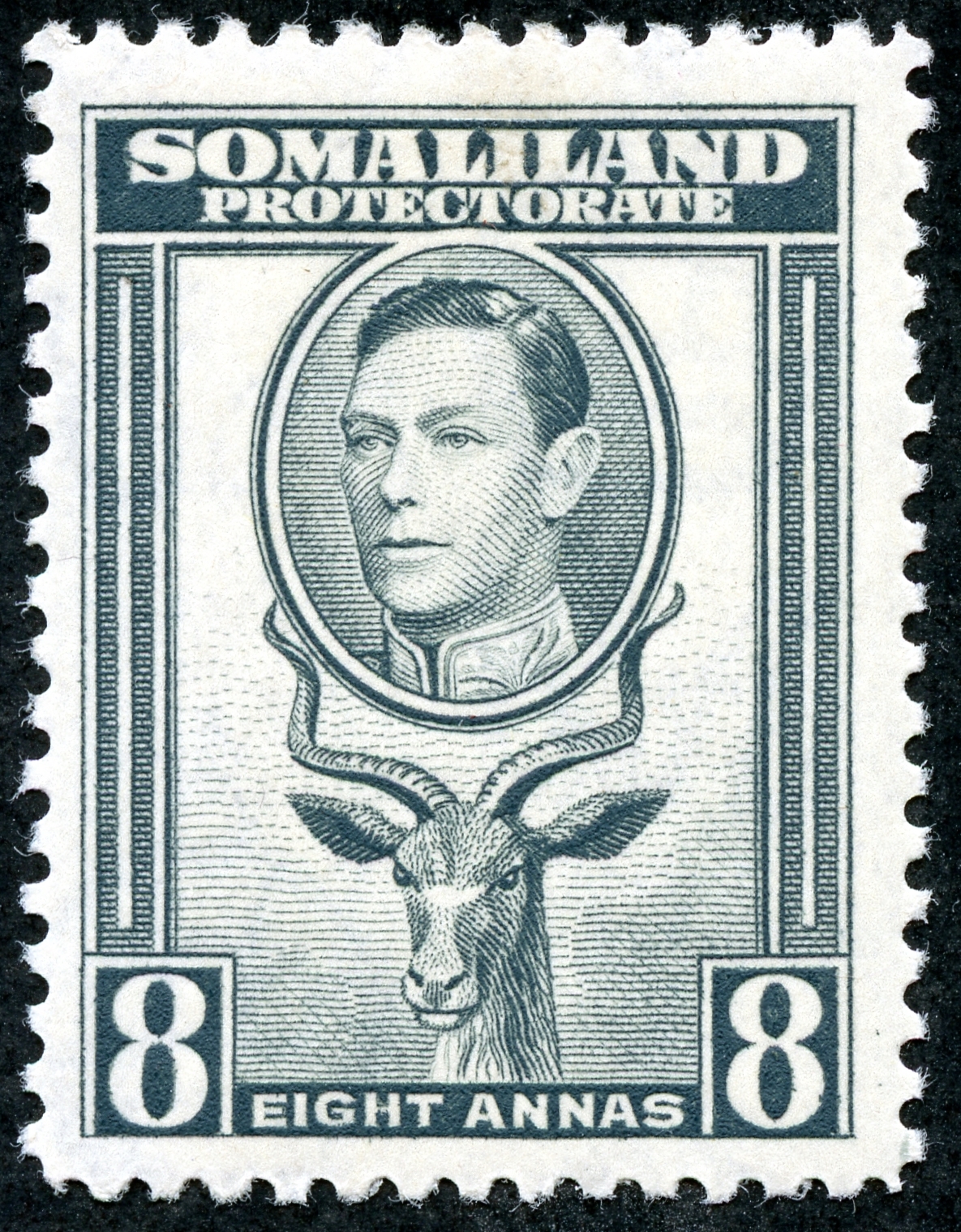
1938 Scott 90 8a gray black
"Greater Kudu"
The key to identifying the 1938 issue is George VI's head: his gaze is looking to his right.

1942 Scott 102 8a gray
"Greater Kudu"
The 1942 issue (twelve stamps) has George VI's gaze more straight ahead (although he still isn't looking at us- why should he?..He is King!).

Japan Additions
100 Mon = 10 Sen
100 Sen = 1 Yen (or En)
10 Rin = 1 Sen

Japan's early stamps, the 1871 issue "Pair of Dragons Facing Characters of Value", the 1872 issue "Dragons and Denomination", and the 1872-73 & 1874-75 issues "Cherry Blossom" are an absolute nightmare for the WW collector because of numerous and excellent forgeries. Do not even consider collecting these stamps without specialty literature on forgeries.

I have the International Society for Japanese Philately monographs on The WADA Cherry Blossom Forgeries (1974- Tyler & Montgomery), The Koban Forgeries of Japan (1979- Wilhelmsen & Tyler), and the SPA handbook Characteristics of Genuine Japanese Stamps Cherry Blossom Issues of 1972-1876 (Varro Tyler).

Frankly, these monographs have been superseded by The International Society for Japanese Philately Forgery CD (All known forgeries up to 2002). 

 One can obtain the Forgery CD for $48, which includes a one year membership in the Society.

"1871 Japan 1 48m brown" WADA Forgery
"Pair of Dragons Facing Characters of Value"
Well, I obtained the CD several years ago, and identified these WADA forgeries.

According to my notes, this stamp (above) is a WADA Plate A forgery, mimicking Plate II.

"1872 Scott 6 1s blue (II) WADA Forgery
"Dragons and Denomination"
And this stamp (above), according to my notes, is a WADA Plate A with Sanko forgery mimicking Plate I.

So, what's the current problem? I can't find the CD! It's buried somewhere in my possessions. When I do, I will elaborate further on why these are WADA forgeries. ;-)

Since the 1871 & 1872 issues have a fairly high CV of $130+ to $650+ for major numbers (minor numbers -mostly shades - are more), a strategy would be to eliminate the plentiful WADA forgeries for these issues by using the CD, and then submitting any remaining genuine possibilities for certification.

1899 Scott 35 5p deep scarlet 
Blue Overprint
Out of the Blue
I hope you enjoyed this little excursion into recent acquisitions.

Note: For more on Gerben van Gelder's magnificent classic era maps, link here. 

Comments appreciated!