
1907 Scott 75 10s red brown, Lithographed
"Ferdinand in 1887 and 1907"
Into the Deep BlueThe 1840-1940 Scott Classic catalogue has, for Bulgaria 1901-1944, 412 major number descriptions. Of those, 354 are CV <$1-$1+, or 86%. Clearly, Bulgaria is inexpensive. There are a few pockets of more expensive stamps, such as the Balkan Games Issues of 1931 and 1933 (14 stamps), where six of them are CV $10+-$400.
We have already posted blogs on Bulgaria (BB Checklist), Bulgaria 1902 Issue, and Bulgaria 1879-1901.
This blog post will look at the 1901-1920 stamp era.
1901-1920 - A closer look
100 Stotinki = 1 Lev (1881)

1901 Scott 66 1 l red orange & bronze green
"Tsar Ferdinand"; Type I
On October 1, 1901, a twelve stamp bi-colored typographed set with a "Tsar Ferdinand" vignette was released. I show the full set in the "Deep Blue" section (scroll down).
These stamps are quite inexpensive for WW collectors today, with eleven @ <$1-$1+.
The 1 Lev denomination has two types.
Type 1 (above) has, for the upper corner "1" numerals, a serif on the right.
These stamps are quite inexpensive for WW collectors today, with eleven @ <$1-$1+.
The 1 Lev denomination has two types.
Type 1 (above) has, for the upper corner "1" numerals, a serif on the right.

1905 Scott 67 1 l brown red & bronze green
"Tsar Ferdinand"; Type II
In 1905, the "Type 1" 1 Lev stamp of 1901 was replaced by a "Type II" stamp: this shows no right serifs on the upper corner "1" numerals. CV is $4.


Ferdinand: Ruling Prince (1887-1908) & Tsar (1908-1918)
Ferdinand had wide ranging interests: Writer, Botanist, Entomologist, Philatelist.
He was known for his affairs/trysts: both women and men.
After WW II, in order to save the monarchy, he abdicated in 1918 n favor of his son, Boris III.
Bulgaria, after surrendering to the Allies, lost all the territory it had gained during WW II, and the territory it had previously won in the Balkan Wars.
Ferdinand would live to see the collapse of the monarchy and the Kingdom.. His son, Boris III, died of a mysterious illness after visiting Hitler in 1943. His grandson, Simeon II, was deposed in 1946

1902 Scott 72 15s blue
"Fighting at Shipka Pass"
The 1902 lithographic three stamp issue, commemorating the "1877 Battle of Shipka Pass", is fascinating, and forgeries abound.
The above 15s blue is genuine however. CV for the issue is $1-$5.
I've published a blog post about this issue.
The above 15s blue is genuine however. CV for the issue is $1-$5.
I've published a blog post about this issue.

1907 Scott 74 5s deep green, Lithographed
"Ferdinand in 1887 and 1907"
For the 20th anniversary of the accession to the throne of Ferdinand, a three stamp lithographic issue was released on August 12, 1907. CV is $1+-$3+.

1909 Scott 85 25s on 30s bister & gray black
Value Surcharged in Red
In 1909, eight previously issued stamps were overprinted ("1909") and surcharged, or surcharged only. CV is very modest @ <$1-$1+.

1911 Scott 91 3s lake & black, Engraved
""City of Trnovo"
In 1911, a twelve stamp engraved issue (many bi-colored), each with a unique portrait or pictorial, was published. Certainly this issue is one of the highlights for Bulgaria collectors.


Trnovo (Veliko Tarnovo)
The medieval town of Veliko Tarnovo is known as the "City of the Tsars".

1913 Scott 109 10s deep red & black
"Ferdinand"; Black Overprint
Commemorating the victory over the Turks in the 1912-13 Balkan War, seven of the 1911 issue stamps were overprinted in various colors on August 6, 1913.

1915 Scott 112 10s on 25s ultramarine & black
"Ferdinand"; Surcharged in Red
The 1911 issue 25s ultramarine & black was surcharged in red as shown on July 6, 1915.
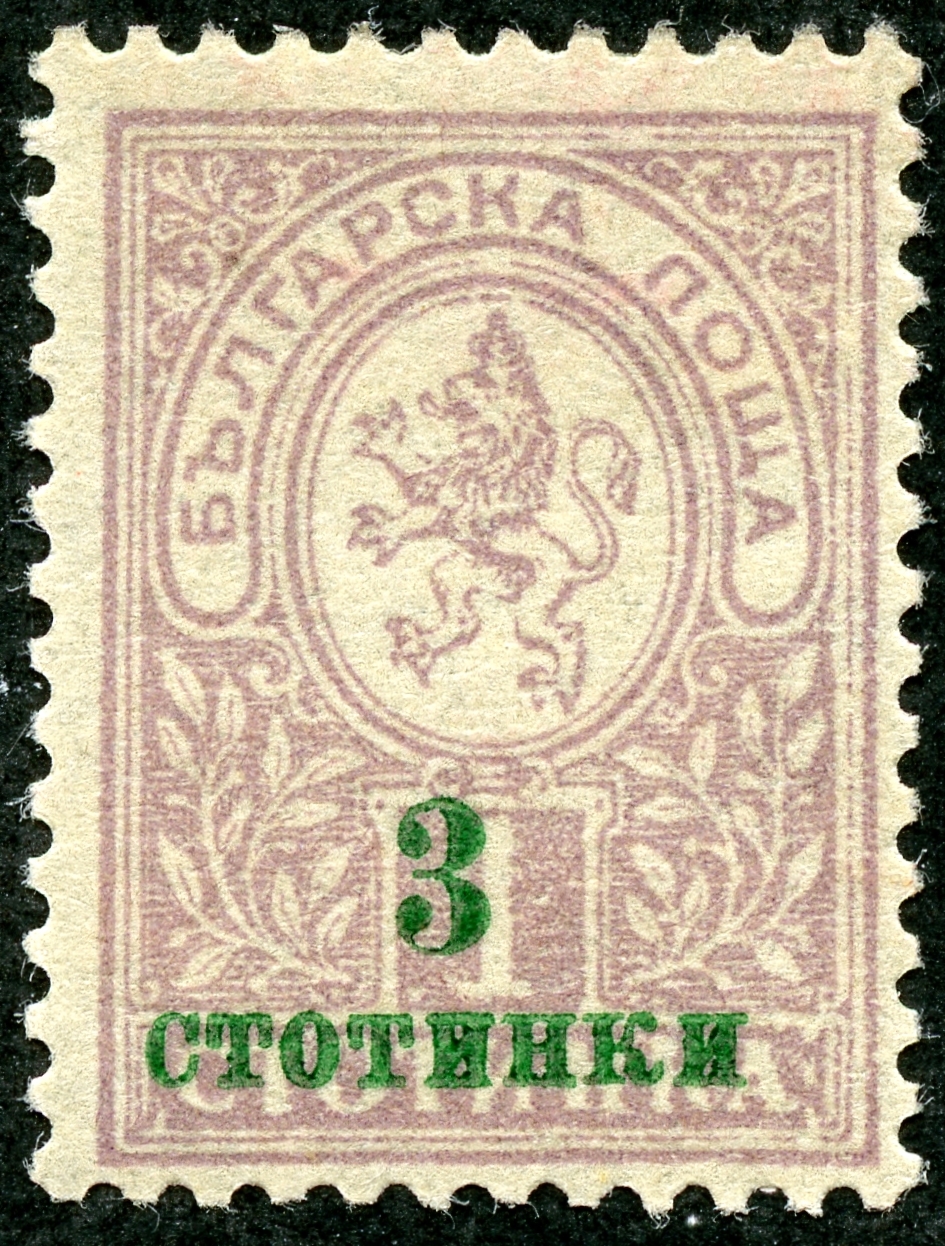
1915 Scott 113 3s on 1889 1s lilac
Surcharged in Green
Also, the 1889 issue 1s lilac was resurrected and surcharged with green ink in 1915.
CV is $4+.
CV is $4+.

1915 Scott 118 25s indigo & black
"Ferdinand"; Types of 1911 Re-engraved
Of interest, in 1915, seven stamps from the 1911 issue were re-engraved with slight design differences, color changes in some stamps, and changes in some stamp dimensions.
Refer to Scott for specifics. CV is <$1 for all stamps in the issue.
Refer to Scott for specifics. CV is <$1 for all stamps in the issue.

1917 Scott 127 3 l claret, Typographed
"View of Gevgeli"
With the "Liberation of Macedonia", six commemorative stamps were released in 1917, with another one (2 l brown orange) in 1919.
Today, the town of Gevelija on the Vardar River is part of the Republic of Macedonia.
Today, the town of Gevelija on the Vardar River is part of the Republic of Macedonia.

1918 Scott 128 1s gray
"View of Veles"
Veles is another river town that is in Macedonia, not in (now smaller) Bulgaria.A bit embarrassing in retrospect.
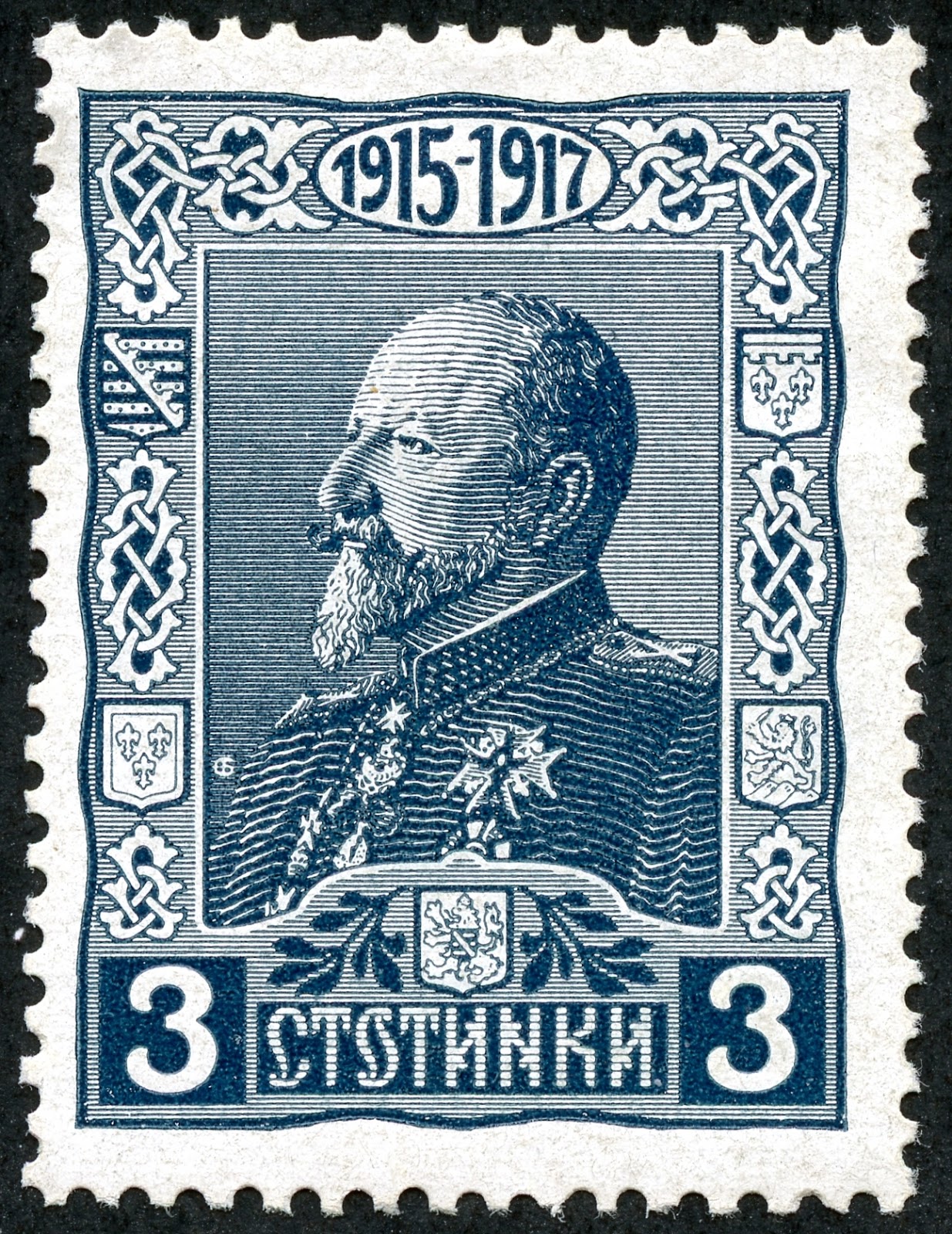
1918 Scott 132 3s indigo
"Tsar Ferdinand"
For the 30th anniversary of his reign, a four stamp set was released on July 1, 1918.
This would prove to be Tsar Ferdinand's last issue, because he was forced to abdicate that October, 1918. (Bulgaria was on the losing side of WW I, and Ferdinand had to go.)
This would prove to be Tsar Ferdinand's last issue, because he was forced to abdicate that October, 1918. (Bulgaria was on the losing side of WW I, and Ferdinand had to go.)

1919 Scott 139 5s green
"Tsar Boris"
On October 3, 1919, a seven stamp typographic set was released for the 1st anniversary of the enthronement of Tsar Boris III (Ferdinand's son). It is rather a poorly produced issue (in looks and execution), but probably reflects the state of post - WW I Bulgaria.

1920 Scott 148 50s dark green
Photogravure; "The Bear Fighter"
On October 20, 1920, a six stamp issue was produced to honor the Bulgarian poet and novelist Ivan Vazov (1850-1921). Of interest, the stamps were produced by photogravure.

1920 Scott B9 2 l + 1 l brown orange
"Demir-Kapiya (Iron Gate)
Semi-postals were issued by Bulgaria on June 20, 1920. They consisted of surcharged regular issues of 1911-20. The ten stamp issue surtax was intended to aid ex-prisoners of war.

1915 Scott J28 50s deep blue
Thin Semi-Transparent paper
Between 1915-1921, there were postage due issues mainly recognized by differences in paper.
All of the postage dues of this era are CV inexpensive (<$1).
The 1915 issue has thin semi-transparent paper (five stamps).
All of the postage dues of this era are CV inexpensive (<$1).
The 1915 issue has thin semi-transparent paper (five stamps).

1919 Scott J30 10s violet
Thicker whiter paper with clean cut perforations
The 1919 issue (five stamps) is on thicker whiter paper with clean cut perforations.

1921 Scott J34 1 l emerald
Thicker paper with rough perforations
The 1921 issue (seven stamps) is on thicker grayish paper with rough perforations.
Deep Blue

1902 "Tsar Ferdinand" Issue in Deep Blue
Deep Blue (Steiner) has 39 pages for the 1920-1944 stamps of Bulgaria. All of the major numbers have a space. Of interest, for the 1919 & 1921 postage dues, which differ by type of paper with some of them minor numbers in Scott, Steiner provides spaces.

1920 Scott 152 5 l deep blue
"The Monk Paisil"
Out of the Blue
And so ends our survey of Bulgarian stamps. Of course, this is merely an introduction. Such is the fate of the WW collector for many (not all) countries.
Comments appreciated!


