A is for Aden and Z is for Zanzabar


A is for Aden and Z is for Zanzibar... Now what is between? For the world wide classical era philatelist and stamp collector, a country specific philatelic survey is offered by the blog author, Jim Jackson, with two albums: Big Blue, aka Scott International Part 1 (checklists available), and Deep Blue, aka William Steiner's Stamp Album Web PDF pages. In addition, "Bud" offers commentary and a look at his completely filled Big Blue. Interested? So into the Blues...

Sunday, July 8, 2012

Greenland

1938 Scott 7 30o blue "Polar Bear"
Quick History
Greenland, an island in the North Atlantic Ocean, was a Danish colony, and a colonial possession of Denmark (along with the Faroe Islands and the Danish West Indies). The Capital is Nuuk ( Godthaab) at 64 degrees north Latitude, about the same latitude as Fairbanks, Alaska (Incidentally, my brother lives in Fairbanks). The population was 16,000 in 1930; about 88% Inuit, and 12% Danes. It is the least densely populated country in the world.

Presently Greenland is an autonomous country within the Kingdom of Denmark.

According to the Icelandic sagas, Erik the Red and his family settled there, and called it "Greenland", in the hope that the attractive name would bring settlers.

The Greenland ice sheet covers 80% of the country. Therefore, the villages and towns are along the ice free coast.

Map of Greenland and the ice sheet
Into the Deep Blue
The 2011 Scott Classic specialized catalogue has nine regular stamps listed for 1938-46, and eleven major number, and seven minor number Parcel Post stamps for 1905-1937. The Parcel Post stamps are CV $60-$700+; rather expensive, I don't have any, and I will say no more about them. ;-)

As mentioned, Greenland only issued a regular stamp set beginning in 1938.

A closer look at the stamps and issues

1938 Scott 2 5o rose lake "Christian X"
Five of the stamps issued in 1938 had the Danish King, "Christian X", on the portrait design. A sixth stamp, with 20 Ore denomination, was issued in 1946. CV is  <$1-$2+ for the stamps.

A rather striking design with the icebergs and ice shelf  in the background.

1938 Scott 9 1k light brown "Polar Bear"
Two of the 1938 stamps show a polar bear among the ice floes. What an attractive stamp! There was an additional 40o "Polar Bear" stamp issued in 1946. CV for the "polar bears" range from $5-$10+.

Deep Blue and Greenland
Deep Blue
Deep Blue (Steiner) has one page for the regular issues (illustrated above), and two pages for the parcel post issues. Of interest, Deep Blue also has a page for a five stamp 1935-38 Thule Local Post set; an issue that is not in Scott.

1938 Scott 3 7o yellow green "King Christian X"
Big Blue
Big Blue '69, on one page, provides spaces for the seven stamp 1938 regular issue. CV for this stamp stamp set is <$1-$5+.

 Checklist

1938
1,2,3,4,5,
7,9,
1938 Scott 1 1o olive black "Christian X"
Out of the Blue
I regret having to stop my collection at ~ 1940, as the Greenland stamp issues are just getting started. ;-)

Note: Map and picture image appear to be in the public domain.

Links
Greenland - Bud's Big Blue

Would like to hear from you!

Village of Ittoqqortoormiit

Monday, July 2, 2012

Four Album "Hermes Head" Cagefight: Scott Greece Specialty, "Steiner", the "Browns", and Big Blue

The Greek "Hermes Heads": the ultimate Album challenge
Quick History
Those of us who collect worldwide classical era stamps love to compare and contrast the merits of  albums for our collections.

I wrote a previous blog comparing three albums, the "Steiner" the "Browns", and Big Blue.

http://bigblue1840-1940.blogspot.com/2011/10/big-blue-browns-and-steiner-three-album.html

But there is more to say. ;-)

Let us meet the current contenders....

A) The Scott "International Postage Stamp Album" , an original five album set covering 1840-1937+, better known as the "Browns" for the color of the cover. A sixth album was added later by Vintage to cover through 1940, and the volumes are still available loose leaf, printed on one side, on good paper, at Subway Stamps.

http://www.subwaystamp.com/prodinfo.asp?number=ZVRW04P1/6

To get a flavor of the scope of the "Browns", here is the quote from the 19th Century Album on the Title page.

"Contains spaces for every principal variety of Postage Stamp issued by any Government in the World during the Nineteenth Century"

Gives me chills.  ;-)

And, if one collects with the "Browns", one is following in the footsteps of the famous collectors of yesteryear. Considering that Scott has not updated the "Browns" for well nigh 70-90 years, it is amazing indeed - and speaks to their pedigree- that the "Browns" are often the choice of collectors even today.

To that point, the author Lawrence Block, who writes a column in Linn's Stamp News detailing the adventures of collecting the classical era, houses his stamps in the "Browns".

But there is a nagging question.

If the "Brown" album has been frozen in time (1919 copyright for the 19th century album), how well will it perform today in a quite challenging area, such as the "Hermes Heads"?

Enter the "Browns", Contender number one......

B) The "Steiner", a PDF album that one can print out on one's own printer, is a favorite of many.

http://www.stampalbums.com/

William Steiner provides 6,500 classic era pages, on through to the whole present world on 50,000 pages. And for a remarkably low subscription price.

I use the Steiner pages for "Deep Blue", the name I chose for my classical collection. Printed on good acid free paper, standard (north american) 8 1/2" X 11" size, housed in off the shelf  heavy duty binders: what's not to like? ;-)

The "Steiner" follows the present Scott catalogue.

But will it hold up with the complicated "Hermes Heads" issues?

Enter the "Steiner", Contender number two....

C) Scott Greece Specialty Album ( First copyright 1961)

The reason I though a comparison of albums for the "Hermes Heads" might be interesting to readers is I happen to have a Scott Specialty Album for Greece that I acquired as a feeder album a while back.

Most (Scott-centric ) collectors are familiar with the Scott Specialty albums for individual countries, as they, more or less, are considered the "Gold Standard" for individual country collecting. (And, of interest, the Scott Country albums actually replaced the "Browns" as Scott's main "serious" album focus.)

But are the Scott country specialty albums beginning to show their age, especially with the nineteenth century descriptions, as they have not ( in this case) been updated for 50 years?

Enter the reigning champion, the Scott Greece specialty album....

D) Big Blue ( Scott International Album, Part I, 1840-1940)

We are familiar indeed with Big Blue, as much of the focus of this blog is taken up with the merits/demerits of this "representative" album.

Its more modest ambition is reflected in the purpose on the title page...

"Provides for a representative collection of the postage stamps of the world, 1840-1940, as well as blank spaces for additional stamps."

Nevertheless, 35,000 spaces is nothing to sneeze at, considering there are very few collectors that have successfully filled all the pages.

So despite its more modest aim, it still deserves the moniker "Big Blue" ;-)

However, considering the heavyweights we have assembled , Big Blue will be relegated to the "exhibition" undercard role here...

A word about other albums, or other approaches to collecting...

I do not have a Global Minkus Supreme, so sadly that venerable album will not be included.  Also, I do not have the Stanley Gibbons Imperial or Ideal albums, so no comparison there either.

Another approach to WW collecting eschews albums altogether, using stock books. A valid approach, but an argument for another day.

1861 Scott 5 5 l yellow green/ greenish "Hermes"
Paris print, Fine Impression
The Hermes Heads
We have recently published a blog on the "Hermes Heads". If you are unfamiliar with these issues, the blog should get you up to speed. ;-)

http://bigblue1840-1940.blogspot.com/2012/06/greece-hermes-heads.html

Suffice to say, the "Hermes Heads" issues are quite complicated, and can require specialists knowledge. But we found that over half of the issues ( including the more modestly priced ones) can be identified by the generalist collector.

But scholarly philatelic knowledge about this issues continues to develop, and that is then reflected in today's Scott Classic catalogue with the present major number descriptions.

How will then the albums do against these formidable stamp issues?

Bottom Line: We will compare/contrast the albums descriptions/spaces against the 58 Hermes Heads stamps (as presently understood).

The reference catalogue will be the 2011 Scott Classic Specialized album (1840-1940). We will use the 2010 Hellas catalogue as a backup reference.

So let's begin Round One, er, issue one....


The "Brown" Scott International: 19th Century Album
Round One

1861 Paris Print Fine Impression (seven stamps): Without Control Numbers (CN) on back except for 10 Lepta. Lines of shading on cheek dotted at the end, clean spandrels. Excellent impression. Scott 1-7

Brown: Spaces/descriptions accurate except for:

1) Has Scott 2a description "2 l  brown buff on buff" as a separate space - now a minor number. In addition, provides a space for major number Scott 2 "2 l olive bister on straw".

Comment: The now minor number Scott 2a must have been considered "major" in 1919.

2) Has description " 5 l emerald green on greenish" rather than Scott 3 "5 l yellow green on greenish'. The "emerald green on greenish" may be minor number Scott 3a "emerald green".

Comment:  Color description changes can be very tricky to determine. Which color were they really asking for?

3) The 10 l space (Scott 7) describes "orange on blue", rather than today's "red orange on blue".

Steiner: Spaces/ descriptions accurate.

Comment: Steiner generally does not give color descriptions for its spaces, unless there could be confusion. The advantage is Steiner will not be antiquated if the color descriptions change. ;-) The disadvantage is there are no color clues here for the spaces. I don't have a problem with this, as I usually have the Scott catalogue by my side; others might though.

Scott Greece Specialty: Spaces/descriptions accurate except for:

1) Has description " 5 l emerald on greenish" rather than Scott 3 "5 l yellow green on greenish". The "emerald on greenish" description today doesn't exactly exist as such, although there is a Scott 3a "emerald green". Of interest, my 1947 Scott has the 5 l "emerald on greenish" color.

Comment: The good news is the Scott Specialty albums always have the major Scott number printed on a space, so there can be little confusion which stamp the Scott is referring to with the description. But it is already clear in Round One that the Scott Greece Specialty album has some "older" color descriptions compared to the present catalogue.

Summary Round One: The Steiner had no faults, the Scott Specialty had one color slip-up, and the Brown had two color slip-ups and a extra space for a now minor number.

Deep Blue (Steiner) and a Greek "Hermes Head" page
Round Two

 1861-62 "Athens Provisionals" Course or Clear Impression  (eight stamps): CN on back except for 1 L, 2 L, 20 L. (Note: The 1 L and 2 L never have CN for any issue.)  CN are very distinct.  Yellowish wash on paper?  CN strongly shaded in the right lines with left lines thin. The 5 L CN is unique. The 80 L CN           was vermilion color, than carmine. Scott 8-15

Brown: Spaces/descriptions accurate except for:

1) "Without Figures on Back - "10 l orange on greenish". I can't find evidence in the catalogues I have that this stamp exists. Not in the '47 Scott either. There is a "10 l orange on greenish" with figures on back (Scott 12), and the Brown does have a space for that variety.

[ Note from Vasilis: the 10 l "without figures on back" probably refers to the "Scott 7 10 l without  figure on back", a proof -No CV given and/or Hellas  4Ba 10 l "orange" without control number -Value 1100 Euros]

Comment: A heavy body blow. It appears this stamp-and space does exist-but Scott labels a "proof", and quite rare.

2) "1 l chocolate on cream" description for today's "1 l chocolate on brownish".

3) "2 l bistre on cream" description for today's "2 l bister-brown on bister"

Comment:  the paper color "cream" description  is now reserved for the later issues, and is one of the distinguishing characteristics.

4) Scott 14b 40 l "red violet /blue" description is now a minor number; the major number color is "red violet/pale blue".


Steiner: Spaces/ descriptions accurate.

Scott Greece Specialty: Spaces/descriptions accurate except for:

1) "1 L chocolate on cream" is today's "1 l chocolate on brownish".

2) "2 l bistre brown on cream" is today's "2 l bister-brown on bister".

3) Describes minor number Scott 13b 20 l "dark blue on bluish" rather than today's major number "blue/bluish".

4) Describes minor number Scott 14b 40 l "red violet /blue" rather than today's major number "red violet/ pale blue".

5) Describes minor number Scott 15b 80 l "dull rose on pink" rather than today's major number "carmine/pink".

Summary Round Two: The Steiner had no faults, the Scott Specialty had five color slip-ups, and the Brown had two color slip-ups and a space for a stamp that is considered a proof by Scott today.


Scott Greece Specialty Album
Round Three

1862-67 "Consecutive Athens " issue (seven stamps): "Fine" CN present, with distinct differences in shading between the left and right sides not infrequently seen. Can be found with ink spots. Image very fine to clear and blotchy.  Relief (raised surface of paper) of white Face portion of design in earlier printings. This underlay used in the printing press was worn away with later printings causing decreased relief.  Spandrels often "fine". Actually a series of printings. More solid color medallion in later printings. Scott 16-22

(Note: the 80 L carmine/pale rose is listed/ described accurately in all the albums, so no further comments are made.)

Brown: Spaces/descriptions accurate except for:

1)  "1 L brown on cream" is today's "1 l brown on brownish".

2) " 2 l brownish bistre on cream" doesn't fit Scott 17a "brownish bistre on bister" or Scott 17 "bister/bister".

3) "10 L orange on greenish" description does not fit any description in today's Scott catalogue. The Brown does have a space for 10 l "orange on blue", which is Scott 19.

[ Vasilis comments that many of the 10 l printings for the "Consecutive Athens" were in fact, on "greenish" paper. Scott  describes Scott 19, 19a, 19c, all with "bluish" paper. No "greenish" paper is listed.]

10 l. Consecutive Athens typical greenish paper
Scan courtesy of Vasilis

10 l. Consecutive  Athens typical back with greenish paper
Scan courtesy of Vasilis

10 l. Consecutive Athens on blue paper
Scott lists blue paper, not green paper
Scan courtesy of Vasilis

Comment: A space with nowhere to go in today's Scott catalogue.  But, Vasilis's observation -and scans-indicate that the Scott catalogue is wrong.

4) Scott 20c 20 l "blue on greenish",a minor number, is given a space in the Brown. The major number "blue on bluish" also has a space.

5) "40 l red violet on blue" is today's "red lilac on blue".

6) Scott 21b 40 l "lilac brown on lilac gray" ,a minor number, has a space rather than the major number color "lilac/blue".

[Note: Vasilis points out that this lilac-gray or "grey-lilac" paper is a major number in Hellas (Hellas 20 II), and probably should be a major number in Scott also. So the fact the Brown offered a space for this is prescient indeed.]

Here are some scans of Vasilis that illustrate the different shades for the 40 l Consecutive Athens...

Consecutive Athens Hellas 20Ib Mauve on Blue
Scan courtesy of Vasilis

Consecutive Athens Hellas 20IIa greyish rose on grey lilac
Scan courtesy of Vasilis

7) "40 L salmon on greenish" space and color doesn't exist today.

Steiner: Spaces/ descriptions accurate.

Scott Greece Specialty: Spaces/descriptions accurate except for:

1)"1 l chocolate on cream" doesn't quite fit either Scott 16b "1 l chocolate on brownish" or Scott 16  "1 l brown on brownish".

2) "2 l brownish bistre on cream" doesn't quite fit either Scott 17a "brownish bister on bister" or Scott17 "bister/bister".

3) "10 l yellow orange on bluish" is now minor number Scott 19a, rather than major number color "orange/blue".

4) "40 l red violet/blue" is now "red lilac/blue".

Summary Round Three: The Steiner had no faults, the Scott Specialty had four color slip-ups, and the Brown had four color slip-ups, and a minor number is given a space ( But arguably the minor number space  deserves a  major number). Further, the Brown has two space denominations and color descriptions that cannot be found in the Scott catalogue . (Interestingly, the Brown is no doubt "right" about the "greenish" paper. But we are playing under Scott catalogue "rules" ;-) The Brown is beginning to stagger, and the Scott Specialty is getting tired.


1872 Scott 40 10 l red orange/greenish with "speckles" showing
Round Four

1868 (1868-69, 1873 (80 L))  "Cleaned plates" issue (seven stamps): CN present. More broader, flat appearance of Head because of absence of relief. More even shading of CN. Can be found with inverted "Zero" on CN. Also 80 L has CN with "0" thicker or heavier than "8". "Bright" appearance of spandrels. The medallion might have white grains or spots.  Grid with number cancellations are found with "cleaned plates" and earlier issues- although possible out to 1872. Scott 23-28

Brown: No spaces exist for the 1868 "cleaned plates" issue!
The Brown is down!!!   The Brown is down!!!  1...2.....3....4....5....6...

Steiner: Spaces/ descriptions accurate.

Scott Greece Specialty: Spaces/descriptions accurate except for:

1) "1 L reddish brown on cream" is a  different description than today's Scott 23 "1 l gray brown/brownish".
[ Note: Vasilis points out that the Hellas catalogue does have 23a, a "deep red brown" shade.]

Comment: Scott no longer lists the shade, although it is recognized in the Hellas.

The Referee has stopped the Cage fight! It is over in the fourth round! A quite early and unanticipated end to a scheduled 10 round ("Hermes Head" issue) battle.....


The Brown has spaces for 14 "Hermes Heads" perforated stamps
Scott has since removed them from the catalogue
Analysis

So what went wrong? While we wait for the Judges decision, lets do a bit of analysis.

The "Brown": There has simply been too many changes in the catalogue over the past 90 years. Those changes, which reflect modern interpretations of the Hermes heads issues, makes the Brown's "Hermes Head" section painful to use for the collector.

One further note. The Brown has a section for 14 perforated "Hermes Heads" stamps. According to the 1947 Scott, "Stamps previously listed, 11 1/2 perforation, have been omitted as these values were not officially perforated".

Scott Greek Specialty: The collector needs to be wary of the color descriptions for a particular Scott number. Many have changed since the 1961 copyright date. ( I doubt if the early Greek pages "color descriptions" have been altered by later editions, unless Scott completely reedited these pages.)

Steiner: Steiner gets through the rounds without a mark, but of course, many of the demerits were given for wrong color descriptions, and Steiner generally doesn't supply them. ;-)
So do they get credit for that? ;-)


Big Blue "Mark-up" album
Note eight spaces and one line for the "Hermes Heads"
Big Blue Exhibition Round
If the collector is not particularly interested in parsing all the "Hermes Heads" issues, then Big Blue will be welcomed indeed.

Here is what Big Blue includes...

1861-82
1 L (illustrated): 1 or 8 or 16 or 23 or 30 or 32 or 38 or 43*
2L "bistre": 17 or 44*
5L "green": 11 or 18 or 25 or 34 or 39 or 45 or 53*
10L "orange": 12 or 19 or 46 or 54*
20L "rose": 56a or 56
20L "ultramarine": 47* or 55
30L "dark brown": 51
80L "carmine": 15 or 22*

Clearly, Big Blue wants no part in the subtleties of the LHH issues, and, apart from color criteria, many of the LHH issues can be mounted.

Of interest, none of the most economical choices for the LHH reach the $35 threshold. The spaces can be filled for CV $8+-$30.

Scott Greek Specialty album
Note: Not all the "Hermes heads" are mounted properly in this pic
Out of the Blue
So the verdict?

Why that is up to you and me and our own needs and opinions!  ;-)

A couple of closing comments....
The Steiner did well, but then again the Steiner doesn't provide any color descriptions. The Steiner really shouldn't get credit for "absence" of information. ;-)

But where the Steiner shines is with the contemporary Scott catalogue. In conjunction with the Scott, it is quite clear where the stamps belong.

The Scott Greek Specialty album is quite nice (good paper, larger format than Steiner, sturdy album binder). Since the Scott numbers are inscribed in the space, there is no doubt where a particular stamp belongs. So the album remains the "Gold Standard", albeit a bit tarnished, as long as one is aware that the color descriptions are often dated.

The "Brown" did not come off too well in this particular contest, but all is not lost.  This was probably the worst case scenario with the quite complicated Hermes Heads. If I was using the "Browns", I would probably substitute the "Steiner" pages here.

And a thanks to Vasilis (See comment section) for the analysis and corrections-and scans illustrating the points. It appears the Scott catalogue still doesn't have the Hermes Heads quite "right". ;-


Realistically, if one wished to do the "Hermes Heads" justice, using the Hellas catalogue as the primary catalogue would be prudent.

I hope you came away with a little more information about album possibilities for a worldwide classic era collection.  And, I hope the "fight" analogies weren't too offensive; I rather enjoyed it, ;-)

Comments?

Please do!


Tuesday, June 26, 2012

Greece- Air Post, Postage Due, Postal Tax, Balkan Wars

1912 Scott N154 5 l green "Cross of Constantine"
1912 Campaign
Quick History
This post will review the "back of the book" issues of Greece: namely  Air Post, the Postage Dues, the frequently used Postal Tax category, and the many stamps issued for "New Greece", the territory acquired during the Balkan Wars.

In 1912, the Balkan League (Greece, Montenegro, Bulgaria and Serbia) attacked Turkey as much of their respective ethnic populations remained under Ottoman dominance.

The source of the Balkan wars conflict 
Different ethnic groups  wanting their own autonomy
Seven months later, Turkey had lost all of its holdings in the Balkans with the signing of the Treaty of London. But Bulgaria was not happy with their apportionment, and the second Balkan war ensued. With Macedonia, Serbia, Greece, Romania, and Turkey all aligned against it, Bulgaria lost most of the territories gained during the first Balkan war.
Territorial acquisitions after the first and second Balkan war
A highly successful result from the Greek perspective added territory from the Aegean islands, Thessaly, Epirus, Macedonia and Thrace. Consequently, overprinted/surcharged  Greek stamps were used in the territory, called 'New Greece", until the lands could be fully absorbed into Greece.

1933 Scott C6 100d deep blue "Zeppelin over Acropolis"
Into the Deep Blue
The 2011 Scott Classic catalogue has 47 Air post, 88 Postage dues, 65 Postal tax, and 272 occupation and annexation major stamp descriptions. Of those, 22 (47%) Air post, 52 (59%) Postage dues, 49 (75%) Postal tax, and 116 (43%) Occupation and Annexation stamps are CV <$1-$4.

What is interesting about the Greek "back-of-the-book" categories is the frequent use of Postal tax stamps, and the large number of occupation/annexation stamps because of the Balkan wars.

A closer look at the stamps and issues


1926 Scott C4 10d multicolored 
"Flying Boat seen through Colonnade"
Air Post initially was provided by the "Italy-Greece-Turkey-Rhodes" route, a service provided by "Aerospresso Italiana", as a contract with the Greek government. There were four "Patakonia" stamps issued  with CV between $1+-$20+. Quite a striking "Mediterranean" design. ;-)

1933 Scott C7 120d dark brown "Zeppelin over Acropolis"
A three stamp "Graf Zeppelin" issue was produced in 1933. The stamps were issued by the firm "Aeroespresso Italia" on the occasion of the Graf Zeppelin LZ-127 flying from Germany to Rome to Rio de Janeiro. There was a flight from Athens that brought the mail to the airship via Rome. Of interest, the firm had the rights to put the unsold quantities after the flight onto the philatelic market. They must have done all right, because today the stamps have a CV of $10+-$50+.

1933 Scott C13 20d black & green 
"Head of Hermes and Airplane"
Also, in 1933, another issue was produced by the firm that had seven stamps, CV <$1-$4 for six of them. To my eyes, this is a quite striking issue, as the example above will attest. ;-)

1933 Scott C17 2d violet 
"Airplane over Map of Icarian Sea"
The Greek government General Air Post Service then became operational, and the above example is from the seven stamp issue. CV ranged from<$1-$5+ for five stamps.

1935 Scott C29 50d violet
"Bellerophon and Pegasus"
A nine stamp 1935 (CV $1-$7+) and a five stamp re-engraved 1937-39 (CV<$1-$3+) issue with designs featuring Greek mythology was then produced. The beautiful classic images on this stamp set are just stunning!

1875 Scott J5 20 l green & black
1876 Scott J30 40 l green & black
The early Greek postage dues have these similar designs which can confuse. The second issue 1876 Postage Due has "Lepton" or "Lepta" in larger Greek letters. 

The 1875 issue has different various perforations, and has 24 stamps. Eleven of the stamps have CV of $1+-$7.

The 1876 issue again comes in various perforations, and also has 24 stamps. Ten stamps range from CV $1+-$7.

1902 Scott J52 5 l yellow green wmk 'Crown & E T"
1913-26 Scott J67 10 l carmine engraved unwmk
1930 Scott J80 1d light blue lithography unwmk
Three issues were then produced with the same design. They vary by perforation, watermark, and engraved/lithographed.

The 1902 issue had 14 stamps, all engraved except for the 2d,3d, and 5d values that were lithographed. CV is an inexpensive <$1 for 10 stamps, with three more from $1+-$4. One clear difference is the 1902 issue is the only one watermarked.

 Wmk 129- "Crown and E T"
Found with the 1902 issue postage due
The "Crown and E T" watermark is quite striking, and should not be a problem to identify.

The second production, the 1913-26 Serrate Roulette 13 1/2 stamps, are engraved, and have sixteen stamps in the issue. CV ranges from <$1-$1+ for fourteen stamps. Colors are somewhat different for this issue. Since these stamps are engraved, the "aluminum foil-pencil eraser" test can be done to confirm.

The 1930-(35)  issue, 10 stamps, is lithographed, and is also in different colors. CV is at minimum catalogue value for 9 stamps.

1914 Scott RA1 2 l red 
"The Tragedy of War"
The first "Charity stamp", found in the catalogue under Postal Tax stamps, was intended for helping families of the Balkan war victims. Although  inexpensive (<$1), what a striking- and sobering- design.

What is the difference between Semi-Postals (often used in other countries to raise charity funds), and Postal Tax stamps?   Postal Tax stamps are mandatory for a fixed time period on all postal correspondence.

1917 Scott RA3 1 l on 1 l; RA6 1 l on 3 l: note thinner letters on 3 l
Surcharges on the "Flying Hermes" set
Imposed by the Athens government during the "National Schism"
During the "National Schism" the Athens Royalist government required that all postal correspondence have  surcharged "Flying Hermes" stamps applied. This eleven stamp set has a very modest CV of <$1-$2+ for all save one. Note that some of the surcharge overprints are in thinner script.

1917 Scott RA31 5l on 50 l violet "Victory"
Surcharged on Revenue stamps
Other stamp issues were likewise surcharged during the National Schism. The example above has the surcharge on a Revenue stamp.

1934 Scott RA49 10 l blue green, orange & buff "Health"
1935 Scott RA53 20 l ultra, orange & buff
1939 Scott RA64 50 l brown & buff
The use of these stamps was obligatory in the mail  four weeks each year, including Christmas, New Year, and Easter. These stamps, which were for the benefit of postal workers who had tuberculosis, were also required on Parcel Post at all times.

The above image shows the 1934 set (Three stamps CV <$1), the 1935 set (Three stamps CV <$1), and the 1939 stamp (CV<$1).

1937 Scott RA 55 & RA55a 50 l violet; RA57 with green OP
These are Social Welfare Fund overprints, not Red Cross overprints. And herein lies a story. ;-)

The first stamp (left) was printed in 1937. There then was the discovery that some of the OPs were inverted (Center). To prevent a philatelic bonanza, many more of the inverted OPs were issued. Today the regular OP is worth slightly more (25c) than the inverted OP (20c). 

But the International Red Cross organization protested that their symbol was inappropriately used on these stamps, as these are not "Red Cross" charity stamps. Hence the "green" red cross stamp (right) was issued.


Lemnos 1912 Scott N33 1 l green (Lithographed)
1912 Scott N38 3 l vermilion (Engraved?)
1912 Scott N50 5 l green (Lithographed)
During the Balkan wars, these stamps were intended for use on Lemnos. The fact that there was a specific overprint for Lemnos shows how important and  strategic the Island was considered.

There were overprints in black (20 stamps; CV for14 stamps <$1-$2+) and overprints in red ( 17 stamps; CV for 10 stamps <$1-$4+). The overprints can be found on either engraved or lithographic varieties, or both.

Now Scott does have a cautionary note about plentiful counterfeits. I noticed the 3 l vermilion (illustrated) is only known engraved. Yet my stamp is lithographed. ;-(   !  Quite suspicious.

1912 Mytilene (Lesbos) Scott N58 20pa rose
overprinted on stamps of Turkey
For use on Mytilene (Lesbos), 20 Turkish stamps were overprinted as illustrated. The overprint can be found reading both up and down. CV ranges from $2-$5+ for eight stamps.

Samos 1912 Scott N81 1 l gray "Hermes"
The island of Samos were issued both regular and overprinted stamps (14 stamps) during the Balkan wars, and setting up the provisional government. CV ranges from $1-$7 for eleven stamps.

1912 Scott N109 20 l red lilac
Overprinted "Greek Administration"
For the parts of Turkey newly occupied by Greece (New Greece) that were to be incorporated into Greece, the overprint - "Greek Administration"-was initially used. Here is the overprint on a "Flying Hermes" stamp.

1912 Scott N111 2 l carmine rose (engraved)
Scott N128 10 l carmine (lithographed)
Scott N138 50 l dull violet with red overprint (engraved)
The "Greek Administration" overprinted stamps include both 1911-21 engraved and 1913-23 lithographed series in both black and red varieties (39 total). Twenty two stamps are CV <$1-$3+.

1912 Scott N153 3l orange "Eagle of Zeus"
"Campaign of 1912"
These stamps were only intended for use in New Greece, and included Macedonia, Epirus, and some of the Aegean Islands. The other design is the "Cross of Constantine" which is found at the post header. CV for these 16 stamps ranges from <$1-$4 for 10 stamps.

Deep Blue
Deep Blue (Steiner) has 40 pages for the "back-of-the-book" categories, and follows the Scott catalogue exactly.

1915 Scott RA2B PT1a (5 l) dark blue & red
"Red Cross, Nurses, Wounded and Bearers"
Big Blue
Big Blue '69, on four pages, has 30 spaces for Air post (64%), 14 spaces for Postage due (16%), 24 spaces for Postal tax (37%), and 26 spaces for occupation/annexation stamps (9%).

If one checks the "affordability" index for these categories....

22  Air post, 52  Postage dues, 49  Postal tax, and 116  Occupation and Annexation stamps are CV <$1-$4.

 It appears BB is generous with coverage of Air Post. The other categories? Not so much. ;-)

Comments:
A) Interestingly, BB includes the three stamp Air Post "Graf Zeppelin" issue.

1933 Scott C5 30d rose red ($10+)
1933 Scott C6 100d deep blue ($52+)
1933 Scott C7 120d dark brown ($52+)

The 120d dark brown was CV $1.50 in my '47 Scott catalogue. According to the U.S. Inflation calculator, http://www.usinflationcalculator.com/ , the cost is equivalent today to $15.43. So indeed the price of the stamp(s) are higher than the inflation rate price.

B) Forced by a (vertical) blank space choice, BB also includes the 1933 (Scott C14) 50d deep brown & deep blue ($50 mint). Contrary to usual form, BB gives the entire set (seven stamps) a space!

C) Besides the above listed stamps, BB also includes six more stamps ($10+-$30) that are rather expensive. All are Air post, save for one postage due. The group is detailed after the checklist.

D) BB is up to its old tricks:  including the 1902-13 postage due issues, but excluding the cheap 1913-26 and 1930 issues. Since there is a very good chance the collector will have some of these stamps, either put them on a separate page, or change Big Blue's dates. ;-)


Simple Checklist

Air post
1926
C1,C2,C3,C4,

1933
C5,C6,C7,

1933
C8,C9,C10,C12,
C11,C13,(C14),

Next page

1933
C15,C16,C17,C19,
C18,C20,C21,

1935-37
C22,C23,C28,C30,
C24,C25,C26,C27,C29,

Next page

Postage Due
1875-78*
J1 or J13, J2 or J14, J3 or J15, J4 or J16, J5 or J17, (J8),(J21),

1902-13*
J49,(J50),(J51),(J52),(J53),(J54),(J56),

Occupation stamps

Lemnos
1912
N17,N18,N19,N20,N21,N22,N23,

Samos
1912
N76,N77,N78,N81,N82,N83,

Turkey
1912
N110,N111,N112,N113,N114,N115,N116,
N150,N151,N153,N154,N155,N156,

Next page

Postal Tax stamps
1914
RA!,RA2,

1917
RA17,RA18,

1917
RA3,RA5,RA7,RA8,RA9,(RA10),(RA12),

1924
RA47,

1922 (actually 1918)
RA45,RA46,

1934
RA48,

1934-37
RA49,RA50,RA51,RA55,RA57,RA56,

1939
RA61,RA62,RA63,

End

Comments
A) Expensive stamps ($10 threshold):
1926 Scott C2 3d multicolored ($10+)
1926 Scott C4 10d  multicolored ($10+)
1933 Scott C5 30d rose red ($10+)
1933 Scott C6 100d deep blue ($52+)
1933 Scott C7 120d dark brown ($52+)
1933 (Scott C14) 50d deep brown & deep blue ($50 mint)
1933 Scott C20 50d violet ($20)
1933 Scott C21 50d dark brown ($30)
1875-78 (Scott J21) 80 l green & black ($10+)

B) A (  ) around a number is a suggested blank space choice.

C) * 1875-78 Postage due: I elected to include both the D1 and D2 designs as choices, even though the illustration cut is D1. The dates specified by BB includes both D1 and D2 designs.

D) *1902-13 Postage due: BB is quite clear it is asking for the 1902-13 series Postage due. Unfortunately, that excludes the 1913-26 issue and the 1930 issue.


Samos 1912 Scott N83 10 l rose
Out of the Blue
I like Greek issues so much that, if I was not committed to collecting the 1840-1940 world, Greece would be high on my list for specialization. :-)


Note: Maps appear to be in the public domain.

Drop me a comment!

Wednesday, June 20, 2012

Greece 1896-1940

1896 Scott 122 25 lepta red "Chariot Driving"
1st International Olympic Games of the Modern Era
Quick History
The recent history of Greece, at least "recent" compared to the glorious history of ancient Greece, is reflected in the stamp issues of 1896-1940.

The 1896 Summer Olympics were the first international sporting games held in modern times. It was considered a huge success, and the expenses for the games was paid for by philatelists, at least in part, by a hugely popular Olympic stamp issue. More about that soon.

The second major event, again reflected in many overprinted stamps, was the Balkan Wars of 1912-13 against Turkey, and then their erstwhile ally Bulgaria, in which Greece acquired considerable territory and population. This will be discussed in more detail with the next blog.

The third major event is known as the "National Schism". The basis of this division between Greeks was whether Greece should enter World War I, and where the support would lay.

Prime Minister Venizelos and King Constantine during happier times
King Constantine's sympathies lay with Germany. Constantine had been educated in Germany, and admired Germanic culture. Queen Sofia was the sister of Kaiser Wilhelm II. But outright joining the Central Powers was not an option because Greece's traditional enemy, the Ottoman Empire, was on the German side. He therefore wanted Greece to remain neutral.

Prime Minister Venizelos believed that the best interests of Greece were served by joining the Allies. In December, 1915, Constantine forced Venzelos to resign, and he went back home to Crete.

But a second provisional government of Greece was set up, based in Thessaloniki, and Venizelos returned to lead the provisional government with the backing of the Allies. In 1916, the royalist Athens based government overprinted Greek stamps to prevent the provisional government from using them. In 1917, the provisional Venizelist Government of National Defence printed a new issue.

In June 1917, after threats to bomb Athens, King Constantine left Greece and Venizelos took control of the government and pledged support for the Allies.

The deep conflict between the Royalists and the Venizelist Liberals left a bitter taste which persisted for decades. It clearly was one of the major reasons the Republic collapsed in 1935 with the Monarchy (via referendum) brought back. Then in 1936, the 4th of August Regime assumed dictatorial powers, under Ioannis Metaxas. 

1906 Scott 191 30 lepta dull purple "Wrestlers"
Into the Deep Blue
The 2011 Scott Classic specialized catalogue has 240 major stamp descriptions for the regular issues between 1896-1940. Of those, 200 are $4 CV or less. "Affordability" is 83%.

A word about 1896-1940 Greek stamps: Classic  ;-)  Greece has fully exploited it's rich heritage with stamp portraits and themes based on Greek mythology. There is a reason why Greece is a popular philatelic country among collectors.

A closer look at the stamps and issues

1896 Scott 118 2 lepta rose "Boxers"
To help defray the cost of the 1896 Olympic Games, a twelve stamp commemorative set was issued. These attractive designs of course portrayed scenes and images from the ancient Olympic games.

1896 Scott 123 40 lepta violet 
"Vase Depicting Pallas Athene (Minerva)"
The issue, printed by the National Printing House of France, was, by any measure ,a popular success. The issue was first put on sale on March 25, 1896, the first day of the Olympic Games. Initially, according to the Hellas catalogue, the issue was only going to be sold during the games. But, in fact, the set remained on sale until the higher values were finally sold out in 1900.

Today, seven stamps are available for CV $3-$10+. The two higher values ( 5d,10d) are $500+.

1990-01 Scott 159 5 l on 1d blue "Stadium and Acropolis"
"A M" = "Axia Metalliki", or "Value in Metal (gold)"
The devaluation of the drachma required payment of international postal rates in gold drachma during 1900-01. Stamps were surcharged "A M", or "Metal Value". The gold currency stamps, such as the surcharged 1896 Olympic Games stamp illustrated above, were usually used for parcel post and foreign money orders.

1901-10 Scott 168a 5 lepta green  type I "Flying Hermes"
In 1901, the first new definitive issue since the "Small Hermes" was introduced. This 14 stamp issue is known as the "Flying Hermes". The 5 lepta green is shown above. The 5 l can be found in two types depending if the letters of "ELLAS" are outlined at the top and left  (type II) or not (type I).

Seven of the stamps can be found at minimum catalogue value, with another four up to $3 CV.

1906 Scott 195 2d rose "Foot race"
Capitalizing on the popularity of the 1896 Olympics, a Greek Special Olympic Games was held in Athens in 1906, with, naturally, another Olympic themed stamp issue.

This fourteen stamp issue from Perkins, Bacon & Co., again was quite popular. Today ten stamps are CV <$1-$3+. This issue has the watermark "Crown & E T".

1911-21 Scott 209 2d vermilion "Hermes Carrying Infant Arcas"
An engraved five design, sixteen stamp issue
In 1911, a new engraved definitive set was introduced with designs from Cretan and Arcadian coins of the 4th Century, B.C. The set is interesting, but clearly confusing to many collectors (to be discussed shortly).

The CV for the issue finds 9 stamps @ <$1, and another 5 stamps between $1+-$4.

1922 Scott 229 5l ultramarine "Hermes Carrying Infant Arcas"
A 1913-23 lithographed five design eighteen stamp issue
The confusion arises for collectors, as, to reduce costs during the Balkan Wars, an eighteen stamp issue was also produced with the same designs and colors by the cheaper lithographic method beginning in 1913.

Now how easy is it to tell the difference between an engraved and a lithographic stamp?

Engraved: 1911-21 Scott 198 1 lepta green "Hermes"
Lithographed: Scott 214 1 lepta green
Above is the 1 lepta stamp from both the engraved and lithographed issues. Although there are visual differences between the two printing techniques (otherwise why bother with the more expensive engraved stamp) , a cursory inspection will not necessarily yield the right answer.

Let me tell you my experience. ;-) I was transferring the two issues from a feeder Scott Specialized Greece album into the Deep Blue (Steiner) album, and. thinking the previous owner was no doubt somewhat of a specialist in Greek stamps, I would check the printing type after I had finished.

When I got around to doing the evaluation, I had quite a surprise. Of the "engraved" stamps, 10 out of the 15 stamps I had placed were in fact lithographic stamps! And I found an engraved stamp among the lithographic issue spaces. So confusion indeed!

Well, how does one tell the difference?

Lithographic- the stamp to the touch is smooth as a baby's skin. The stamp on appearance may seem more "superficial" than the engraved variety. Perhaps less fine detail, but that is quite variable.

Engraved, or "recess printed"- one actually will find recesses or ridges on the stamp.
A) View the stamp. Not uncommonly, one will spot an elevation (ridge) or a recess on an engraved stamp either from the front or back.
B) Touch the surface of the stamp with a finger. One should feel some ridges. This is a quick way to evaluate a group of stamps, and sort the lithographic from the engraved varieties.
C) The aluminum foil technique. (Reynolds Wrap or other aluminum foil)
Put the stamp down on a hard surface face up. Cover the stamp with a (larger) square of aluminum foil. While holding the aluminum foil down, rub over the foil covered stamp with a pencil eraser until one sees the perforations around the stamp. Look at the foil. There should be a partial or full imprint of the stamp on the foil if the stamp is engraved.

A picture is worth a hundred words...

The engraved 1921 10d deep blue with image left on the foil
A couple of comments...
1) If you rub, concentrate more on the lower portions of the stamp,as a hinge mark or hinge might leave an indentation in the foil and possibly confuse. Also, if you use the touch method, a hinge divot or remnant might create a false impression.
2) One can always use the aluminum foil technique if one is unsure after visual/tactile examination.
3) I doubt if the thickness of the aluminum foil makes a difference-I have "heavy duty", and it still works fine.
4) A little practice goes a long way. After a couple of tactile exams or aluminum evaluations, one can quickly discern the difference between the two printing methods.
5) I've said nothing about how a stamp is engraved or lithographed. The Scott catalogue has an explanation.

1916 Scott 241 40 lepta indigo "Iris holding Caduceus"
"National Schism": Athens Royalist government overprinting stamps
The "National Schism" is clearly reflected in the stamp issues. In 1916, the Athens Royalist government overprinted a "E T" ((Hellenic Posts) and the Greek crown on some of the preceding "engraved" and "lithographic" issues. The eighteen stamp issue has 13 stamps with CV <$1, with the most expensive of the rest @ $4+.

1916 239a 25 lepta ultramarine, lithographed
1913 Scott 221a 25 lepta blue, lithographed
The image above shows the 25 lepta stamp of the lithographed series can be found in different colors. But the other reason I'm showing this is because, in 1926, the 25 lepta, the 40 lepta, and the 1 drachma were lithographed in Vienna with new engraving plates. In this case, the primary difference with the new Vienna engraving is that both ends of the right numeral "5" is shorter compared to the earlier Corfu printing. I though I might have one with the right hand stamp, but no such luck. ;-) The Hellas catalogue has a wonderful one page illustrative layout of the differences in the printings for the three values. The Scott catalogue mentions the 1926 engravings, but doesn't even give them a minor number. I can't help but think if this difference was found in a U.S. stamp, Scott would given these stamps major numbers with alacrity.

1917 Scott 251 10 lepta rose "Iris"
"National Schism": Thessaloniki Venizelist Provisional government
An eleven stamp issue with the above design was produced by the Venizelist provisional government. CV is <$1 for 5 stamps, and $1+-$3 for 3 more stamps. What a gorgeous socked-on-the-nose cancellation for this stamp!

1923 Scott 262 1d on 1d ultra (Greece  stamp, 1913)
1923 Scott 267 5 l on 3 l orange (Occupation of Turkey stamp, 1913)
1923 Scott 277 10 l on 10 l red (Crete stamp, 1900)
1923 Scott 291 5 l on 5 l green (Crete stamp, 1909-10)
In 1923, some 63 stamps from previous issues, including occupation of Turkey stamps (1912 campaign) and Crete stamps as illustrated above, were surcharged. The overprint says "Revolution of 1922", and was printed on orders from the "new" revolutionary government in power at the time. I would think that pretty much exhausted any old stamp issues laying around the government post offices. ;-)

1927 Scott 334 25d green & black "Acropolis"
Part of a fourteen stamp definitive issue
In 1927, a new definitive issue was introduced consisting of "Landscapes". The issue was in post offices, at least in part, until 1939. It was greeted by mixed reviews as the double recess plates printing process resulted in sometimes shoddy output. CV for ten stamps is <$1.

1928 Scott 339 4d dark gray blue "Battle of Navarino"
In 1927-28, a six stamp set was released to honor the centenary of the naval battle of Navarino. CV is <$1-$10+. This battle occurred during the Greek War of Independence when an Ottoman and Egyptian armada was defeated by the naval forces of France, Great Britain, and Russia. It is a naval historic milestone, as it was the last battle fought entirely with sailing ships.

1930 Scott 351 15d yellow green "Dionysios Solomos"
"Heroes" issue for Greek Independence Centenary
Using the combined forces of Perkins, Bacon & Co. (9 stamps), and Bradbury,Wilkinson & Co. (9 stamps), a monstrous "Heroes" and Pictorial scenes issue was produced in 1930 for the centenary of Greek independence. Eleven stamps are CV <$1, while two more are $1+-$3.

1927 Scott 328 1d dark blue & bister brown type I
1931 Scott 365 1d dark blue & orange brown type II
1933 Scott 366 1d dark blue & orange brown type III
In 1931, and again in 1933, the "Landscapes" definitive 1d was re-engraved. One might want to enlarge the image for a close look at the differences in engraving.
Type I: Greek letters "L,A,D" has pointed tops, Numeral "1" is 1.5 mm wide at the foot, Rho (uppercase P) has a small opening in the center of the Rho (uppercase P).
Type II: Greek letters "L,A,D" have flat tops, numeral "1" is 2.0 mm wide at the foot, Rho (uppercase P) has a larger opening in a semi-circular shape.
Type III: Greek letters "L,A,D" has pointed tops, the "1" in lower left corner has no serif at left of foot, Temple lines have been deepened, Rho (uppercase P) has a larger opening that is triangular in shape.

1927 Scott 329 2d dark green & black ""The Acropolis"
1933 Scott 367 2d dark green & black re-engraved
Also, in 1933, the 'landscapes" 2d stamp was re-engraved. The distinctions are the Parthenon on the 1933 re-engraved stamp is strongly outlined, and clear; the four blocks of marble between the two pillars is much clearer, and the houses on the hill to the right of the pillar are more distinct. The most obvious difference is the shadows in front of (below) the pillars extends past the second pillar in the re-engraved stamp, while stopping just short of the second pillar on the 1927 original.

1927 Scott 330 3d deep violet & black "Cruiser Georgios Averoff"
1934 Scott 368 3d red violet & black re-engraved
The "landscapes" 3d was also re-engraved in 1934. The differences are that on the re-engraved stamp, the design is clearer, especially the vertical lines on the smoke stacks, and the reflections in the water. An "R" figure is visible on the middle of the hull close to the waterline, but not seen with the original engraving. The stamp image for the re-engraved version is 18.2 mm tall, while 17.5 mm tall in the original. The re-engraved version will have at least two sides with perforation 11 1/2. Finally, the color "deep violet" vs "red violet" for the two frames offers a clue.

There are additional original and re-engraved versions of the 'landscapes" series 50 l, 10d, 15d and 15d. I don't have example pairs of them at the moment.

A comment: Again I found confusion in albums with the original/re-engraved stamps put in the wrong spaces. In fact, I had to go hunting for an original 2d and 3d stamp (illustrated above), as the first 2d and 3d I put into the "landscapes" original engraving section was wrong! Also the 10d I had placed in the original "landscapes" section was in fact a re-engraved version. ;-)

1935 Scott 387 15d on 75d 
Surcharged with the date of the plebiscite (November 3, 1935)
Restored the Monarchy
In 1935 the Republic effectively collapsed as the monarchy was restored by a plebiscite vote on November 3, 1935. A five stamp surcharged issue (illustrated above) was produced to mark the event. CV ranges from <$1-$6. 

Then, in 1936, the dictator Ioannis Metaxas was installed as head of the 4th of August Regime.

WW II began for Greece with the Greco-Italian War, then the Germans occupied Greece.

After WW II, liberation was followed by a Greek civil war between communist and anticommunist forces.

Deep Blue
Deep Blue (Steiner) has, for the 1896-1940 regular issues, 22 pages that follows Scott's major number sequence.

Deep Blue's 1913-23 Lithographic issue page
Deep Blue, as usual, has a nice layout presentation. I managed to put stamps on 20 pages. ;-)  Any shortcomings are due to Scott not providing as much depth as the Hellas catalogue.


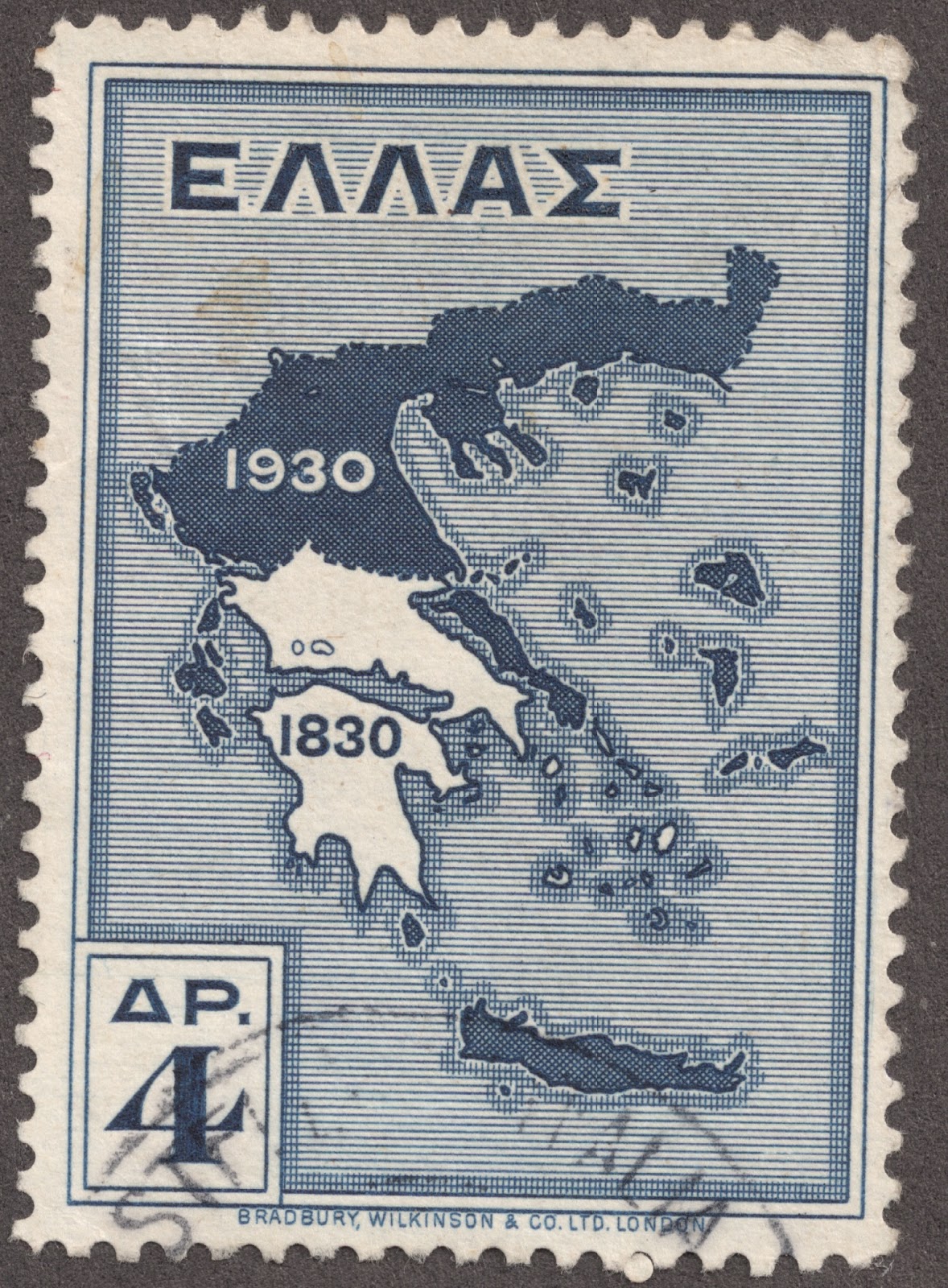
1930 Scott 359 4d dark blue 
"Map of Greece in 1830 and 1930"
Big Blue
Big Blue '69, on 5+ pages, has 152 spaces for the 1896-1940 regular issues. Coverage is 63%.

The most expensive stamp for the years 1896-1940 regular issues is the 1896 Olympic issue Scott 125 1d blue @ $26. There are a total of eleven stamps with CV $10+. The identified stamps can be found after the checklist. The good news is BB does a good job here of keeping expensive stamps out of the spaces. But BB also (IMHO) does not provide enough spaces for inexpensive stamps.

What (may) be missing in Big Blue...
A) BB provides 8 out of the 12 spaces for the 1896 Olympic issue, perhaps missing the 60 l black ($20+).

B) For the 1901 "Flying Hermes" issue, BB does not provide spaces for the 2d ($8), and 3d and 5d ($10+).

C) The 1906 Special Olympic issue has spaces for 10 out of 14 stamps, perhaps missing the 1d gray black ($10+).

D) The 1911-21 engraved issue  (16 stamps) and the 1913-23 lithographic issue (18 stamps) is given 11 spaces: woefully short. ;-) As usual, BB only provides one space for the engraved/lithographic varieties. But BB also has no space for the 15 l, 2d,3d,5d,10d, and the 25d. These stamps could have been put in BB for CV <$1-$4.

E) The 1916  "National Schism"  Athens Royalist government overprinted stamps are missing the 1d,2d, and 3d spaces (<$1-$3).

F) The 1917  "National Schism" Venizelist provisional government stamps are missing spaces for the 3d and 5d ($3-$7+).

G) The 1923 surcharged 63 stamp "Revolution of 1922" issues is given 11 spaces in BB. Thirty-seven of these stamps have a CV of <$1-$1+.

H) As one would expect, BB does not provide any additional spaces for the 1931-35 re-engraved "landscape" stamps. (CV <$1-$1+ for six stamps).

I) The 1935 Scott 383-387 surcharged "Restoration of the Monarchy" issue is missing. (CV <$1-$6)


Checklist
1896
117,118,119,120,

Next page
1896
121,122,125,123,

1901
165,166,167,168a or 168b, 169,170,171,
172,173,174,175,

1902
179,180,181,

1906
184,185,186,187,188,191,192,
189,190,193,194,

1911*
198 or 214,199 or 215, 200 or 216, 201 or 217, 202 or 218, 203 or 220,204 or 221,

Next page

1911
205 or 222,206 or 223,207 or 224,208 or 226,

1913
232

1916
233,234,235,236,237,238,239,
240,241,242,

1917
249,250,251,252,
253,254,255,

1924
316,317,

1923
260,261,267,268,269,
277,277B,290,291,292,293,

1926
318,

Next Page

1927*
321,322,323,324,325,326,327,
328,329,330,331,332,

1927-28
335,336,337,338,
339,340,341,342,343,

1930
344,345,346,347,348,349,
350,351,352,353,354,355,

Next Page

1930
356,357,358,359,363,

1934
381,

1935
382,

1936
389,390,

1937
395,

1937
391,392,393,397 or 413, 398,401,
396,399,400,402,
403,404,405,406,

Next Page

1937
407,408,412,414,415,

1938
409,410,411,

1939
416,
417,418,419,420,

1939
421,422,423,424,

1940
425,426,

Comments
A) Expensive stamps ($10 threshold):
1896 Scott 122 25 l red ($10+)
1896 Scott 125 1d blue ($20+)
1906 Scott 194 1d gray black ($10+)
1928 Scott 341 5d dark brown & black ($10+)
1928 Scott 342 5d violet blue & black ($10+)
1928 Scott 343 5d lake & black ($10+)
1930 Scott 351 15d yellow green ($10+)
1930 Scott 352 20d blue black ($10+)
1939 Scott 418 20d yellow orange ($10+)
1939 Scott 419 20d dull blue ($10+)
1939 Scott 420 20d carmine lake ($10+)

B)*1911: I elected to include choices in the spaces for both the 1911-21 engraved and the 1913-23 lithographic issues, and ignored some (minor) color differences.

C) *1927 Be aware there were 1931-35 re-engraved 50 l, 1d,2d,3d, and 10d stamps produced with engraving differences.


1939 Scott 420 20d carmine lake 
"King George I of Greece and Queen Victoria of England
75th anniversary of Ionian Islands with Greece
Out of the Blue
A very enjoyable excursion through the 1896-1940 regular issue Greek offerings. Classic lovely designs, and enough issue complications to keep a flyspecker like me happy. ;-)

Note: Picture of King Constantine and Venizelos appears to be in the public domain.

Links
Greece - Bud's Big Blue

Would appreciate a comment!