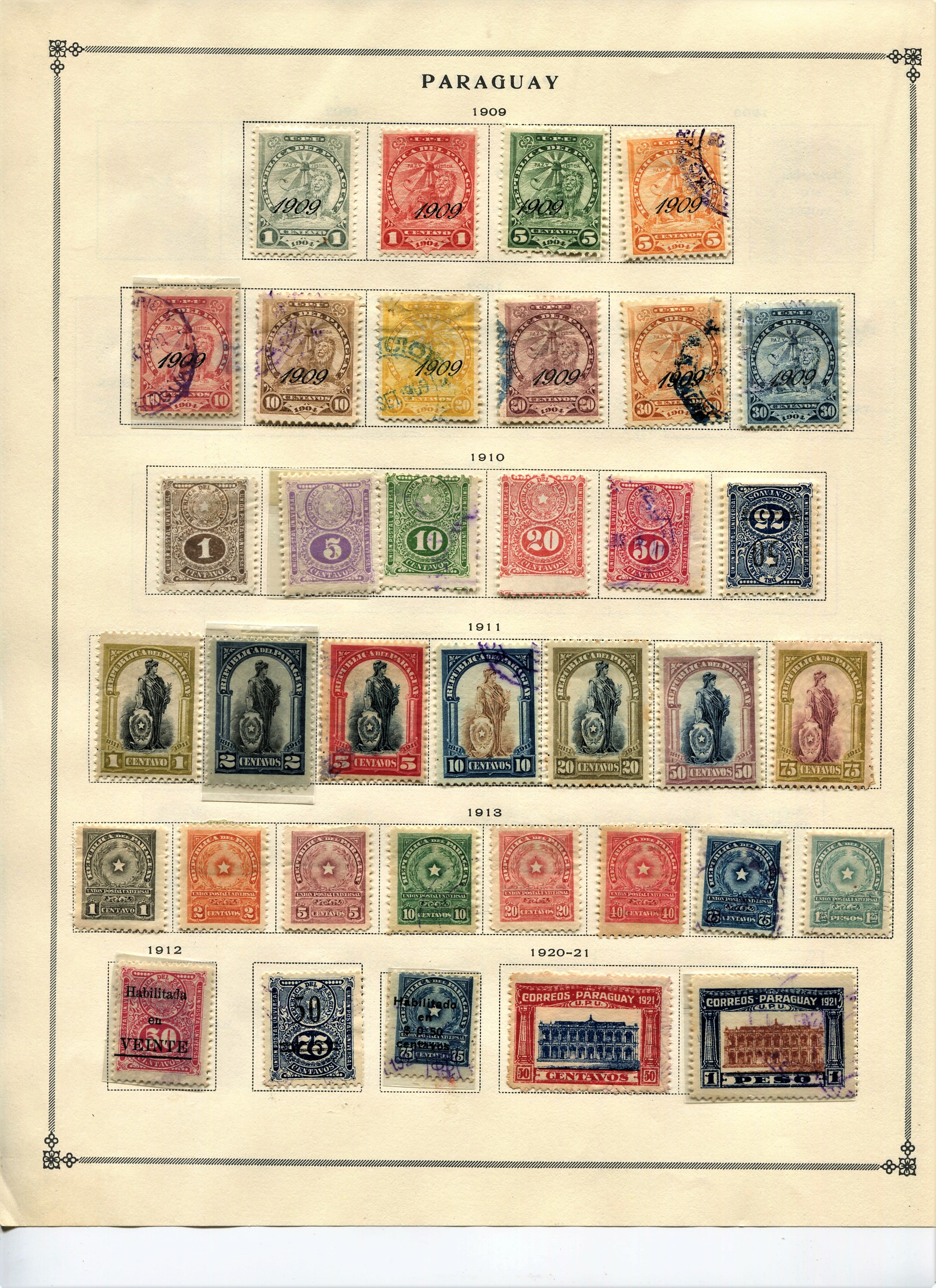
A lion, a star, and a floppy Phrygian cap on a stick – strange choices for Paraguay’s national symbols. No lions live there. Phrygia, an ancient kingdom in what is now eastern Turkey, is 7404 miles away. Alpha Centauri A and B, although visible from Paraguay, are about 4.35 light-years away. Moreover, the bleu, blanc, rouge colors of the French revolution flag seem out of place. The only local elements are the palm and olive branches beside the star. Paraguay’s flag is one of the few with different sides, a star on the front and a lion on the back.

The star and the lion with the cap are featured on
almost all of Paraguay’s stamps from 1879 through 1930. These symbols can be
traced back to Paraguay’s independence from Spain (1814). Dr. José Gaspar
Rodríguez de Francia, the country’s first president/dictator, was a scholarly
disciple of the French philosopher Jean-Jacques Rousseau and he tried to build
a utopia based on Rousseau’s theory of social contract. Paraguay’s national
symbols connote Francia’s fascination with post-revolutionary France, although
the flag was not adopted until 1842, two years after his death.

Francia’s utopia aimed
to eliminate racial disparities. He forbade Spaniards from marrying other
Spaniards; they could wed only Mestizos, Amerindians, or Africans. He limited
the powers of the Church and the landed elites, placing welfare of the poor
beyond charity and in state control. He also imposed an inflexible economic
isolation by banning international trade and championing local industry. Such
policies conformed to the wishes of Paraguay’s marginalized and vulnerable
peoples (i.e., most Paraguayans at the time) among whom he was extremely
popular. They called him El Supremo. The wealthy, of course, resisted. In
subsequent years repression resumed.

The lion, a common power metaphor in Europe, signifies strength and courage of Paraguay’s new start, particularly fiscal courage since it is the insignia of the Treasury and the Supreme Court. In the Americas, the floppy Phrygian cap came to denote liberty (see discussion in the Nicaragua post), although it never had that meaning in Phrygia; and the star, the most common of all national symbols everywhere, portends utopian hope and happiness.

All these symbols derive
from Francia’s Rousseau-inspired vision. Their signifying power continues even
today. According to a recent Gallup poll on well-being, Paraguay, although
still poor, ranked as the world’s happiest nation. (1)
It’s curious, then, that Francia’s image appears on no Paraguayan stamps or currency until September 1940, the centenary of his death. (Compare George Washington’s slew, or Miguel Hidalgo’s, the founding father of Mexico).

There are few surviving engravings or other portraits of Francia. The
two best known were used for the 1940 stamp series.


Another curiosity is
Paraguay’s stamps with ocean-going warships. Paraguay, despite its
reclusiveness, has the largest navy of any landlocked country. Although nearly
100 years old, the “Paraguay” gunboat is still commissioned for active duty. It
accesses the Atlantic via Río Paraguay and Río Paraná.

The “Humaitá” now
serves as a museum. Both ships saw active duty during the 1930s.

Paraguay’s classic era stamps
remain comparatively inexpensive, and recent interest in South American stamps has
stabilize prices. Forgeries abound, as do errors and oddities. From the
mid-1960s onward, heaps of mint wallpaper stamps – Disney, nudes, antique cars,
etc. – have sullied comprehensive modern Paraguay collections.
Census: 357 in BB
spaces, six tip-ins, 201 on supplement pages.
(1) https://www.nbcnews.com/health/health-news/worlds-happiest-country-would-you-believe-paraguay-n110981

I needed the last three stamps in the set, and when a national dealer was having a sale on Paraguay, off went my order.
Quire striking, Yes? And the entire eight stamp set is only CV $6+ unused.
What could go wrong?