A is for Aden and Z is for Zanzabar


A is for Aden and Z is for Zanzibar... Now what is between? For the world wide classical era philatelist and stamp collector, a country specific philatelic survey is offered by the blog author, Jim Jackson, with two albums: Big Blue, aka Scott International Part 1 (checklists available), and Deep Blue, aka William Steiner's Stamp Album Web PDF pages. In addition, "Bud" offers commentary and a look at his completely filled Big Blue. Interested? So into the Blues...

Thursday, March 4, 2021

Mozambique Company - Bud's Big Blue

 
Scott #10
Bud's Big Blue
Bud's Observations
In the late 19th century, Portugal, an empire eager to extract wealth from its colonies, admitted that it had no way to exploit all of Mozambique. So, it ceded large swaths of the colony to privately financed companies -- a common colonial strategy under such circumstances. Mozambique Company, one such administrative arrangement, was established in 1891 and financed by British, German, French and South African investors. In exchange for agreeing to develop agriculture, metal and mineral excavation, railways, port facilities, and government services (plus a small percentage of the profits), the Company had complete rights to exploit the lands and people in 51,881 square miles of territory.

As it turned out, Mozambique Company met few of its obligations but it did conscript labor and raise taxes -- main sources of corporate income. It rapidly became a forced labor regime aimed at plundering the region. Although the slave trade had been formally abolished, the Company transformed its prerogatives to corporate form of slavery, violently when it deemed necessary.(1) It even sent conscripts to work in South African mines. “To minimize expenses the directorship kept salaries of local European employees low, expecting them to supplement their wages by pillaging the local population.”(2)

Many outraged Africans fled the areas under Company control or, not surprisingly, rebelled against this new form of slavery. Portugal twice sent in the military to quieten matters.

The Company’s main center for administrative control was located in the port city of Beira where it established a postal service that issued stamps and a bank that issued currency.

Beira Post Office, about 1920

The Company built an imposing structure for its main post office. Notice the tram carriages passing by it, a conveyance enjoyed by Europeans in many east African cities. Rickshaw-like buggies jostled along on tracks with African natives pushing.

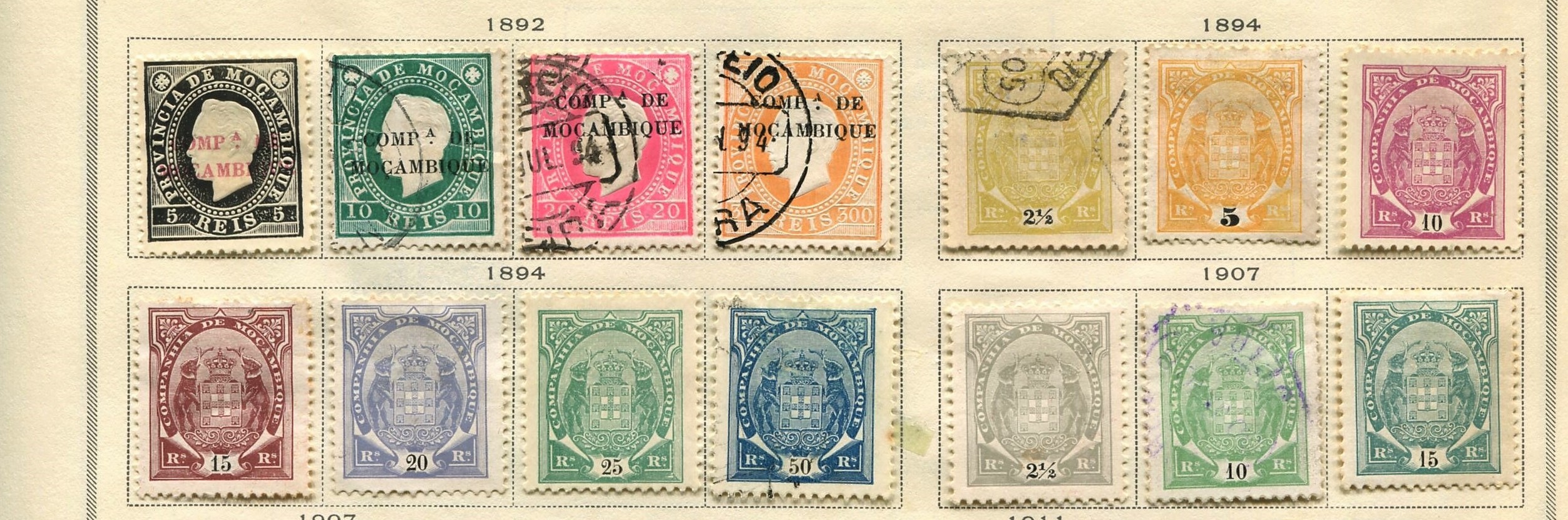
From 1892 until 1918 the Company used standard Portuguese stamps overprinted or inscribed “Companhia de Moçambique.” The earliest of these, if found in feeder albums, are sometimes reprints. Of the seven showing on the supplement pages (below), I believe to top two to be smooth surfaced reprints and the five others to be originals with chalky surfaces. Reprints command higher prices.

Scott #s 8 and 9 (chalky surface)

Beginning in 1918, the Company issued its own stamps that were designed and printed by Waterlow and Sons, Ltd., a British Company. These stamps show happy Africans tending prosperous plantations, modern transport, and thriving wildlife -- images not remotely consistent the realities described above. However, stamp collectors throughout the world enthusiastically filled their album spaces with these attractive stamps, thereby unintentionally providing the Company with a considerable source of income and a public relations triumph. Many of us, my childhood self included, were transfixed by the beauty of these stamps.

Scott #s 118, 122, 127, 129, and 155

Essays for the first Waterlow stamps appear at the end of the supplement pages. They are colored differently from the stamps that were actually issued. They have the “specimen” overprints and the values punched out.

Selected Waterlow essays

The Company’s philatelic public relations gambits continued. In 1939 seven stamps were overprinted to commemorate a visit from the Portuguese president -- appealing triangles with animals and ships. At the time, the President must have been impressed with what he saw because he awarded the Grand Cross of the Order of the Colonial Empire to the Company.

Scott #s 196-8

The Company’s last philatelic public relations ploy, and coincidentally their last stamps ever, was the set of seven commemorating the double centenary of the Foundation of Portuguese Nationality in 1140 and the Restoration (that is, separation from Spain) in 1640. (Five showing below, the remainder in the page scans). If these were meant to curry favor in Lisbon, they did not do so sufficiently, for the Company lost its concession in 1942. However, despite its bad financial performance and the Portuguese desire to consolidate control of its colonies, the Company was allowed to continue some farming and commercial operations. But no more stamps.

Scott #s 201-5

Census: 122 in BB spaces, 145 on supplement pages.

 (1) The Mozambique Company’s brutality is detailed in Eric Allina, Slavery by Any Other Name: African Life under Company Rule in Colonial Mozambique (Charlottesville: University of Virginia Press, 2012). His data come from previously unavailable Company records and interviews with survivors.

(2) Allen Isaacman and Barbara Isaacman, Mozambique: From Colonialism To Revolution, 1900-1982 (Avalon Publishing,1983).

 Mozambique Company charity stamps seem contradictory to my foregoing comments, so I put them at end of this post surrounded in black.

Scott #s B1-7
Jim's Observations
The Mozambique Company had the concession from Portuguese government to administer (and extract wealth) from the central portion of Portuguese East Africa (Mozambique). The exclusive concession began in 1891, and lasted 50 years until 1941, when it was not renewed.

Among the rights of Mozambique Company, financed largely with British capital, was the ability to collect taxes, and use forced labor on its plantations. These two prerogatives, were, in fact, how the Company made its money. It did little to develop the lands, except for the Beira- Salisbury (now Harare) railway in 1899, and a Nyasaland line in 1922.

One of the other rights? The production of stamps. 

And produce they did, with some 275 stamps issued between 1892-1941. But not just any stamps- you know, the usual uninspired Portuguese colony fare- but bi-colored pictorials engraved in London beginning with the 1918 issue forward.

Wow!...as poor as their administration of the colony was, their stamps are magnificent- and cheap for WW classical collectors to own.

But truth be told, Bud's essay (above) does put a pall on these stamps.


Page 1


1a


1b


1c


1d


Page 2


2a


2b


2c


2d


Page 3


3a


3b


3c


3d


Page 4


4a


4b


4c


Supplements
Page 1


Page 2


Page 3


Page 4


Page 5


Page 6


Comments appreciated!

Tuesday, February 23, 2021

Colombian States - Boyaca & Cundinamarca

Boyaca 1903 Scott 17 10p black/buff
"President Jose Manuel Marroquin"
Into the Deep Blue
Now Departments within the Republic of Colombia, Boyaca and Cundinamarca were originally "States", and issued stamps between 1870-1904 (Cundinamarca) and 1902-1904 (Boyaca).

Colombian States - Boyaca & Cundinamarca
Colombia (Map by Gerben van Gelder )
So far, we have had posts on the Colombian States of Antioquia and Bolivar.

Also, there was an earlier 2011 post about Big Blue's coverage (or lack of) for the Colombian States.

Boyaca - a closer look
100 Centavos = 1 Peso

The State of Boyaca was late to the game: only issuing stamps between 1902-1904.

1903 Scott 4 10c dark gray "Coat of Arms"
Imperforate
The most substantial issue for Boyaca was released in 1903, and consisted of five denominations and five designs for the imperforate version.

1903 Scott 5 20c red brown "Coat of Arms"
As is usual for Colombia and Colombian States stamps of the era, they were produced lithographically.

1903 Scott 6 1p red 
CV for the imperforate five stamp issue is <$1 to $6+.

1903 Scott 10 10c dark gray "Coat of Arms"
Perf 12
The 1903 issue also had a Perf 12 version, given major numbers by Scott

1903 Scott 11 20c red brown "Coat of Arms"
Perf 12
CV for the seven stamp Perf 12 issue ranges from <$1 to $22.

1903 Scott 13 50c dull blue
"Gen. Prospero Pinzon"
Perf 12
An additional design is found with the Perf 12 issue: this one in 50c green (Scott 12) and 50c dull blue (above - Scott 13).

1903 Scott 17 10p black/buff
"President Jose Manuel Marroquin"
Perf 12
A larger format was used for the 10 peso denomination (and 5 peso - not shown).  CV for the 10p black/buff is $2+. The 10 peso stamp can also be found in black/rose (CV $22).

I note for the "Perf 12" stamps, some of the sides almost look like sewing machine perfs.

1904 Scott 18 10c orange
"Statue of Bolivar"
Perf 12
The last issue for Boyaca was in 1904, and consists of this one stamp. CV is <$1.

Cundinamarca - a closer look
100 Centavos = 1 Peso

Cundinamarca issued stamps between 1870 - 1904

I should mention at the outset that Cundinamarca ( and other Colombian States, and naturally Colombia) are infested with fakes/forgeries. It is truly hard for the non specialist to obtain information about them. Nevertheless, I did find an internet discussion link for Cundinamarcan fakes. Thanks Will and The Stamp Forum! Unfortunately, for the specific stamps discussed (1870, 1886) I don't have a copy. It does sound, though, that, for the counterfeit 1870 issue, there are long scratches through the plate in the upper half of the stamp. And, if the stamp copy is not clearly printed, it is probably a forgery.

1882 Scott 7 50c purple "Coat of Arms"
Imperforate
Between 1877-1882, a lithographic four "coat of arms" design, four denomination issue was released.
CV is <$1-$10+.

1884 Scott 11 5c blue "Coat of Arms"
Redrawn
A 5c blue design was issued in 1884. Scott 10 has a period after the A of COLOMBIA. The redrawn stamp (Scott 11) does not have this period. Both types are CV <$1.

1904 Scott 24 2c gray blue
In 1904, a twelve stamp nine design issue for Cundinamarca was released.

1904 Scott 29 20c blue/green
One can tell one is in the philatelic backwoods with this issue. My 2011 Scott has four of the designs still illustrated in black & white. All of the black & white illustration stamps are CV <$1. !! My 2020 Scott finally shows these illustrations in color.

1904 Scott 33 50c red violet
The issue comes in Perf 10 1/2, 12 (major numbers) and imperforate (minor numbers).

1904 Scott 34 1p gray green
CV for the 1904 twelve stamp issue (major numbers) is  <$1-$1+, except for the 40c blue/buff @ $40+. 

1904 Scott F2 10c bister
Registration Stamp
In 1904, besides the twelve stamp regular issue, a registration stamp was produced. CV is $1+.

The year 1904 proved to be the last of the issues for the Colombian States/Departments.

Out of the Blue
I find it quite curious that these fairly obscure States issues tend to have a very modest CV. Yet, these stamps are not all that common in WW collections. Supply/Demand curve?

Note: I'm going to now do  updates on other "C" and possibly "D"  countries, and leave Colombian States: Santander & Tolima for a later time.

Comments appreciated!