A is for Aden and Z is for Zanzabar


A is for Aden and Z is for Zanzibar... Now what is between? For the world wide classical era philatelist and stamp collector, a country specific philatelic survey is offered by the blog author, Jim Jackson, with two albums: Big Blue, aka Scott International Part 1 (checklists available), and Deep Blue, aka William Steiner's Stamp Album Web PDF pages. In addition, "Bud" offers commentary and a look at his completely filled Big Blue. Interested? So into the Blues...

Wednesday, December 9, 2020

Mongolia - Bud's Big Blue

Scott #4, multicolored on gray blue, with vajra
Bud's Big Blue
Bud's Observations
At first glance the stamps on Big Blue’s Mongolia page seem to come from two different countries. One county prefers lithographed stamps with traditional symbols in muted colors while the other likes military and industrial themes better, photoengraved and monochrome. But Big Blue did not in this case, as it often does, fit two countries with only a few stamps onto a single page. Mongolia’s stamps stand alone.

Scott #64, indigo
A closer look does reveal some minor continuities between the 1924/29 and the 1932 issues. The Soyombo, a symbol of Mongolia invented in 1686, appears on most stamps, albeit indistinctly on the 1932 set. The parts of this symbol are often construed as advice for the Mongolian people. “Spread like fire.” “Shine like the sun.” “Be sharp like pointed spears, strong like walls.” And so forth. Mongolians interpret the yin yang symbol as being two fish with watchful eyes signifying the importance of reproduction. “Be numerous,” the fish say, and “keep an eye out for trouble.” The Soyombo continued on Mongolia’s stamps until 1946.

Soyombo
In addition to the Soyombo, the use of the Latin alphabet on Mongolia’s stamps provides continuity of a sort, especially since one might not expect enthusiasm for Latin letters on Central Asian stamps. Scott #67 shows a sizeable crowd studying the Latin alphabet writ large on a wall. Their eagerness implies an interest greater than mere compliance with UPU specifications.
Scott #67, rose red, Soyombo upper right
Mongol script remained in nearly universal usage during the classical stamp era. It provides yet another reinforcement of Mongolia’s philatelic continuity. The Cyrillic alphabet replaces Mongolian script on stamps beginning in 1946. Thereafter, Cyrillic predominates, sometimes with Latin letters too, but often not.

Scott #16a, “Postage” overprint on fiscal stamp (possibly forged)
These minor continuities notwithstanding, the stark contrast between the stamps of 1924-29 and those of 1932 remains obvious, signaling major social change and disruption. The Soyombo’s fish were wise to recommend watchfulness, for even in 1924 trouble was at hand. Then things got worse.

Scott # 39, yellow green and black, Soyombo

Accounts of what actually happened differ greatly. Mongolia, a vast but sparsely populated country, had long been torn between China and Russia.  The Russian sympathizing Mongolian People's Republic (MPR) gained control in 1924. It wavered between minimal tolerance of venerable Mongolian traditions and aggressive repression of them. For example, the Buddhist vajra appearing on Mongolia’s first stamps (Scott #4 above) was soon replaced by the more secular Soyombo (Scott #s 16a, 39, and 67), which itself was phased out in 1946.
More fatefully, private trade was suppressed. Collective farming led to massive relocation of herdsmen and slaughter of livestock. Buddhist church property was confiscated. Popular revolts sprang up and were put down. The MPR enforced isolationism. By 1937 Stalinist purges had eliminated most of the nobility and Buddhist clergy; perhaps as many as 30,000 Mongolians died.
Reflecting none of this turmoil, the 1932 stamp series advertised the peace-nourishing accomplishments of Mongolian industry and culture, as if to reassure the rest of the world that everything was fine. This Soviet-style propaganda must have worked well; the 1932 stamps circulated widely among collectors while the world paid little attention to Mongolian misery.
As a result, most Big Blue feeder albums on the market today have several examples of the 1932 series, but less frequently have the 1924 issues.
A deeply troubling and yet fascinating specialization, Mongolia’s stamps have been studied in detail; see Wolfgang C. Hellrigl. The postal history of Mongolia, 1841-1941: the history of the Russian and Chinese post offices in Mongolia, and the postage stamps and postal history of independent Mongolia. London: Royal Philatelic Society, 2011.
Census: 21 in BB spaces, six on the supplement page.
Jim's Observations
China, during the early 20th century, considered "Outer Mongolia" to be part of its own territory. But the White Russian forces, Chinese forces, and Red Russian /Mongolian Partisan forces fought over the territory in 1921, with the Bolsheviks winning. Consequently, Mongolia's "independence" was declared on July 11,1921, albeit with heavy Russian influence and alignment.

The Mongolian People's Republic was formed in 1924. (Stamps were also introduced in 1924.)

(About the same time-1921- the Republic of Tannu Tuva in northwestern Mongolia came into existence. The territory was likewise very closely aligned with the Soviet Union.)

Collectives for livestock was instituted in 1928, Buddhist monasteries were destroyed, and the Stalinist repressions began.

But Imperial Japan invaded adjacent Manchuria in 1931, leading to the Soviet-Japanese Border War of 1939.

After WW II, there were still simmering land disputes between China and Russia. China agreed to a referendum over Outer Mongolia, and on October 20, 1945, according to "official" figures, 100% of the populace voted for independence (severing all ties with China).

As one would expect, after China became a People's Republic, the relationship softened, and both Russia and China affirmed Mongolia's mutual recognition on October 6, 1949.

But Mongolia continued to align itself closely with the Soviet Union even after the Sino-Soviet split of the later 1950s. The Soviets still had 50,000+ troops in Mongolia in the 1980s.

Today, after perestroika and the introduction of a new constitution in 1992, a market economy, if somewhat rough, now exists.

Mongolia Blog Post & BB Checklist

Page 1

1a

1b

1c

1d

Supplements
Page 1


Comments appreciated!

Monday, November 30, 2020

Colombian States - Antioquia

1886 Scott 56 2 1/2c black/orange
"Coat of Arms"
Into the Deep Blue
How can one tell that one is in the (exciting to me!) philatelic backwaters of the hobby? Perhaps an unconventional way is comparing the Scott 1840-1940 classic catalogue over the years. I believe Scott began replacing black & white stamp illustrations around 2004. By 2011, it was rare to find a black & white stamp illustration, because they had been replaced with colored ones. Yet, with the Colombian States, the 2011 catalogue still had 51 B&W illustrations - Wow! My 2020 Classic catalogue now has none - finally. !!

The original post....

Colombian States & BB Checklist

Colombia (Map by Gerben van Gelder )
Stamp Issuing States in Red
If you enjoy exploring the backwaters of an interesting era, then the Colombian States offer much!

From my original Colombian States post...

"The United States of Colombia (1862-85) consisted of nine original States: Antioquia, Bolivar, Boyaca, Cundinamarca, Panama, Santander, Cauca*, Magdalena*, and Tolima. Naturally, all of them  issued stamps as early as 1863. After a new constitution was adopted in 1886, the States became Departments, losing their sovereignty. But the Departments retained some rights, including issuing stamps as late as 1904. It should be noted that Panama left the Republic in 1903.
* Cauca and Magdalena did issue "stamps", but they are not presently listed in Scott."

I thought we would revisit these Colombian States.

This is actually a big topic. I will illustrate some (what I have) of the stamp issues from each State/Department. To make it manageable, I will publish several posts. 

A Closer Look - Antioquia
100 Centavo = 1 Peso

1873 Scott 16 50c blue
Imperforate, Lithographed
Most issues of Antioquia (Medellin the most prominent town) and other Colombian States stamps were lithographic printed, which give them a flat, somewhat primitive quality. Of course, Colombia itself had mostly lithographic issues during this era.

I actually wish I had more Colombian States stamps, as I find the issues fascinating, and frankly not that well known, and somewhat hard to obtain. And yet the CV prices tend to be in the $1's and $10's (There are exceptions of course).

Antioquia had an 1868 issue (four stamps- CV $500-$1000), an 1869 issue (six stamps - CV $6-$20+), and then an 1873 issue (eight stamps, eight designs - CV $3+-$40+), of which the above is a member.

1886 Scott 61 50c yellow brown/buff
"Coat of Arms", Lithographed
There were three more issues produced (1875-85- nine stamps; 1878-85 -eight stamps; 1883-85 - seven stamps) before this shown 1886 stamp (eight stamps, one design - CV $1-$9). Recall that 1886 is when the "States" became "Departments" with a new constitution, and the governors were appointed by the President of the Republic. Perhaps this issue signaled the new era.

1887-88 Scott 64 1c red/violet
"Coat of Arms", Lithographed
In 1887-88, five more stamps were issued, similar in design to the 1886 issue, but in different colors. CV is <$1-$3+.

Just like Colombian stamps, there are forgeries extant for the primitive lithographic Colombian States issues also. (I can't guarantee that all of these illustrated stamps are genuine.)

For instance the above 1887-88  1c red/violet and the 1886 header stamp 2 1/2c black/orange are on the suspect list.

Here is another list of stamps where forgeries need to ruled out...
1868: 2½ 5 10c 1p
1869–73: 2½c–1p 1c–5p
1869–72: 2½c–1p
1869–73: 5 10 1p 5c
1873: 5p
1875–7: 1 1 1c
1889: 2½ 2½ 5 5c

1889 Scott 75 5c black/yellow
Lithographed
In 1889, the first perforated (13 1/2) issue for Antioquia was released (four stamps, one design). CV is <$1. Note the stamp know states "Departamento".

The "errors" of color found for the issue are essays or possibly reprints. 

1890 Scott 85 5c black/orange
Typeset, Perf 14
A five stamp provisional issue (four designs) was typeset in 1890. Scott states there are 20 varieties of the 5c denomination. Talk about primitive! CV is $4+-$10+.

 Printed by the 'IMPRENTA DEL DEPARTAMENTO' in MedellĂ­n, as a shortage of stamps existed.

1892 Scott 90 2 1/2c purple/lilac
Lithographed, Perf 13 1/2
In 1892, a lithographic three stamp, one design was issued. 

1893 Scott 95 5c vermilion
Lithographed
And in 1893, four more stamps in the same design, but different colors, were published.

CV for both the 1892 & 1893 issues are <$1-$2+.

1896 Scott 108 20c blue
Lithographed, Perf 14
In 1896, a twenty stamp one design issue was released.

1896 Issue Scott 97-108
Although lithographed, the stamps have an almost engraved appearance.

CV ranges from <$1 to $200.

1899 Scott 127 2p olive gray
"General Jose Maria Cordoba"
In 1899, an eleven stamp lithographic issue with one design (as above) was released. They are still extremely ubiquitous in general stamp mixtures, and for many collectors, would represent their first introduction to Antioquia. I noticed when I had many Big Blue albums as feeder albums, invariably there would be some of these Antioquia stamps in them.

1901 Scott 129 1c ultramarine
Typeset, Perf 12
In 1901, another typeset issue was released (five stamps, three designs). There are four varieties of the 1c denomination, according to Scott. Do you like primitive? I do. ;-) CV is <$1-$9.

1902 Scott 137 20c gray green
"Atanasio Girardot", Lithographed
The 1902 set (ten stamps, four designs) is very inexpensive (CV <$1).

1902 Issue Scott 131-140
But what is truly more attractive - a set produced by a well know printing house in New York or London for a country, or a set that is produced "in house"? I vote for the latter. ;-)

1903 Scott 143A 1c blue
Lithographed
In 1903, two more stamps were issued, in different colors, with the same design as the 1902 set.

1903-04 Scott 152 1p olive gray
"Custodio Garcia Rovira" 
In 1903-04, another thirteen stamp, three design issue was released, using lithography.  

1903-04 Issue Scott 145-152
CV is <$1-$10+. This 1903-04 issue would prove to be the last of Antioquia's output.

Registration 1899 Scott F3 2 1/2c dull blue
"Cordoba", Lithographed
An 1899 Registration stamp...

Acknowledgment of Receipt 1902-03 Scott  H1 5c black/rose
Lithography
An Acknowledgement of Receipt stamp....

Late Fee 1901 Scott I2 2 1/2c red violet
Typeset
A Late Fee stamp, in primitive typeset....


1896 Scott 55 1c green/pink
"Coat of Arms', Lithographed
Out of the Blue
Hopefully, this review of the primitive, but fascinating issues of Antioquia was found interesting!

Comments  Appreciated!

Thursday, November 26, 2020

Monaco - Bud's Big Blue

Monaco, Scott #C53-C54, Prince Rainier III and Princess Grace
Bud's Big Blue
Bud's Observations
Although smaller than the average Kansas corn farm, Monaco cultivates more super wealthy folks per acre than any place on earth. It can afford tax shelters to protect this tender crop thanks to proceeds from tourists, gamblers (foreigners only) and stamp collectors.

The government prints more stamps than the locals need, then exports the surplus to not-so-wealthy collectors, a trickle-up irrigation scheme. Usually eBay has more Monaco stamp lots on offer than the country has people living there. Delcampe, a European auction site, is trying to sell ten times that number, starting as low as $0.02.

Some Monaco princes are said to have collected stamps but, apparently, not avidly enough to dry up the overproduction.

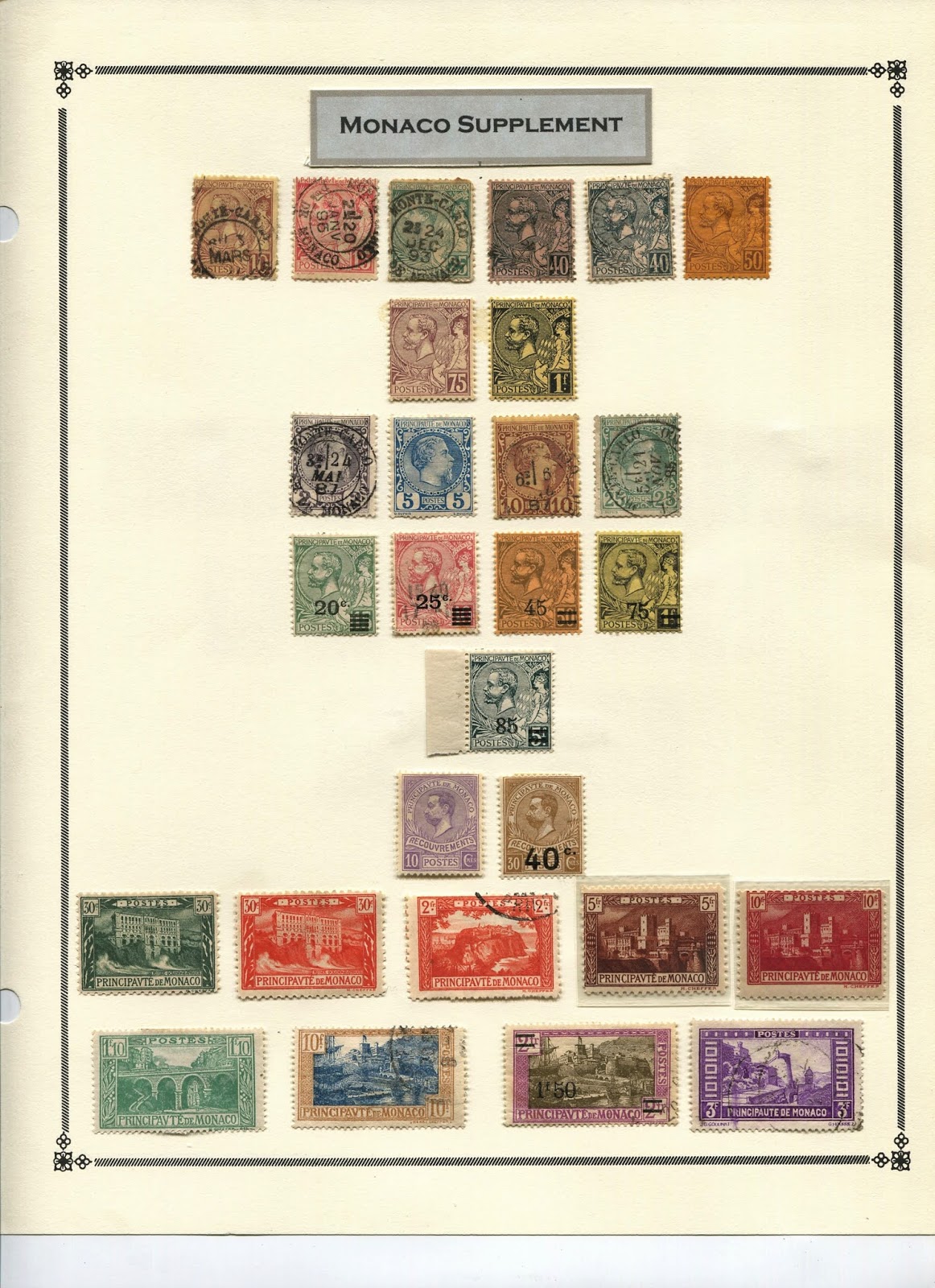
My Monaco stamps - all common as corn in Kansas - came entirely from feeder albums. A few have moderately high CVs, but none will win county fair ribbons.

Census: 143 in BB spaces, one tip-in, 49 on supplement pages.

Jim's Observations
Bud has a realistic view of Monaco and it's stamps. I have imprinted on me - for better or for worse- my childhood romantic view. You see, I clearly recall the exotic triangular shaped Monaco stamps I received "on approval" from a certain well known dealer from Boston who advertised in "Boy's Life", guaranteed to increase in value. Then there was the whole Princess Grace - Prince Rainier thing in the news. Even now, there is a certain extra thrill when I obtain a Monaco stamp - vestiges from my childhood memories.

Monaco Blog Post & BB Checklist

Page 1

1a

1b

1c

Page 2

2a

2b

2c

2d

Page 3

3a

3b

3c

Page 4

4a

4b

Page 5

5a

5b

5c

Supplements
Page 1

Page 2

Comments appreciated!