A is for Aden and Z is for Zanzabar


A is for Aden and Z is for Zanzibar... Now what is between? For the world wide classical era philatelist and stamp collector, a country specific philatelic survey is offered by the blog author, Jim Jackson, with two albums: Big Blue, aka Scott International Part 1 (checklists available), and Deep Blue, aka William Steiner's Stamp Album Web PDF pages. In addition, "Bud" offers commentary and a look at his completely filled Big Blue. Interested? So into the Blues...

Sunday, February 7, 2016

How did my collection grow this past 2015 year?

United States 1847 Scott 2 10c black/bluish 
"George Washington"
Into the Deep Blue
Part of the fun of collecting for us obsessive types is doing an accounting at the end of the year. ;-)

The time era limit of my "serious" (Ha! ;-) WW collection is 1840-1940, with the exception that British Commonwealth are collected to 1952. The ultimate collection, 100% filled, would have 83,541 (Scott major number) stamps.!!!... and cost $$$$$$ !!!! ;-)

( But the secret of WW collecting is that the majority of stamps are < $. And the journey is the true joy. )

I put the stamps into "Deep Blue", my affectionate name for the 6,500 Steiner album pages housed in some 44 binders. But I also keep track (and actively collect as realistic do-able goal) all the stamps that will fit into Big Blue, the Scott International Part I 1840-1940 album - some 34,872 spaces. My "virtual" Big Blue collection, housed within Deep Blue, is based on the checklist I have created for all the stamp spaces in BB.

How did I do?

The 2015 year started with 39,632 major Scott number stamps, and ended with 42,734 - a 3,102 stamp increase. I only initiated the WW collection in 2011, so, not too bad.

My virtual Big Blue collection grew from 26,087 to 28,134 stamps, a 2,047 stamp increase. As my general objective was ~100 stamps/month (~1200/year) addition into the virtual Big Blue, I am pleased. Note that ~50% of the new stamps accumulated for the year only have a space in Deep Blue.

Countries/ Stamps added 2015
1) Italy/ 265
2) Yugoslavia/ 132
3) Belgium/ 120
4) United States/ 113
5) Austria/ 94
6) Gabon/ 88
6) Surinam/ 88
8) China/ 82
9) Colombia States/ 78
9) Luxembourg/ 78

This is the list of the top ten countries for the 2015 year. Let's review a little more about them, plus a few more countries I selected. (As the Surinam post will soon be published, I will say no more about that country here.)

For an overview of all the countries in Big Blue/ Deep Blue, see the ......

Status of my Deep Blue & Big Blue Collections post. (Updated monthly.)

Italy Offices in China 1917-18 Scott 15 10c claret
Italian Stamps of 1901-16 Overprinted
Italy has 1554 spaces in Deep Blue, and, as I began the 2015 year with only 460 spaces filled, it should perhaps be not too surprising that I added 265 stamps.

The stamps came from an Italy country collection I picked up this past year.

Of those, 75 stamps had spaces in Big Blue.

Yugoslavia 1932 Scott B30 4d + 1d red orange & light blue
"Zagreb Cathedral"
The Yugoslavia collection increased by 132 stamps in Deep Blue, 74 stamps in Big Blue.

I have 319 stamps in Big Blue, and need 22 stamps.

Belgium 1918 Scott B41 35c + 35c light violet & black
"Cloth Hall of Ypres"
Types of Regular Issue of 1915 Surcharged in Red
Belgium is one of my favorite countries, and with a Belgium collection coming my way, I added 120 stamps into Deep Blue. Currently I am 17 stamps shy for the 549 spaces in Big Blue.

United States 1909 Scott 341 50c violet "Washington"
Wmk "Double Lined "USPS" in Capitals; Perf 12
United States was a pleasant surprise this past year, as I added 113 stamps, most of them from a U.S. collection obtained at a local Stamp Club auction that was well represented for the Washington-Franklin era.

And the Pipex stamp show in Portland, Oregon yielded the most expensive stamp in Big Blue: the USA 1847 Scott 2 10c black/bluish "George Washington" (Illustrated post header).  I've always wanted one. What a lovely stamp!

Austria 1850 Scott 1 1kr yellow "Coat of Arms"
Austria added 94 stamps, 87 of them which had spaces in Big Blue. I grabbed an 1850 Scott 1 1kr yellow, which here (illustration scan) is rather muddy in appearance.

Austria 1850 Scott 1
As shown by retroReveal
A retroReveal scan shows much more hidden detail.

Gabon 1904 Scott 19 5c yellow green
"Navigation and Commerce"
The Gabon additions (88 for Deep Blue, 65 for Big Blue) was from a 90%+  filled Big Blue offered on e-Bay by country lots. The next post by a guest author (Bud), at my invitation, will have much more to say about this 90%+ filled Big Blue- stay tuned!

China 1912 Scott 182 8c deep brown
"Dr. Sun Yat-sen"
China is a country where I would like to increase my holdings significantly. In fact, I've joined the China Stamp Society. As everyone knows, it is a "hot" country, and I don't find much China offered in general collections. Rather, using my China want list, I visited Asian specialty dealers at PIPEX. I added 82 stamps to my collection.

(BTW, Portland, Oregon will be hosting the Summer  APS StampShow August 4-7, 2016. !!)

Colombia States Bolivar 1880 Scott 27 20c red
"Bolivar"; Bluish Laid Paper
Colombia States is an interesting area, and I added 78 stamps to Deep Blue. The '69 BB editors dropped the Colombia States, but I am using the 40s BB editions checklist to add back the 155 spaces.

Luxembourg 1893 Scott 67 1fr deep violet
"Grand Duke Adolphe"
Luxembourg is another favorite country, and I utilized dealers at local stamp shows to add 78 stamps.

Guatemala 1894 Scott 56 1c on 2c yellow brown
Surcharged in Black
One of goals for this past year was to increase the Latin American country collections. I did use a national dealer who specializes in Latin America for that end. For Guatemala, I added 56 stamps.

Belgium Congo 1910 Scott 54 1fr carmine & black
"Hunting Elephants"
Who doesn't like Belgium Congo stamps? I managed to add 25 stamps to the collection.

British Central Africa 1895 Scott 21 1p black 
"Coat of Arms of the Protectorate"
British Central Africa is one of those countries, that being obscure, is particularly fun to find for the overall collection. I added six stamps, and lack only one for Big Blue.

United States 1913 Scott Q11 75c carmine rose
"Harvesting"
Out of the Blue
If you read the notes and looked at the scans for this blog post, and still don't understand the attraction of WW classical era collecting, then I cannot help you. ;-)

Comments Appreciated!

Monday, February 1, 2016

Spanish Morocco

1937 Scott E6 20c bright carmine "Mounted Courier"
Quick History
Spanish Morocco, on the northwest coast of Africa and consisting of local Berber populations, was a Spanish protectorate from 1912-1956. But Spain has had influence in the coastal area for centuries, and was one of the nations (along with France, Great Britain, and Germany) that had opened up "offices" in Morocco for mail handling beginning in (for Spain) 1903.

Spanish Morocco (pink) on the Mediterranean; Cape Juby (pink)
French Morocco (yellow-green)
But with the 1912 Treaty of Fez between France and Spain, a northern strip of territory on the Mediterranean (Spanish Morocco), and a southern strip next to Spanish Sahara (Cape Juby) was delegated to Spanish protection. The rest of "Morocco", the largest section, was a French Protectorate (French Morocco).

The reason for "giving" Spain protectorate rights over the Moorish coast wasn't entirely altruistic; in fact, a bit machiavellian. Great Britain wanted a weaker power "in charge" across from Gibraltar and the strait. ;-)

Spanish Morocco
The capital was Tetuan, and the population was ~750,000 circa 1940.

Tangier was given the status as an "International City" with the 1912 treaty. (Of interest, during WW II, Spain occupied Tangier from 1940-45.)

Overprinted stamps of  Spain were introduced in 1914, and Spanish Morocco received their own issues beginning in 1928.

Berber opposition to Spanish hegemony in the Rif Mountain region (in the center part of the protectorate) between 1921-26 required the Spanish army (as well as the French) to put down the rebellion.

The Spanish Civil War was initiated in 1936 with the uprising against the Republican government of Spain by the well trained African stationed troops under the leadership of Francisco Franco. These troops, along with additional Moroccan volunteers, became the core of the Nationalist Army.

Spanish Morocco, then, was in the Nationalist camp from the beginning, That would explain perhaps why the 1937 sixteen stamp issue, with their martial themed pictorials, celebrated the "First Year of the Spanish Civil War".

In 1956, Spanish Morocco, French Morocco, and Tangier joined together, under the Kingdom of Morocco as an independent nation. (Two Mediterranean coastal enclaves, Ceuta and Melilla, were kept by Spain.)

The Spanish enclave of Ifni was returned to Morocco in 1969.

1928-32 Scott 98 15c orange brown 
"Mosque of Alcazarquivir"
Into the Deep Blue
The 2014 Scott Classic Specialized 1840-1940 catalogue has, for Spanish Morocco 1903-1940, 251 major number descriptions. Of those, 205 are CV <$1-$1+, or a remarkable 82%. Clearly, Spanish Morocco is affordable indeed for the WW classical era collector.

Included in the listings are 25 stamps for the international city of Tangier. These consist of the overprinted 1929 Seville-Barcelona stamps of Spain, and the overprinted 1926 semi-postal stamps of Spain. As I happen to not have any, I will say no more about them.

A closer look at the stamps and issues
100 Centimos = 1 Peseta
1903-09 Scott 1 1/4c blue green 
Spain Scott 221A Overprinted in Carmine
The 1876 Scott 221A 1/4c green imperforate of Spain, based on the A21 design for the 1872 Scott 174 1/4c ultramarine, was pressed into duty in various forms for the overprinted Moroccan issues.

In each case, it was the lowest denomination for the issue. Here, it is overprinted "Correo Espanol/ Marruecos", and was intended for the Spanish "Offices in Morocco" issue of 1903-09 (thirteen stamps).

It was also used in 1914, 1915, and 1916-18 as the low denomination lead-off for those overprinted issues (We will be reviewing these issues shortly).

The only aspect that is somewhat puzzling and varies is the colors of the stamps. The original Spain 1876 Scott 221A is described as "green". The overprinted 1903-09 stamp (shown above) is described as "blue green", which it appears to be, but I also have an example in "green".The OP 1914 stamp is "green", while the OP 1915 stamp is "blue green", and the OP 1916-18 stamp is "blue green". Were there two deliberate "major" colors used for the stamp, or, more likely, the color mix simply was not consistent? Scott makes no mention about shades.

1903-09 Scott 3 5c green "Alfonso XIII"
On stamps of Spain, 1901-05
Overprinted in Carmine or Blue
The 1903-09 issue, the first one for the Spanish "Offices in Morocco" era, used this Spanish stamp design overprinted on twelve denomination stamps. CV is <$1-$1+ for five stamps.

I should mention that Spanish stamps can be found postmarked from Morocco between 1860 until this issue in 1903.

1909-10 Scott 15 5c green
On Spanish stamps of 1909-10
The same overprint in carmine or blue was used for the 1909-10 twelve stamp issue, using Spanish engraved stamps of 1909-10 "Alfonso XIII". CV is <$1-$1+ for five stamps.

The "Correo Espanol/ Marruecos" overprinted stamps were used throughout Morocco until 1914, when the "Protectorado Espanol en Marruecos" overprinted stamps were introduced, to reflect the new protectorate status. Then the "Correo Espanol/ Marruecos" overprinted stamps were continued only in the city of Tangier

1914 Scott 27 2c dark brown
Stamps of Spain, 1909-10
Overprinted in Carmine or Blue
With the new status as a protectorate ("Spanish Morocco"), a thirteen stamp issue, overprinted as shown in carmine or blue, was released in 1914. CV is <$1-$1+ for six stamps.

1915 Scott 48 50c slate blue
Stamps of Spain, 1909-10
Overprinted in Red or Blue
Reflecting the new "Protectorate" status, the same 1909-10 issue of Spain was overprinted in red or blue "Protectorado Espanol en Marruecos" on thirteen stamps in 1915. CV is <$1 for eleven stamps.

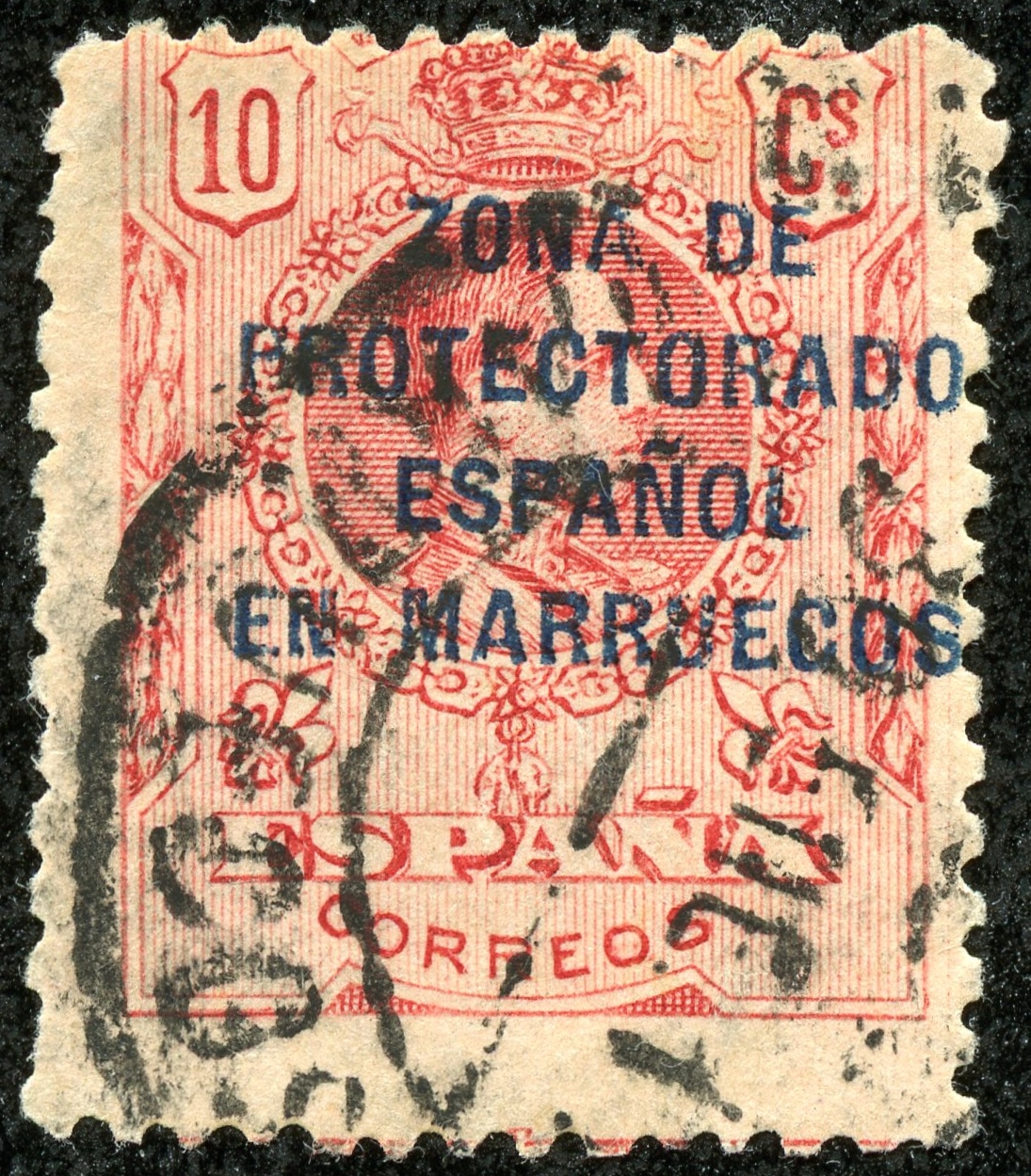
1916-18 Scott 55 10c carmine
Stamps of Spain 1909-10
Overprinted in Red or Blue
Between 1916-18, a thirteen stamp set ,with the overprint in red or blue "Zona de Protectorado Espanol en Marruecos", was issued. The overprint reflects the reality that Spain controlled a "zone" of Morocco, and a small zone at that. ;-)  (But at least it was on the Mediterranean coast!)

The 15c violet and the 20c olive green were not regularly issued (CV $140). The 5c denomination was issued in green, but there is a rare olive brown color extant (CV $525).

1920 Scott 65 15c ocher
Blue Overprint on Spain Scott 310
The same overprint exists for the 1917 Spain 15c yellow ocher, issued in 1920 for Spanish Morocco.

1921-24 Scott 76  20c violet
Stamps of Spain 1917-20
Overprinted in Blue or Red
The Spain 20c violet 1920 was overprinted for Spanish Morocco as shown. This is the lithographic print- I checked with the aluminum foil rubbing test. ;-)

1921-24 Scott 78 20c violet
Stamps of Spain 1920-21
Overprinted in Red
The Spain 1921 20c violet was also overprinted. The aluminum foil test reveals this stamp is engraved. ;-)

1923-28 Scott 81 10c yellow green
Stamps of Spain, 1922
Overprinted Type "a" in Red or Blue
The 1922 issue of Spain was used for an overprinted 1923-28 four stamp issue of Type "a".

1923-25 Scott 84 5c red violet
Stamps of Spain, 1922
Overprinted  Type "b" in Red or Blue
The same 1922 Spain issue was overprinted with Type "b" for a 1923-25 nine stamp production.

1928-32 Scott 100 25c copper red
"Moorish Gateway at Larache"
Between 1938-32, an engraved fourteen stamp issue for Spanish Morocco proper featuring five local scenes was released. !! This is clearly the philatelic high point, so far, for the protectorate.

The stamp is postmarked "Larache", on the Atlantic coast, and where the Moorish Gateway, depicted on the stamp, is located.

1929 Scott 113 20c purple
Seville-Barcelona issue of Spain, 1929
Overprinted in Red or Blue
Most of the Spanish colonies or protectorates seem to have an overprinted version of the Seville-Barcelona issue: and Spanish Morocco is not an exception.

1929-34 Scott 128 10p brown
Stamps of Spain, 1922-31
Overprinted Type "a" in Black, Blue, or Red
Between 1929-34, an eight stamp overprinted issue using 1922-31 Spanish stamps was released. One can see here the very poor centering often seen with Spanish productions up to about 1950

CV is <$1-$1+ for five stamps..

1933-34 Scott 134 15c slate green
Stamps of Spain 1931-32
Overprinted in Black
A fourteen stamp issue with "Marruecos" overprint was produced between 1933-34. CV is <$1 for eleven stamps.

1933-35 Scott 148 15c yellow
Green Control Numbers printed on Gum
A nice fourteen stamp issue with seven local scenes was released in 1933-35. Contrary to the usual "blue" control numbers, this issue has "green" control numbers on back.

1937 Scott 170 2c red violet "View of Bokoia"
A seven stamp issue with five local scenes was released in 1937. Printing was by photogravure. CV is <$1 for six stamps. Who says classical era stamp collecting is expensive? ;-)

1937 Scott 183 25c magenta "Ifni Sharpshooters"
First Year of Spanish Civil War
Spanish Morocco was a hotbed of Nationalist support, no doubt because Francisco Franco was the leader of the Spanish Morocco stationed troops. To "celebrate" the first anniversary of the Spanish Civil War, a sixteen stamp issue was released in 1937. This remarkable issue depicts soldiers from the native population of Spanish Morocco and Cape Juby ready to fight.

1940 Scott 199 2c olive green "Mail Box"
"ZONA" printed in Black on Back
The bloody bloody Spanish Civil War (Both Hitler and Stalin used the war as a testing ground for their own armaments and modern warfare techniques) lasted until April, 1939, with hundreds of thousands dead, and Franco victorious. The 1940 sixteen stamp photogravure issue, each with their own pictorial, is a mixture of local scenes, and references to the Spanish Civil War ("Spanish War Veterans", "Victory Flag Bearers", "Calvary"). CV is <$1 for fourteen stamps.

1938 Scott C2 10c emerald
"Stork of Alcazar"
The only air post stamps during the classical era was the 1938 ten stamp production, each with a different scene. CV is <$1 for all ten stamps.

A comment: Beginning in 1928, and continuing through 1940, I am impressed with the number of stamps (~90)  released with local pictorial scenes. 

1939 Scott RA3 10c blue "Franco"
Postal Tax Stamp
The Postal Tax stamps of 1937-39 was used to raise funds for disabled soldiers in North Africa. Appropriately, the stamps depict General Francisco Franco.

Franco and Victory Parade, End of Spanish Civil War, 1939
Franco was recognized as the Spanish head of state by France and Great Britain in 1939. In 1947, he declared Spain a "Monarchy", with himself as "regent for life". But he was essentially "King", and his visage appeared on coins and stamps.

His regime lasted until his death in 1975.

His legacy is clearly mixed, to say the least. Many consider his brutal regime to be the very definition of "fascist".  But Spaniards during his long reign were also taught in school that he was sent by Divine Providence to save Spain from disorder and want.

Deep Blue
1939 Issue in Deep Blue
Deep Blue (Steiner) has, for Spanish Morocco 1903-1940, 28 pages. All the major Scott numbers have a space, as well as the minor number souvenir sheets.


1903-09 Scott 4 10c rose red
On stamps of 1900 Spain
Big Blue
Big Blue '69, on six pages, has 134 spaces for the stamps of Spanish Morocco. Coverage is 54%.

The 40s editions coverage is under Spain- "Offices in Morocco".

Big Blue has no spaces needing a stamp with CV $10+.

It appears that when the '69 editors rearranged the 1933-35 section and the 1937 section, they introduced space errors -giving 151, 160, and 162 a second space.

The error is not corrected in my 1992 edition.

The '69 editors no doubt intended, under "1937",  that 169, 172, 173 be given a space, (correct in the 1940s editions), but the '69 album has a second "151" image cut, and a description for "160" and "162".  To correct for the error,  put 169, 172, and 173 in these spaces.

Checklist

1903-18
(1),(26),(39),(14),(15),(16),(17),
Eight blank spaces: Choices 2-13, 18-25, 27-38, 40-51, 53-64

1923-34
(131),(132),(133),(134),(135),(136),(125),(137),
Eight Blank Spaces: Choices 79-92, 121-124, 138-143

1928
93,95,96,97,98,
99,100,102,103,104,105,

Next Page

1929
108,109,110,113,111,
112,114,

1933-35
144,147,148,149,151*,
145,146,150,152,
153,158,160*,162*,154,
159,161,163,

Next Page

1937
“151” suggest 169*, “160” suggest 172*, “162” suggest 173*,174
170,171,
176,177,178,179,180,
181,182,183,184,185,186,
187,188,189,190,
*Note: 151, 160, 162 are given spaces twice.
 An error.  Suggested substitutions are 169,172,173.

Next Page

1939
194,195,196,197,
198,199,200,201,
202,203,204,205,206,207,
208,209,210,

Next Page

Semi-Postal
1926
B1,B2,B3,B4,B5,

For Tangier
1926
LB1,LB2,LB3,LB4,LB5,

1929
L1,L2,L3,L4,L5,

Special Delivery
1915-40
E2,E5,E8,E6,E4,

Next Page

Air Post
1938
C1,C2,C3,C4,
C5,C6,

C7,C8,C9,C10,

Comments
A) Expensive stamps ($10 threshold): None.
B) (  ) around a number indicates a blank space choice.
C) *Note: 151, 160, 162 are given spaces twice. An error.  Suggested substitutions are 169,172,173.

1937 Scott 179 10c emerald "Moroccan Phalanx"
First Year of Spanish Civil War
Out of the Blue
I really warmed up to the stamps of Spanish Morocco, especially the 1928-1940 issues with their many local pictorials. And the history- the Spanish Civil War- is embedded in the stamps.

Note: Maps and pic image (Franco and victory parade) appear to be in the public domain.

Have a comment?

Tuesday, January 26, 2016

Spanish Guinea

1909 Scott 94 50c dark violet "Alfonso XIII"
Quick History
Spanish Guinea, located in western Africa originally between the French Congo (then Gabon , also French Equatorial Africa) and Cameroon on the Gulf of Guinea, was a Spanish protectorate (1885), and then a Spanish colony, beginning in 1900.

Rio Muni (Spanish Guinea)
Until 1909, Spanish Guinea actually only consisted of the continental territory known as Rio Muni, after a river flowing through the region. Bata, a military post on the coast, was the capital. (Bata is still the largest city on the mainland.)

Spanish Guinea (Rio Muni)
(Year labeling on the map is initial influence of the European Power)
Stamps issued for the Rio Muni territory from 1902-1909 were labeled "Guinea Espanola" and "Guinea (Continental) Espanola".

But there were other Spanish  colonies on islands in the Gulf of Guinea: namely Fernando Po with the important settlement Santa Isabel and administrative capital (Stamp production 1868-1908, 1929), and Elobey, Annobon & Corisco (Stamp production 1903-1910).

(For more background on the history and stamps, see the Fernando Po and Elobey (Grand and Chico), Annobon & Corisco blog post links above. Also, for much more history, as well as a great synthesis map, check out Gerben's wonderful Stamp World History website here and here. )

In 1909, "Spanish Guinea (Rio Muni)" is expanded administratively to include:
Fernando Po, and  Elobey, Annobon & Corisco"
Then, in 1909, the administration- for all intents and purposes- of all the Spanish colonies in the area was subsumed under "Spanish Guinea", with Santa Isabel on Fernando Po island the most important settlement. (The formal legal changes were not made, though, until 1926.)

Cacao, coffee, and logging were the main economic activities.

Stamps from 1909 for the territories was issued under "Spanish Territories of the Gulf of Guinea", and Fernando Po and Elobey, Annobon & Corisco stamp production ceased (except for a 1929 production from Fernando Po). Spanish Guinea, under this new amalgamation, lasted until 1960. 

Spain tried to keep the territory by making it "provincial"  from 1960-68, but that didn't work.

Full independence was achieved in 1968, and Equatorial Guinea was born.

Of interest, the Michel catalogue keeps the 1909-1959 issues separate as the Spanish Territories in the Gulf of Guinea, while the other major catalogues lumps all these issues under Spanish Guinea.

Equatorial Guinea
As a legacy, Equatorial Guinea is the only independent African nation in which Spanish is the official language. The population in 2012 is a small 1.6 million. Malabo (the former Santa Isabel) on Bioko island (Fernando Po) is the capital. Of interest, Equatorial Guinea is now a large oil producer, and is the richest country per capita in Africa, although the wealth is distributed very unevenly. 20% of children die before age 5, and 50% do not have access to clean drinking water. Human trafficking is a major problem, and the current authoritarian regime in power has one of the worst human rights records on the entire planet.

1912 Scott 117 5c deep green "Alfonso XIII"
Into the Deep Blue
The 2014 Scott Classic Specialized 1840-1940 catalogue has, for Spanish Guinea 1902-1940, 319 major descriptive numbers. Of those, 177 are CV <$1-$1+, or 55% of the total. Clearly, a healthy portion of the stamps of Spanish Guinea are inexpensive for the WW classical era collector.

Now one just needs to find them. ;-)  As a general rule in my experience, Spanish colony stamps are underrepresented in feeder albums and collections in the United States. So, although inexpensive, also not common.

A closer look at the stamps and issues
100 Centimos = 1 Peseta

Recall that Spanish Guinea only included the Rio Muni area beginning in 1902, and stamps of Spanish Guinea were issued and used only for Rio Mundi. Fernando Po, and Elobey, Annobon and Corisco had their own stamp issues.

Beginning in 1909, all of these territories came under the administration of Spanish Guinea, and Spanish Guinea stamps were used.

1909 Scott 85 1c orange brown
"King Alfonso XIII"
The "Rio Muni" era (1902-09) consists of seven issues with 90 stamps. Most issues reflect the "Alfonso XIII" key type issued as well for other Spanish colonies, but there was also a surcharged 1903 and Revenue issue, and an overprinted 1906 issue, using the stamps of Elobey, Annobon, and Corisco.

Long story short- I have none of them at the moment, although 30 are CV <$1-$1+. (Didn't I mention that Spanish colony stamps are not that common in U.S. based WW collections? ;-)

Consequently, the coverage review begins with the 1909 "Spanish Territories of the Gulf of Guinea" era, when Spanish Guinea consisted of all the Spanish colonies around the Gulf of Guinea: Rio Muni, Fernando Po, and Elobey, Annobon, and Corisco.

The 1909 issue has thirteen stamps, and the CV is <$1 for 10 of them.

Blue Control Numbers on Back
As is typical for many Spanish issues, there is a control number on the back of the stamp.

1912 Scott 118 10c red "Alfonso XIII"
The 13 stamp 1912 issue has another portrait of Alfonso XIII. Most of the issues for Spanish Guinea are printed by typography, as is this one. Note the "Santa Isabel/ Fernando Po" cancellation?

1914 Scott 134 25c dark blue "Alfonso XIII"
The 1914 issue has thirteen stamps, ten of which are CV <$1.

Alphonse Leon Ferdinand Mary James Isidore Pascal Anthony of Bourbon and Habsburg-Lorraine was King of Spain from 1886 to 1931. He was a monarch from birth, although his mother (Maria Christina of Austria) served as his regent until his 16th birthday. Because he had family ties to both sides of the conflict, he kept Spain neutral during WW I.

1914 Scott 137 50c deep claret
This is another stamp from the 1914 issue, but cancelled Santa Isabel/ Fernando Po.

1917 Scott 152 4p lilac "Alfonso XIII"
Stamps of 1912 Overprinted
The 1917 overprinted issue, using the stamps of 1912, consists of 13 stamps. Although the 5c to 1p nine stamp denominations are CV <$1, the 1c and 2c values are CV $80+! I'm sure there is a story behind this, but the Scott catalogue does not elaborate.

1919 Scott 158 1c lilac "Alfonso XIII"
The 1919 issue has thirteen stamps, and the CV for 10 stamps is <$1. I note that Scott lists a 165a 25c blue (error in color) as CV $60+, as the normal color is green. By presumption, the blue color for the 20c must have been used by mistake for the 25c. I assume this is documented as the cause of the error. But, in general, if one finds a blue stamp that should be green, that is usually a chemical changeling in my experience.

I should mention that the blue control number on the back of this 1c stamp is A000,000. ! ? I'm not sure why, could this have been a "specimen" stamp?

1919 Scott 164 25c green
Here is another stamp from the 1919 issue. I believe all my cancelled examples are from Santa Isabel.

1920 Scott 179 40c light brown "Alfonso XIII"
The 1920 issue has thirteen stamps. Many of the stamp issues for Spanish Guinea are rather poorly centered, and the typographic print is nothing to write home about, either. ;-)

1922 Scott 191 30c violet "Alfonso XIII"
The 1922 issue has thirteen stamps, with eleven @ CV <$1-$1+. Getting tired of Alfonso XIII portraits?

1924 Scott 203 40c dull blue & black "Nipa House"
The nest 12 stamp issue of 1924 is a nice pictorial  bi-colored of "Nipa House".

The "Nipa House" was apparently the residence of the governor.  "Nipa" refers to, I believe, a stilt design.

1924 Scott 202 30c orange & black "Nipa House"
A 30c orange & black from the 1924 issue SON.

1929 Scott 213 25c bright rose 
"Santa Maria  and View of Seville"
Seville-Barcelona Issue of  Spain, Overprinted in Red or Blue
For the international exhibition in Seville-Barcelona, the 1929 Issue of Spain was overprinted for Spanish Guinea on eleven stamps, as well as for Fernando Po, Spanish Morocco, and Spanish Sahara.

1931 Scott 225 20c deep violet "Porter"
A three design fourteen stamp issue ("Porter", "Drummers", "Alfonso XIII and Queen Victoria") was produced in 1931. Locally themed issues are always more interesting.

This 1931 issue was overprinted "Republica Espanola" in 1931 in black, and in 1933 in red or blue. A republic was established in Spain in 1931.

1926 Scott B9 60c myrtle green "Alfonso XIII"
Red Cross Issue
Types of Semi-postal Stamps of Spain, 1926
Overprinted in Black or Blue
In 1926, the semi-postal "Red Cross Issue" of Spain was overprinted for Spanish Guinea on twelve stamps. The 1926 Red Cross Issue can also be found overprinted for Spanish Morocco and Spanish Sahara.

Deep Blue
1914 Issue of Spanish Guinea in Deep Blue
Deep Blue (Steiner) has 17 pages for the stamps of Spanish Guinea. All major numbers have a space.

1914 Scott 129 2c carmine rose "Alfonso XIII"
Big Blue
Big Blue '69, on four pages, has 104 spaces for the stamps of Spanish Guinea.

Coverage is 33%.

BB could have been more generous, as there are a number of CV <$1 stamps not given a space. And the 1917 overprinted issue (nine stamps CV <$1) is left out. But, considering the lack of availability of Spanish Guinea stamps in most collections, perhaps that is for the better. ;-)

The coverage is located between Spain and Spanish Morocco in the '69.

The 40s editions have less coverage, as the '69 adds 1926 Semi-postal B6-B12 (nine spaces).

There are no "expensive" (threshold CV $10) stamps needed in BB.  The most costly stamps are in the  $6-$7 range

Checklist

(Rio Muni area only)
1902
1,2,

1903
9,10,11,

1905
27,28,

1907
58,59,60,61,62,(64),

(Now includes Rio Muni, Fernando Po, Elobey, Annobon and Corisco)
1909
85,86,87,88,89,90,91,(92),

1912
115,116,117,118,119,120,121,

1914
128,129,130,131,132,133,134,135,

1919
158,159,160,161,162,163,164,

1920
171,172,173,174,175,176,177,

Next Page

1922
184,185,186,187,188,189,190,

1924
197,198,199,200,201,202,

1929
209,210,211,213,212,

1931-35
220,221,222,223,224,225,
226,227,228,229,230,231,

1931-33*
234 or 248, 235 or 249, 236 or 250, 237 or 251, 238 or 252, 239 or 253,

Next Page

1931-33*
240 or 254, 241 or 255, 242 or 256, 243 or 257,
244 or 258, 245 or 259,

Next Page

Semi-Postal
1926
B3,B1,B2,B6,
B4,B5,B7,B8,B9,

B10,B11,B12,

Comments
A) Expensive stamps ($10 threshold): None
B) (   ) around a number indicates a blank space choice.
C) *1931-33: Various types of overprints (the 1931 and 1933 issue) are admitted based on BB's criteria. Each stamp space, then, can have either the 1931 or the 1933 example.

1917 Scott 149 40c carmine rose "Alfonso XIII"
Stamps of 1912 Overprinted
Out of the Blue
With 177 Spanish Guinea stamps with CV <$1-$1+, cost should not be a factor. Now I need to find them. ;-)

Note: Maps appear to be in the public domain. The Rio Mudi map, which I cropped from the original, is from an upload at Stamp Community Family Forum by Rodney Allen (Rod222) of Perth, Australia fame, who has given me general permission to use his uploads for the blog. Thanks Rod!

Have a comment?