A is for Aden and Z is for Zanzabar


A is for Aden and Z is for Zanzibar... Now what is between? For the world wide classical era philatelist and stamp collector, a country specific philatelic survey is offered by the blog author, Jim Jackson, with two albums: Big Blue, aka Scott International Part 1 (checklists available), and Deep Blue, aka William Steiner's Stamp Album Web PDF pages. In addition, "Bud" offers commentary and a look at his completely filled Big Blue. Interested? So into the Blues...

Friday, August 15, 2014

North West Pacific Islands

1919 Scott 33 9p violet, Wmk 10
Stamps of Australia, Overprinted
Quick History
During WWI, Australian Forces captured German holdings in the Pacific, and hence "N.W. Pacific Islands" overprinted Australian stamps were used by the inhabitants, primarily in German New Guinea, the Bismarck Archipelago, and Nauru.

German New Guinea & the Bismarck Archipelago
At the onset of WWI, Australian Forces captured these lands
The Australian Military Government initially printed stamps for the territory in 1915, and these issues continued until 1922, when the League of Nations placed these lands under mandate to Australia. These 'temporary" issues ceased, and New Guinea, the Australian mandated country, subsequently issued stamps.

Another map view of the Bismarck Archipelago
(The island "Neu Pommern" was named "New Britain", and also had German New Guinea and Marshall Islands stamps overprinted "G.R.I." These issues are quite expensive, and I will say no more about them here. Consult the Scott catalogue. "New Britain" then became a part of the Australian mandated New Guinea.)

If interested, see my post about German New Guinea.

And, if interested, see my post about New Guinea and Nauru. Note- Do not confuse (Australian) New Guinea with "British New Guinea" (Papua), on the southeastern part of the very same island. ;-)

1918 Scott 44 2p orange, Wmk 9
Into the Deep Blue
The 2011 Scott Classic Specialized catalogue has, for North West Pacific Islands 1915-1923, 49 overprinted stamps of Australia listed. Of those, 11 ( 22%) are CV $4-$10. Although not cheap, the WW classical collector should be able to accumulate a few examples.

1915 Scott 2 2 1/2p dark blue, Wmk 8
The first issue of 1915-16 had 10 stamps with wmk 8 "Wide Crown & Wide A", and all featured an overprinted Australian Kangaroo stamp. The overprint was Type a: "P" of "Pacific" above "S" of "islands".

The CV is  a robust $10-$120+ for 8 stamps.

1915 Scott 12 1p carmine , Wmk 9
The remaining 11 stamps of the initial 1915-16 issue had wmk 9 "Wide Crown & Narrow A", and had both the Australian Kangaroo and George V designs. CV for six stamps is $5-$10+.

Wmk 8 "Wide Crown & Wide A"; Wmk 9 "Wide Crown & Narrow A"
Wmk 10 "Narrow Crown & Narrow A; Wmk 11 "Multiple Crown & A"
This might be a good time to review watermarks for the North West Pacific Islands stamps. It is important to check all the watermarks, as this is the primary way to differentiate issues.

1915 Scott 23 2p gray, Wmk 10
Also, a group of four wmk 10 stamps were released in 1915-16. Two stamps are CV $9.

1918 Scott 31 3p olive bister, Wmk 10
Ten stamps were issued between 1918-23 with wmk 10 and with a revised overprint. Note Type b: "P" of "Pacific" above space between "I" and "S" of "Islands". All of this issue are Australian overprinted Kangaroos. Four of the stamps have CV $10+.

1919 Scott 39 1/2p emerald, Wmk 11
A wmk 11 "George V" 1/2p emerald stamp was issued in 1919, and is shown here.

1922 Scott 43 1p violet, Wmk 9
Finally, another 1918-23 ten stamp issue with "George V" overprinted Australian stamps, and wmk 9 was produced. CV is $2-$10 for four stamps.

Note the "Rabaul" and "New Britain" postmark. The "N.W, Pacific Islands" overprinted stamps were mostly used on New Britain and Nauru during the 1915-22 period of use. ( The German New Guinea and Marshall Islands stamps overprinted "G.R.I." for use on New Britain were issued during the time period 1914-15.)

Also note the perforated "O S"?  This is an official stamp, yet Scott doesn't list that category for N.W. Pacific Islands.

Deep Blue
1918-23 Wmk 9 Issues in Deep Blue
Deep Blue (Steiner) has three pages for North West Pacific Islands, and includes spaces for all the descriptive major Scott numbers.

1922 Scott 45 2p red, Wmk 9
Big Blue
BB '69 has two lines of one page and seven spaces for North West Pacific Islands. The spaces are located on the same page as "Niger Coast Protectorate", just after "New Caledonia", and before "Newfoundland".

Observations...
* Check the "comments" section for stamp specific observations
* Five stamps are CV $10-$30+, but none are in the "Most Expensive ($35+) category.
* BB does not include as choices the "George V" 1918-23 Scott 41-49 stamps: Four are a modest CV $2-$10.

Checklist

1915-19*
1/2p emerald (green)*: (A4)-39 or 40
1p carmine*: (A4)-12
1p gray:(A1)-1 or 13 or 23 or 29
2 1/2p dark blue*: (A1)-30
3p olive bistre: (A1)-3 or 31
6p ultramarine: (A1)-4 or 18 or 32
9p violet: (A1)- 5 or 19 or 33

Comments
A) Expensive stamps ($10 threshold):
1915 Scott 12 1p carmine ($10)
1919 Scott 30 2 1/2p dark blue ($10)
1918 Scott 31 3p olive bistre ($30+)
1919 Scott 32 6p ultramarine ($10+)
1919 Scott 33 9p violet ($10+)
B) *1915-19- as BB doesn't specify any specific watermark, there are often several choices for a space. Also, I included if the stamp is an A4 design ("George V") or an A1 design ("Kangaroo".
C) * 1/2p emerald (green)- Scott only has "emerald" as a choice now.
D) * 1p carmine- BB's specification on color eliminates the carmine red and scarlet color choices.
E) *2 1/2p dark blue- the choice, a Scott 30, is a wmk 10 stamp. I did not include as a choice the wmk 9 Scott 14 stamp @ CV $17,500!

1922 Scott 47 2p violet, Wmk 9
Out of the Blue
A bit expensive for the WW collector, but who doesn't like Kangaroos? ;-)

Note: Maps appear to be in the public domain.

I like comments!

Saturday, August 9, 2014

North Ingermanland & Forgeries

1920 Scott 9 30p buff & gray green "Peasant"
Quick History
Between the River Neva-which flows through St. Petersburg (Petrograd)- and north to Finland, there was a short lived revolt against Bolshevist Russia between July 9, 1919 and December 5, 1920. This "Republic of North Ingria" (or North Ingermanland- (Swedish Name)) was declared January 23, 1920, and was supported by Ingrian Finns who wished the lands to be incorporated into Finland.

The am using "North Ingermanland" as the post topic, as that is the name used in the Scott catalogue.

Karelian Isthmus
The Russian-Finnish border (lower red line on map) was eventually resolved by the Treaty of Tartu on October 14, 1920 to be the same as the old border between the Grand Duchy of Finland and Imperial Russia. BTW, the upper red line on the map became the new border between Finland and Soviet Russia after the "Winter War" of 1939.

Map of North Ingermanland (North Ingria)
Note "Kirjasalo", the "Capital", close to the border
The North Ingrian Regiment soon was forced to retreat into Finland, and the southern Karelian isthmus lands became part of Soviet Russia.

If you wish to know more about this (mostly) forgotten historical episode, I recommend reading Michael Adkins excellent Dead Countries Stamps North Ingria post.

Well, as one would expect of any "country" that exists in a tenuous way,- they issue stamps!

( And the reality was the only area the Regiment controlled in Russia was Kirjasalo, and the "Kirjasalo Post Office" was actually located in an office room of the railroad station at Rautu, just across the Finnish border! ;-)  (Update note: I had it as "Tautu", but the correct spelling is "Rautu". See Gerben's comments.)

1920 Scott 8 10p gray green & ultramarine "Arms"
Into the Deep Blue
The 2011 Scott Classic Specialized catalogue has, for North Ingermanland 1920, 14 descriptive numbers. Of those, nine stamps ( 64%) have a CV between $2-$3. The other five stamps range in CV from $9-$220+.

There are two issues: the March 21,1920 seven stamp "Arms" issue, and the August 2, 1920 seven stamp pictorial issue.

About the lithographed bi-color pictorial issue, -there is bad news and good news.

Forgeries abound.

But Varro Tytler's "Focus on Forgeries " (Copyright 2000 by Linn's Stamp News) discusses  the most common forgery (there are two others) of the pictorial issue on seven full pages! I will try, then, to alert the collector to the genuine/forgery differences.

( I will not necessarily point out what Varro Tyler used for his genuine/forgery differences- but pick my own if I believe it is better for my particular stamps. ;-)

Of interest, these lithographed common forgeries appeared in the late 1950s, and were first offered to Finnish collectors by a dealer in Great Britain.

A closer look at the stamps and issues
100 Pennia = 1 Markka
1920 Scott 2 10p rose red "Arms"
The seven stamp "Arms" issue set was released March 21, 1920, and is illustrated here. Often, examples are not well centered. Unused are less expensive CV wise than used. Four lower denomination stamps are CV $2, while the remaining higher denominations are $20+-$200+.

1920 Scott 8 10p gray green & ultramarine "Arms"
Genuine & Forgery
The 10p gray green & ultramarine stamp of the pictorial issue has Finnish script for North Ingria. Pictured above is a genuine and the most common forgery. Note the greener color of the forgery, as well as the very white paper.
1920 Scott 8 10p gray green & ultramarine Forgery
Note the double lines
The easiest marker for the forgery stamp is a double line along the top of the top of the shield. This does not exist on the genuine stamp.

1920 Scott 9 30p buff & gray green "Peasant"
Genuine & Forgery
Shown above is the "Peasant" pictorial for the 30p denomination. The vignette in the forgery appears cruder, and the stamp is on white paper.

1920 Scott 9 30p buff & gray green Forgery
The red arrow shows the fourth and fifth horizontal lines from the top close together and prominent. Generally, the lines around the head are unevenly spaced. The shading lines around the head are evenly spaced in the genuine.

The marker for the frame on the forgery I found most easy to spot is the thin "K" line (black arrow). Compare to the genuine.

1920 Scott 10 50p ultramarine & red brown "Plowing"
Genuine & Forgery
Although both the genuine and forgery stamps are perf 11 1/2, the forgery's perfs are often rougher, as shown here. The paper is quite white on the forgery, more cream on the genuine.

Genuine (red arrow); Forgery (green arrow)
On the 50p ultramarine & gray, there is, on the upper right frame, two curly branches with two sharp projections pointing up between the branches. On the left projection, there are some dots and dashes on the genuine (red arrow), while none (green arrow) on the forgery. The left projection is rounder in the genuine, much more pointed on the forgery.

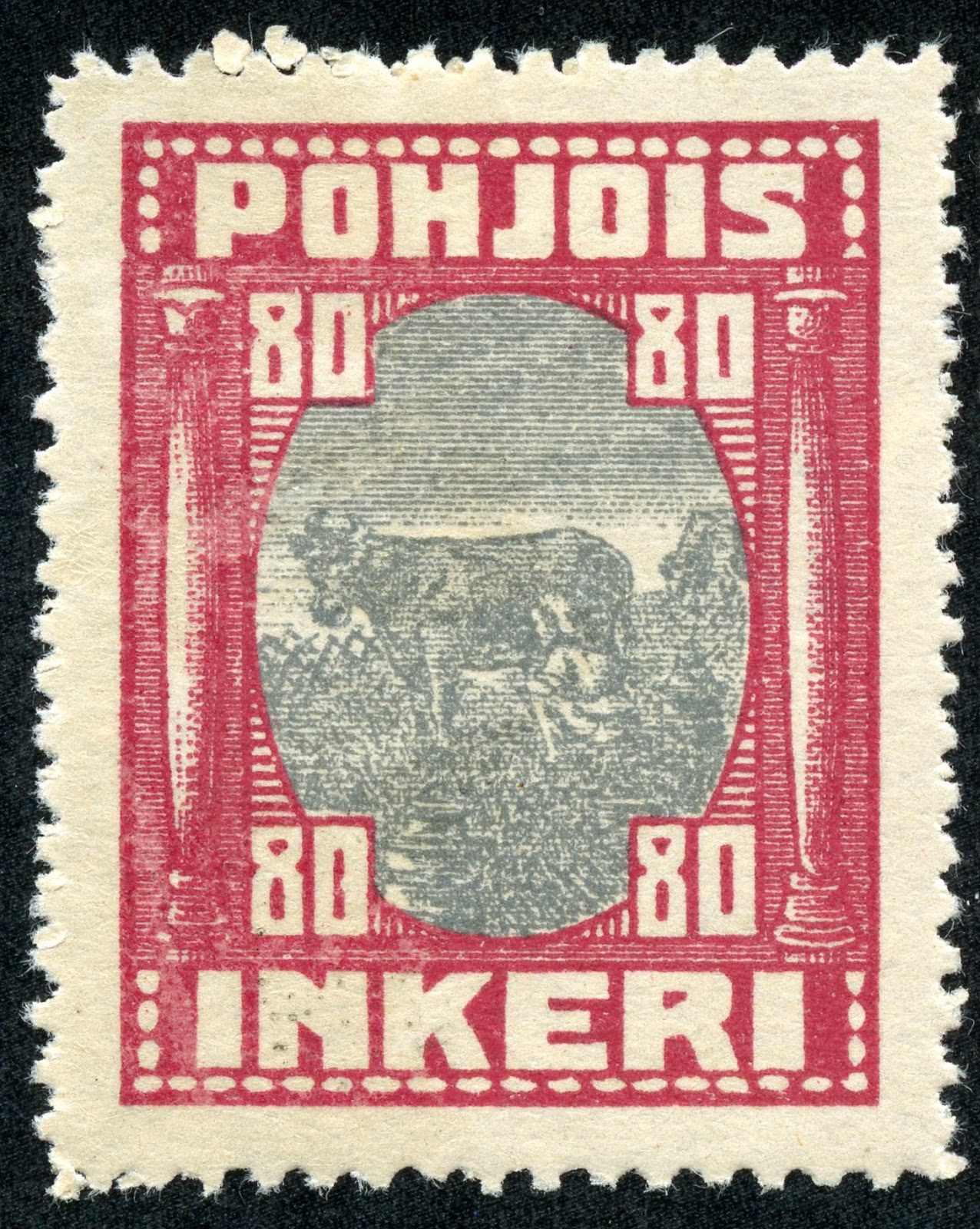
1920 Scott 11 80p claret & slate "Milking"
Genuine & Forgery
For the 80p claret & slate, the vignette in the forgery appears cruder, and the stamp is on very white paper.

Milk can (black arrow) visible on genuine
Beads, and "0" in "80", on forgery (green arrows)
The differences I found include: a visible "milk can" in the genuine, and thinner bead shapes and a thicker center of the "0" in "80" in the forgery (green arrows).

80p Forgery: Examine the Slate colored thin horizontal lines
Uppermost line extends farther to the right than the second line
One other clue is visible on my second 80p forgery copy in my collection: The top horizontal line extends to the right. This does not occur with the genuine specimens.

1920 Scott 12 1m red & slate "Planting"
Forgery
I only have forgeries for the 1m and 5m stamps.. But, I plan to point out a "marker" on the forgery, so you will know if that is what you have (likely in general collections).

Remember, the forgeries are on very white paper.

Scott 12 1m red & slate Forgery
White space between the sixth and seventh line (black arrow)
Smudge of color in ball (red arrow)
The genuine, in contrast, has somewhat indistinct horizontal lines that are all uniformly spaced. The genuine has a colored line in the ball that is attached to the ribbon above.

1920 Scott 13 5m dark violet & dull rose 
"Ruins of Church"
Forgery
Note the very white paper and the crude perforations here on this 5m dark violet & dull rose.

The third full bead from the top  is flattened on the left side in the forgery
Subtle differences are all we sometimes are left with. ;-) The third full bead is not flat on the left in the genuine (red arrow).

1920 Scott 14 10m brown & violet
"Peasants playing Zithers"
Genuine & Forgery
Note the CV for the pictorial set ranges from  $3-$9. The 10m brown & violet forgery (right) again shows the white paper, and the rough perforations.

1920 Scott 14 10m brown & violet
"Peasants playing Zithers"
Forgery
A dot in the oval gives this away as a forgery- usually (See note)
The genuine has two separate curved lines in the oval, but no dot above the curved lines.

Note: There is a possibility that some genuines have the dot-(see comment note by rw)

A zither? This string instrument has taken a back seat to the guitar in modern times. It had a resurgence after a zither was used on the musical score of the 1949 film noir , The Third Man.

But back to Genuine vs Forgery...a closer look....

1920 Scott 14 10m brown & violet
Genuine Close-up 
* The white oval under the left side of the "O" has two separate curved lines.
* The white bar to the left of the  lower right corner "M" has a notch in the upper end.

Now compare to the Forgery...

1920 Scott 14 10m brown & violet
Forgery Close-up 
* The white oval under the left side of the "O" has a dot above two touching curved lines.
Note: There is a possibility that some genuines have the dot-(see comment note by rw)
* The white bar to the left of the  lower right corner "M" has no notch in the upper end.

Deep Blue
North Ingermanland 1920 issue in Deep Blue
Deep Blue (Steiner) has one page for the stamps of North Ingermanland. One will need to print out a second copy for the forgeries that will inevitably accumulate, or use a quadrilled page.

1920 Scott 10 50p ultramarine & red brown "Plowing"
Big Blue
Big Blue '69, on two lines of one page- sharing the page with Northern Nigeria- has 9 spaces for North Ingermanland. The page is located between North Borneo and Northern Rhodesia.

Coverage is 64%. The CV of the stamps not in BB vary from $9-$220+.

North Ingermanland in Big Blue
Included in BB is one "expensive stamp", the 1m red & slate @ CV $20+.

Of course, many collections have counterfeits- mine certainly does. ;-) One will need to actively seek out genuine copies.

Checklist

1920
1,2,3,4,
8,9,10,11,12,

End

Comments
A) Expensive stamps ($10 threshold):
1920 Scott 12 1m red & slate ($20+)

1920 Scott 11 80p claret & slate "Milking"
Out of the Blue
I suspect only stamp collectors- and perhaps some readers of Finnish history- are aware of North Ingria or North Ingermanland.

The forgeries- as long as one is aware they are forgeries- adds some spice to the collection.

Note: Maps appear to  be in the public domain.

Have a comment?

Sunday, August 3, 2014

Northern Rhodesia

1925 Scott 3 1 1/2p carmine 
"King George V"
Quick History
Northern Rhodesia, the lands north of the Zambezi river, became a British protectorate in 1924 when the British South Africa Company (A Cecil Rhodes founded commercial endeavor) gave up administration, in exchange for cash. At the same time, Southern Rhodesia ( or "Rhodesia"), south of the Zambezi, was turned over to the white settlers, who established highly discriminatory laws against the black African majority.

Lets take a look at the changing history through a series of maps...

British South Africa Company 1889 Map
Lands south and north of the Zambezi River
Before 1924, The British South Africa Company (whose lands were known as "Rhodesia", after Cecil Rhodes), operated primarily south of the Zambezi River. White settlers also took the prime agricultural land south of the Zambezi. The lands north of the Zambezi were an afterthought.

Northern Rhodesia 
Northern Rhodesia was put together from the former lands and BSAC administrative districts of  North-Eastern Rhodesia (blue), North-Western Rhodesia (pink), and Barotesland (green).

African Map of Colonialism 1914
One can see the British sphere is mapped in maroon. North of the Zambezi is the Northern Rhodesia lands, with the Nyasaland Protectorate (formally British Central Africa) on the east, and Southern Rhodesia south of the river. 

At this time- and until 1923, Northern and Southern Rhodesia were administered by the British South Africa Company. Stamps were issued for "Rhodesia" beginning in 1890- and was valid throughout the British South Africa Company lands of southern and northern Rhodesia.

Then, in 1924, with the removal of the British South Africa Company as administrators, stamps were produced for the British Colony of Southern Rhodesia and the Protectorate of Northern Rhodesia separately.

The Capital of Northern Rhodesia was Lusaka, and the population, in 1925, was 4,000 white settlers (with voting privileges), and 1,000,000 black Africans. 

The Federation of Rhodesia and Nyasaland
(Central African Federation)
1953-1963
In 1953, a federation of the self-governing colony of Southern Rhodesia and the British protectorates of Northern Rhodesia and Nyasaland was formed. This was an unhappy union, as black African  nationalism was rising against the dominant power of the  minority white population.

1966 map showing Zambia, Malawi, and "Rhodesia"
In 1964, Northern Rhodesia  gained independence (Zambia), as did Nyasaland (Malawi), and Southern Rhodesia ( now called just "Rhodesia"). In 1980, "Rhodesia" became known as Zimbabwe.

There- you have it. ;-)

1938 Scott 34 3p ultramarine "George VI"
Into the Deep Blue
The 2011 Scott Classic Specialized catalogue has, for Northern Rhodesia 1925-1949, 57 regular and postage due major number descriptions. Of those, 35 are CV <$1-$1+, or 61%. Clearly, the WW collector should be able to form a collection, at least of the lower denominations, without much financial stress.

Besides the usual "common design type" productions, the stamps consist mainly of two issues: a 1925-29 seventeen stamp "George V" definitive set, and a 1939-52 twenty one stamp "George VI" definitive set. No pictorials as such, other than an "African motif" design work around the frame.

1925 Scott 2 1p dark brown "George V"
The initial 1925-29 issue consisted of a set of 17 stamps with "a George V" vignette, and a frame showing African elephants and a giraffe. CV is <$1-$2+ for eight stamps. The seven lower values are less expensive used. This reflects a bias (in my opinion), as collectors often prefer unused stamps for their collection. I suspect there are more unused than used stamps around, and with few inhabitants who would use the mails at the time, attractive non philatelic used specimens should be highly collectible.

1935 Scott 19 2p indigo & green 
"Silver Jubilee Issue"
I don't show very often the "common design type" stamps. What's the point? But it doesn't mean they are not attractive- especially the Silver Jubilee Issue.

1937 Scott 23 2p yellow brown
"Coronation Issue"
This "Coronation issue" stamp has a "Luanshya" postmark, and that tells an economic tale. Copper was originally discovered in the "copper belt" in 1895, and Luanshya and the Roan Antelope Copper Mines in 1926 eventually became a big part of the boon. Demand for copper increased significantly with the increase in electrical devices and motors.

1941 Scott 30 1 1/2p brown orange "George VI"
Between 1938-52, a 21 stamp set, almost identical to the former definitive production, save for the replacement of "George VI" in the vignette, was issued. This issue serves as  a particularly good argument for collecting  the "George VI" era stamps through 1952, rather than have an arbitrary cutoff of 1940. Of the 21 stamps in the set, 8 were issued between 1941-52.

Deep Blue
1938-52 "George VI" issue in Deep Blue
Deep Blue (Steiner) has five pages for Northern Rhodesia. All major numbers have a space.

1948 Scott 48 1 1/2p orange 
"Silver Wedding issue"
Big Blue
The '69 Big Blue has one page with 33 spaces, and is situated just before "Norway".

Observations...
(Some of these observations are repeated in the "comments" section.)
* BB does a fine job of including all of the inexpensive stamps eligible up to 1940. See the next two "observations" though.
* Interestingly, BB includes spaces for two 1941 stamps in the "George VI" issue. But...
* As the "George VI" issue actually was produced between 1938-52, there are several "missing' inexpensive stamps- Scott 26,28,33,35, & 39.  I agree with the Scott Classic Specialized catalogue and the Steiner album, that the "George VI" era through 1952 should remain intact. 
* Two stamp spaces (both blank spaces) require CV $10+-$20 stamps.
* A BB snafu. The 1925 issue spaces....has a  blank space, but a small blank space, and all the "small" A1 stamps in the issue have already been given a space. ! So, one will need to stuff an A2 larger stamp there- I chose the Scott 12 2sh 6p green & black @ CV $10+. ;-)

Checklist

1925
1,2,3,4,5,6,
7,8,(9),(12*),10,(11),

1935
18,19,20,21,

1937
22,23,24,

1938
25,27,29,31,34,36,38,

1938
40,

1941*
30,32,

Postage Due
1929
J1,J2,J3,J4,

End

Comments
A) Expensive stamps ($10 threshold):
1925 (Scott 11) 2sh ultramarine & brown ($20)
1925 (Scott 12) 2sh 6p green & black ($10+)
B) (   ) between a number indicates a blank space choice.
C) *12- a dilemma of BB's making. A blank space, but a small blank space, and all the "small" A1 stamps in the issue have already been given a space. ! So, one will need to stuff an A2 larger stamp there- I chose the Scott 12 2sh 6p green & black @ CV $10+. ;-)
D) *1941- yes, BB includes two 1941 stamps from the 1938-52 issue. ! I'm not sure I've seen that before in the 1840-1940 BB.

1949 Scott 52 6p gray "UPU Issue"
Out of the Blue
Trying to make sense of the colony/protectorate/country changes in Africa is half the fun of collecting classical era African stamps. ;-)

Note: Maps appear to be in the public domain.

Have a comment?